



Orlando Patent Attorney Guidance: Navigating the Patent Process
Getting a patent approved requires understanding the system and avoiding costly mistakes. At Daniel Law Offices, P.A., we help Orlando business owners navigate this complex process with clear Orlando patent attorney guidance.
The path from invention to protection involves multiple stages, each with specific requirements and potential pitfalls. This guide walks you through what to expect and how to strengthen your position at every step.
What Makes an Invention Worth Patenting
Not every invention qualifies for patent protection, and understanding what the USPTO actually grants patents for saves you time and money before you file. The USPTO receives over 600,000 applications annually, but roughly 8% get rejected for lacking novelty, non-obviousness, and utility alone. This means your invention must be genuinely new, not just a minor tweak of something already patented. A patentable invention must fall into one of three categories: a utility patent covering a process, machine, composition of matter, or article of manufacture; a design patent protecting the ornamental appearance of an object; or a plant patent for new asexually reproduced plant varieties. Most inventors pursue utility patents because they offer the broadest protection, lasting 20 years from your filing date. The key requirement is that your invention must be non-obvious to someone with knowledge in your field. If a patent examiner can combine existing patents or prior art to arrive at your idea, the USPTO will reject it.
Why Your Patent Search Determines Everything
A comprehensive patent search forms the foundation of any successful filing. The Orange County Library System offers free access to USPTO databases through its Patent and Trademark Resource Center, providing a low-cost starting point for Orlando inventors. However, searching alone isn’t enough; you must understand what the patents you find actually claim. Patent claims define the legal scope of protection, and reading them carefully tells you whether your invention truly differs from existing work. Applications prepared with professional guidance show roughly 10% higher approval rates without major revisions, primarily because attorneys know how to position your invention against prior art effectively. When you skip this step or rush it, you risk filing an application the USPTO will reject, wasting filing fees and delaying your protection by months.
How Strong Specifications and Claims Protect Your Patent
Well-written specifications-the detailed description of your invention-boost approval chances by approximately 30%, according to USPTO data, because examiners need clear, comprehensive information to understand what makes your idea patentable. Strong claims, structured with broad independent claims followed by narrower dependent claims, correspond to roughly 25% fewer initial rejections. High-quality drawings improve approval likelihood by about 20%, so invest in professional illustrations that clearly show how your invention works and what makes it different. These three elements (specifications, claims, and drawings) work together to create a patent application that withstands examination and holds up in court if you ever need to enforce your rights. At Daniel Law Offices, P.A., we help Orlando inventors prepare applications that meet these standards, guiding you through each requirement to position your innovation for approval. Understanding these foundational elements prepares you for the next critical phase: conducting your search and preparing your actual application.
Moving From Idea to Filing
Your patent search results tell you whether filing makes financial sense, but most inventors underestimate how much work happens between that decision and actually submitting your application to the USPTO. The search confirms novelty, yet preparing a filing-ready application demands far more than a simple description of your invention. You need a complete technical disclosure that enables someone skilled in your field to build and use your invention without additional experimentation, detailed drawings that illustrate every functional aspect, and claims written with surgical precision to define exactly what protection you’re seeking.
The USPTO received 189,338 provisional applications in 2022, and about 50% convert to full non-provisional filings within the required 12-month window. This statistic reveals that many inventors file provisional applications to establish an early priority date before investing in a complete application. However, provisional filings create a false sense of progress; they buy you time but don’t guarantee approval and require substantial additional work to convert into a non-provisional utility patent that actually gets examined.
Most inventors file alone and make mistakes that cost them thousands in attorney fees to fix later, or worse, result in weaker patents that fail to protect their actual innovation. Applications prepared with professional guidance show roughly 10% higher approval rates without major revisions, and this difference stems largely from how your specifications, claims, and drawings interact from the beginning.
What Your Application Needs to Succeed
Your specification must describe your invention in enough detail that a person with knowledge in your field can understand every aspect, every variation you’ve considered, and how your invention solves the problem it addresses. The USPTO examines enablement strictly; if your specification leaves gaps, examiners reject your application or narrow your claims so dramatically that protection becomes worthless.
Include drawings that show your invention from multiple angles, label all components clearly, and illustrate how it functions differently from existing solutions. These drawings must be professional quality because rough sketches or photographs often fail USPTO requirements and delay your filing. Your claims represent the legal boundary of your patent, and structure matters enormously; start with one or two broad independent claims that capture the core of your innovation, then add dependent claims that narrow protection to specific embodiments or variations.
Well-drafted claims correspond to roughly 25% fewer initial rejections according to USPTO data, because examiners spend less time arguing about what you actually invented.
Navigating the Examination Process
The USPTO doesn’t rubber-stamp applications; most receive office actions requesting clarification, amendments, or arguments about patentability. An examiner searches prior art to determine whether your invention is truly novel and non-obvious, then communicates concerns through formal office actions that give you a deadline to respond (typically three months).
Your response might include amending your claims to distinguish your invention from prior art, submitting arguments explaining why your invention is patentable, or providing additional technical information. Electronically filed applications process roughly 15% faster than paper filings, so use the USPTO Patent Center system and convert all documents to PDF format before submission.
Avoiding Common Filing Mistakes
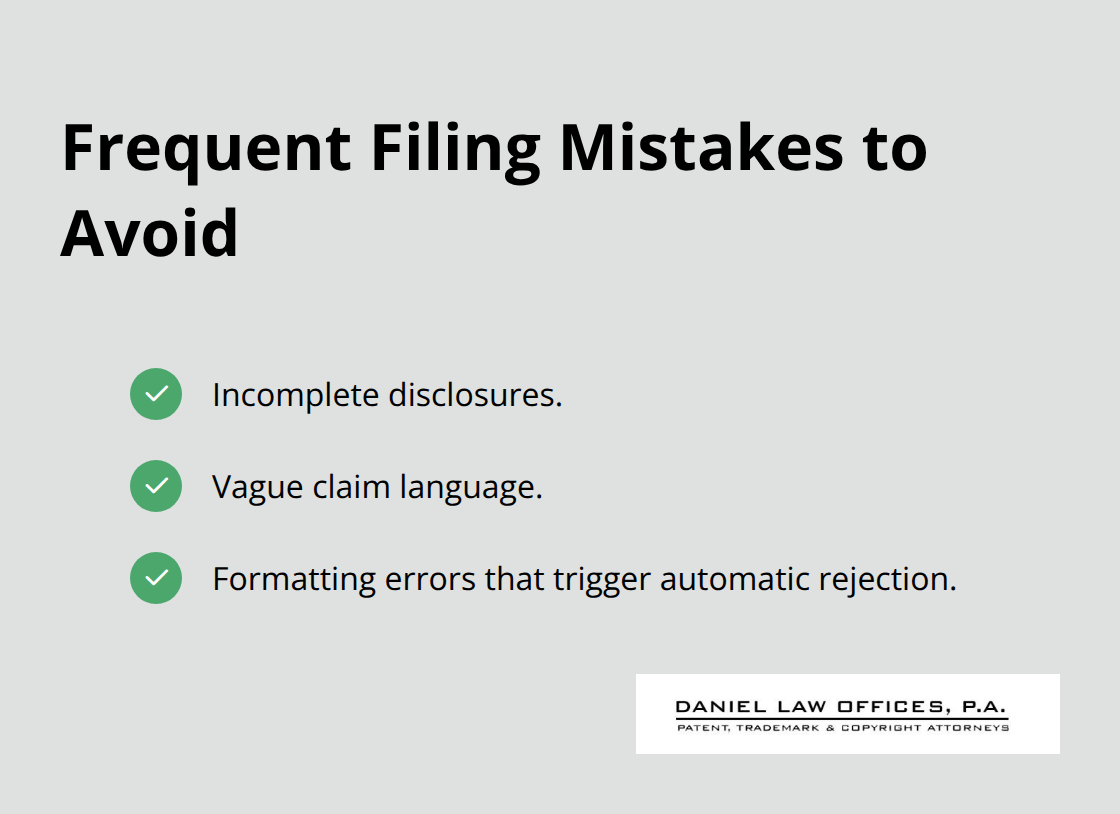
Common filing mistakes affect roughly 60% of applications, including incomplete disclosures, vague claim language, and formatting errors that trigger automatic rejection. These errors compound during examination, forcing you to spend additional time and money correcting problems that professional preparation would have prevented from the start.
Understanding what examiners look for and how they evaluate your application positions you to respond strategically when office actions arrive. The next phase of your journey involves handling those office actions and managing the back-and-forth communication that ultimately determines whether the USPTO grants your patent.
Overcoming Patent Office Rejections and Budget Reality
Patent office rejections feel like failure, but they’re actually part of the normal examination process that roughly 60% of applications experience. The USPTO doesn’t reject your invention; it rejects your application as written, which means you have a concrete pathway to fix the problem. When an examiner issues an office action, they communicate exactly what concerns them, and your response determines whether your patent moves forward or stalls.
Understanding Why Rejections Happen
Most rejections fall into three categories: lack of novelty (your invention isn’t actually new compared to prior art), obviousness (combining existing patents or prior art reaches your idea), or specification problems (your description lacks sufficient detail for someone in your field to build it). The first two require strategic claim amendments that narrow your protection to what’s genuinely novel, while the third demands clarification through revised specifications or additional drawings. Each rejection type calls for a different response strategy, and understanding which category applies to your application shapes how you proceed.
Responding to Office Actions Strategically
The USPTO typically gives you three months to respond to an office action, and missing that deadline abandons your application entirely, forfeiting your filing fees and any priority date you established. Electronically filed applications process roughly 15% faster than paper submissions, so respond through the USPTO Patent Center system rather than mailing paper documents. Your response might include amending your claims to distinguish your invention from prior art, submitting arguments explaining why your invention is patentable, or providing additional technical information that addresses examiner concerns. The examiner can clarify what specific language would overcome a rejection, saving you from submitting amendments that still miss the mark.
Understanding Patent Costs and Timeline Pressures
Budget realities stop most inventors cold, yet costs aren’t mysterious if you understand what actually drives them. Filing fees alone run $80 for micro entities, $160 for small businesses, and $320 for large entities according to 2023 USPTO rates, but that’s only the beginning. Patent searches cost $500 to $2,000 depending on complexity, while attorney fees typically range from a few thousand dollars up to ten thousand when you factor in application preparation, office action responses, and prosecution through approval.
The one-year grace period after public disclosure is your real deadline, not a suggestion; if you’ve already shown your invention to customers, investors, or the public, filing after one year eliminates your patent rights entirely, so speed matters more than perfection. Conducting a thorough prior art search before filing separates successful applicants from those facing rejection after months of examination. Provisional applications establish priority for $320 and buy you twelve months to prepare a complete filing, but only about 50% actually convert to non-provisional applications within that window, suggesting many inventors file provisionally then abandon the process when costs mount.
Investing Upfront to Avoid Expensive Fixes
Professional preparation costs more initially but prevents expensive mistakes down the road. Applications prepared with professional guidance show roughly 10% higher approval rates without major revisions, meaning fewer office action responses and faster approval. Strengthen your application before filing by investing in comprehensive specifications and professional drawings that meet USPTO standards, because fixing these elements after rejection costs substantially more than getting them right initially. Common filing mistakes affect roughly 60% of applications, including incomplete disclosures, vague claim language, and formatting errors that trigger automatic rejection and compound during examination.
Final Thoughts
Filing a patent without comprehensive preparation wastes money on applications the USPTO will reject, and rushing your specifications forces expensive revisions during examination. Applications prepared with professional guidance show roughly 10% higher approval rates without major revisions, well-drafted claims correspond to 25% fewer initial rejections, and strong specifications boost approval chances by approximately 30%. Missing the one-year grace period after public disclosure eliminates your rights permanently, so timing your filing strategy matters as much as the technical quality of your application.
Your patent represents years of work and significant financial investment in your innovation, so protecting it demands more than a DIY approach. Orlando patent attorney guidance transforms your invention from an idea into a defensible legal asset that holds real value in the marketplace. We at Daniel Law Offices, P.A. help individual inventors and businesses secure their valuable ideas through comprehensive patent searches, strategic application drafting, and guidance through the entire patent prosecution process.
Contact us for a consultation to discuss your invention, understand your options, and develop a patent strategy tailored to your situation. Visit Daniel Law Offices, P.A. to start protecting your intellectual property today.