



Patent Filing Steps: From Idea to Issued Patent
Getting a patent approved requires navigating multiple stages, each with specific requirements and deadlines. We at Daniel Law Offices, P.A. guide inventors through the patent filing steps so nothing gets missed.
This guide walks you through each phase, from searching existing patents to receiving your issued patent. You’ll learn what documents you need, how to respond to USPTO rejections, and when to seek professional guidance.
Search for Prior Art Before Filing
Why Prior Art Searches Matter
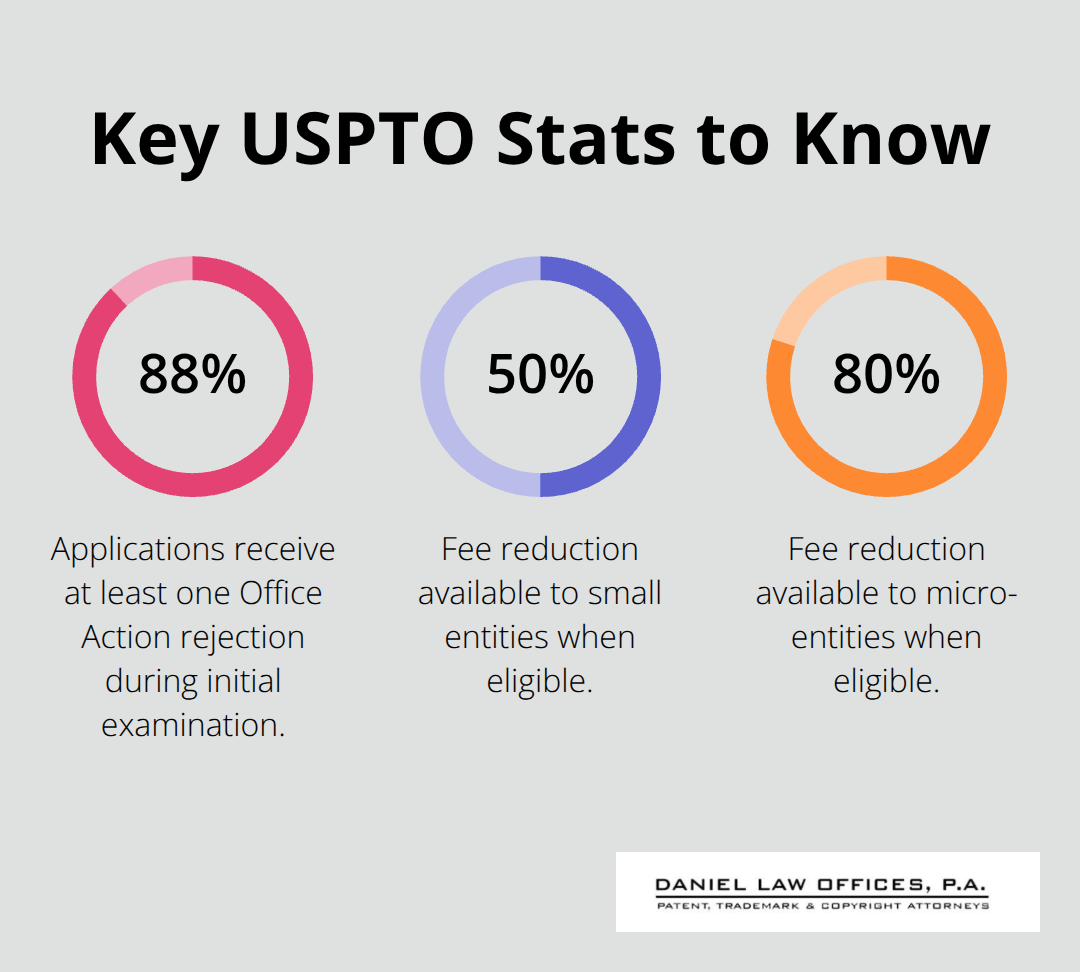
Starting your patent search is non-negotiable. The USPTO reports that approximately 88% of patent applications receive at least one Office Action rejection during initial examination, and a significant portion of these rejections stem from prior art references applicants overlooked. The Patent Public Search tool lets you explore over 11 million patents issued throughout US history, which means the competition for novelty is intense.
You must search methodically using multiple databases and search strategies to avoid wasting months and thousands of dollars on an application destined for rejection. Applicants who conduct comprehensive prior art searches before filing achieve substantially higher grant rates than those who skip this step or perform surface-level searches.
Where to Search for Prior Art
Start with the USPTO Patent Public Search, then expand to Google Patents and the World Intellectual Property Organization Patentscope to capture international patents that could block your novelty claims. Use multiple search approaches: brainstorm keywords related to your invention, search by CPC classifications to find similar technologies, and review the most relevant documents to assess how closely they resemble your idea. Search for non-patent literature as well, including academic papers, published articles, and product descriptions, since prior art includes anything publicly available before your filing date.
Evaluating What You Find
Many inventors discover during this phase that their idea has been patented or published already, which saves them from filing a doomed application. If you are filing a method patent, verify that your process ties to a specific machine or transforms something into a different state (the machine-or-transformation test historically guides process patent eligibility). You should conduct this search yourself first to understand the landscape, then consult with a patent attorney who can perform a more sophisticated analysis and spot subtle prior art conflicts you might miss.
Investing Time in Research
Plan to spend substantial time on this research-it is the most important investment you can make before committing to filing fees and prosecution costs. The depth of your prior art analysis directly influences whether your application will survive examination or face repeated rejections. Once you have completed your search and confirmed that your invention stands apart from existing patents and publications, you are ready to move forward with documenting your invention in detail and preparing your formal application.
Building Your Patent Application in Orlando, Florida
Write a Detailed Specification
With your prior art search complete, you now move into the critical phase of preparing and filing your actual patent application. This is where vague ideas transform into legally precise documents that the USPTO examiner will scrutinize. The quality of your application directly determines whether you receive a patent or face repeated rejections. Start by writing a detailed specification that describes your invention in clear language anyone in your field can understand. Include the background of the problem your invention solves, a summary of how your invention works, and a thorough explanation of how each component functions and interacts.
Many inventors underestimate how much detail the USPTO demands. Your specification must be so complete that someone skilled in your field could build or use your invention based solely on your written description. Include drawings or flowcharts showing all the key features and their relationships.
Prepare Your Drawings and Claims
The USPTO requires drawings to be filed electronically via Patent Center, and they must be black-and-white unless color is necessary to show your invention clearly. Number your drawing sheets in the format 1/5, 2/5, and so on. Pay close attention to your claims, which are the specific legal boundaries of what you are protecting.
Claims are notoriously difficult to draft because they must be broad enough to protect variations of your idea but narrow enough to avoid prior art references you found in your search. Many self-filed applications fail because the claims are either too vague or too narrow. This is one area where professional guidance makes a measurable difference in grant rates.
Choose Between Provisional and Nonprovisional Applications
You must decide whether to file a provisional or nonprovisional application. Provisional applications cost less upfront and establish an early filing date without requiring formal examination, allowing you to use Patent Pending status for up to 12 months. According to the USPTO, provisional applications have been available since June 8, 1995, and they work well if you need time to refine your invention, test the market, or raise funding before committing to full examination costs. However, you must file a corresponding nonprovisional application within 12 months to claim the earlier filing date. If you miss this deadline, you lose the benefit of the provisional date entirely.
File Your Nonprovisional Application Correctly
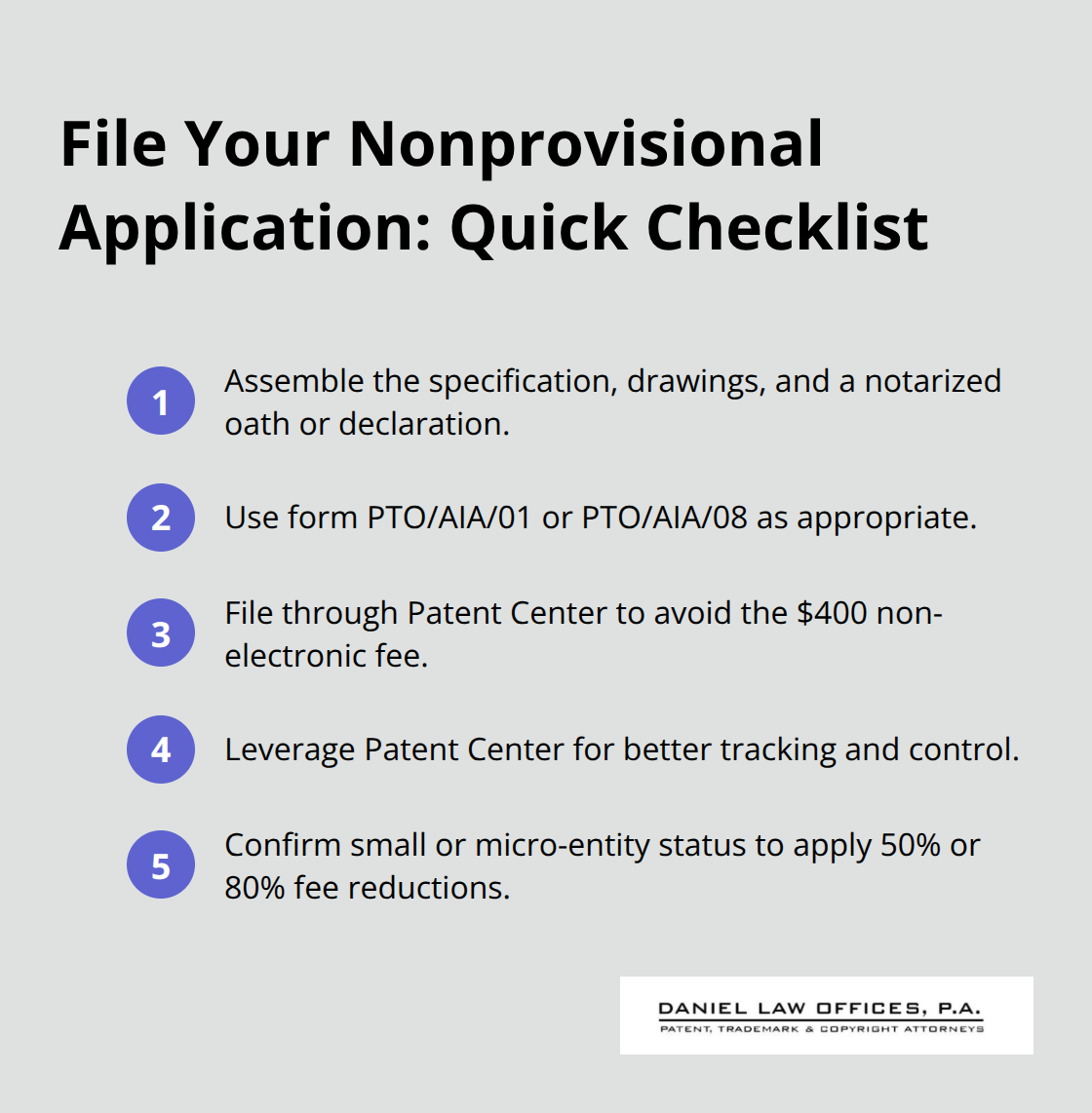
The nonprovisional application includes your specification, drawings, and an oath or declaration signed before a notary, using either form PTO/AIA/01 or PTO/AIA/08. File through Patent Center, the official electronic system, to avoid a $400 non-electronic filing fee and to gain better tracking and control over your application. Small entities receive 50% fee reductions and micro-entities receive 80% reductions, so verify your size status before calculating costs.
The average pendency from filing to final disposition for utility patents was approximately 26.3 months in 2024 according to the USPTO Patents Data Visualization Center, meaning you should expect over two years before receiving your issued patent. This timeline assumes straightforward prosecution without major complications. Once you submit your application, the USPTO assigns it to an examiner who will review your work and communicate any objections or rejections through Office Actions-the next phase where your ability to respond strategically becomes essential.
Navigate the USPTO Examination Process in Orlando, Florida
What Happens After You File
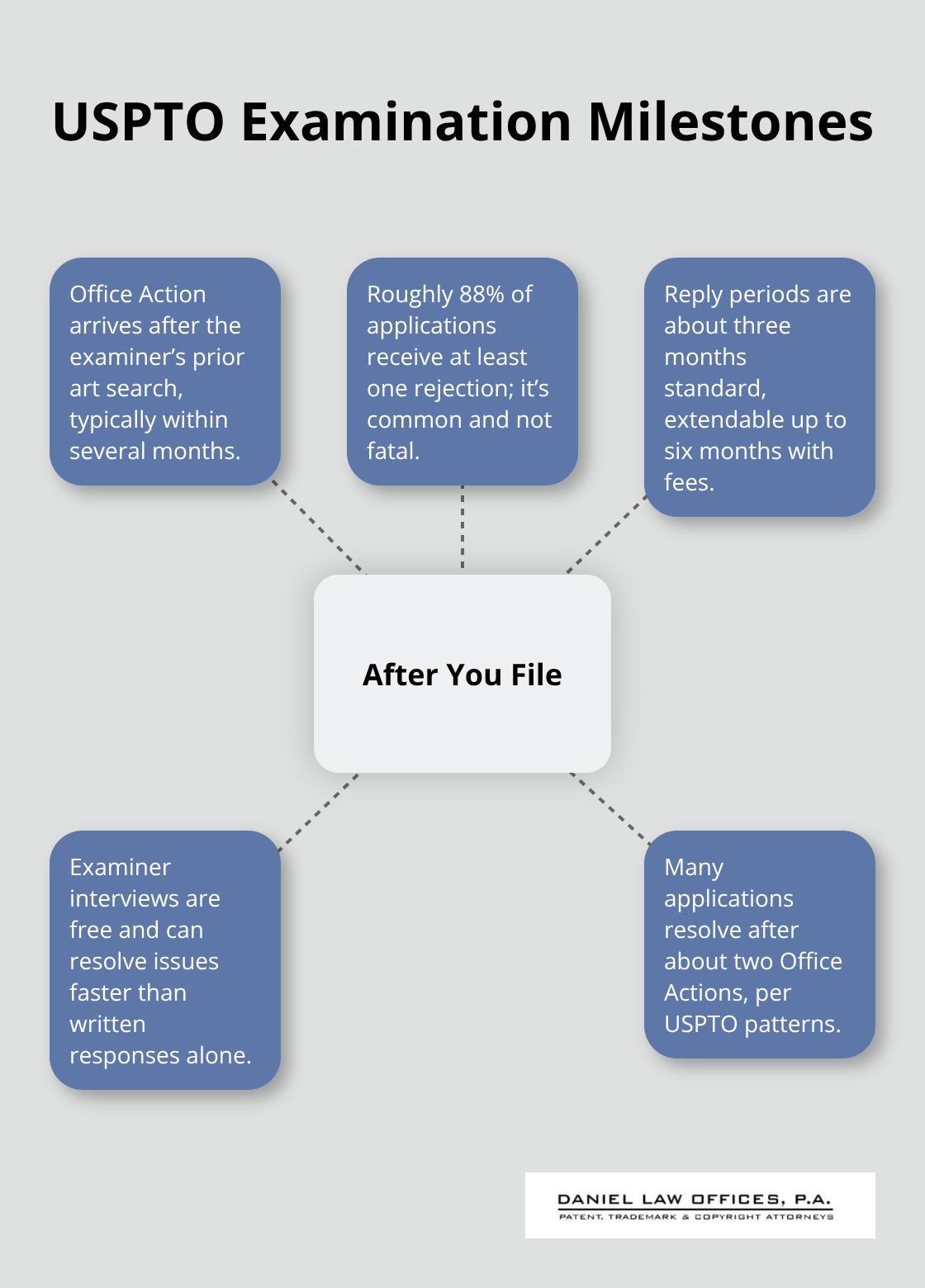
After you file your nonprovisional application, the USPTO assigns an examiner to your case who will conduct a prior art search and issue an Office Action within several months. This document outlines any objections, rejections, or formal deficiencies the examiner found. The USPTO data shows that approximately 88% of applications receive at least one Office Action rejection, so receiving one does not mean your patent is doomed. What matters is how you respond.
Responding to Office Actions and Rejections
Most replies are due within six months, though the standard period is about three months, and you can request extensions if needed. Failure to respond by the deadline leads to abandonment, though revival may be possible if delays were unintentional. The examiner’s Office Action will specify which claims are rejected and on what grounds-usually either anticipation by prior art, obviousness, lack of enablement, or indefiniteness.
Your response must address each rejection directly. If the examiner cites a prior art reference, you can argue why your invention differs from that reference, amend your claims to narrow their scope and avoid the cited art, or submit evidence showing unexpected results or technical advantages that overcome an obviousness rejection. Many applicants panic at the first rejection and unnecessarily narrow their claims to the point of worthlessness. Instead, study the rejection carefully and determine whether the examiner misunderstood your invention or whether your specification and claims genuinely need refinement.
Using Examiner Interviews to Resolve Issues
Consider requesting an examiner interview, which is a telephone or video conversation with the patent examiner. These interviews are free and often resolve issues faster than written responses alone. During an interview, you can explain your invention verbally, address misunderstandings, and sometimes reach agreement on claim language that satisfies both you and the examiner. The average application typically requires about two Office Actions to reach resolution, according to USPTO examination patterns.
Handling Final Rejections and Next Steps
If the examiner issues a final rejection after your first response, you have three options. You can amend your claims further and request continued examination, appeal the rejection to the Patent Trial and Appeal Board, or abandon the application. Continued examination allows you to file another response with new arguments or claim amendments, effectively restarting the prosecution process-though this costs additional fees. Appeals take longer and are more expensive but can succeed if you have strong arguments about patentability.
Achieving Allowance and Maintaining Your Patent
Once the examiner indicates allowance, you will receive a Notice of Allowance and Fees Due. You must pay the issue and publication fees within three months, and this deadline is not extendable. After payment, the patent issues as an electronic grant through Patent Center, and you gain exclusive rights to your invention for 20 years from your filing date. At this point, you must begin paying maintenance fees at 3.5, 7.5, and 11.5 years to keep your patent in force. Large-entity fees are approximately $1,600, $3,600, and $7,400 respectively. Late payments incur surcharges and can jeopardize enforceability, so calendar these dates immediately. Professional representation throughout examination significantly improves grant odds compared with self-representation, and a registered patent attorney can guide you through each Office Action and strategic decision to maximize the likelihood of obtaining an issued patent.
Final Thoughts
The patent filing steps from idea to issued patent demand attention to detail, strategic thinking, and persistence through multiple examination phases. You now understand that a thorough prior art search prevents wasted effort on unpatentable ideas, that your specification and claims must be drafted with precision to survive Office Actions, and that responding strategically to examiner rejections significantly improves your odds of grant. The USPTO data confirms that approximately 88% of applications receive at least one rejection, yet many of these applications ultimately issue because applicants respond effectively rather than abandoning their work at the first obstacle.
Professional representation throughout this journey makes a measurable difference. Applications filed with a registered patent attorney achieve substantially higher grant rates than self-filed applications, and an attorney can spot subtle prior art conflicts, craft claims that balance breadth with enforceability, and navigate examiner communications with the strategic precision that examiners respect. After your patent issues, you must pay maintenance fees at 3.5, 7.5, and 11.5 years to keep your patent enforceable, and you should monitor the market for infringement.
A 2023 European Patent Office study found that startups with both patents and trademarks were up to 10.2 times more likely to secure funding than those without intellectual property, underscoring the financial value of a strong IP portfolio beyond legal protection alone. We at Daniel Law Offices, P.A. guide inventors and businesses through each phase of patent prosecution, from conducting comprehensive patent searches to securing your issued patent. Contact us to discuss your patent filing strategy and learn how professional guidance can strengthen your application and maximize your chances of obtaining an issued patent that truly protects your innovation.