



How to File Patent: A Step-by-Step Guide to Successful Prosecution
Filing a patent protects your innovation from being copied or used without permission. Many inventors struggle with the process because they don’t understand what makes an invention patentable or how to navigate the USPTO system.
We at Daniel Law Offices, P.A. created this guide to walk you through how to file a patent application successfully. You’ll learn what examiners look for, how to respond to rejections, and when to seek professional guidance.
What Makes Your Invention Patentable in Orlando, Florida
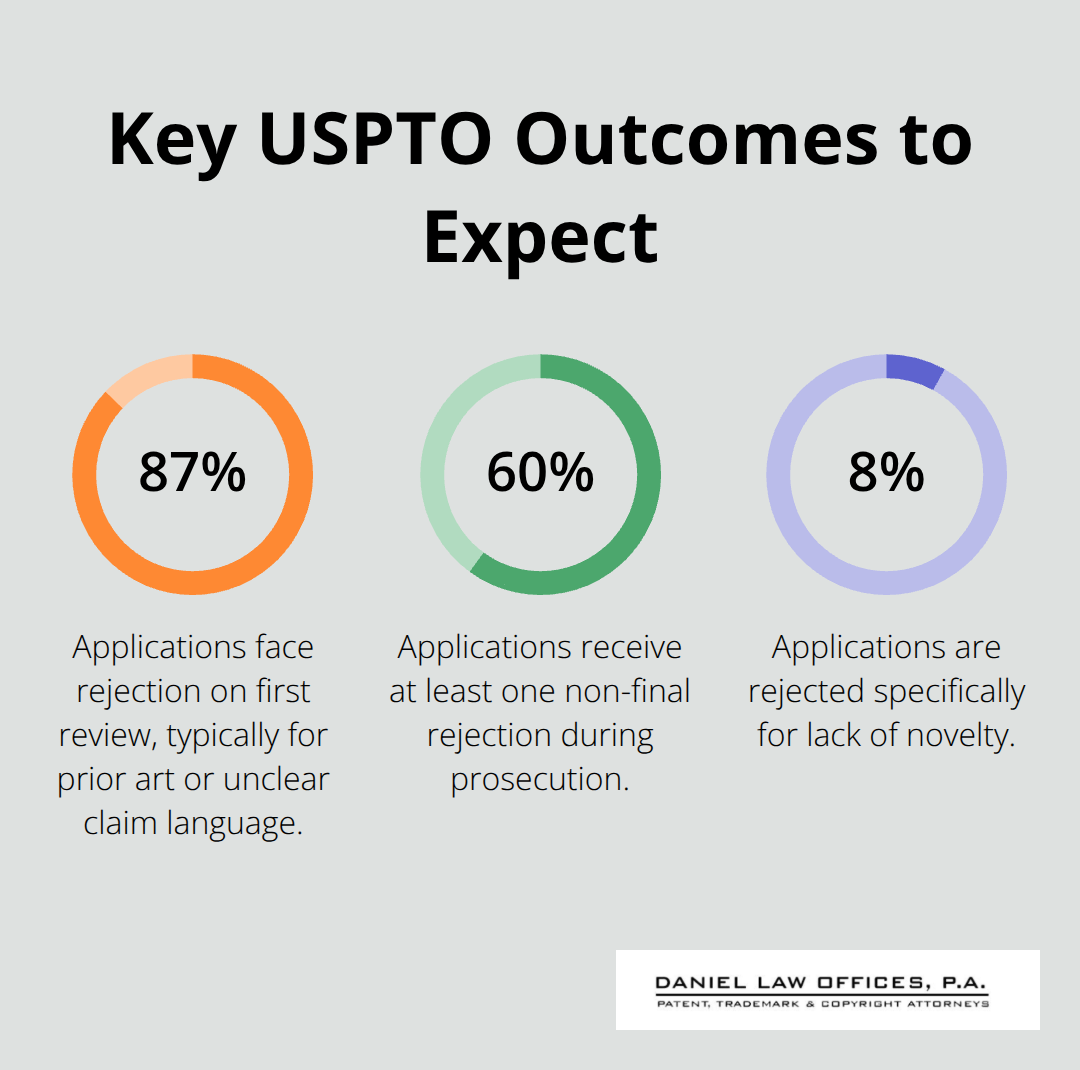
The USPTO receives over 600,000 patent applications annually, but only a fraction become granted patents. Your invention must meet three non-negotiable requirements to qualify for patent protection: novelty, non-obviousness, and utility. Novelty means your invention cannot already exist in the public domain or prior patents. Non-obviousness requires that your invention is not a predictable combination of existing technologies that someone skilled in your field would naturally develop. Utility means your invention must have a practical, real-world application. Many inventors skip the novelty assessment entirely, assuming their idea is unique. This mistake costs time and money. The USPTO reports an 8% rejection rate specifically for lack of novelty, which means roughly one in twelve applications fails because the invention already exists somewhere in the patent record. Before you invest thousands in filing, you need to know whether someone else has already patented your core concept.
Search the Patent Record Thoroughly
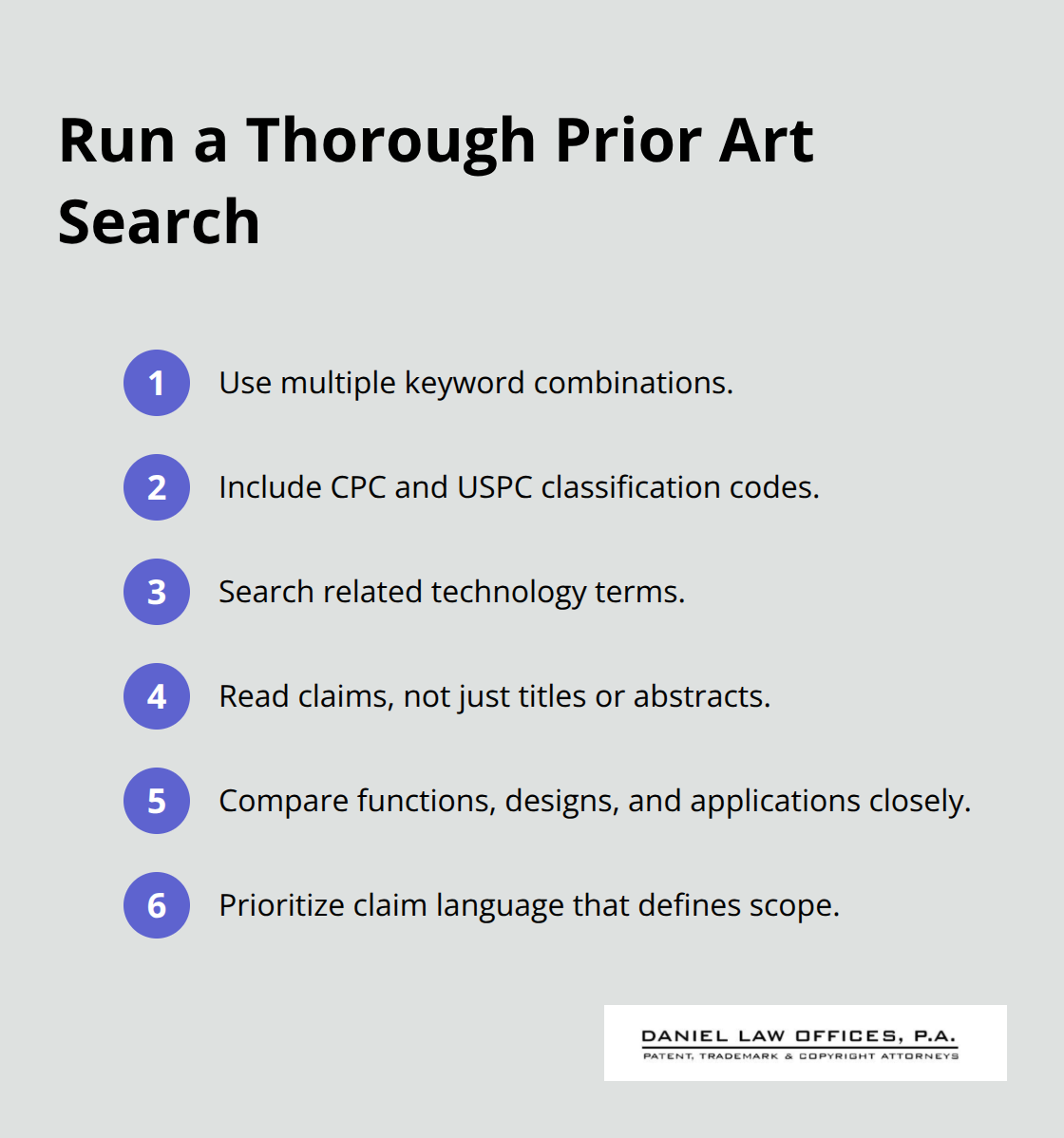
Conducting a prior art search is non-negotiable. The USPTO Patent Public Search tool and Google Patents both give you free access to over 11 million U.S. patents and published applications. A comprehensive search typically takes 8 to 12 hours if you do it yourself, and professional patent searches often yield better results. The Orange County Library System’s Patent and Trademark Resource Center provided free assisted searches to over 500 inventors in 2022, demonstrating how accessible this resource is for Florida-based inventors. When searching, use multiple keyword combinations, classification codes, and related technology terms. Many inventors find only surface-level results because they search too narrowly. Pay close attention to the claims language in patents you find, not just the title or abstract. Claims define the legal scope of protection, so understanding them separates truly relevant prior art from tangentially related patents.
If you identify patents that closely resemble your invention, examine whether your innovation differs meaningfully in function, design, or application. Small differences sometimes matter; sometimes they do not.
Identify Obstacles Before Filing
Professional searches correlate with roughly a 10% higher likelihood of approval without major revisions, according to USPTO data. This statistic alone justifies hiring someone to conduct a thorough search before you file. Identifying obstacles early-whether that means finding conflicting prior art, recognizing that your invention lacks novelty, or discovering that the market is too small to justify patent costs-saves you from wasting resources on an application destined for rejection. Patent applications cost between $9,000 and $17,000 depending on complexity and the number of office actions required. If your market is under $10 million annually or competitors can easily design around your concept, patenting may not be the right choice. We recommend conducting a cost-benefit analysis before filing. Some inventors pursue patents for inventions that would be better protected as trade secrets or copyrights. Understanding what you are actually protecting determines whether a patent makes financial sense for your situation.
What Comes Next in Your Patent Journey
Once you confirm that your invention meets patentability requirements and that filing makes financial sense, you move into the application phase. This stage requires you to draft claims that accurately capture your innovation, gather technical documentation, and prepare drawings that meet USPTO standards. The strength of your application at this stage directly influences how smoothly your patent prosecution proceeds and whether examiners accept your claims with minimal revisions.
Building a Strong Patent Application in Orlando, Florida
Your patent application’s strength determines whether examiners grant protection with minimal friction or reject your claims repeatedly. The USPTO reports that roughly 60% of applications receive at least one non-final rejection, and about 87% face rejections on their first review, primarily for prior art conflicts or unclear claim language. This high rejection rate reflects a critical reality: most inventors underestimate how precisely they need to draft claims and how thoroughly they must document their invention.
Craft Claims That Protect Your Innovation
Claims are the legal boundaries of your patent, and weak claims sink applications regardless of how innovative your underlying invention is. The USPTO data shows that applications with well-drafted claims experience about 25% fewer initial rejections. Draft 15 to 20 claims total, including 1 to 3 independent claims that stand alone and several dependent claims that narrow the scope as fallbacks. This structure gives examiners multiple paths to grant protection and gives you negotiating room during prosecution.
Your independent claims should be broad enough to protect variations of your core invention but specific enough that examiners can reasonably grant them without encountering fatal prior art. Many inventors draft only 5 to 8 claims and paint themselves into corners when examiners reject the independent claims. The precision you invest in claim language at the filing stage pays dividends throughout prosecution.
Write a Specification That Enables Understanding
Your specification-the written description that explains how your invention works-must enable someone skilled in your field to make and use the invention without undue experimentation. Failures in enablement and best-mode disclosure contribute to roughly 15% of patent invalidations in litigation, meaning poor documentation haunts you long after the patent grants. A thorough specification addresses how your invention solves problems, what components it includes, and how those components interact to produce results.
Prepare Professional Patent Drawings
Technical drawings follow specific USPTO formatting rules, and poor drawings correlate with roughly 20% higher rejection rates and additional office actions. Simple inventions typically require 3 to 5 sheets of drawings, while complex devices need 10 to 15 sheets. Professional patent drawings cost $100 to $300 per sheet and include exploded views, cross-sections, and numbered reference elements that your specification explains. Do not submit hand-sketches or low-resolution images; examiners need clarity to understand your invention’s structure and function.
File Your Application Electronically
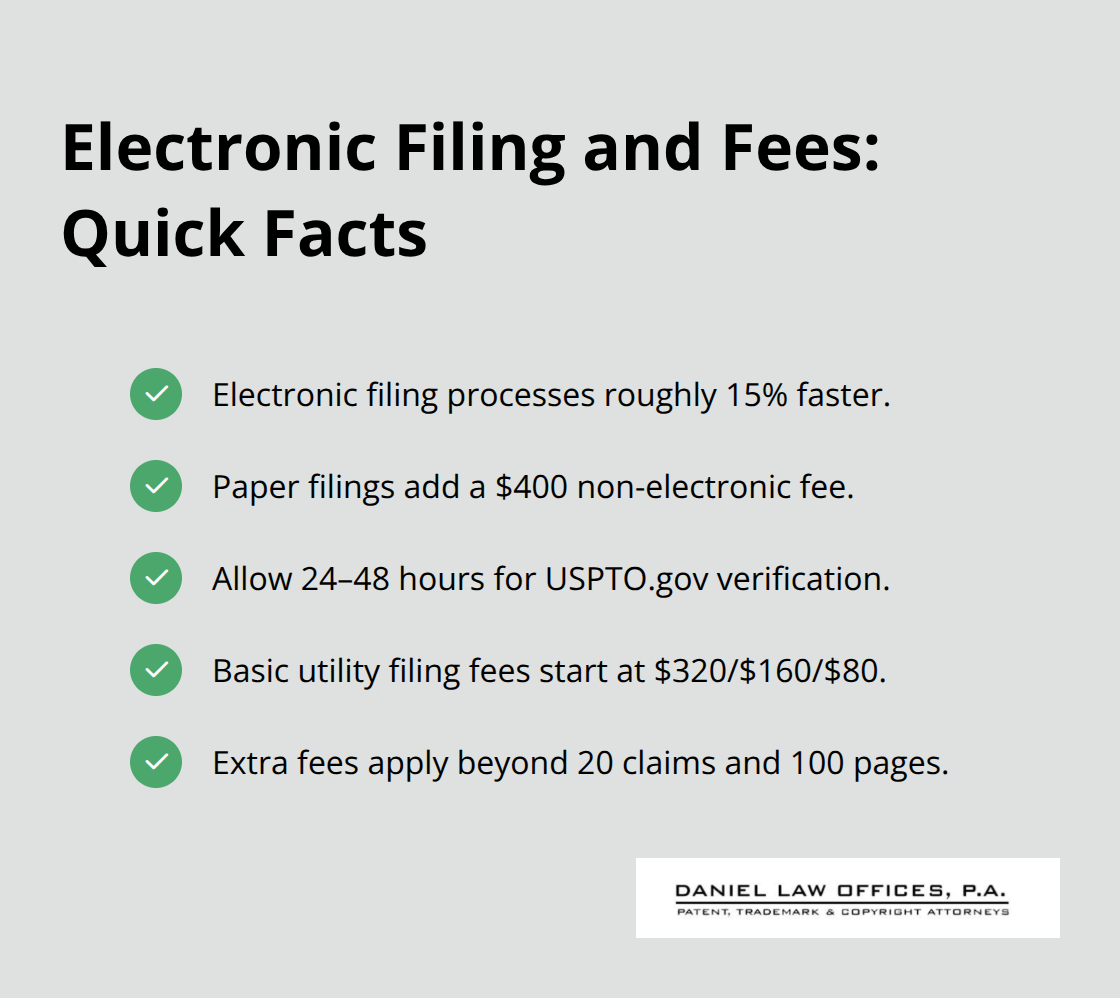
When you file electronically via the USPTO Patent Center, the system accepts PDF submissions, and electronic filing processes roughly 15% faster than paper filings, which incur a $400 non-electronic fee on top of examination costs. Create your USPTO.gov account early and allow 24 to 48 hours for authentication and identity verification before your filing date. Basic filing fees for non-provisional utility patents start at $320 for large entities, $160 for small entities, and $80 for micro entities as of 2023, but additional fees apply for claims beyond 20 and pages beyond 100.
If complexity or budget constraints concern you, provisional applications cost around $800 and provide 12 months of patent-pending status without formal examination. However, only about 50% of provisional filers convert to non-provisional applications within that window. Filing non-provisional immediately starts the process toward a granted patent and avoids the conversion complexity that provisional filings introduce.
Once your application reaches the USPTO, a patent examiner reviews your work and communicates concerns through office actions. How you respond to those communications-and whether you understand what examiners actually want-determines whether your patent grants smoothly or faces years of back-and-forth negotiation.
Navigating Patent Prosecution in Orlando, Florida
After the USPTO assigns your application to a patent examiner, expect your first office action to arrive within 6 to 18 months. About 87% of applications face rejection on first review, typically citing prior art conflicts or unclear claim language. This rejection rate is not a sign of failure-it’s standard procedure. The examiner tests whether your claims are narrow enough to avoid prior art but broad enough to protect your invention meaningfully. When you receive an office action, you have three months to respond, though you can request a six-month extension for $400 to $1,600 depending on your entity size.
Many inventors panic at their first rejection and abandon applications unnecessarily. The rejection is a negotiation, not a final verdict. Treat each office action as actionable feedback rather than a roadblock.
Respond Strategically to Rejections
Your response options include amending your claims to narrow their scope, submitting arguments explaining why the examiner’s rejection lacks merit, or both. The USPTO data shows that applications with well-drafted claims experience 25% fewer initial rejections, which means your foundation matters enormously. If your claims are too broad, narrow them to distinguish your invention from the prior art the examiner cited. If your claims are too narrow, you lose protection, so this balancing act requires precision.
Patent attorneys typically charge $3,500 to $4,500 per office action response, and this investment correlates with dramatically higher success rates. Pro se applicants (those representing themselves) win roughly 23% of cases, while attorney-represented applicants exceed 70% success rates. This 47-point gap reflects the reality that claim amendments require precision and legal strategy that most inventors lack.
Schedule Examiner Interviews for Faster Resolution
Schedule an examiner interview before submitting your formal response. These interviews allow you to discuss concerns directly and sometimes resolve issues more efficiently than written exchanges. The examiner can clarify what specific language would overcome a rejection, saving you from submitting amendments that still miss the mark. This direct communication often accelerates progress toward allowance.
Plan for Multiple Office Actions and Extended Timelines
Most inventors face one to three office actions before reaching allowance, meaning your total patent prosecution timeline typically spans 18 to 36 months from filing to grant. Total costs usually range from $15,000 to $25,000 including attorney fees, USPTO charges, and maintenance fees. If your first office action arrives and proposes only minor amendments, you may reach allowance in 12 to 18 months. If the examiner raises significant prior art concerns, you could spend 24 to 36 months responding and amending.
Track One prioritized examination costs $4,200 for large entities and delivers a final disposition within 12 months, which compresses the timeline significantly if you need faster results.
Navigate Final Rejections and Post-Allowance Requirements
Once the examiner issues a final rejection, you have limited options: appeal to the Patent Trial and Appeal Board (starting around $2,000), file a continuation application to restart examination with amended claims, or abandon the application. Continuation filings restart the clock and allow you to pursue different claim scope, but they cost additional USPTO fees and attorney time. The decision to appeal versus continue depends on whether you believe your claims are grantable in their current form or whether you need to try a fundamentally different approach.
Upon allowance, you receive a Notice of Allowance and must pay the issue fee within three months. Failure to pay leads to automatic abandonment, so calendar this deadline carefully. After timely payment, the patent issues as an electronic grant through Patent Center, and you gain 20 years of protection from your original filing date for utility and plant patents, subject to maintenance fees due at 3.5, 7.5, and 11.5 years.
Final Thoughts
Filing a patent application successfully hinges on three core principles: thorough prior art searches before submission, precise claim drafting, and strategic responses to examiner feedback. Applications with well-drafted claims face 25% fewer initial rejections, professional searches correlate with 10% higher approval rates without major revisions, and attorney-represented applicants succeed at rates exceeding 70% compared to 23% for those filing alone. These statistics reveal that how to file patent applications effectively depends far more on preparation and precision than on luck or hope.
Your first office action will teach you more about your invention than months of internal development. When the examiner rejects your claims, treat that communication as actionable information rather than failure-the examiner tells you exactly what needs to change for your patent to grant. Most inventors underestimate the complexity of claim language and the importance of detailed specifications, then abandon applications unnecessarily at the first rejection. The patent process takes 18 to 36 months and costs $15,000 to $25,000 on average, but the protection you gain lasts 20 years and prevents competitors from copying your work.
If your invention meets patentability requirements and your market justifies the investment, Daniel Law Offices, P.A. can guide you through patent searches, application drafting, and prosecution. Start with a thorough search, draft strong claims, file electronically, and respond strategically to office actions. Your patent success depends on these fundamentals.