




Brand Protection Through Trademarks: A Practical Guide
Your brand is your most valuable business asset, yet many business owners in Orlando, Florida overlook brand protection until it’s too late. Counterfeiters and competitors exploit unregistered marks, dilute brand recognition, and confuse your customers every single day.
At Daniel Law Offices, P.A., we’ve seen firsthand how trademark registration stops infringement before it starts. This guide walks you through registration, common pitfalls, and enforcement strategies that actually work.
What Your Trademark Actually Protects
A trademark is a unique sign, symbol, word, or combination that identifies your business’s products or services in the marketplace. Florida has an estimated 3 million small businesses according to the Small Business Administration, and most of them operate without understanding what a trademark actually guards against. Your trademark protects your specific brand identity-not your product itself, not your business method, and not your general idea. When you register a mark, you gain the exclusive right to use that mark for the goods or services you’ve identified in your application. This means competitors cannot use confusingly similar marks in related categories. If someone sells products under a mark that could deceive customers into thinking they’re buying from you, your registered trademark gives you legal grounds to stop them. The moment you register, you can use the ® symbol, which signals nationwide ownership and strengthens your legal position significantly. Without registration, you only have common law rights based on your actual use, which are weaker and harder to enforce across state lines.
How Brand Confusion Damages Your Revenue
Brand confusion directly harms your bottom line. When a competitor uses a similar mark, customers accidentally purchase their products thinking they’re buying yours. This diverts sales, damages your reputation if their product quality is poor, and forces you to spend money on cease-and-desist letters and potential litigation. A registered trademark prevents this by giving you clear legal ownership that’s documented in federal records. The cost of not protecting your brand extends beyond lost sales. Rebranding is expensive-updating signage, packaging, websites, social media, marketing materials, and inventory can cost tens of thousands of dollars or more depending on your business size. Early registration avoids this disaster. Additionally, unregistered marks cannot be listed on Amazon, eBay, or Etsy for trademark protection purposes, leaving your products vulnerable to counterfeit sellers on these platforms. Once you have federal registration, you can request rapid removal of infringing listings and provide proof of ownership that deters counterfeiters.
Which Brand Elements You Can Register
You can register word marks, logos, symbols, slogans, product names, packaging designs, colors, sounds, or any combination of these elements. The key requirement is that your mark must be distinctive-meaning it stands out and identifies your specific source rather than describing the product itself. A mark that simply says “Fast Shoes” for a shoe company is too generic and won’t register.
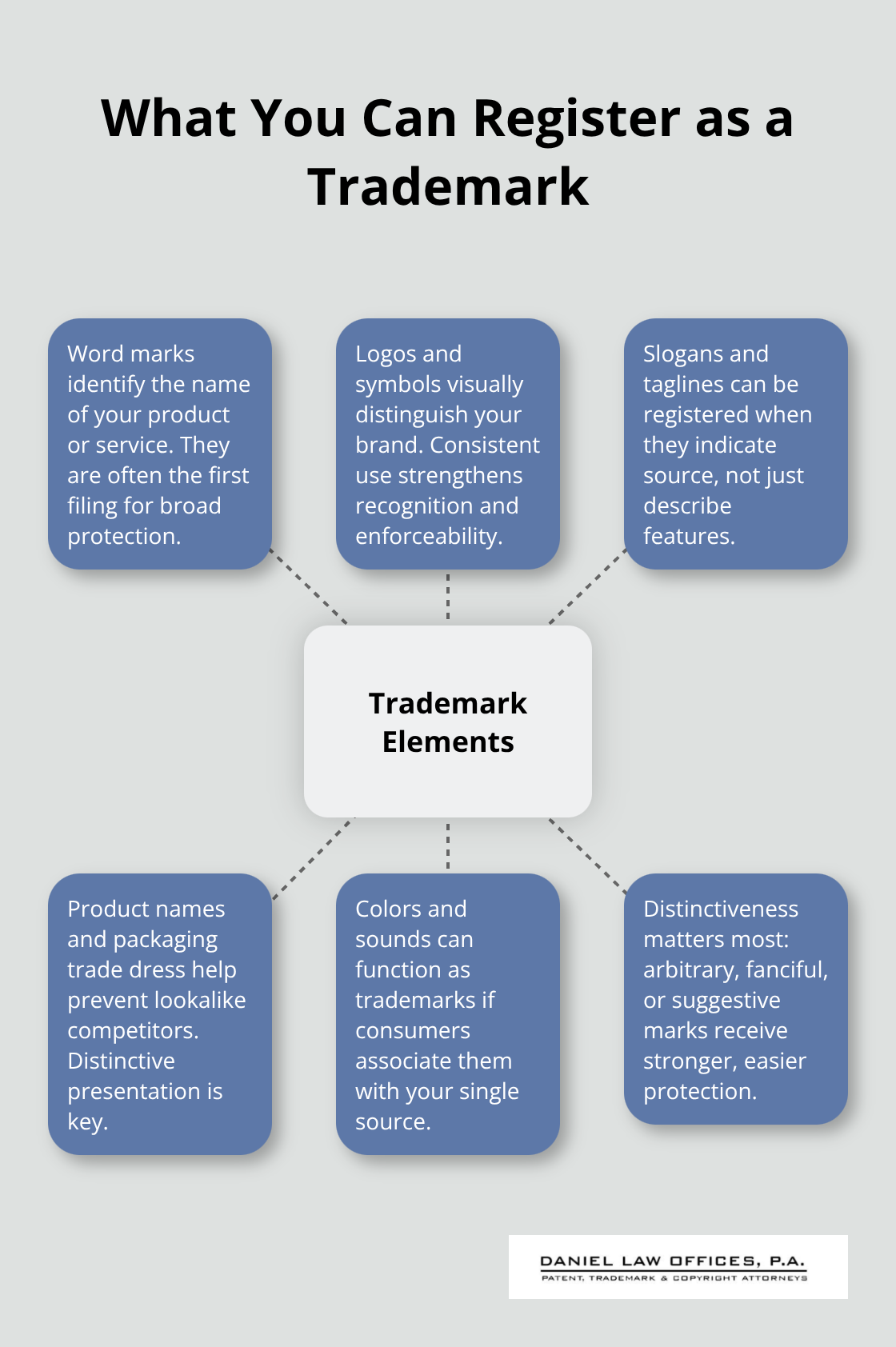
But “Swoosh” for Nike shoes registers because it’s arbitrary and distinctive. A suggestive mark like “Coppertone” for sunscreen works because customers must use imagination to connect the mark to the product. Your company name, logo, and main slogans should all be registered separately to maximize protection. If you plan to expand nationally or internationally, federal registration with the USPTO provides nationwide protection immediately, whereas Florida state registration through the Division of Corporations only protects your brand identity within Florida’s borders. This distinction matters significantly when you consider your growth trajectory and competitive landscape.
How to Search, File, and Respond to Your Trademark Application
Start with a Thorough Trademark Search
Before you file anything with the USPTO, you must search the trademark database thoroughly. This step separates businesses that succeed from those that waste thousands on applications destined for rejection. You should start at the USPTO’s Trademark Electronic Search System, which contains all federal registrations and pending applications. Search not just your exact mark, but also phonetic variations, similar logos, and marks in related categories. If you sell fitness equipment, search for confusingly similar marks in apparel, supplements, and gym services-not just equipment. Many business owners skip this step or perform only a surface search, then face office actions months later requesting evidence that their mark doesn’t conflict with existing registrations.
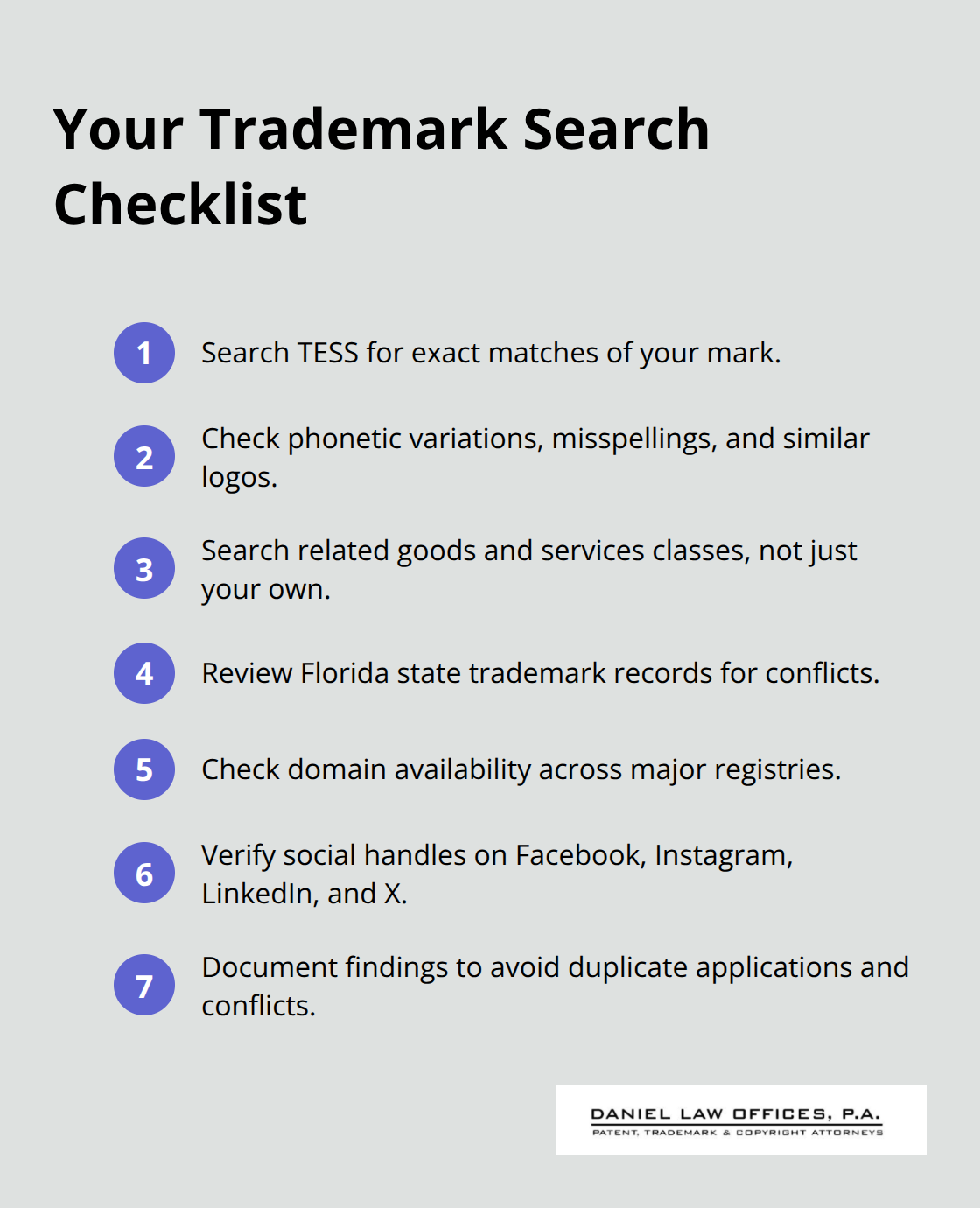
A comprehensive search takes two to three hours and might reveal that your preferred mark is already taken or too similar to something registered. This discovery now saves you application fees, attorney time, and the emotional frustration of rebranding later. Beyond the USPTO database, you should search your state’s trademark records through the Florida Division of Corporations, check domain name availability across major registries, and verify that your mark isn’t already claimed on Facebook, Instagram, LinkedIn, and X. Counterfeiters and cybersquatters register domains and social handles before legitimate businesses do, so you must secure these assets upfront to prevent fragmentation of your brand identity across platforms.
Prepare Your Application with Accurate Information
Once your search confirms your mark is clear, you should prepare your application for the USPTO by gathering specific information. You’ll need a clear image of your mark, the exact goods or services you’re offering, and the date you first used the mark in commerce. The USPTO requires accurate classification codes for your goods and services-choose the wrong class and your protection becomes narrow or ineffective. If you sell running shoes, you should not classify under apparel; instead, use the footwear class. Your application must also include a statement of use or an intent-to-use basis, depending on whether you’ve already launched with this mark.
Filing costs approximately $250 to $350 per class through the USPTO’s online system, and processing takes four to six months on average. You should submit your application through the USPTO’s online portal, which streamlines the process and provides immediate confirmation of receipt. Accuracy matters at this stage because errors in your goods or services description can limit your protection or trigger rejections that delay registration.
Navigate the Examination and Office Actions
After you submit your application, the USPTO assigns an examining attorney who reviews your application for compliance with trademark law. You should expect an office action if your mark is descriptive, generic, or conflicts with existing marks. Responding to an office action requires you to submit evidence, arguments, or amended applications within six months-missing this deadline abandons your application entirely. The examining attorney may request that you narrow your goods or services, provide evidence of acquired distinctiveness, or modify your mark to avoid conflicts with existing registrations.
The entire process from filing to final registration typically spans twelve to eighteen months, so you must maintain attention to deadlines and respond promptly to any USPTO correspondence. Each office action presents an opportunity to overcome objections through strategic arguments and evidence. If you need guidance through this examination process, a registered patent attorney can help you respond strategically to rejections and overcome objections that might otherwise derail registration. The stakes are high-one missed deadline or poorly crafted response can result in abandonment of your application and loss of your filing fees.
Secure Your Brand Across All Platforms
Once the USPTO approves your registration, you gain the exclusive right to use that mark nationwide and can use the ® symbol to signal your ownership. However, registration is not the end of your brand protection journey. You must now monitor the marketplace for infringement, enforce your rights against counterfeiters, and maintain your registration through required filings. Counterfeiters and competitors don’t stop trying to exploit your brand simply because you’ve registered it-they adapt their tactics and test your vigilance. Your next step involves establishing a monitoring system to detect unauthorized use of your mark across online marketplaces, social media platforms, and retail channels, ensuring that your investment in registration translates into actual brand protection.
Common Trademark Mistakes That Undermine Your Brand Protection
Most business owners in Orlando, Florida treat trademark registration as a one-time event rather than an ongoing commitment. They file their application, receive their certificate, and assume the work is finished. This assumption costs them thousands in lost brand equity and enforcement expenses. Businesses that registered their marks years ago often fail to implement consistent usage across platforms, monitor for counterfeits, or renew their registrations on schedule. These gaps transform a registered trademark from a powerful asset into a liability.
Inconsistent Brand Presentation Weakens Your Legal Position
Inconsistent brand presentation across your website, social media, packaging, and retail locations weakens your trademark’s legal strength and confuses customers about what your brand represents. If your logo appears in one color on your website, a different color on your packaging, and a simplified version on Instagram, you fragment your brand identity and make enforcement harder if someone copies your mark. The USPTO examines whether you use your mark exactly as registered when you file maintenance documents at the five to six year mark. Significant deviations from your registered mark can result in cancellation or reduced protection.
Your company name should appear consistently across your website header, email signatures, social media bios, and business cards. Product names should use identical spelling, capitalization, and formatting everywhere they appear. Slogans should remain word-for-word across all channels. This consistency demonstrates to courts and the USPTO that you actively protect your brand and use it as a source identifier rather than abandon it. Inconsistency also makes it harder to prove infringement when someone uses a similar mark, because you cannot show clear evidence of what your established brand looks like in the marketplace.
Failing to Monitor for Infringement Allows Counterfeiters to Thrive
Registration grants you the legal right to enforce your mark, but enforcement requires vigilance and action. Counterfeiters do not announce themselves; they quietly launch products on Amazon, Etsy, and eBay under names nearly identical to yours, hoping you will not notice. The moment you discover them months later, they have already generated sales, damaged your reputation if their product quality is poor, and potentially built customer confusion that takes years to repair.
You should implement a monitoring system within thirty days of receiving your registration certificate. This means setting up Google Alerts for your brand name, checking Amazon and eBay weekly for lookalike products, monitoring social media for accounts using your trademarked name, and reviewing domain registrations for variations of your mark. For high-value brands, consider hiring a monitoring service that uses automated tools to scan the internet continuously and alert you to potential infringements. Once you detect infringement, you must act quickly.
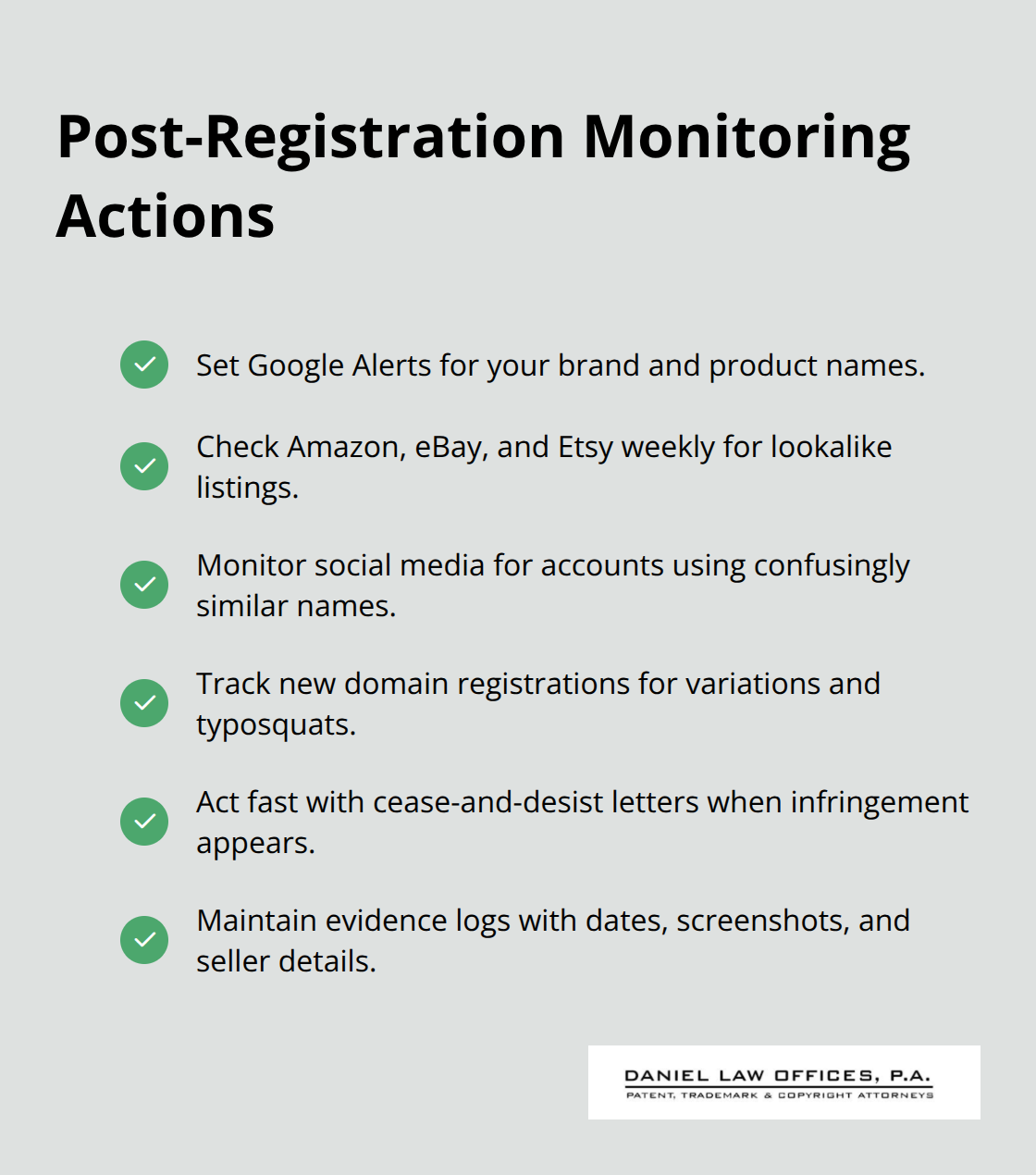
A cease-and-desist letter sent within days of discovering unauthorized use carries more weight than one sent months later, because it demonstrates you actively protect your brand. Delay weakens your legal position and signals to infringers that you are not serious about enforcement.
Choosing Generic or Descriptive Marks Dooms Your Application
Choosing marks that are too generic or descriptive dooms your application from the start. Generic marks like “Fast Shoes” or “Premium Coffee” describe the product category itself rather than identify your specific source. The USPTO will reject these outright because allowing one company to register them would prevent all competitors from using ordinary language to describe their products. Descriptive marks like “Creamy” for ice cream or “Waterproof” for boots face the same obstacle unless you prove acquired distinctiveness through years of exclusive use and substantial sales. Most business owners cannot meet this burden.
Instead, choose marks that are arbitrary, fanciful, or suggestive. Arbitrary marks like Apple for computers or Nike for athletic gear have no obvious connection to the product but are instantly protectable. Fanciful marks like Xerox or Kleenex are invented words that automatically qualify for protection. Suggestive marks like Coppertone for sunscreen require imagination to connect the mark to the product and receive strong protection. Before you settle on a brand name, test it against this framework. If your mark simply describes what your business does or what your product is, you build on unstable ground and face rejection or limited enforceability in the marketplace.
Final Thoughts
Trademark registration demands ongoing commitment long after you receive your certificate. You must use your mark consistently, monitor for infringement, and respond swiftly when competitors or counterfeiters attempt to exploit your brand. Businesses that treat brand protection as a continuous process build stronger market positions and avoid costly rebranding disasters.
Working with a registered patent attorney transforms your trademark strategy from guesswork into a defensible plan. An attorney conducts comprehensive searches that reveal conflicts before you invest in applications, guides you through office actions that derail unrepresented applicants, and helps you classify your goods and services correctly so your protection actually covers what you sell. At Daniel Law Offices, P.A., we assist businesses in securing and protecting their brand identity through the entire registration process, and the difference between filing alone and filing with professional guidance often comes down to approval rates, scope of protection, and your ability to enforce your rights later.
Enforcement falls entirely on you-the USPTO will not police your mark for you. You must detect infringement, send cease-and-desist letters, and pursue legal action when necessary, which requires vigilance, speed, and strategic decision-making about which violations warrant your resources. Contact Daniel Law Offices, P.A. to discuss your brand protection strategy and ensure your trademark registration delivers the protection your business deserves.