




Patent Litigation Basics: From Complaint to Resolution
Patent infringement can threaten your business and drain resources quickly. We at Daniel Law Offices, P.A. help clients navigate patent litigation basics from the initial complaint through final resolution.
Understanding the process-from discovery to settlement-gives you a realistic picture of what lies ahead. This guide breaks down each stage so you know what to expect.
What Counts as Patent Infringement
Patent infringement occurs when someone makes, uses, sells, or imports a patented invention without permission from the patent holder. The USPTO grants patents, but the agency does not police patent rights-that responsibility falls entirely on you. Direct infringement happens when an unauthorized party manufactures or sells your patented product or process. Indirect infringement includes actively inducing someone else to infringe or knowingly contributing to infringement.
Understanding Willful Infringement and Its Costs
Willful infringement carries the highest financial exposure. If a court finds that someone continued infringing after receiving notice, damages can reach up to three times the actual award. This distinction matters because willful infringement fundamentally changes the financial exposure and remedies available to you. A cease-and-desist letter that clearly identifies your patent and describes the infringing activity can trigger willfulness liability if the infringer ignores it and continues anyway.
Detecting Infringement Early
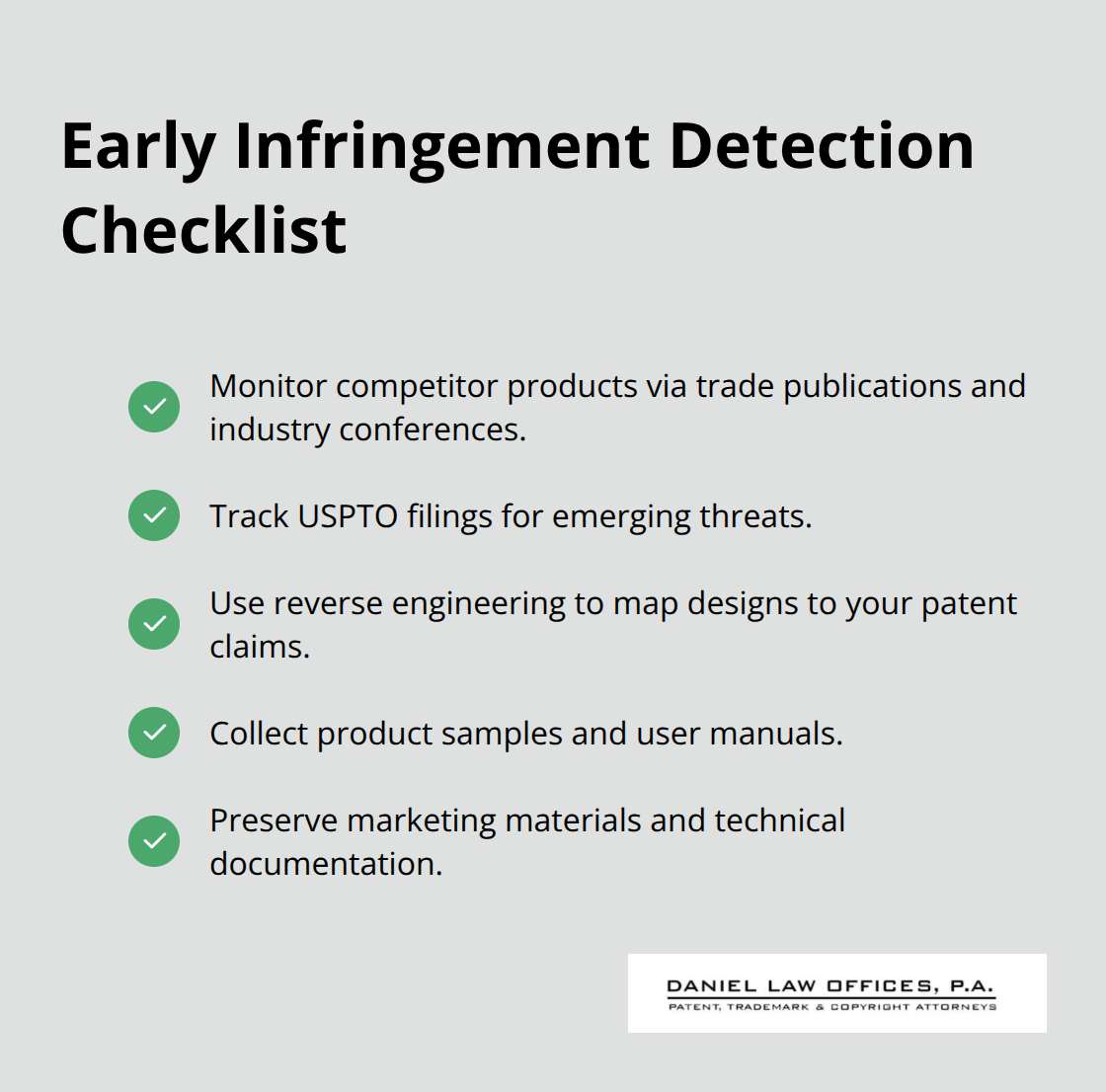
Early detection saves money and limits accumulated damages. Monitor competitor products through trade publications, industry conferences, and USPTO filings to reveal threats before they grow. Reverse-engineering analyses of competitor products provide concrete evidence of how their design maps to your patent claims. Gather product samples, user manuals, marketing materials, and technical documentation as your case develops.
Mapping Claims to Accused Products
A detailed claim-by-claim comparison between your patent and the accused product determines whether infringement actually exists. If even one element of your claim is missing and no legal equivalent is present, the infringement theory fails. This is why many patent disputes settle early: once both sides see a clear infringement map, negotiation becomes practical. Pharmaceutical and medical device companies face the most patent litigation because their products carry high value and complex claims that competitors frequently challenge.
Understanding these infringement categories and detection methods positions you to act decisively when threats emerge. The next stage-filing a complaint and navigating initial pleadings-requires precision and proper documentation to withstand early dismissal motions.
Moving From Complaint to Trial
Filing Your Complaint With Precision
Filing a patent infringement complaint in federal district court demands precision because procedural errors can sink your case before it reaches the merits. The complaint must identify each patent you’re enforcing, describe exactly how the defendant’s product or process infringes your claims, establish jurisdiction and venue, and specify the relief you seek-damages, injunctions, enhanced damages for willfulness, and attorney fees in exceptional cases. District of Delaware requires you to attach the actual patent documents and file a civil cover sheet listing all related cases to prevent judge misassignment. Many plaintiffs add claim charts showing a detailed element-by-element comparison between patent claims and the accused product, though not all courts require this at filing. The complaint must survive a motion to dismiss, which means alleging infringement for at least one claim of each patent with enough factual detail that a judge cannot dismiss it as conclusory. You do not need to assert every claim initially; additional claims can be added later through the contention process. Once served, the defendant typically has 21 days to respond, often filing counterclaims that challenge your patent’s validity through prior art or claim defects.
Discovery: The Costliest Phase
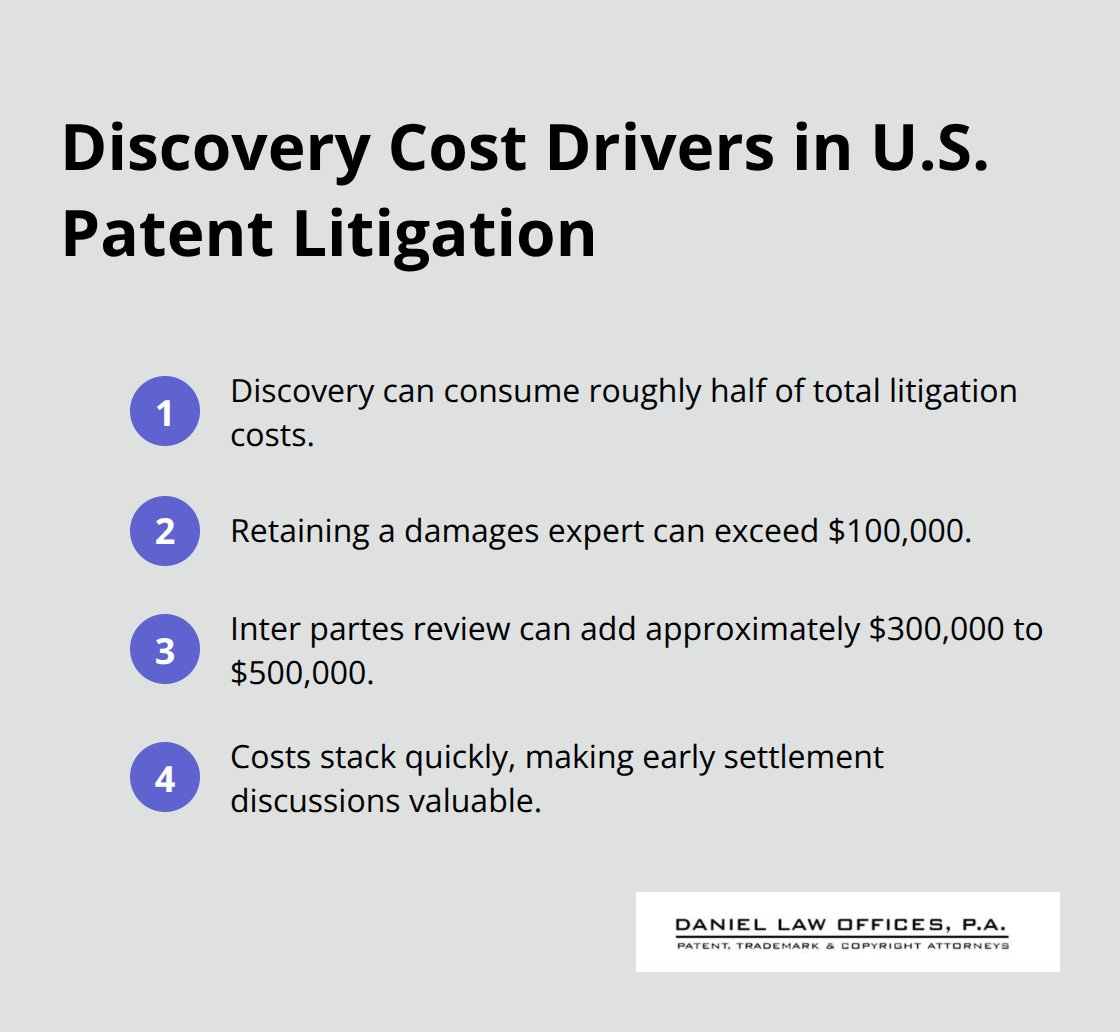
Discovery becomes the most expensive phase of patent litigation, consuming roughly half of all costs before trial even begins. Both sides exchange internal documents, answer detailed interrogatories, and sit for depositions where witnesses testify under oath about product development, design choices, and knowledge of your patent. Hiring a damages expert alone can exceed $100,000, and inter partes review proceedings-where the defendant challenges patent validity at the USPTO-add another $300,000 to $500,000 in costs. These expenses accumulate quickly, making early settlement discussions valuable for controlling overall litigation budgets.
Markman Hearings and Claim Construction
The Markman hearing arrives as a pivotal patent-specific milestone where the judge construes the meaning of disputed claim terms using patent documents, prosecution history, and expert testimony. This construction often determines the case’s outcome because a narrow construction favors defendants while a broad one helps plaintiffs. After Markman, either side may file summary judgment motions requesting the judge rule in their favor without a trial, which happens in roughly half of patent cases.
Trial, Costs, and Settlement Realities
If the case survives summary judgment, trial typically occurs before a jury that hears infringement evidence from the plaintiff and validity challenges from the defendant. AIPLA data from 2019 shows median litigation costs around $4 million for single-patent cases, with cases lasting three to five years from filing through appeals, though some courts operate rocket dockets that compress timelines under two years. Settlement and licensing resolve most disputes before trial; many cases settle once both sides understand claim construction and the strength of infringement evidence. Early mediation with a neutral evaluator provides a practical path to avoiding trial costs and timeline delays, allowing you to redirect resources toward business growth rather than prolonged courtroom battles.
Defending Against Patent Infringement Allegations in Orlando, Florida
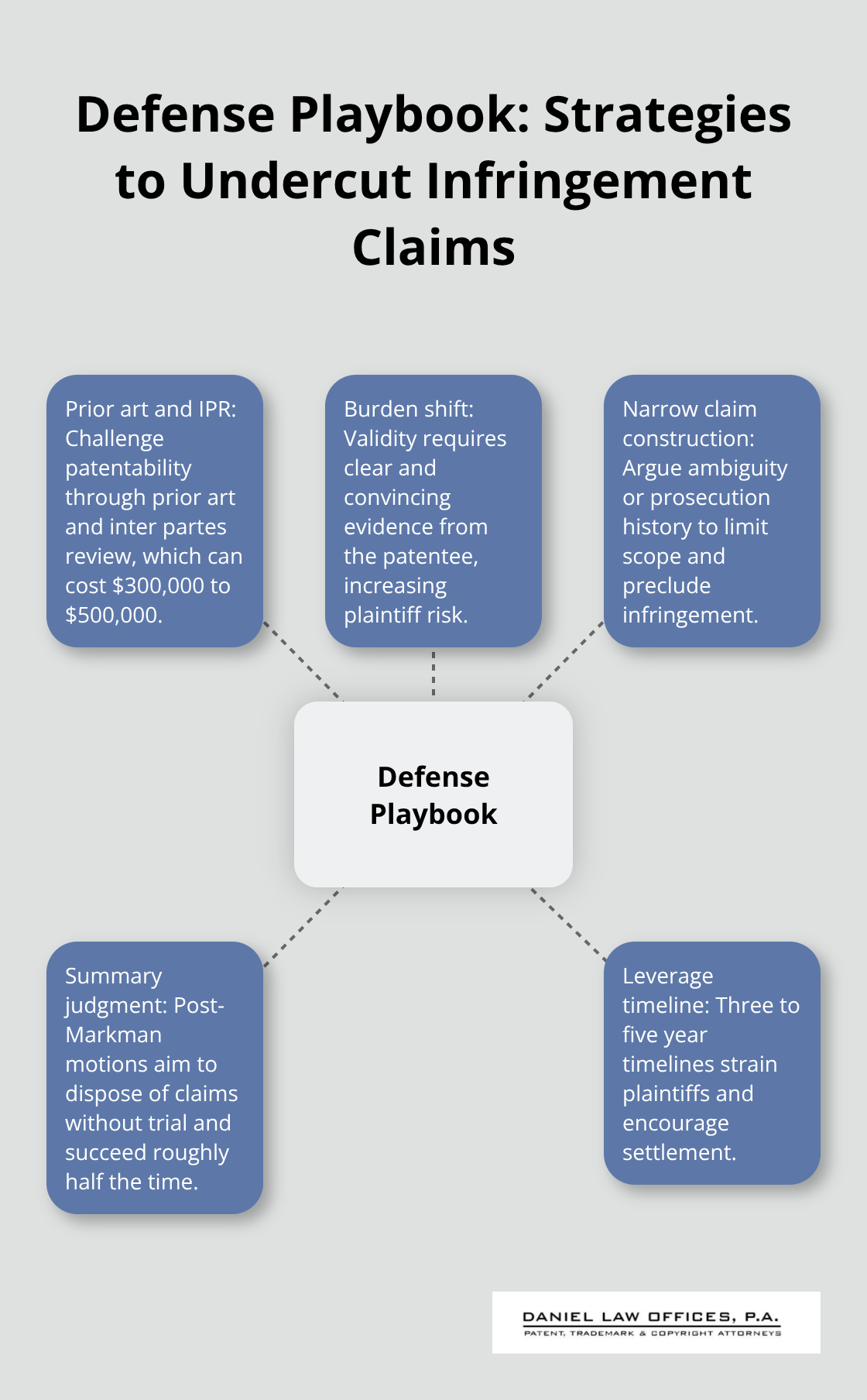
When you face patent infringement allegations, the strongest defense attacks the patent’s validity rather than arguing non-infringement. A defendant can challenge your patent by proving prior art existed before your filing date, showing that someone else invented or disclosed the same technology earlier. The Patent Trial and Appeal Board conducts inter partes review proceedings where defendants argue your patent claims are unpatentable based on prior art or lack of enablement, costing roughly $300,000 to $500,000 in base costs. This strategy shifts the burden because validity requires clear and convincing evidence from you to maintain the patent, a stricter standard than the typical civil burden of proof. Defendants also attack claim construction during Markman hearings by arguing patent terms are ambiguous or that the prosecution history limits their scope. A narrow claim construction can make infringement impossible to prove because the defendant’s product simply does not fall within the narrowly defined claims.
Prior Art Searches and Invalidity Arguments
Prior art searches reveal existing patents, publications, products, or public disclosures that predate your patent filing. If a defendant locates prior art combining two or more earlier inventions in ways that render your claims obvious, the patent becomes vulnerable to invalidation. Defendants hire technical consultants to conduct reverse-engineering analyses showing that competitors already practiced similar technology before your patent issued. The USPTO does not police prior art during prosecution, so defendants discover it during litigation through thorough document searches and expert investigation. Courts evaluate obviousness under a flexible standard examining whether the prior art combination would have been obvious to someone skilled in the field at the time of your filing. A single prior art reference rarely invalidates a patent, but multiple references combined with evidence that the field motivated combining them create powerful invalidity arguments. Pharmaceutical and medical device defendants frequently succeed using prior art because their technologies build incrementally on existing compounds or devices.
Motion to Dismiss and Claim Construction Attacks
Many defendants file motion to dismiss arguments claiming the complaint lacks sufficient factual detail about how infringement occurred. Defendants attack claim construction during Markman hearings by arguing patent terms are ambiguous or that the prosecution history limits their scope. A narrow claim construction can make infringement impossible to prove because the defendant’s product simply does not fall within the narrowly defined claims. Krippelz v. Ford Motor Co. demonstrates this risk: the case resulted in a massive verdict initially, but the Federal Circuit later overturned part of the ruling by invalidating the patent due to prior art, showing that even successful trial verdicts collapse if the patent itself is invalid.
Defense Costs and Timeline Advantages
Defending a patent infringement case costs defendants roughly the same as prosecuting one, with AIPLA data showing median defense costs around $4 million for single-patent cases. Defendants must budget for document discovery, depositions, expert witnesses, and potentially inter partes review filings that run parallel to district court litigation. The three to five year timeline favors defendants because prolonged litigation drains plaintiff resources and creates uncertainty about infringement damages. Defendants strategically use summary judgment motions after discovery closes to eliminate claims without trial, succeeding roughly half the time. Early settlement discussions benefit defendants too because plaintiffs facing mounting costs and uncertain trial outcomes often accept reasonable licensing terms rather than gamble on jury verdicts.
Final Thoughts
Patent litigation basics demand careful planning because costs reach $4 million on average for single-patent cases, with timelines spanning three to five years. Acting early-detecting infringement before damages accumulate, gathering solid evidence of how a competitor’s product maps to your claims, and sending a clear cease-and-desist letter-strengthens your negotiating position significantly. Many cases settle once both sides understand claim construction and the infringement evidence, avoiding the expense and uncertainty of trial.
Defendants face similar costs and timelines, which is why prior art searches and invalidity arguments become their primary strategy. A strong prior art challenge can invalidate your patent entirely, as the Krippelz v. Ford Motor Co. case demonstrated when the Federal Circuit overturned an initial verdict by finding the patent unpatentable. This risk underscores why patent quality matters from the start.
When infringement threatens your business, you need guidance from someone who understands both the technology and the litigation landscape. We at Daniel Law Offices, P.A. help clients navigate patent prosecution and enforcement by securing strong patents and protecting them when disputes arise. Contact us to learn how we can help protect your innovations.