




Understanding Patent Infringement Litigation: Key Facts and Strategies
Patent infringement litigation can threaten your business, drain resources, and create uncertainty about your intellectual property rights. Whether you’re facing a claim or considering legal action, understanding the process and your options matters.
At Daniel Law Offices, P.A., we’ve guided businesses through patent disputes in Orlando, Florida and beyond. This guide covers what patent infringement actually means, how litigation works, and the strategies available to protect your interests.
Understanding Patent Infringement: What It Means in Orlando, Florida
What Counts as Patent Infringement
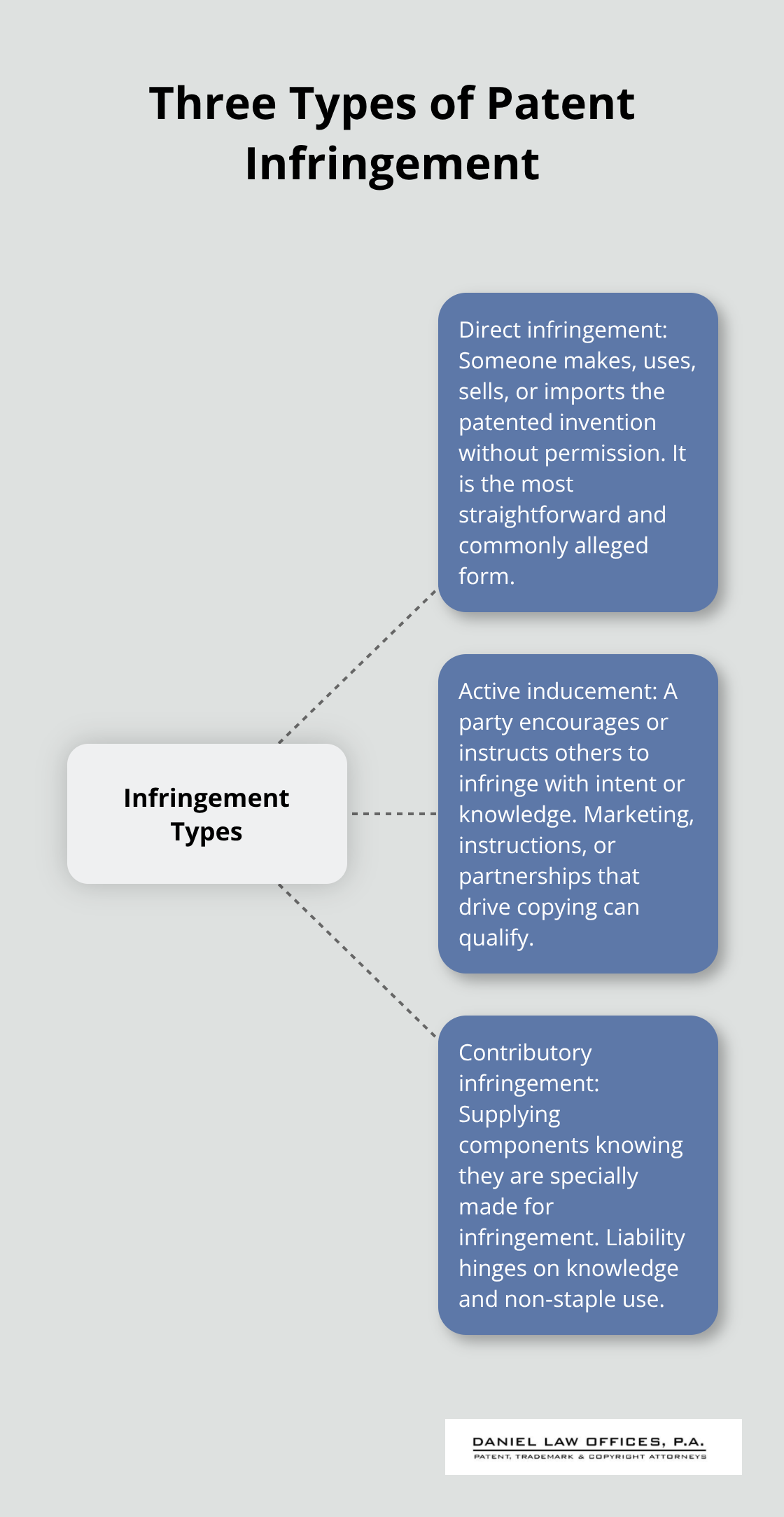
Patent infringement occurs when someone makes, uses, sells, or imports a patented invention without permission from the patent holder. The United States Patent and Trademark Office grants patents as exclusive rights to prevent others from exploiting your invention, but enforcement falls entirely on you through civil lawsuits in federal district court. The government does not police patents or enforce them automatically. Direct infringement is straightforward: a competitor manufactures your patented product, sells it, or uses your patented process to generate profit. Indirect infringement is more subtle and often overlooked. It happens when someone actively induces another party to infringe, such as instructing a manufacturer to copy your design, or when they contribute to infringement by supplying components knowing they will enable someone else to violate your patent. Courts recognize three categories: direct infringement, active inducement, and contributory infringement. The distinction matters because indirect infringement requires proof of intent or knowledge, making these cases harder to win but potentially more damaging to your competitive position.
How Infringement Manifests in Real Business Situations
Real business situations reveal why understanding these categories protects you. If a competitor purchases your patented product, reverse-engineers it, and manufactures an identical version, that constitutes direct infringement. If they sell components specifically designed to work only with your patented system, knowing that customers will use those components to operate your invention without a license, that constitutes contributory infringement. If they advertise instructions on how to modify their product to infringe your patent or knowingly partner with manufacturers to copy your design, that constitutes active inducement. Pharma patent disputes illustrate the stakes involved. Pfizer’s patent on Protonix faced challenges from generic manufacturers Teva and Sun Pharmaceuticals, resulting in billion-dollar settlements and a dramatic collapse in Pfizer’s market share when generics entered in 2007 and 2008. The patent holder lost exclusive control, and competitors captured significant revenue.
Acting Quickly Protects Your Position
Your response speed matters enormously. You should gather evidence of infringement immediately-including purchase records, product comparisons, manufacturing documentation, and communications showing knowledge-to strengthen your position whether you pursue licensing negotiations or litigation. Acting slowly allows infringers to entrench themselves in the market and claim reliance on their investment. The sooner you document what happened, the stronger your case becomes. This evidence forms the foundation for any strategy you pursue next, whether that involves direct negotiation, licensing arrangements, or formal legal action in court.
How Patent Litigation Unfolds in Florida
Building Your Evidence Foundation
Before filing a lawsuit, documentation becomes your foundation. Gather purchase records, product comparisons, manufacturing details, and any communications showing the infringer knew about your patent. This Evidence of Use forms the backbone of your case and helps attorneys assess whether you have grounds to proceed. Many businesses skip this step and regret it later-infringers will challenge your claims, and weak documentation makes defending your position nearly impossible. Once you have solid evidence, an initial consultation with a patent attorney helps determine whether litigation makes financial sense.
Understanding Litigation Costs and Timeline
U.S. patent litigation costs around 3.5 million dollars on average, though cases involving 1 to 10 million dollars at risk drop to approximately 1.5 million dollars in median costs as of 2019 according to the American Intellectual Property Law Association. Discovery accounts for roughly half these costs, so understanding your damages upfront matters. Patent cases typically take 3 to 5 years from filing to appeal, though some courts resolve matters faster. The Eastern District of Texas handles a significant volume of patent cases and remains a leading venue for patent disputes.
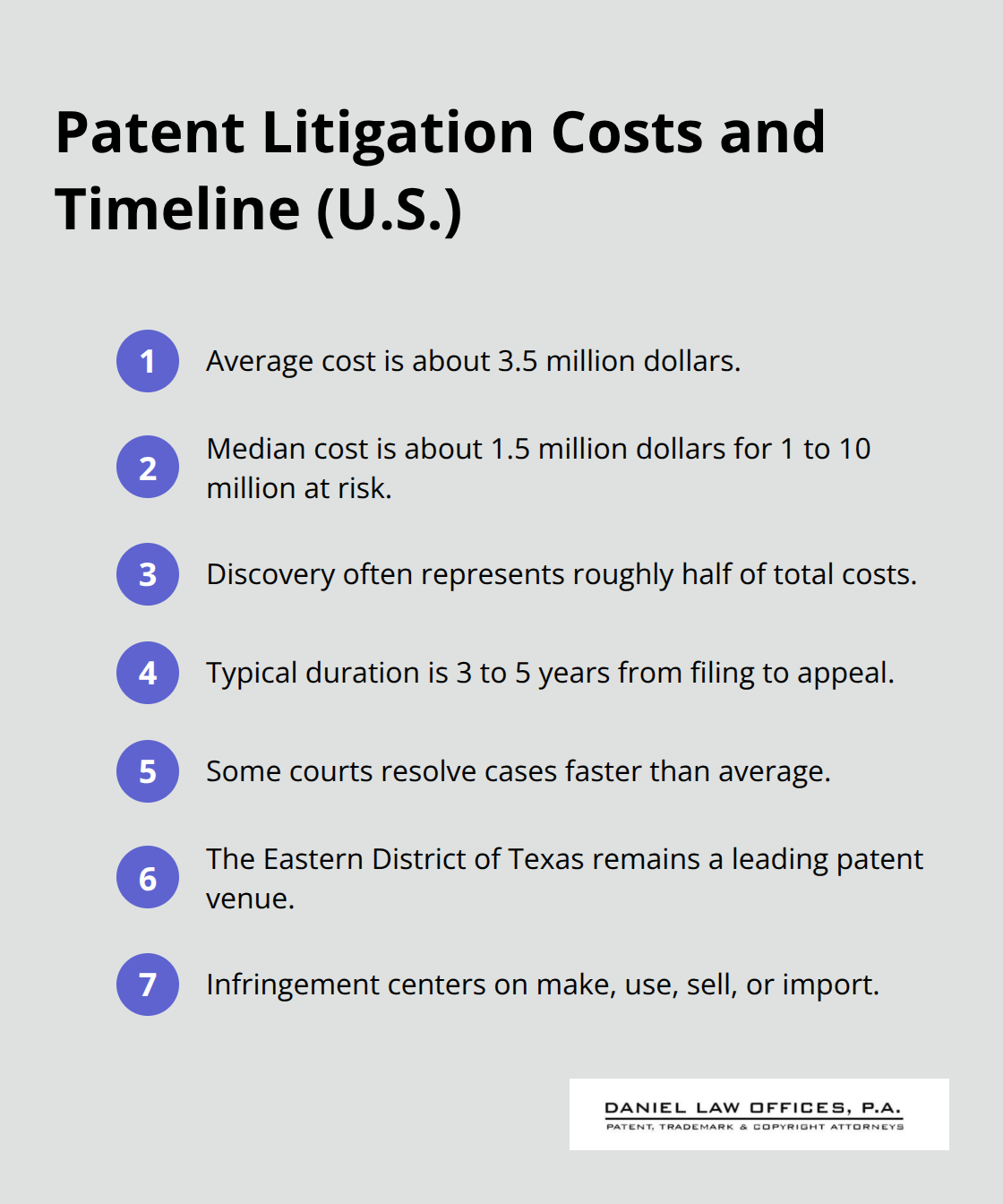
If you suspect infringement but are uncertain about grounds, a consultation can clarify whether the defendant made, used, sold, or imported your patented invention without authorization-the four core elements of infringement.
The Federal Court Process and Key Hearings
Filing a lawsuit in federal district court launches the formal process, and timing becomes critical. Once filed, the defendant responds, discovery begins, and both sides exchange internal records, interrogatories, and depositions. A Markman hearing determines how the court interprets your patent claims using intrinsic evidence like claim language and prosecution history, plus extrinsic evidence such as technical dictionaries and expert testimony. This hearing outcome often decides the case before trial even starts-if the court interprets claims too narrowly, infringement becomes harder to prove.
Settlement and Trial Outcomes
Most cases settle before trial; licensing agreements and royalty arrangements resolve disputes without jury trials. If litigation proceeds, trials are typically jury trials where inventors, experts, and business witnesses testify about infringement, damages, and validity. Remedies include monetary damages, injunctions stopping continued infringement, and potentially treble damages if the court finds willful infringement. Appeals generally go to the Federal Circuit, where median decision time is about one year.
Managing Expert Costs and Validity Challenges
Expert fees can exceed 100,000 dollars per expert, and inter partes review challenges where defendants attack patent validity cost 300,000 to 500,000 dollars according to the American Intellectual Property Law Association. Acting quickly with experienced counsel helps navigate these substantial expenses and positions your case for the strongest possible outcome. Understanding these cost drivers upfront allows you to evaluate whether your damages justify the investment and to plan your litigation strategy accordingly.
Strategies for Defending Against Patent Infringement Claims in Orlando, Florida
Attack Patent Validity Through Prior Art
When facing a patent infringement lawsuit, your first defense strategy targets the patent itself. Defendants frequently challenge patent validity by arguing the invention lacks novelty or that prior art already disclosed the same technology before the effective filing date. According to the American Intellectual Property Law Association, inter partes review proceedings cost between $300,000 and $500,000, making validity challenges a significant investment but one that can invalidate an entire patent if successful. Courts require challengers to meet a clear and convincing evidence standard when attacking validity, which sounds high but is actually achievable when prior art is well-documented.
Your defense team should conduct a thorough prior art search immediately, identifying patents, publications, and products that predate the infringement claim and cover the same technical ground. If you can prove the patent should never have been granted because the invention was already known or obvious, the entire lawsuit collapses.
Prove Non-Infringement Through Claim Analysis
Non-infringement defenses take a different approach: you argue that even if the patent is valid, your product or process does not actually fall within the patent’s claims. This requires careful claim analysis at the Markman hearing, where the court interprets what the patent actually covers using the patent language and technical evidence. A narrow claim interpretation favors defendants because competitors can design around patents with clear boundaries, while vague or overly broad claims invite invalidity challenges.
Your technical team should document how your product differs from the patented invention in specific, measurable ways that matter to the claims as the court will interpret them. This documentation becomes your roadmap for the Markman hearing and trial preparation.
Negotiate Licensing Agreements and Settlements
Settlement and licensing negotiations often produce better outcomes than protracted litigation, especially when the patent has genuine strength. Most patent cases settle before trial according to enforcement data, and these settlements typically involve licensing agreements where you pay royalties to use the patented technology rather than fighting in court for years. The median cost for patent litigation involving $1 to $10 million in damages sits around $1.5 million, and that figure covers only the initial case before appeals, so licensing can be far cheaper than discovery, expert witnesses, and trial preparation.
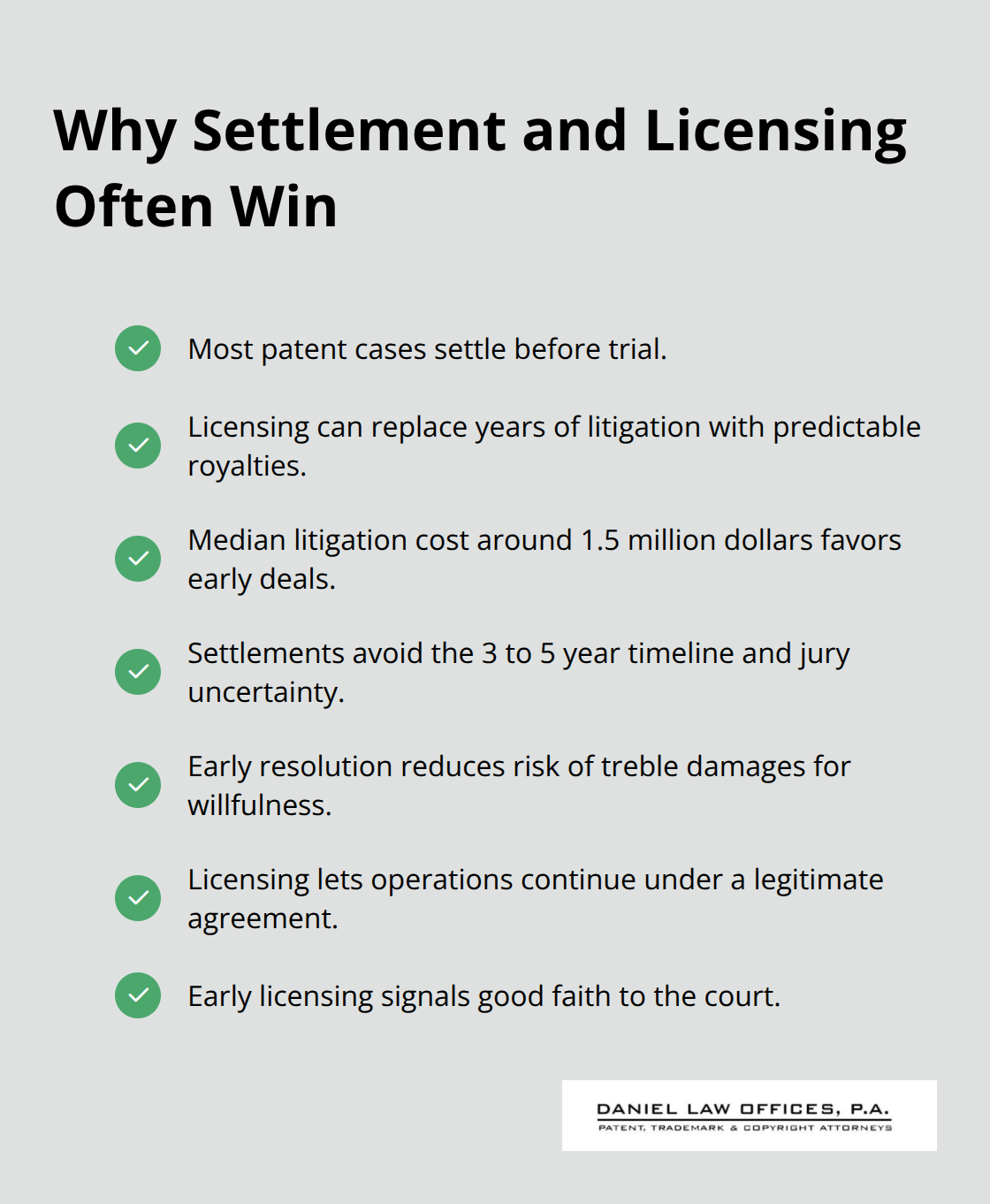
If you face a claim and your product infringes a valid patent, paying reasonable royalties upfront avoids the 3 to 5 year timeline and unpredictable jury trial outcomes. Courts may award treble damages for willful infringement if the plaintiff proves you acted with knowledge of the patent, making early settlement even more attractive when infringement is clear.
Use Licensing as a Defensive Tool
Some defendants obtain a license early to demonstrate good faith and eliminate willfulness arguments that could triple damages. This strategic approach protects your business from enhanced damages while allowing you to continue operations under a legitimate licensing arrangement. Early licensing also signals to the court that you acted reasonably once you became aware of the patent, which strengthens your position if litigation proceeds despite settlement efforts.
Evaluate Your Defense Strategy
Assessing patent strength, infringement exposure, and damage projections helps you decide whether to fight validity, prove non-infringement, or negotiate a licensing arrangement that lets your business move forward. Each path carries different costs and timelines, and the right choice depends on your specific situation, the patent’s technical quality, and your product’s actual relationship to the claimed invention. An Orlando patent lawyer can guide you through these options and help you select the strategy that best protects your interests.
Final Thoughts
Patent infringement litigation demands swift action, solid evidence, and clear strategy. The stakes are real: businesses lose market share, face substantial legal costs, and endure years of uncertainty when patents are challenged or infringed. Understanding what constitutes infringement, recognizing the litigation timeline and expenses, and knowing your defensive options separates companies that protect their interests from those that stumble through disputes unprepared.
The path forward depends on your specific situation. If you hold a patent and suspect infringement, you should gather evidence immediately and consult with a patent attorney to assess whether your damages justify litigation costs. If you face an infringement claim, you should evaluate whether attacking patent validity, proving non-infringement, or negotiating a licensing agreement makes the most sense for your business (most cases settle, and early assessment of patent strength and infringement exposure helps you avoid the 3 to 5 year litigation timeline and unpredictable jury outcomes).
Patent infringement litigation is expensive and time-consuming, but the alternative-allowing competitors to profit from your innovation or facing claims without preparation-costs far more. Contact us at Daniel Law Offices, P.A. to discuss your patent infringement litigation concerns and explore how we can help you protect your intellectual property rights in Orlando, Florida and beyond. Reach out for a consultation to clarify your options and position yourself to make informed decisions about your intellectual property.