




Startup Patent Portfolio: Building an Early-Stage IP Backbone
Your startup’s patent portfolio is often the difference between thriving and getting copied out of the market. Investors scrutinize IP protection before writing checks, and competitors will exploit any gap in your defenses.
At Daniel Law Offices, P.A., we’ve seen firsthand how early-stage companies that move fast on patents gain real leverage. The sections below show you exactly what to protect, how to avoid costly mistakes, and when to act.
Why Patents Matter for Startup Funding and Growth
Investors Demand IP Defensibility Before Funding
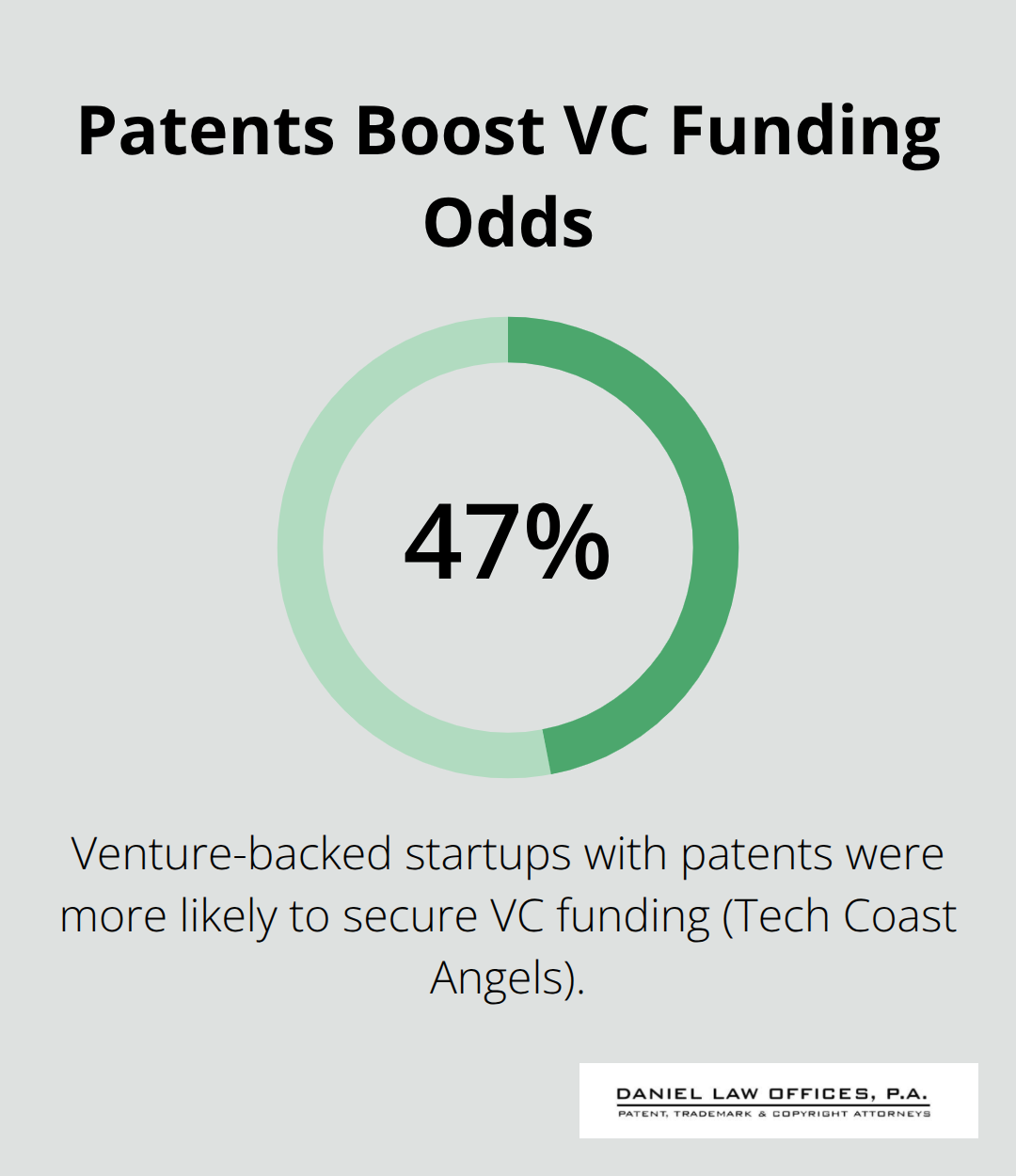
Investors won’t fund your startup without understanding your IP defensibility, and they’ll ask about it before they ask about your unit economics. Venture-backed startups with patents were valued nearly 2x higher than those without, according to Tech Coast Angels data, and were 47% more likely to secure VC funding in the first place. That gap isn’t theoretical-it’s the difference between a Series A and a rejected pitch.
When you file patents early, you price defensibility into your valuation. A six-month IP sprint of provisional filings can materially boost an exit offer by seven figures, because acquirers view a patent portfolio as a tangible, enforceable asset. Timing matters enormously: file your first provisional before major fundraising rounds so investors price IP protection into the valuation, not after the term sheet when you’ve already left value on the table.
Patent Portfolios Correlate Directly with Exit Success
Patent portfolios correlate directly with exit probability-startups with 30 or more patents have over an 80% chance of exit, while those with none face a much steeper climb. This isn’t coincidence; it’s because patents reduce acquisition risk and give buyers confidence that they’re purchasing defensible technology. Acquirers see a strong patent portfolio as proof that your innovation stands on solid legal ground.
Competitors Cannot Replicate Your Patent Portfolio Overnight
Your competitors can reverse-engineer most products in months, but they cannot replicate a patent portfolio overnight. Filing patents forces you to document exactly what makes your solution different and defensible, which clarifies your own roadmap and protects your core innovations from being copied wholesale. A patent also blocks competitors from pursuing the same technical path, forcing them to spend time and money designing around your claims or licensing from you.
The Real Cost of Patent Protection
The cost of a utility patent in the US typically ranges from $5,000 to $15,000 when working with a patent attorney, with provisional filings running roughly $3,000 to $5,000 if professionally drafted-far cheaper than the cost of defending against infringement or losing market share to a well-funded copycat. File a provisional application within 60 days of any public demo or pitch to lock in your priority date at minimal cost, then convert to a non-provisional utility patent within 12 months. This staged approach lets you validate product-market fit before committing to full prosecution costs.
Start Your IP Foundation Before Launch
Starting your IP foundation now, while your product is still evolving, is far cheaper and faster than retrofitting protection after launch. A comprehensive patent search confirms novelty before filing, ensuring your application covers defensible ground and doesn’t waste resources on obvious or already-patented approaches. Once you’ve identified what to protect, the next step is understanding which specific technologies deserve your filing budget and which can wait.
Building Your Patent Portfolio from Day One
Conduct a Prior Art Search Before Filing
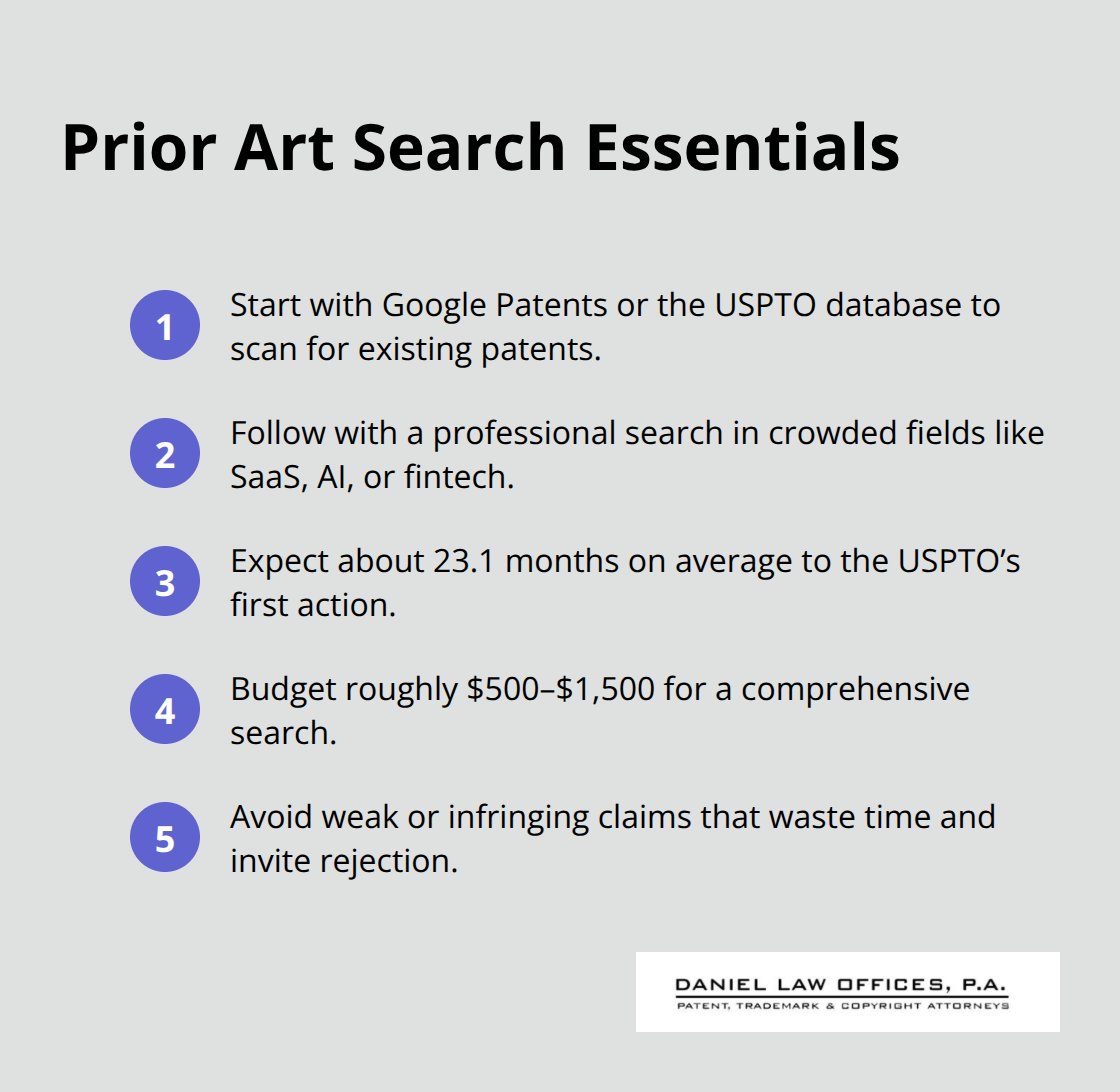
A patent search before filing is non-negotiable, yet most startups skip it and waste thousands on applications that overlap with existing patents or cover obvious ground. The USPTO reports an average time to first action of about 23.1 months, meaning your filing decision today will face examination scrutiny far into your product roadmap. Start with a prior art search using free tools like Google Patents or the USPTO database to scan for existing patents in your space, then follow up with a professional search if your technology touches a crowded field like SaaS, AI, or fintech. A comprehensive search costs roughly $500 to $1,500 and saves you from filing weak claims that examiners will reject or, worse, filing patents that infringe existing claims and expose you to litigation.
Identify Your Core Technical Differentiators
Once you confirm novelty, map your core technical differentiators against your revenue model. Which features drive customer acquisition? Which are hard to reverse-engineer? Which would force a competitor to spend significant engineering time working around? These three questions separate what deserves patent protection from what doesn’t. A matching algorithm that ranks user behavior gets protection; a UI button does not. Data pipelines with pricing intelligence, API authentication flows, and fraud detection systems are all patentable and valuable because they create switching costs and licensing opportunities. Avoid the trap of filing broadly on every feature; instead, focus your budget on the technologies that competitors would need to replicate your core business model.
Prioritize Filings Around Your Most Defensible Innovations
Prioritize filings around your most defensible technical achievements first, then expand to secondary innovations as your revenue grows and your burn rate allows it. This approach concentrates your early-stage budget on the inventions that matter most to your competitive position and licensing potential.
Use Provisional Patents to Lock in Priority Dates
Provisional patents are your tactical weapon for locking in priority dates without full prosecution costs. File a provisional application within 60 days of any public demo or pitch-this costs $3,000 to $5,000 if professionally drafted and gives you 12 months to decide whether to convert to a full utility patent. During those 12 months, validate product-market fit and customer traction; if the feature or product gains real adoption, convert the provisional to a non-provisional utility patent. If it flops, abandon it and conserve cash.
Align Your Filing Roadmap with Funding Milestones
A staged filing roadmap aligned with your funding milestones is critical: file your first provisional before Series A conversations so investors see defensibility priced into your valuation, not after the term sheet when you’ve already left millions on the table. The PitchBook Patent Research Report from 2023 found that deep tech startups filing patents early raise more capital and command higher valuations, so treat provisional filings as a fundraising asset, not an afterthought. Your next step is understanding which mistakes derail most startup patent strategies and how to sidestep them before they cost you time and money.
Three Patent Mistakes That Drain Your Budget
File Smart, Not Broad
Most startups file patents without a clear filter for what actually deserves protection, which means they waste thousands on weak claims while leaving core defensible technology unpatented. The mistake isn’t filing too many patents-it’s filing the wrong ones. You might patent a UI element that any competitor can redesign in weeks, then skip protection for your matching algorithm that would take months to reverse-engineer. This backwards prioritization happens because founders conflate filing volume with defensibility. A portfolio of 30 mediocre patents is worthless; a portfolio of 5 airtight patents covering your revenue-linked differentiators is a real moat.
Before filing anything, ask three hard questions: does this claim cover a feature that drives customer acquisition, can infringement be detected if a competitor steals it, and does it strengthen your licensing or negotiation power? If the answer to any is no, don’t file. Narrow claims that target your actual competitive advantage are far more defensible than broad claims that examiners will reject or that competitors can design around in days.
The USPTO reports an average examination time of 23.1 months, so your filing decision today faces months of scrutiny; weak claims waste that time and your money. Conversely, filing too narrowly on a single technical implementation leaves you exposed when competitors tweak the approach slightly. Patent your core innovation at the architectural level, not just the tuning parameters, so your protection survives as your product evolves. A data pipeline that enriches transaction logs with pricing intelligence is worth protecting; the specific machine learning model you use today is not, because you’ll swap it out in six months anyway.
Protect Your Brand Name Alongside Your Technology
Trademarks and patents protect different assets, yet most startups ignore trademarks entirely and focus only on utility patents, leaving their brand vulnerable to dilution and market confusion. Your trademark protects your brand name, logo, and market identity across products and geographies; your patent protects the underlying technology. A competitor can design around your patent in months, but they cannot use your brand name without triggering infringement claims.
Register your core brand name as a trademark with the USPTO now, before a competitor in an adjacent market claims it or a trademark squatter registers it in your target countries. The cost is roughly $300 to $500 per class if you file yourself, or $800 to $1,500 with an attorney, far cheaper than defending against brand confusion or losing your name to someone else. Trademarks also last indefinitely if you renew them every 10 years, whereas patents expire in 20 years, making them a permanent defensibility layer.

If you’re building a platform or marketplace, protect your matching algorithm with patents and your platform name with trademarks-together they create a legal moat that competitors cannot easily breach. Filing trademarks alongside patents signals to investors that you understand brand protection, not just technology protection, and that you’re building defensible business value on multiple fronts.
Lock in Priority Dates Before Launch
Waiting to file until after launch, fundraising, or hiring is the costliest mistake because you lose the ability to establish early priority dates and because ownership disputes erupt when contributors aren’t bound by invention assignment agreements from day one. File a provisional patent within 60 days of any public demo or pitch; this costs $3,000 to $5,000 if professionally drafted and locks in your priority date without requiring full prosecution. Waiting six months to file means a competitor could file a similar patent in your jurisdiction and block your own claims, or your employee who built the core feature could claim partial ownership if no assignment agreement exists.
The PitchBook Patent Research Report from 2023 showed that deep tech startups filing patents early raise more capital and command higher valuations, so delays directly cost you fundraising leverage. Align your first provisional filing with your Series A timeline, not after the term sheet when you’ve already left millions on the table.
Inventors must also assign all IP rights to the company in writing from day one; absent proper assignment agreements, ownership disputes can derail exits or trigger litigation that costs $2.8 million to $3.5 million per case according to 2025 data. Get signed invention assignment agreements from all co-founders and early technical contributors now, before anyone claims they built something valuable and deserves equity or cash from the patent. This single step prevents catastrophic ownership disputes later and ensures your company owns the IP portfolio outright when acquirers conduct due diligence.
Final Thoughts
Your startup patent portfolio isn’t a luxury-it’s the foundation that separates companies that scale from those that get copied out of the market. The data is clear: startups with strong IP protection raise more capital, command higher valuations, and exit at significantly better terms than those without. Every month you delay filing is a month your competitors could be moving faster, and every invention you leave unprotected is a competitive advantage you’re handing away.
Start by conducting a prior art search to confirm your innovations are novel, then identify the three to five core technologies that drive your business model and defensibility. File provisional patents on these differentiators within 60 days of any public demo or pitch-this locks in your priority date for under $5,000 and buys you 12 months to validate product-market fit before committing to full prosecution. Align your filing roadmap with your fundraising milestones so investors see IP protection priced into your valuation from the start, and register your brand name as a trademark alongside your patents to build a multi-layered legal moat.
The cost of building a startup patent portfolio early is minimal compared to the cost of defending against infringement, losing market share to a copycat, or fighting ownership disputes during due diligence. A six-month IP sprint can materially boost your exit offer by seven figures because acquirers view a defensible patent portfolio as proof that your innovation stands on solid legal ground. Contact Daniel Law Offices, P.A. to discuss your startup patent portfolio strategy and lock in your competitive advantage.