




Trademark Office Action Orlando, Florida: How to Respond to a USPTO Refusal
Receiving a trademark office action in Orlando, Florida can feel like a setback, especially after you have already invested time in choosing a brand and filing your application. An office action is simply a letter from the examining attorney at the United States Patent and Trademark Office explaining why your mark cannot be registered yet, and it often comes with a clear path forward. Some office actions raise minor issues that can be fixed with a short amendment, while others raise substantive refusals that require careful legal argument and evidence. Knowing what the letter means, how much time you have, and which response strategy fits your situation gives you real control over the outcome.
At Daniel Law Offices, P.A., we help Central Florida entrepreneurs, startups, and established companies protect their brands at the USPTO so you can move forward with confidence. This guide explains what a trademark office action actually is, how the response process works, and the mistakes that can cause an otherwise promising application to be abandoned.
What a Trademark Office Action Actually Is
Federal trademark law builds the office action into the examination process. Under 15 U.S.C. 1062(b), if the applicant is found not entitled to registration, the examiner must notify the applicant and give the reasons. The applicant may then reply or amend the application, which is reexamined, and that cycle may repeat until the examiner finally refuses registration or the application is abandoned. In other words, an office action is the start of a conversation with the USPTO, not the end of your application.
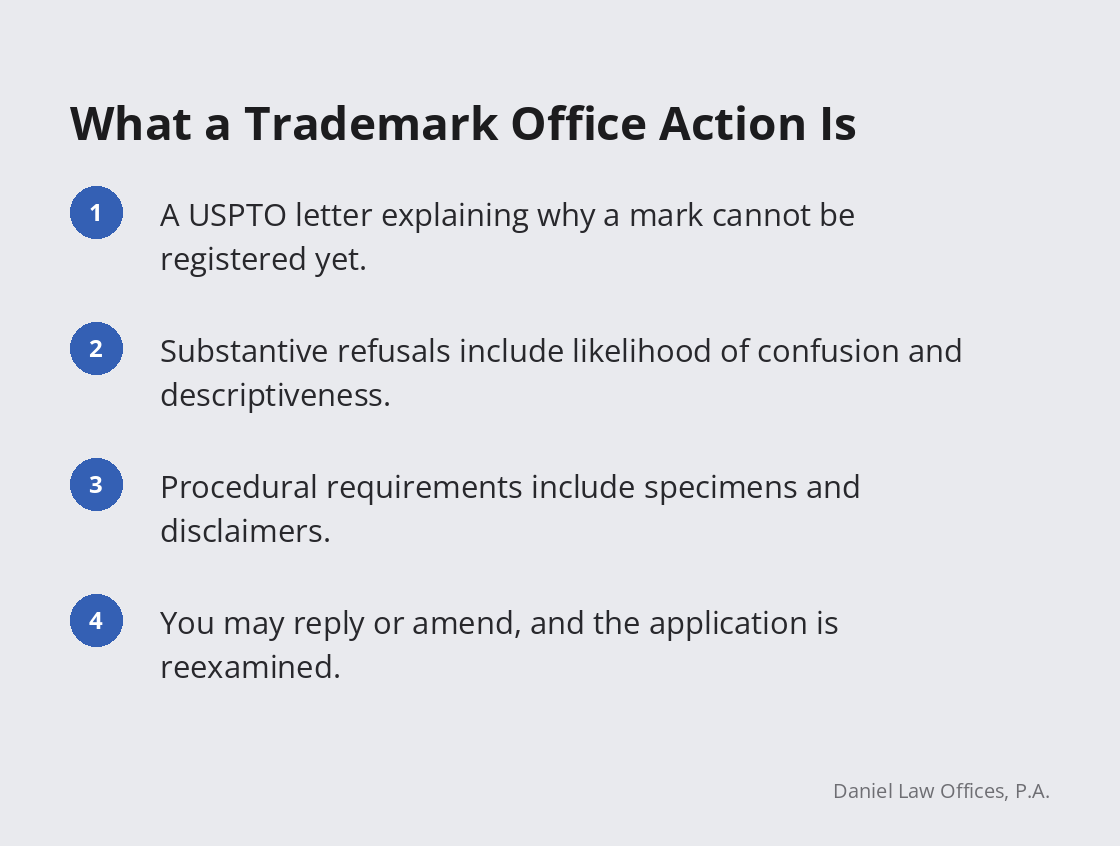
Office actions generally contain two kinds of issues. Substantive refusals challenge whether the mark can be registered at all, while procedural requirements ask you to clarify or correct something in the application, such as the wording of your goods and services. Many letters include both, and every issue raised must be addressed in your response.
Likelihood of Confusion Refusals
One of the most common substantive refusals comes from Section 2(d) of the Lanham Act, codified at 15 U.S.C. 1052(d). That provision allows the USPTO to refuse registration of a mark that so resembles a registered mark, or a mark or trade name previously used in the United States by another and not abandoned, as to be likely, when used on or in connection with the applicant’s goods, to cause confusion, to cause mistake, or to deceive. These refusals often turn on how similar the marks look, sound, and feel, and on how closely the goods or services are related. A careful search before filing reduces this risk, which is why we encourage clients to read our guide on trademark search importance in Florida before choosing a name.
Descriptiveness and Other Statutory Refusals
Section 1052(e) lists other grounds for refusal. A mark may be refused if, when used on or in connection with the applicant’s goods, it is merely descriptive or deceptively misdescriptive of them, primarily geographically descriptive, primarily geographically deceptively misdescriptive, or primarily merely a surname, or if it comprises any matter that, as a whole, is functional. Descriptiveness refusals are common for brands that directly describe a product’s features. Under Section 1052(f), however, many of these marks can still be registered if they have become distinctive of the applicant’s goods in commerce, and the Director may accept proof of substantially exclusive and continuous use as a mark in commerce for the five years before the claim of distinctiveness as prima facie evidence of that distinctiveness.
Procedural Requirements
Not every issue in an office action is a refusal. Examining attorneys frequently require applicants to clarify the identification of goods and services, submit an acceptable specimen, or enter a disclaimer. Under 15 U.S.C. 1056(a), the Director may require the applicant to disclaim an unregistrable component of a mark otherwise registrable, and a disclaimer does not prejudice the applicant’s rights in the disclaimed matter. Under 37 C.F.R. 2.56, a specimen for goods must show the mark on the goods, their containers or packaging, labels or tags, or a point-of-sale display, while a service mark specimen must show the mark as used in the sale or advertising of the services. The rule specifically states that a digital image or similar mockup of how the mark may be displayed is not a proper specimen.
How to Respond to a Trademark Office Action
A strong response is organized, complete, and filed on time. The USPTO’s rules spell out when and how a response must be submitted, and the deadline in your office action controls. Treat the letter as a checklist: every refusal and every requirement needs an answer, whether that answer is an amendment, an argument, evidence, or a combination of all three.
Understanding the Response Deadline
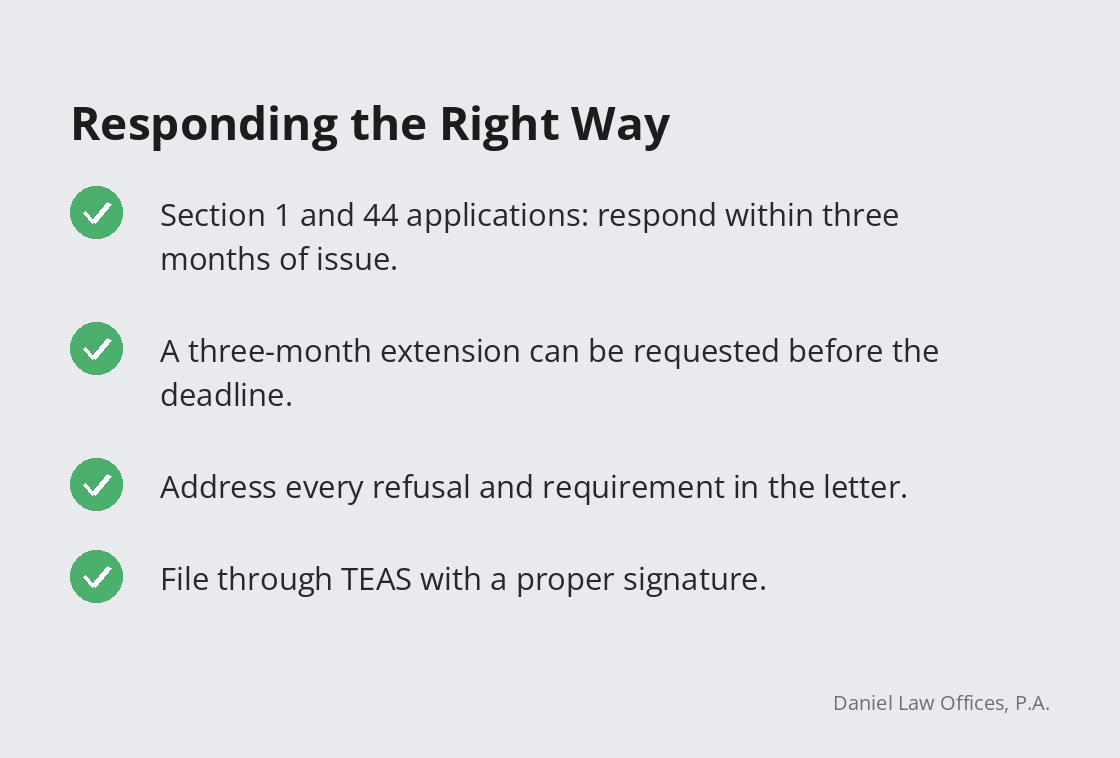
Under 37 C.F.R. 2.62(a), each office action sets forth the deadline for response. Unless the applicant is notified otherwise, the response period is three months from the issue date for applications filed under Section 1 or Section 44 of the Trademark Act, and six months from the issue date for applications filed under Section 66(a). For the three-month period, the applicant may request a three-month extension, up to a maximum of six months from the issue date, but the request must be received by the USPTO on or before the original deadline. Calendaring the deadline the day the office action arrives is one of the simplest ways to protect your application.
Building Arguments and Evidence
For substantive refusals, the response usually combines legal argument with evidence. In a likelihood of confusion refusal, that may mean explaining differences in the overall commercial impression of the marks, showing how the goods or services differ, or narrowing your identification so the overlap disappears. In a descriptiveness refusal, it may mean arguing that the mark is suggestive rather than descriptive, or, when the facts support it, submitting a claim of acquired distinctiveness under Section 1052(f). Evidence should be gathered now rather than later, because 37 C.F.R. 2.142(d) provides that the record should be complete before an appeal is filed and that evidence should not be filed with the Trademark Trial and Appeal Board after the notice of appeal.
Signing and Filing the Response Correctly
Under 37 C.F.R. 2.62(b), the response must be signed by the applicant, someone with legal authority to bind the applicant, such as a corporate officer or a general partner, or a qualified practitioner. Under 37 C.F.R. 2.62(c), responses and extension requests must be submitted through the Trademark Electronic Application System, known as TEAS, and responses sent by email or fax will not be given a date of receipt. Applicants whose domicile is outside the United States must also be represented by an attorney qualified to practice before the USPTO under 37 C.F.R. 2.11. Filing through the correct channel, with the correct signature, ensures your hard work actually counts.
Mistakes That Lead to Abandonment
Many trademark applications are lost not because the brand was unregistrable but because of avoidable procedural errors. The USPTO’s abandonment rules are strict, and recovering from a missed step can be difficult. Understanding the most common pitfalls helps you keep your application moving toward registration in Orlando, Florida and beyond.
Missing or Incomplete Responses
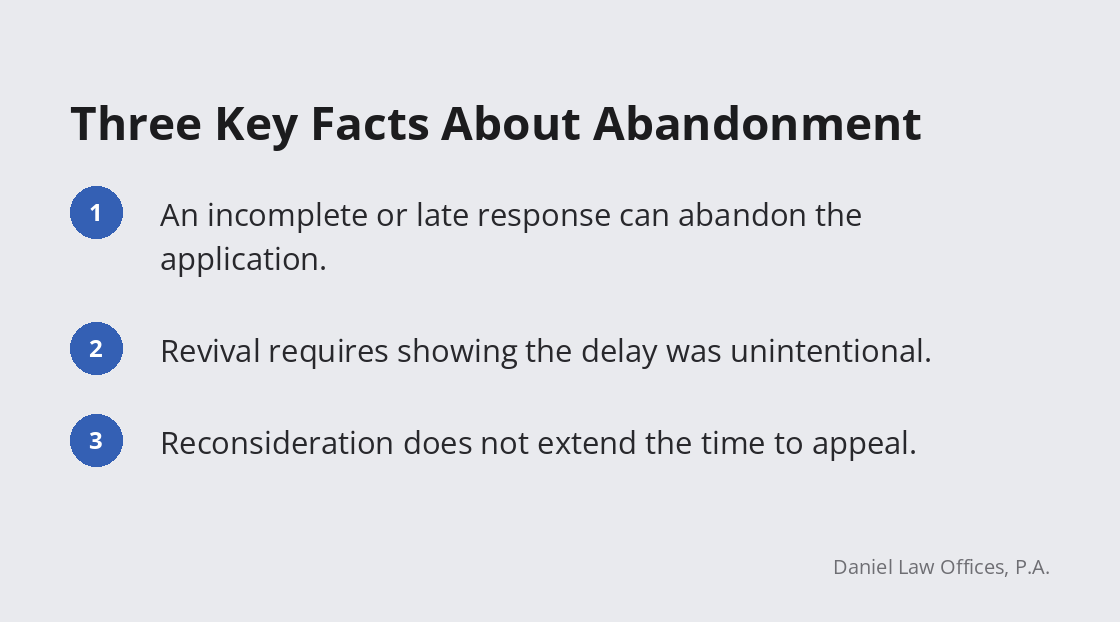
Under 37 C.F.R. 2.65(a), an application will be abandoned if the applicant fails to respond to an office action, or to respond completely, within the response period, including any granted extension. If all refusals and requirements are expressly limited to certain goods or services, the application will be abandoned only as to those goods or services. Federal law provides a narrow safety valve. Under 37 C.F.R. 2.66, an applicant may petition to revive an application abandoned because of an unintentional delay, generally no later than two months after the issue date of the notice of abandonment, and the petition must include a statement that the delay was unintentional along with a response to the office action. Relying on revival is risky, so the better practice is to respond completely and early.
Misunderstanding a Final Refusal
If the examining attorney is not persuaded, the next letter may be a final office action. Under 37 C.F.R. 2.63(b), when a final action maintains a substantive refusal, the applicant may respond by filing a request for reconsideration, an appeal to the Trademark Trial and Appeal Board, or a request for an extension of time to respond or appeal. A critical detail is that filing a request for reconsideration does not stay or extend the time for filing an appeal or petition. Under 15 U.S.C. 1070, an appeal may be taken to the Board from any final decision of the examiner, and under 37 C.F.R. 2.142(a), the appeal must be filed within the time provided in Section 2.62(a).
Amending in Ways That Hurt the Brand
The fastest way to overcome a refusal is not always the best way. Deleting key goods or services, accepting a narrow identification, or entering a disclaimer without understanding its effect can leave you with a registration that does not protect the business you are actually building. Before agreeing to any amendment, consider how you use the mark today and how you plan to grow over the next several years. A thoughtful response balances the goal of getting registered with the goal of owning a meaningful, enforceable right. For a broader look at the full filing journey, see our guide to trademark registration in Orlando, Florida.
Final Thoughts
A trademark office action is a normal part of federal registration, and many applications that receive one still go on to register. The keys are to understand each refusal and requirement, respect the response deadline, gather strong evidence, and file a complete, properly signed response through TEAS. Missing a deadline or answering only part of the letter can lead to abandonment, while a careful strategy can keep your brand on track.
Your brand is one of your most valuable business assets, and the decisions you make in responding to the USPTO can shape the strength of your rights for years to come. Taking the time to respond thoughtfully now protects the identity you have worked hard to build.
If you have received an office action and want help understanding your options, contact Daniel Law Offices, P.A. to speak with our team in Orlando. We will review the examining attorney’s letter, explain your choices, and help you take the next step with confidence.