




Patent Grace Period Orlando, Florida: How Public Disclosure Affects Your Rights
The patent grace period Orlando, Florida inventors hear about at pitch events and trade shows is one of the most misunderstood rules in patent law. Many founders believe they can show their invention to the world, gauge interest, and file a patent application whenever they are ready. The grace period does give inventors some breathing room in the United States, but it is narrower than most people think, and it does not travel well outside the country.
At Daniel Law Offices, P.A., we help inventors, startups, and growing technology companies throughout Orlando and Central Florida plan their disclosures around their patent filings so that early publicity does not jeopardize their rights. This guide explains how the grace period actually works under federal patent law, how to use it wisely, and the disclosure mistakes that most often put patent protection at risk, so you can move forward with confidence.
How the Patent Grace Period Actually Works
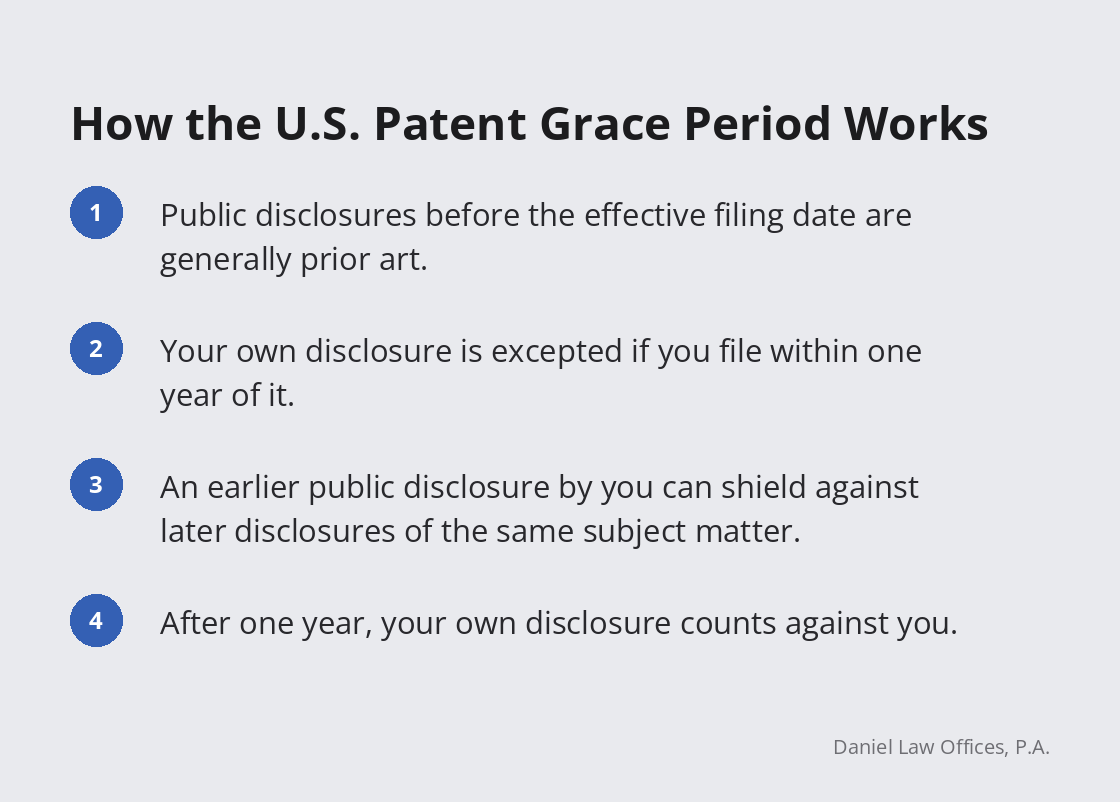
Every patent application is judged against the prior art, meaning what was already known before the application’s effective filing date. Under 35 U.S.C. 102(a)(1), a person is not entitled to a patent if the claimed invention was patented, described in a printed publication, or in public use, on sale, or otherwise available to the public before the effective filing date of the claimed invention. That list is broad. A conference presentation, a product listing, a demonstration video, a crowdfunding page, or a detailed social media post can all raise the question of whether the invention was made available to the public before you filed.
The One-Year Exception for Inventor Disclosures
The grace period comes from 35 U.S.C. 102(b)(1). Under subparagraph (A), a disclosure made one year or less before the effective filing date of a claimed invention is not prior art under section 102(a)(1) if the disclosure was made by the inventor or a joint inventor, or by another who obtained the subject matter disclosed directly or indirectly from the inventor or a joint inventor. In practical terms, if you publicly reveal your own invention, United States law generally gives you up to one year from that disclosure to file before your own disclosure can be used against you. Once that year passes, your own disclosure becomes prior art like anything else.
What Effective Filing Date Means
The grace period is measured from the effective filing date, so it is important to know exactly what that date is. Under 35 U.S.C. 100(i), the effective filing date for a claimed invention is the actual filing date of the patent or application containing the claim, unless the application is entitled to a right of priority or the benefit of an earlier filing date, in which case it is the filing date of the earliest such application. The USPTO’s Manual of Patent Examining Procedure explains that the one-year grace period in section 102(b)(1) is measured from the filing date of any U.S. or foreign patent application to which the patent or application is entitled to benefit or priority as to that invention. That is why the content of your earliest application matters so much.
Protection Against Later Third-Party Disclosures
Section 102(b)(1)(B) adds a second layer. A disclosure made one year or less before the effective filing date is not prior art if the subject matter disclosed had, before that disclosure, been publicly disclosed by the inventor, a joint inventor, or another who obtained it from them. This can shield an inventor who discloses first from someone else’s later disclosure of the same subject matter. The USPTO reads this exception narrowly. According to MPEP 2153.02, the exception does not apply even if the only differences between the later disclosure and the inventor’s earlier public disclosure are mere insubstantial changes, or only trivial or obvious variations. Relying on an early disclosure as a shield is therefore far riskier than simply filing first.
Using the Grace Period Wisely in Orlando, Florida
The grace period is best viewed as a safety net, not a filing strategy. Inventors who plan their disclosures around an early application keep far more options open than those who disclose first and hope the grace period covers them. A few practical steps make a significant difference.
File Before You Disclose Whenever Possible
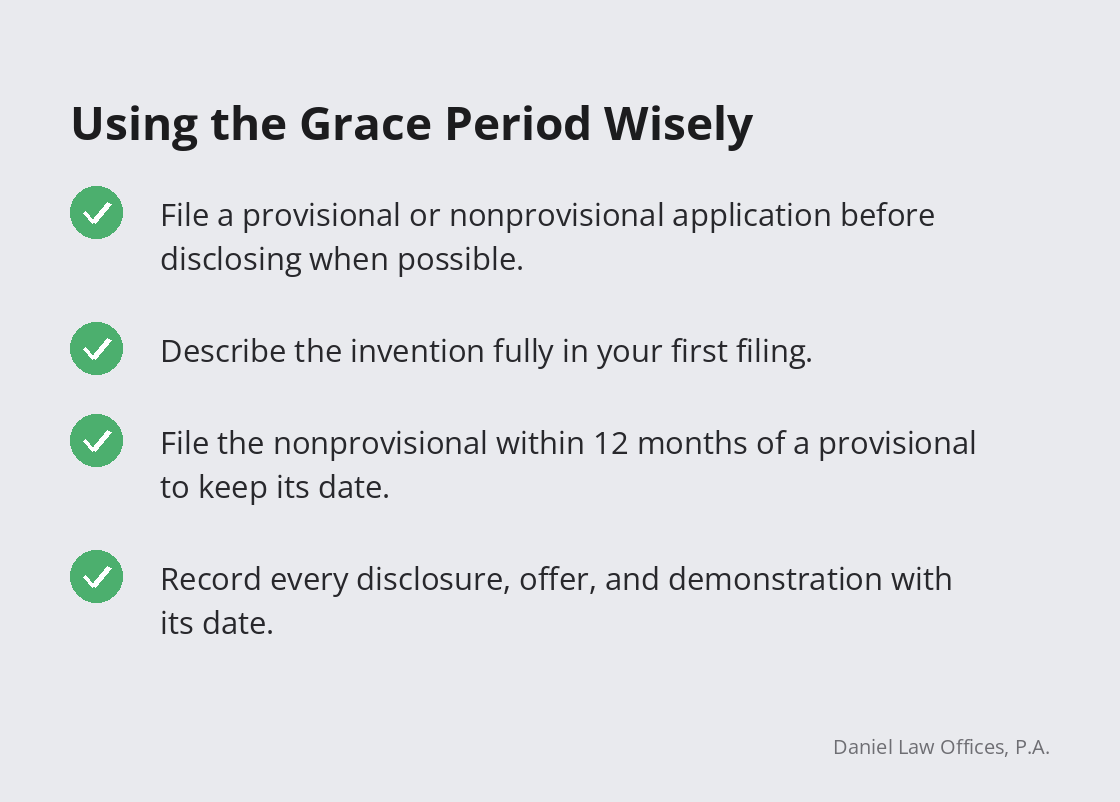
The simplest way to avoid grace period questions is to file before your invention becomes public. A provisional application can help. Under 35 U.S.C. 111(b), a provisional application must include a specification and drawings, but it does not require claims, and its filing date is the date the specification is received by the USPTO. Under 35 U.S.C. 119(e), a later nonprovisional application filed not later than 12 months after the provisional receives the provisional’s date for an invention disclosed in the provisional in the manner the statute requires, as long as it contains a specific reference to the provisional. Our provisional patent overview explains that process in more detail.
Describe the Invention Fully in Your First Filing
A provisional application protects only what it actually describes. The benefit under section 119(e) applies to an invention disclosed in the provisional in the manner provided by section 112(a), other than the best mode requirement, which means a thin or rushed provisional may not support the claims you eventually pursue. If you have already made a public disclosure, a detailed first filing becomes even more important because it fixes the date that your grace period and your effective filing date depend on. Treat the provisional as a complete technical description rather than a placeholder.
Track Every Disclosure and Its Date
Keep a simple record of every time your invention is shown, demonstrated, offered, published, or described outside your company, including who received the information and whether they were under a confidentiality obligation. That record helps you calculate deadlines and gives your patent counsel what they need to evaluate prior art questions. The USPTO also allows applicants to include a statement in the specification upon filing regarding inventor-originated public disclosures, as described in MPEP 2153.02, which can be useful when a disclosure has already occurred.
What Puts Your Patent Rights at Risk
The most serious grace period problems arise when inventors assume the rule is broader than it is, or forget that commercial activity counts just as much as publicity. Understanding these risks helps you decide when to talk about your invention and when to wait.
Assuming the Rest of the World Has a Grace Period
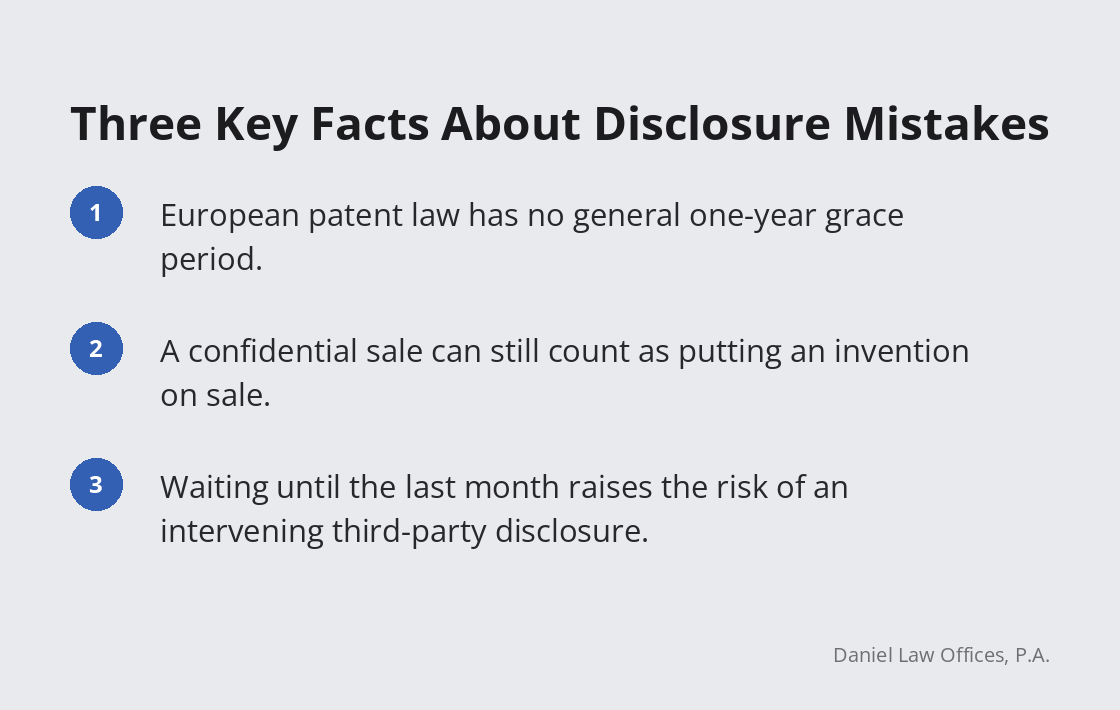
Other patent systems can be far less forgiving than the U.S. grace period, and Europe is a leading example. Under Article 54 of the European Patent Convention, the state of the art comprises everything made available to the public by means of a written or oral description, by use, or in any other way, before the date of filing of the European patent application, and under Article 89 a valid priority date counts as the filing date for that purpose. Article 55 excuses only disclosures made no earlier than six months before filing that resulted from an evident abuse in relation to the applicant or from display at certain officially recognized international exhibitions. An inventor who discloses first and files later in the United States may lose the chance to protect the invention in Europe. Our guide to foreign patent filing covers international planning in more depth.
Treating Confidential Sales as Safe
Commercial activity can trigger the on-sale bar even when it is not public. The MPEP notes that in Helsinn Healthcare S.A. v. Teva Pharmaceuticals USA, Inc., the Supreme Court held that Congress did not alter the meaning of on sale when it enacted the America Invents Act, and that an inventor’s sale of an invention to a third party who is obligated to keep the invention confidential can qualify as prior art under section 102(a). Sales or offers by the inventor that precede the effective filing date by less than one year may fall within the grace period exception, but a confidential supply deal, pilot agreement, or purchase order more than a year before filing can still create a serious problem.
Waiting Until the Last Minute
Inventors who know about the one-year window sometimes plan to file in month eleven. That approach leaves no room for error. A third party may independently publish similar work in the meantime, and as the MPEP explains, the shield for intervening disclosures applies only to the same subject matter the inventor previously disclosed. Calculating the deadline from the wrong event, or discovering an earlier demonstration no one recorded, can also shorten the time you thought you had. Filing as early as practical, even with a well prepared provisional, keeps the grace period available as a backup rather than a necessity.
Final Thoughts
The U.S. grace period is a valuable protection for inventors, but it is a narrow one. It covers your own disclosures for up to one year before your effective filing date, offers only limited protection against later third-party disclosures, and has only a narrow counterpart under the European Patent Convention. Confidential sales and offers can count against you as well, so commercial plans deserve the same attention as publicity.
The safest approach is to file before you disclose, describe your invention completely in that first application, and keep a careful record of every disclosure. When a disclosure has already happened, acting quickly preserves the most options at home and abroad.
If you’re preparing to launch, pitch, or demonstrate a new invention, contact Daniel Law Offices, P.A. to speak with our team in Orlando. We’ll review your disclosure timeline, explain your filing options, and help you protect your invention with confidence.