




A Comprehensive Patent Search: Key to Early IP Protection
Many inventors skip the patent search phase and jump straight to filing. This mistake costs thousands in rejected applications and wasted resources.
A comprehensive patent search in Orlando, Florida reveals what already exists in your field before you invest time and money. At Daniel Law Offices, P.A., we’ve seen how this single step transforms patent strategy from reactive to proactive.
Why Patent Searches Protect Your Bottom Line in Orlando, Florida
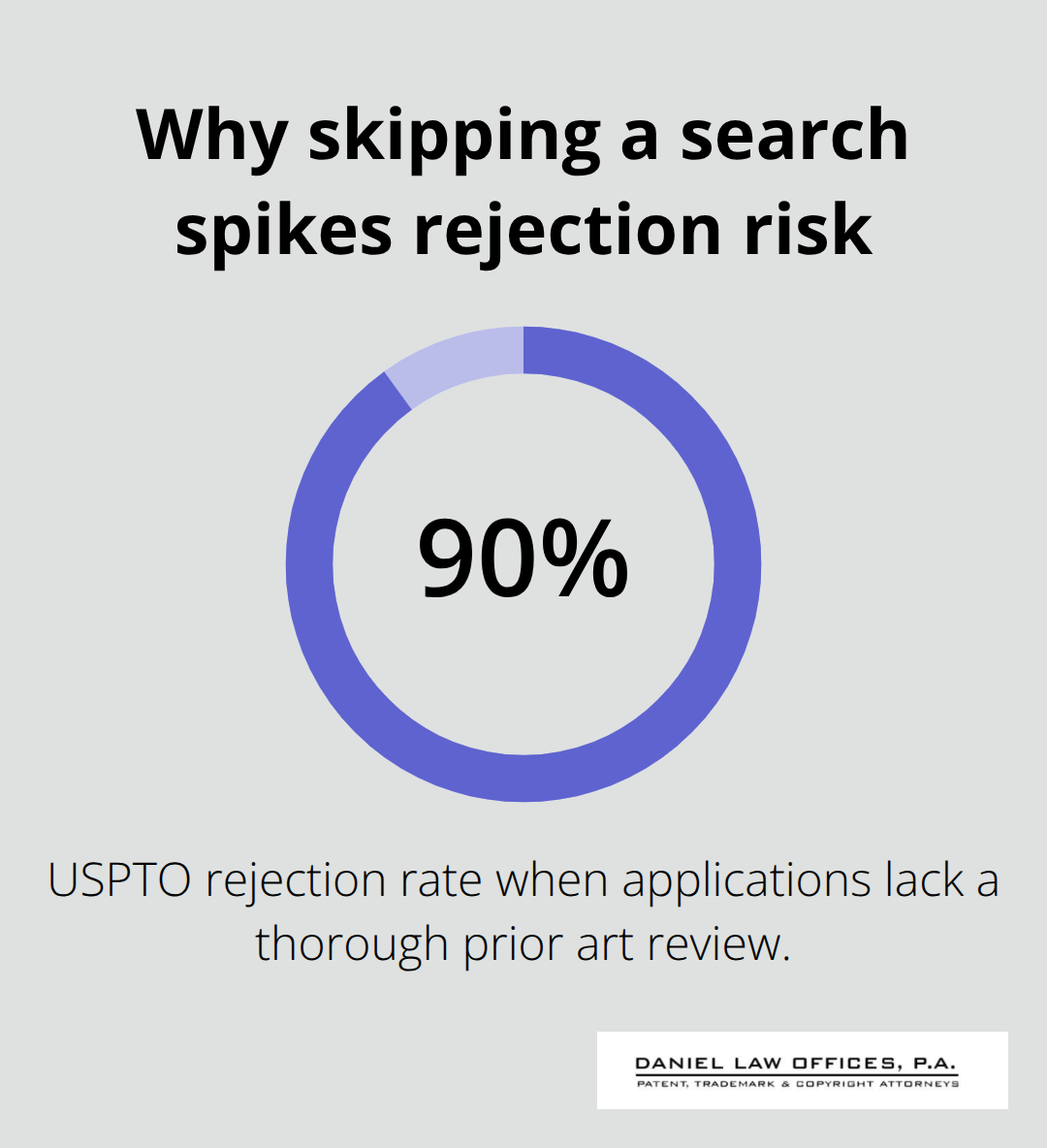
Skipping a patent search before filing costs money in ways most inventors don’t anticipate. The USPTO rejects roughly 90% of patent applications that lack a thorough prior art review, according to patent prosecution data. These rejections force you to pay additional examination fees, attorney time, and delays that stretch timelines by months or years.
A single rejected application can cost $3,000 to $5,000 in combined fees and legal work. A comprehensive search upfront costs far less and eliminates this risk entirely. We recommend conducting a search before filing your provisional or nonprovisional application because the cost of a quality search-typically $500 to $1,500 depending on complexity-pales compared to fixing a rejected application later. The USPTO Patent Public Search database and Espacenet offer free access to millions of patents and published applications. Starting there gives you visibility into what already exists in your technical space. If results overwhelm you or terminology differs across patents, that’s the moment to engage a patent attorney who can interpret findings and advise on patentability with confidence.
What Prior Art Really Means for Your Filing Strategy
Prior art includes any publicly available information that existed before your filing date, whether it’s a granted patent, a published application, or even a technical article in a trade journal. Finding prior art that closely matches your invention doesn’t automatically kill your patent prospects-it narrows what you can claim. A search often reveals that your broad product idea is less protectable than a specific workflow, system architecture, or manufacturing method within it. For example, if you’re building AI software, the general concept may have hundreds of prior patents, but the specific data pipeline or model-training approach might be novel and defensible. This distinction matters enormously when drafting claims. A weak search misses this nuance and leads to claims that examiners reject or that prove unenforceable in litigation. Espacenet’s classification system (CPC) is invaluable here because it lets you filter results by technology domain, making it easier to spot the technical features that genuinely differentiate your invention. The goal is not to find zero prior art-that’s unrealistic-but to understand the landscape so you file claims that survive examination and hold up if challenged.
Competitive Intelligence Hidden in Patent Data
A patent search reveals what competitors are protecting and where they’re investing R&D resources. If three major players hold patents in adjacent technology areas, you know the field is crowded and your filing strategy must be laser-focused on a narrow, defensible improvement. Conversely, if a technology area shows few recent patents, you may have a genuine gap to exploit. This competitive picture shapes decisions about where to file internationally. Filing in the US and Europe costs significantly more than the US alone, but if your search shows active patent portfolios in European companies’ hands, patent protection becomes essential to block them from copying your work. Forward and backward citation analysis-tracing which patents cite or are cited by a given document-reveals technology trends and shows which inventions influenced later developments. This intelligence helps you refine your own filing to target features that matter to the market, not just features that seem novel in isolation. A thorough search transforms your patent filing from a checkbox exercise into a strategic business decision rooted in real competitive data, positioning you to make informed choices about where to file and what claims to pursue next.
How to Actually Search Patents Like You Mean It
Start with the Right Database and Tools
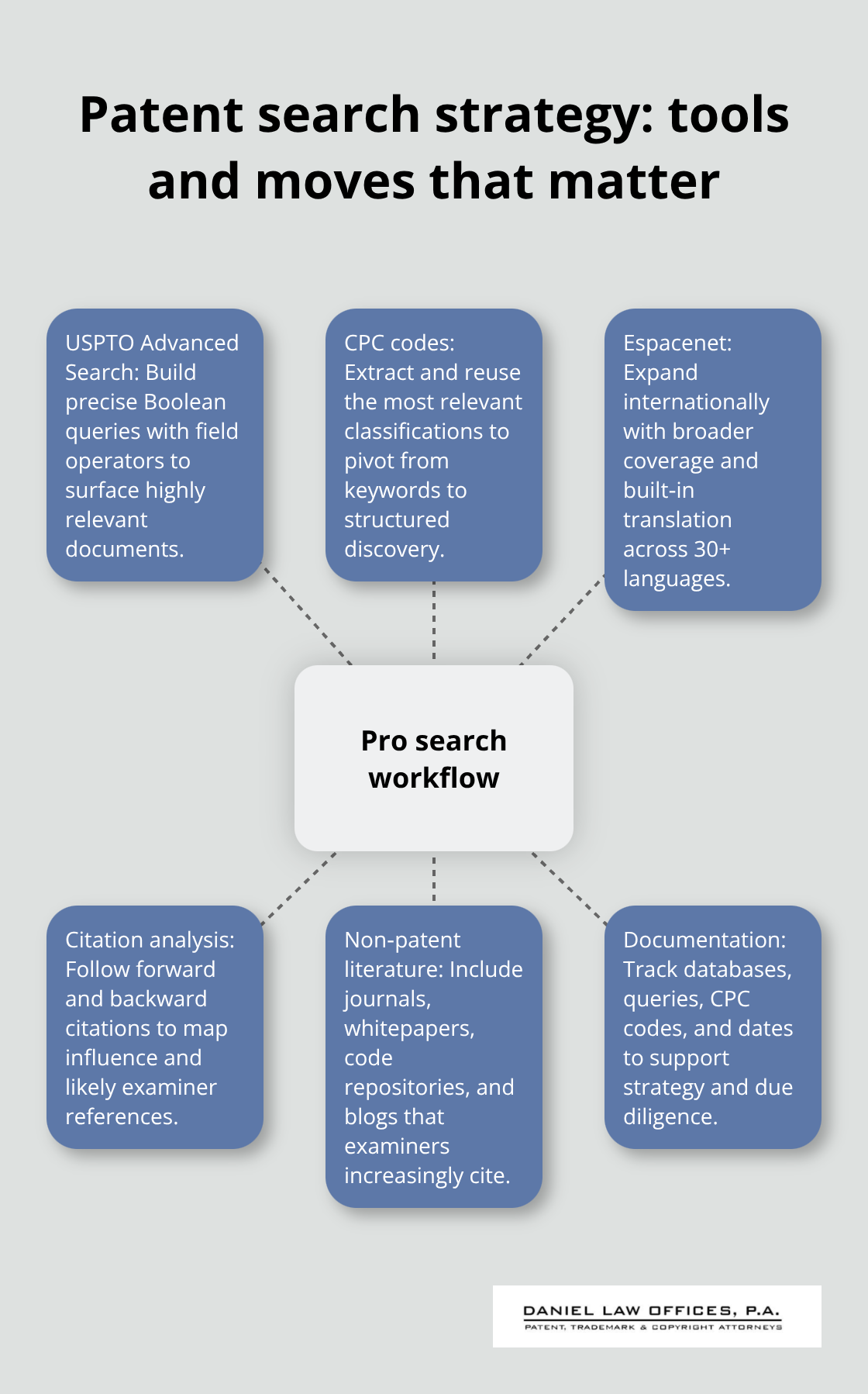
The USPTO Patent Public Search database outperforms Google Patents for serious searching. Google Patents indexes millions of documents, but the USPTO’s official tool provides precision controls that matter for thorough investigation. Use the Advanced search mode to build Boolean queries with field-specific operators that narrow results to your exact technical space. Search your core technical terms first, then extract the CPC classification codes that appear in relevant results. CPC codes act as the hidden lever that transforms a messy keyword search into a focused investigation. Once you identify three to five relevant CPC codes, switch to Espacenet and search those codes directly. Espacenet’s classification system covers international patents more completely than the USPTO’s system, and it handles 30 languages with built-in translation. This two-database approach catches prior art the USPTO alone might miss.
Target Your Technical Features, Not Your Product Name
Start narrow with your most distinctive technical feature rather than your product name. If you’re building AI software, search for the specific workflow or data pipeline, not AI itself. If you’re inventing a hardware component, search the materials, configuration, and function separately. Broad keyword searches return thousands of irrelevant results that waste hours of your time. Search forward and backward citations from your most relevant findings to reveal how technology evolved. If you find a patent that closely matches your invention, trace which patents it cites and which newer patents cite it. This citation chain shows what examiners will likely cite against you. The Lens and Google Patents both display these relationships clearly, making it straightforward to follow the thread.
Include Non-Patent Literature in Your Search
Non-patent literature matters more than most inventors realize for establishing what already exists. Trade journals, conference proceedings, and technical whitepapers all count as prior art that can affect your filing. If a startup published a blog post describing your exact feature before your filing date, that post can be cited against you during examination. Search relevant industry publications and GitHub repositories for software-related inventions. GitHub especially matters because many engineers share code publicly, and examiners increasingly cite open-source projects as prior art in their office actions.
Analyze Results and Document Your Process
Pull the top ten most relevant patents and create a simple spreadsheet noting the grant date, claims, and how closely each matches your invention. Does your invention improve on these patents, or does it overlap exactly? If overlap is significant, your claims must narrow to cover only the novel part. If the overlap is minimal, you have stronger patentability odds. Don’t assume granted patents are bulletproof; invalidity searches have invalidated many patents by uncovering prior art examiners missed during initial examination. Document which databases you searched, which keywords and CPC codes you used, and when you searched. This record helps your attorney draft a stronger application and proves you conducted due diligence if infringement questions arise later.
Interpret Your Findings for Strategic Filing
If your search uncovers dozens of active patents in your field, the landscape is crowded and your filing strategy must be surgical and narrowly focused. If you find few recent patents, you may have genuine white space, but verify by searching non-patent sources to confirm. The goal is not perfection but confidence that you understand what exists and where your true innovation sits. This understanding positions you to make informed decisions about claim scope and filing locations. With a clear picture of the competitive landscape, you’re ready to evaluate whether your invention warrants immediate filing or whether additional development could strengthen your position before you invest in formal patent protection.
Patent Search Mistakes That Cost You Money in Orlando, Florida
Google Patents Alone Leaves Critical Prior Art Hidden
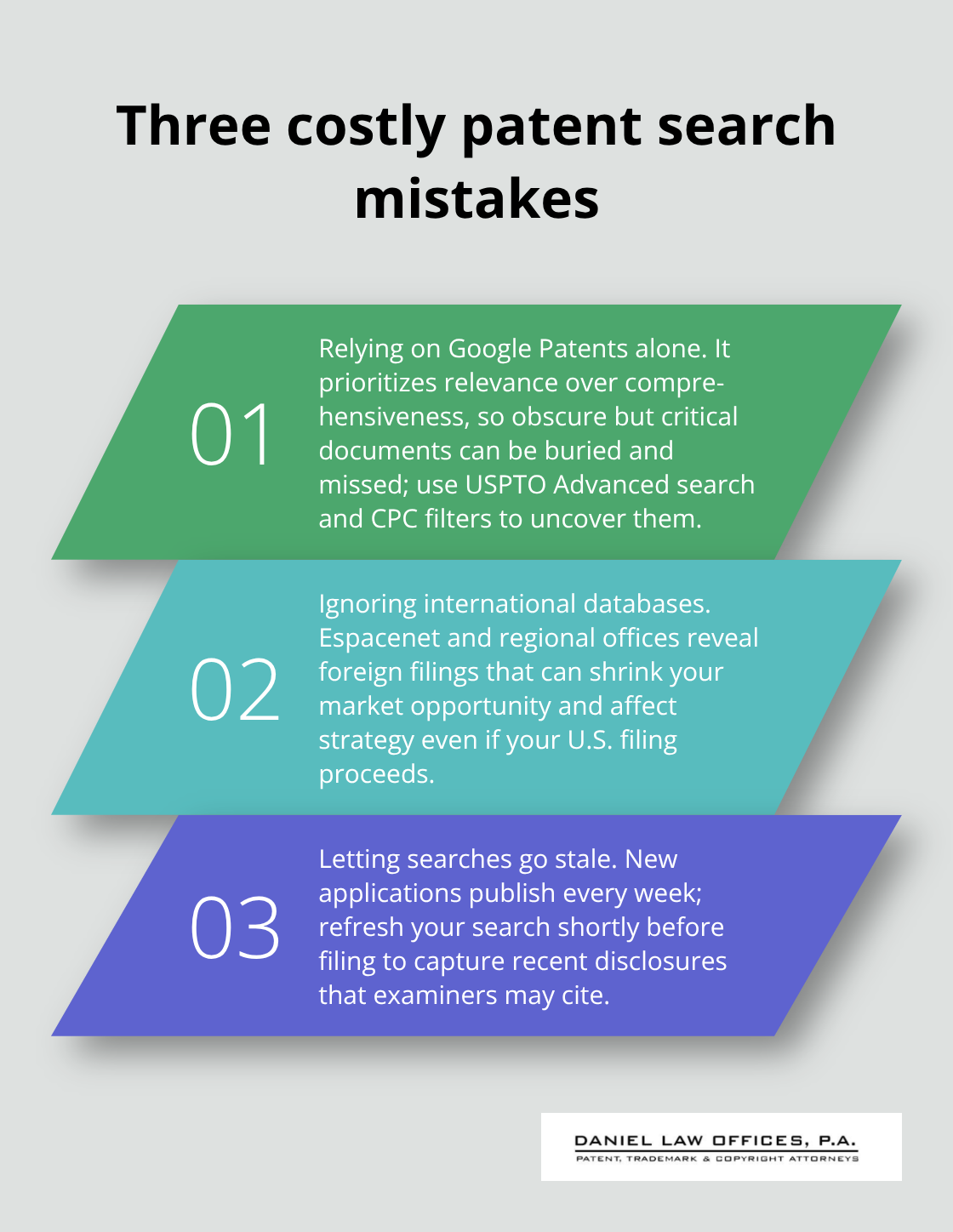
Most inventors rely exclusively on Google Patents because it feels fast and free, then wonder why their attorney later uncovers critical prior art they missed. Google Patents indexes a massive corpus dating back to 1790, but its search algorithm prioritizes relevance over comprehensiveness, meaning obscure but highly relevant patents often disappear into page ten or beyond. The USPTO Patent Public Search database returns different results because it uses precise field-specific operators and classification codes that Google’s general interface strips away. When you search the USPTO’s Advanced mode with a targeted CPC code, you catch patents that Google’s keyword matching completely misses.
Hundreds of applications have been filed where inventors believed their search was thorough until examiners cited patents the inventor never found. The cost difference between conducting a proper search upfront and fighting office actions later is staggering. A thorough search across the USPTO, Espacenet, and The Lens takes three to five hours and costs $500 to $1,500; a single office action rejection forces you to pay additional examination fees of $1,500 to $2,000 plus attorney time to respond.
Google Patents alone is insufficient because it lacks the classification filters that reveal related technology areas you might not have considered.
International Patents Create Blind Spots That Derail Filings
International patents represent another blind spot that derails filings constantly. If you file a US patent without searching the European Patent Office database or Japan’s INPIT, you may discover after filing that your invention is already patented abroad. This discovery doesn’t invalidate your US filing, but it signals that your market opportunity is smaller than you thought and that competitors already have protection in key jurisdictions.
The USPTO database contains only US patents and applications; Espacenet covers European, international, and many national patent offices in a single interface. If your invention has commercial potential in Europe or Asia, you must search those regions before filing anywhere. Failing to search internationally leaves you exposed to competitors who already hold foreign patents in your technology space.
Stale Searches Guarantee Missed Prior Art
Failing to update your search before submitting your application is equally dangerous. Patent applications publish eighteen months after filing, which means new prior art enters the system constantly. If you conducted a thorough search six months ago but delayed filing, you must search again before submitting your application. Examiners will cite patents that published between your search date and your filing date if those patents are relevant.
The USPTO sees roughly 600,000 patent applications annually; new disclosures appear in published applications every week. A stale search creates false confidence that your invention is patentable when newer prior art may have rendered your claims obvious or anticipated. Conduct your final search no more than two weeks before filing to capture the most recent publications and ensure your claims target genuine gaps in what already exists.
Final Thoughts
A comprehensive patent search protects your innovation far more effectively than filing without one. Inventors who invest time upfront understanding what already exists prevent rejected applications, wasted legal fees, and the frustration of discovering too late that your claims overlap with prior art. The cost of a thorough search remains negligible compared to fixing problems after filing or defending a weak patent in litigation.
Your patent application strength depends entirely on the search that precedes it. When you understand the competitive landscape, you draft claims that examiners approve and that hold up if challenged. You identify the technical features that genuinely differentiate your invention from what competitors already protect, and you make informed decisions about where to file internationally and whether your invention warrants immediate filing.
We at Daniel Law Offices, P.A. help inventors and businesses conduct thorough patent searches and guide them through the entire patent prosecution process. A registered patent attorney interprets search results, identifies the technical improvements that matter most, and positions your application for approval. Contact us today to start your comprehensive patent search and protect your innovation with confidence.