




Patent Search Best Practices: Maximizing Novelty and Freedom to Operate
Most inventors skip patent searches and rush straight to filing. This mistake costs thousands of dollars and months of wasted development time.
At Daniel Law Offices, P.A., we’ve seen countless innovators discover blocking patents only after investing heavily in their ideas. A thorough patent search reveals what already exists, protects your freedom to operate, and saves you from costly legal battles down the road.
Why Search Before You File
A patent search isn’t optional-it’s the foundation of smart IP strategy. Without one, you risk pouring resources into an idea that someone else already owns or that lacks novelty. The USPTO receives over 600,000 patent applications annually, and a significant portion face rejection because applicants failed to identify existing prior art. Searching early reveals whether your invention is actually new and whether third-party patents could block your commercialization plans. This distinction matters enormously. A patentability search answers whether you can obtain a patent grant. A freedom-to-operate search answers whether you can sell your product without infringing someone else’s patent rights. These are fundamentally different questions, and skipping either one leaves you exposed to substantial financial and legal risk.
The Cost of Skipping This Step
Most inventors underestimate the damage a missed blocking patent causes. Average patent litigation costs reach into the millions, with median damages around $8.7 million according to recent litigation data. If you launch a product and then discover a blocking patent, you face three brutal options: stop selling immediately, pay licensing fees retroactively, or mount an expensive validity challenge. All three scenarios drain cash and momentum. A comprehensive patent search costs between $50,000 and $150,000 for a formal opinion, which sounds substantial until you compare it to the cost of designing around a blocking patent after launch or defending infringement litigation. Early identification of genuine threats allows design changes when they remain feasible and inexpensive.
Mapping Your Competitive Reality
Patent searches reveal far more than blocking patents. They show you who dominates your technology space, what features competitors protect, and where innovation gaps exist. Searching backward and forward through patent citations uncovers entire families of related patents you might otherwise miss. A single keyword search often captures only 40 to 60 percent of relevant prior art, which is why multiple databases and search strategies are non-negotiable. Espacenet provides access to over 140 million patent publications worldwide, while the USPTO’s Patent Public Search and Google Patents offer free entry points. Commercial platforms like Derwent and Orbit add structure and citation analysis that free tools cannot match. The patent landscape in your field likely contains dozens of relevant patents (some recent grants, some expiring soon, some held by competitors, and some held by patent assertion entities). Understanding this landscape before you file shapes everything from claim drafting strategy to market-entry timing.
What Your Search Results Actually Tell You
Patent data reveals competitive positioning and technology trends that inform your next moves. Forward citations show which newer patents build on earlier work, signaling where the field is heading. Backward citations expose the foundational prior art that shaped existing patents. This citation network often uncovers blocking patents that keyword searches alone would miss.
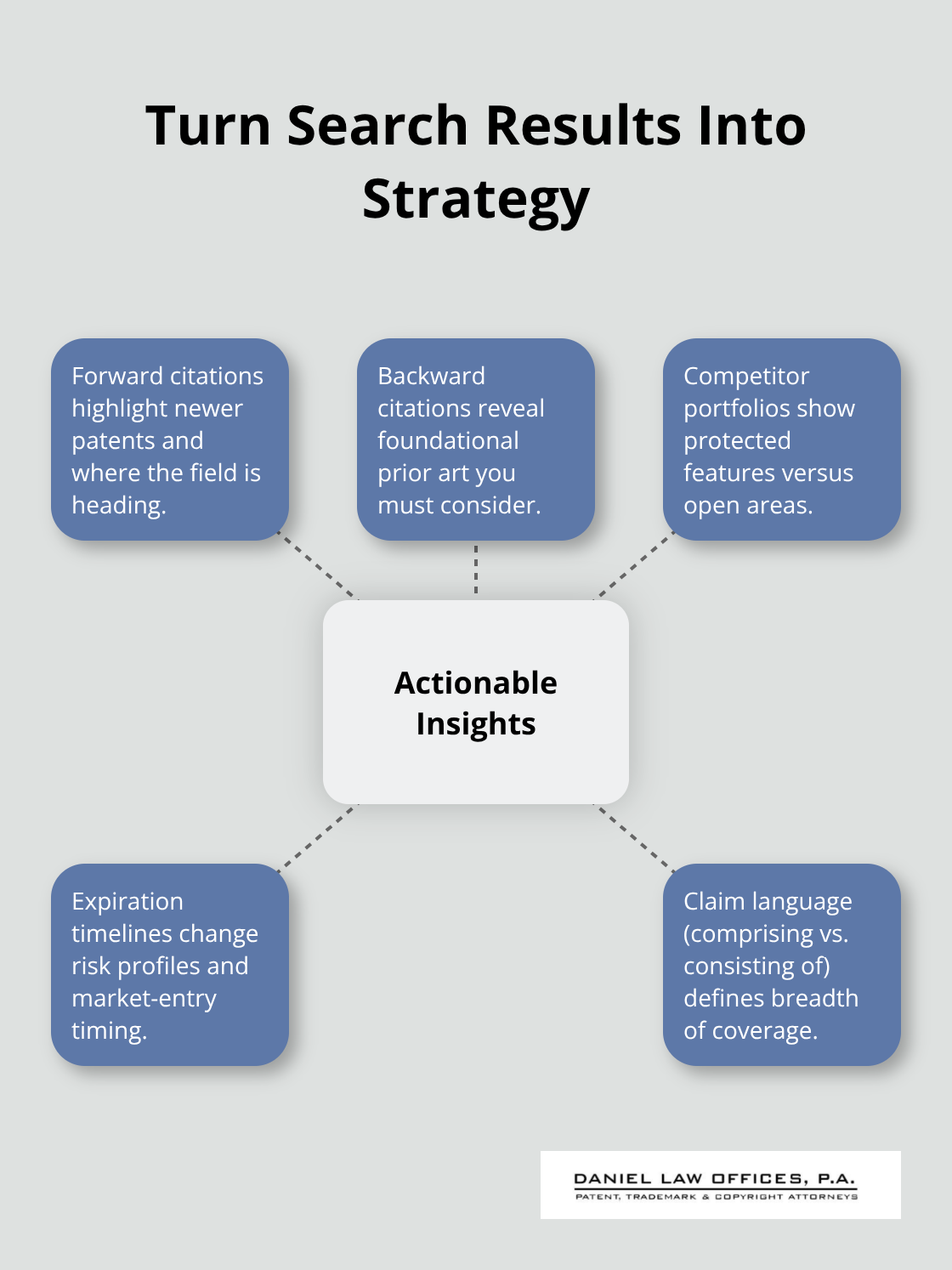
Competitor portfolios tell you which features they’ve chosen to protect and which they’ve left open. Patent expiration dates matter too-a blocking patent expiring in two years creates a different risk profile than one with fifteen years remaining. Analyzing claim language (particularly whether claims use “comprising” versus “consisting of”) determines how broadly a patent covers your product. These details transform raw search results into actionable intelligence for your development and filing strategy.
How to Build a Search Strategy That Actually Works
Define Your Invention With Precision First
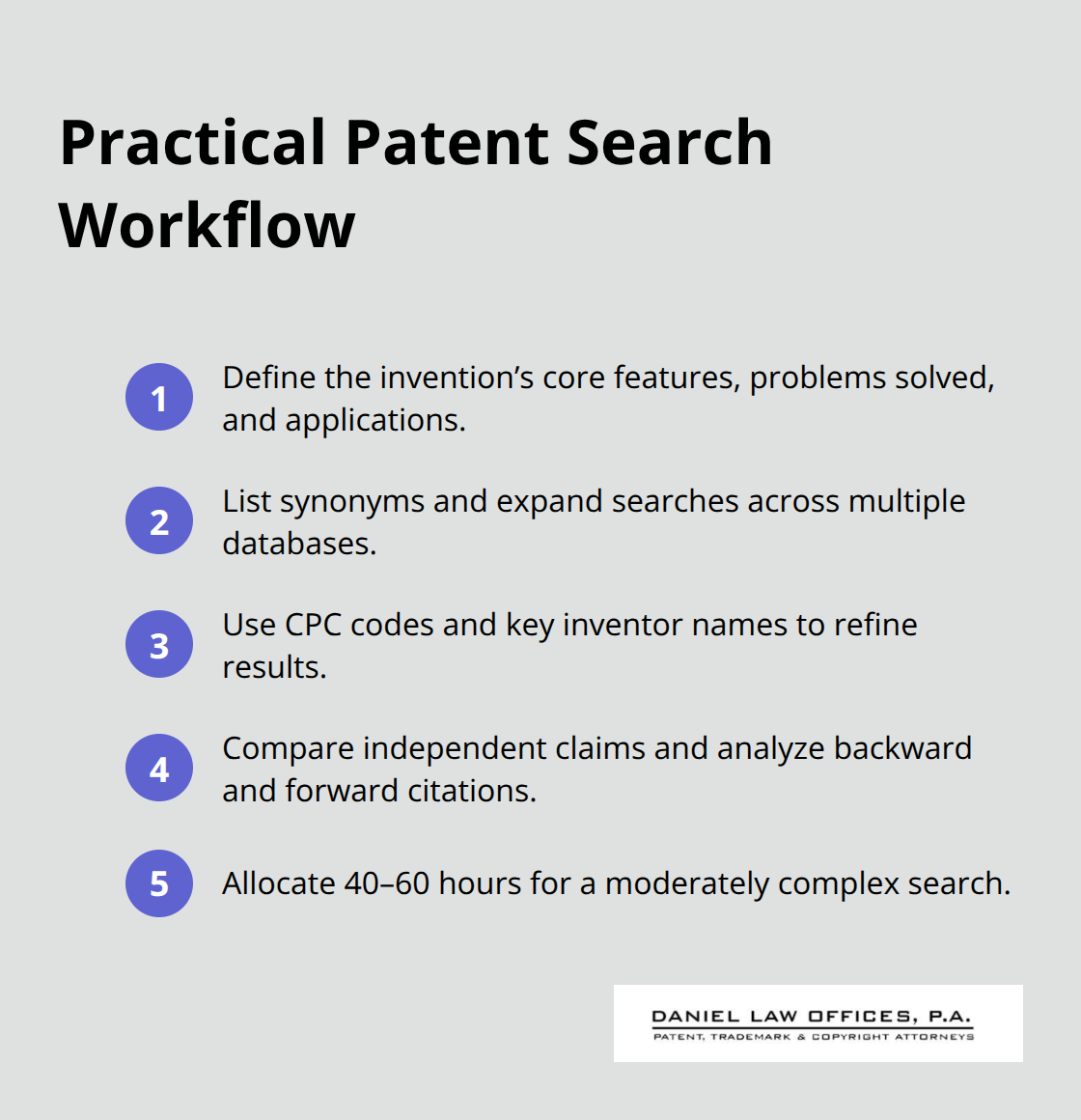
A patent search without structure wastes time and misses critical prior art. Start by defining your invention with precision before you touch a database. Document the core technical features, the problem it solves, the materials or processes involved, and the intended application. For a pharmaceutical compound, this means capturing the molecular structure, salt forms, polymorphs, formulation details, and route of synthesis. For a medical device, it means documenting the functional components, materials, assembly method, and intended use. This Technology Document becomes your search roadmap and prevents keyword drift as you move between databases.
Vague or overly broad searches return thousands of irrelevant results; precise searches return manageable result sets where signal outweighs noise.
Expand Your Search Across Multiple Databases and Synonyms
Next, brainstorm all the synonyms and alternative phrasings for your key features. If your invention involves a sunshade mechanism, search for umbrella, parasol, shade device, and similar terms across multiple databases simultaneously. Free databases like Google Patents and the USPTO Patent Public Search provide entry points but capture only a fraction of global patent activity. Espacenet accesses over 140 million publications worldwide and includes patents from countries where your competitors may file. Commercial platforms like Derwent and Orbit add backward and forward citation networks that reveal entire patent families a keyword search would miss. Starting with free tools scopes the landscape, then supplementing with at least one commercial platform ensures comprehensive coverage. The difference between a 60 percent coverage search and a 95 percent coverage search often determines whether you identify blocking patents before launch.
Use Classification Codes and Inventor Names to Narrow Results
Classification codes and inventor names dramatically narrow or expand your results depending on your strategy. The Cooperative Patent Classification system organizes patents into technology hierarchies; searching by CPC code rather than keywords alone captures patents using different terminology but covering the same technical space. For example, a search for heart valve designs might miss relevant prior art if you rely only on the term valve; adding CPC codes for cardiovascular devices pulls in patents using alternative terminology that a keyword-only approach overlooks. Inventor name searches work best when you know which individuals or organizations dominate your field; competitor patent portfolios often list the same inventors repeatedly, signaling where innovation concentrates.
Analyze Claims and Citation Networks for Blocking Patents
Once you have preliminary results, the real work begins: reviewing claims, not specifications. Patent claims define the legal scope of protection, and a patent with broad claims poses greater blocking risk than one with narrow claims. Compare the independent claims in relevant patents against your invention feature-by-feature; if your product contains every element of an independent claim, infringement risk exists regardless of how the patent specification describes the invention. Forward citations reveal which newer patents build on earlier work and whether blocking patents have been challenged or invalidated at the Patent Trial and Appeal Board. Backward citations expose foundational prior art and often surface patents that keyword searches alone would miss. This citation network analysis typically adds 20 to 30 percent more relevant patents to your final risk assessment.
Plan Adequate Time for Thorough Analysis
Plan for at least 40 to 60 hours of search and analysis work for a moderately complex invention; the complexity of your technology, the breadth of your target markets, and the density of existing patents in your field determine the actual time required. Once you’ve mapped the patent landscape and identified your highest-risk blocking patents, the next step involves assessing whether those patents actually threaten your commercialization plans-a process that requires careful claim interpretation and legal analysis.
Common Patent Search Mistakes That Cost Money
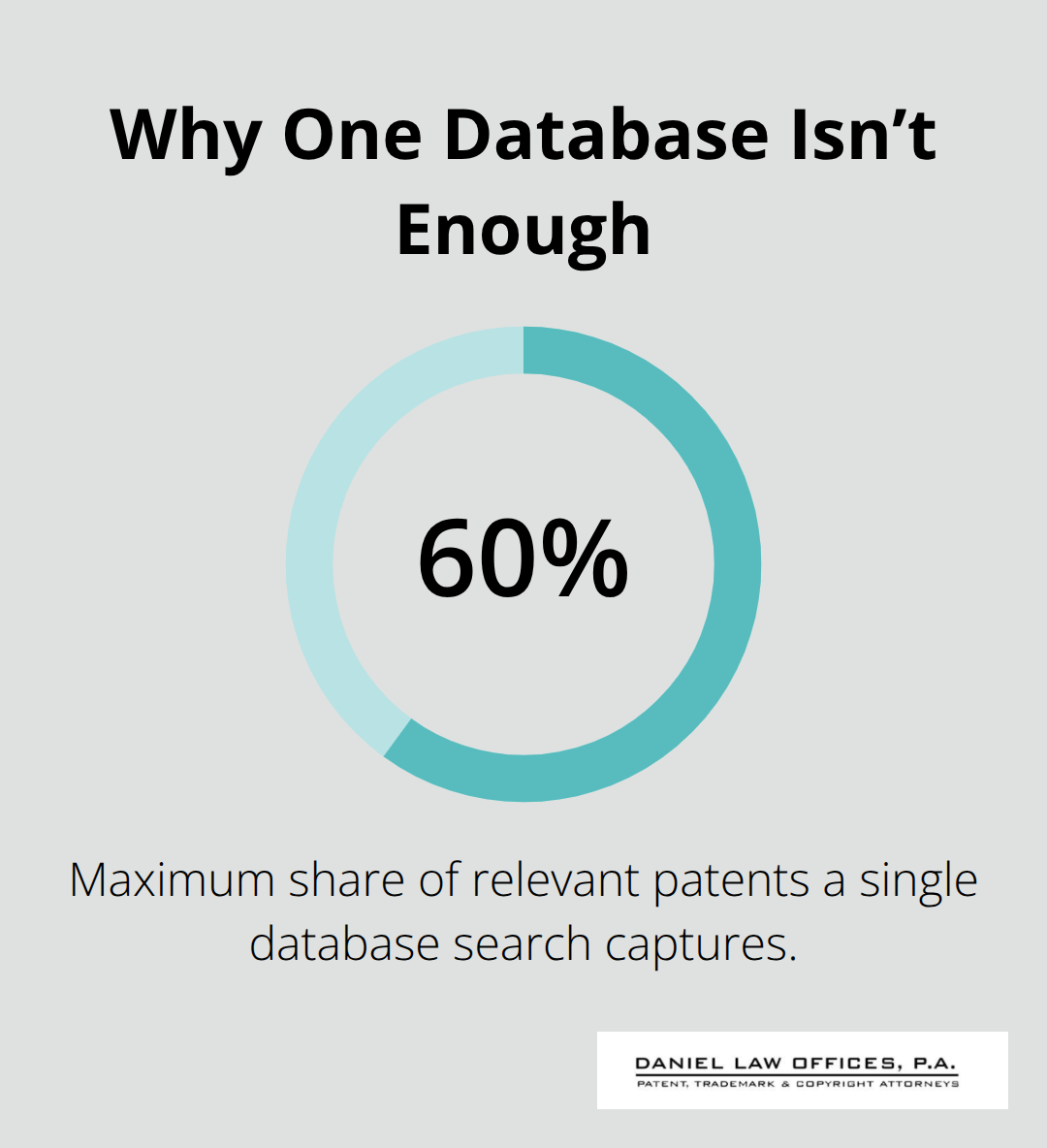
Most patent searches fail not because the databases are bad, but because searchers rely on incomplete methods that miss critical prior art. A single database search captures at most 60 percent of relevant patents in your technology space, yet many inventors treat one search result as conclusive. The USPTO, Espacenet, Google Patents, and commercial platforms like Derwent each index different patent families and use different classification systems.
Searching only the USPTO misses European patents that could block your product in key markets. Searching only Espacenet misses recent USPTO grants that haven’t yet been indexed elsewhere. A pharmaceutical company searching only for molecular structure terms will miss process patents covering the same compound made through different synthesis routes, even though both patents cover the same final product. Clients who conduct multi-database searches identify 30 to 40 percent more blocking patents than those who rely on a single platform. The time investment to search across three to four databases adds only 15 to 20 hours to your project timeline, yet the risk reduction is substantial.
Misinterpreting Claims Over Specifications
Another critical error involves treating patent claims as secondary to the specification. Claims define legal scope; specifications provide context but do not determine infringement. A patent specification might describe ten different embodiments of a sunshade design, but the independent claims might cover only three of those embodiments. If your product falls outside the claimed scope, infringement risk drops significantly. Many inventors misread claim language and incorrectly conclude that broad specifications mean broad patent protection. Transitional phrases matter enormously: a claim using “comprising” allows additional elements beyond those listed, while “consisting of” excludes additional elements entirely. A medical device patent claiming a stent comprising a metal frame and polymer coating covers your device even if you add a drug coating, because “comprising” permits additions. The same patent with “consisting of” would not cover your device.
Ignoring International Patent Databases
Skipping international patent databases creates blind spots that surface only after you’ve invested in development. China’s SIPO patent office has issued over 3 million patents in recent years, and many cover technologies relevant to Western markets. Japan’s JPO similarly holds millions of patents in pharmaceuticals, electronics, and manufacturing that never appear in English-language searches. If you plan to commercialize your product in Asia or Europe, limiting your search to US patents alone leaves you exposed to blocking patents you never evaluated. A freedom-to-operate analysis that covers only the USPTO and misses a granted European patent creates false confidence about market-entry timing.
Missing Forward Citation Networks
Forward citation analysis represents another frequent failure point. Many searchers identify relevant patents but stop there, missing the entire network of later patents that cite them. A patent granted in 2015 might have been cited by twelve newer patents issued between 2018 and 2024. Those newer patents often contain improved designs or broader claims that pose greater blocking risk than the original patent. Forward citations also reveal which patents have been challenged at the Patent Trial and Appeal Board, allowing you to assess whether a blocking patent’s validity remains solid or has been weakened by prior invalidation decisions. Neglecting this step means you might design around a patent that a competitor has already invalidated through an IPR proceeding, wasting engineering resources on a non-blocking patent.
Allocating Insufficient Time for Thorough Analysis
Time pressure frequently drives search shortcuts that undermine results. Allocating only ten to fifteen hours for a comprehensive search guarantees you’ll miss relevant prior art. The complexity of your invention and the density of existing patents in your field determine realistic timelines; a moderately complex invention typically requires forty to sixty hours of search and analysis work. Rushing through databases to meet an arbitrary deadline produces incomplete results that feel conclusive but contain hidden gaps. These gaps surface months or years later when a blocking patent emerges during product development or after launch.
Final Thoughts
A patent search before filing protects your investment and clarifies your freedom to operate in ways that keyword searches alone cannot achieve. The cost of skipping this step reaches into millions when blocking patents surface after product launch, forcing you to redesign, license retroactively, or defend litigation. Patent search best practices demand multiple databases, careful claim analysis, and adequate time for thorough evaluation, separating inventors who move forward with confidence from those who discover fatal flaws only after substantial investment.
The complexity of modern patent landscapes makes professional guidance invaluable, as citation networks, international databases, classification codes, and claim interpretation require knowledge that extends beyond running basic searches. We at Daniel Law Offices, P.A. guide clients through comprehensive patent searches that identify blocking patents, map competitive positioning, and reveal technology gaps in your field. Our registered patent attorney helps you interpret search results, assess infringement risk, and develop filing strategies that account for what already exists in the patent system.
Conduct your search now, before you file, before you invest heavily in development, and before you commit to market-entry timelines. A thorough patent search protects your innovation and accelerates your path to commercialization. Contact Daniel Law Offices, P.A. to begin your comprehensive patent search and secure your innovation with confidence.