




Comprehensive Patent Search: A Practical Guide for Inventors
Most inventors skip the patent search phase entirely, assuming their idea is unique. This assumption costs thousands in filing fees and months of wasted time when the USPTO rejects applications based on existing patents.
A comprehensive patent search reveals what’s already protected before you invest in your application. At Daniel Law Offices, P.A., we’ve seen how this single step separates inventors who succeed from those who face expensive rejections and dead ends.
Why Patent Searches Save Money in Orlando, Florida
Skipping a patent search before filing amounts to gambling with thousands of dollars. Over 92% of patent applications receive at least one rejection from the USPTO, and many of those rejections stem from prior art that a thorough search would have uncovered.
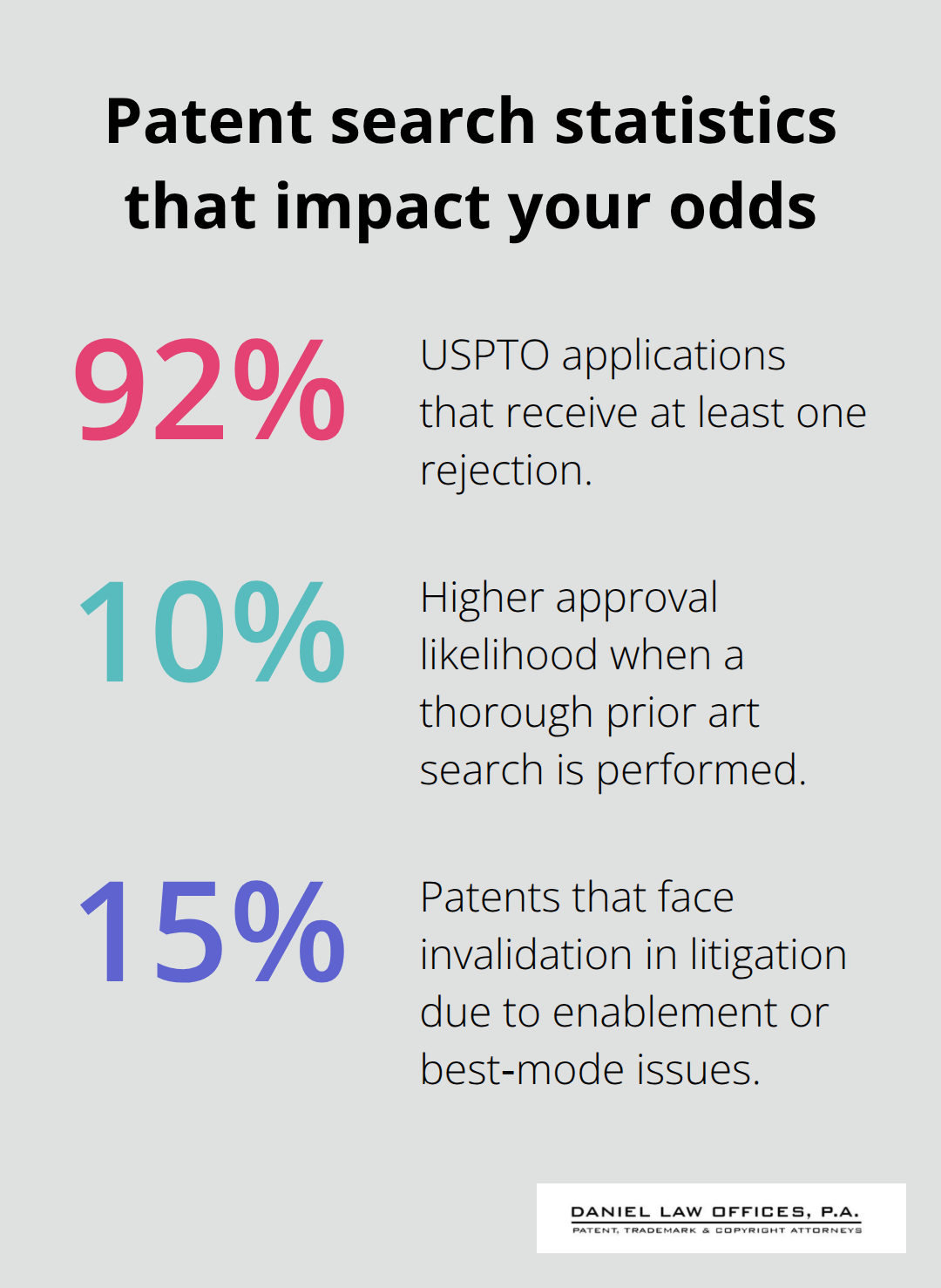
A professional prior art search costs between $1,000 and $3,000, yet USPTO data shows that thorough searches correlate with about a 10% higher likelihood of approval. Compare that to the $10,000 to $20,000 you’ll spend on attorney-drafted applications and the $8,000 to $25,000 in total prosecution expenses, and the math becomes obvious: investing in a search upfront prevents far costlier mistakes down the line. When the USPTO cites prior art during examination, you face two painful options: narrow your claims so much that the patent becomes worthless, or abandon the application entirely and lose your filing fees.
What Prior Art Actually Costs You
The USPTO’s Patent Public Search tool and the Official Gazette, published weekly, reveal thousands of issued patents and published applications that could block your invention. A single prior patent disclosing all elements of your invention kills patentability instantly. You need absolute novelty in many jurisdictions for global protection, meaning even one overlooked reference can derail your entire protection strategy. International databases like Espacenet for European patents and Patentscope for international filings add layers of complexity that DIY searches typically miss, yet they remain free to access. The competitive landscape matters too: understanding what competitors have already patented tells you exactly where you can operate safely and where you face infringement risk before you manufacture or commercialize anything.
The Real Cost of Incomplete Searches
Surface-level searches miss critical prior art hiding in non-patent literature, code repositories, and open-source projects (especially for software or hardware inventions). Professional searches examine USPTO classifications, assignment records through the Assignment Center, and international patent families using Global Dossier and the IP5 Common Citation Document. About 15% of patents face invalidation in litigation due to inadequate enablement or failure to disclose the best mode-problems a comprehensive pre-filing search helps you avoid by clarifying exactly what distinguishes your invention. Without this foundation, you file blind, hoping the examiner doesn’t find what you missed.
Why Professional Searches Matter
A patent attorney in Orlando, Florida can conduct novelty searches that assess patentability by identifying existing patents and publications, plus freedom-to-operate searches that evaluate infringement risks before you invest in manufacturing. These searches protect your interests and maximize your commercial potential. The difference between a surface-level search and a professional one often determines whether your application succeeds or fails during examination.
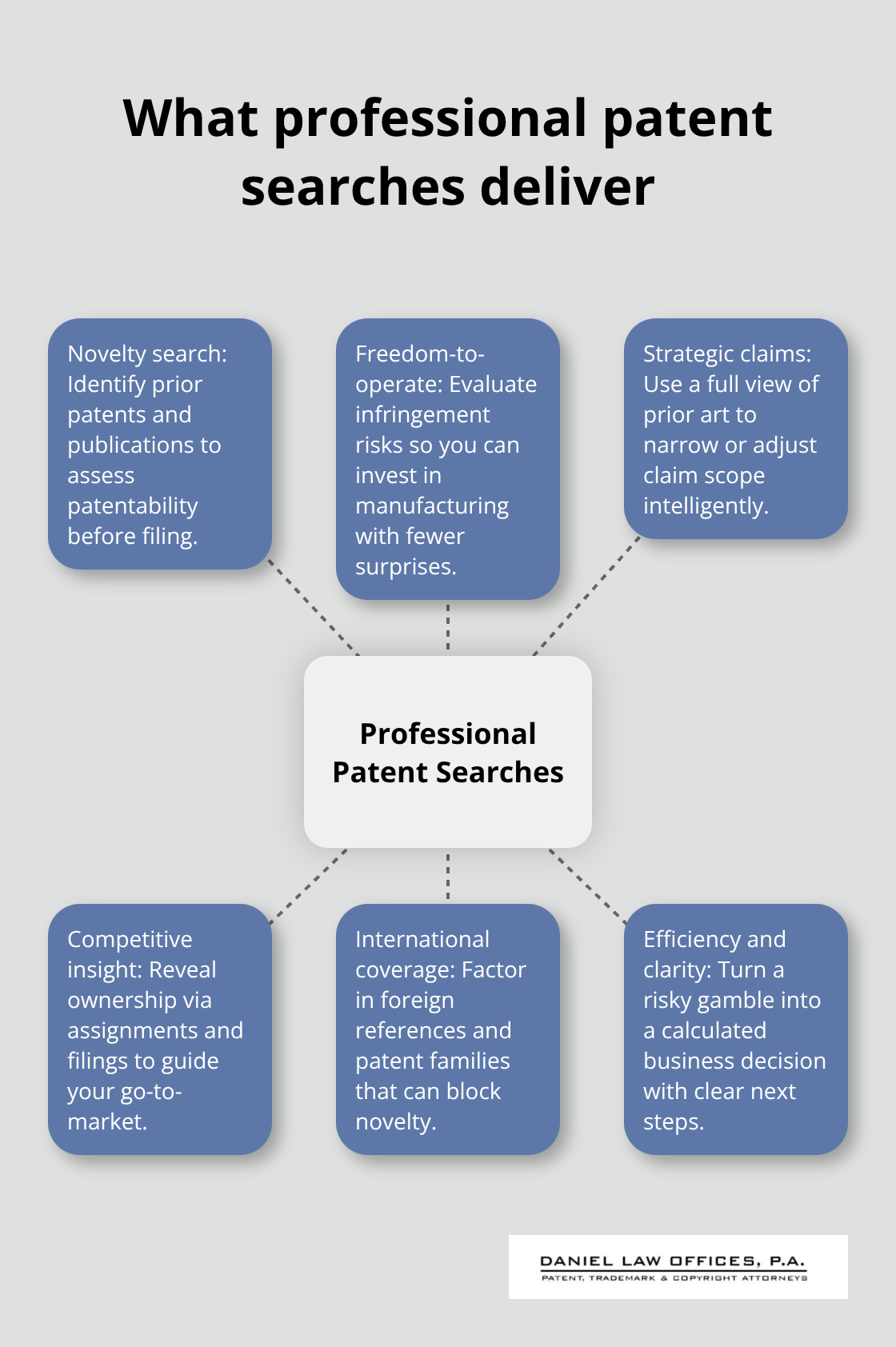
Understanding the full landscape of prior art positions you to make informed decisions about whether to proceed, how to narrow your claims strategically, or whether to pivot your invention entirely. This clarity transforms patent protection from a risky gamble into a calculated business investment.
How to Actually Find What’s Already Patented
Start with the Right Tools
The USPTO Patent Public Search tool beats Google or general search engines every time. Patent Public Search contains issued patents and published applications spanning decades, and it costs nothing to access. When you open Patent Public Search, search by keyword first to understand what exists in your field, then shift immediately to the Cooperative Patent Classification system to narrow your results by technology area. The CPC system (developed jointly by the USPTO and the European Patent Office) organizes patents into specific classifications so you find exactly what matters to your invention rather than wading through thousands of irrelevant results. Once you identify relevant CPC classifications, retrieve both issued patents and published applications in those categories. Published applications matter because they represent inventions that received patent protection even though the patent hasn’t issued yet, and they can still block your novelty.
Expand Your Search Across Multiple Sources
Check the Official Gazette, published weekly by the USPTO, to catch the most recent patent activity in your field. For software, hardware, or combined inventions, expand beyond patent databases into non-patent literature and code repositories like GitHub, since open-source projects and published code count as prior art and examiners will find them. International databases like Espacenet (for European patents) and Patentscope (for international filings) add coverage that DIY searches often skip entirely, yet both remain free to access.
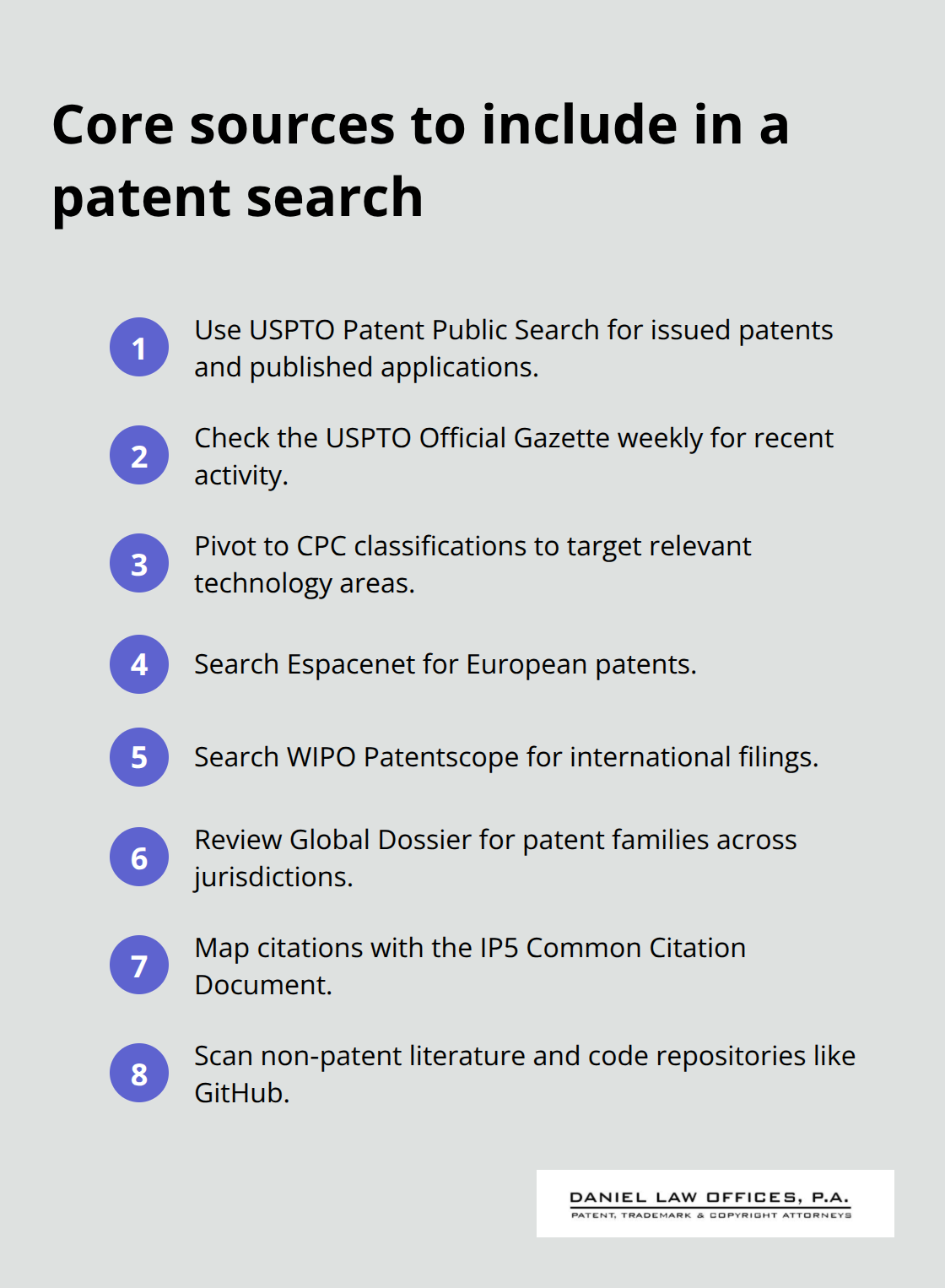
If you want to understand the full competitive landscape, use Global Dossier to see patent families across multiple jurisdictions and the IP5 Common Citation Document to map how patents cite each other, revealing the citation networks examiners use when evaluating your application.
Interpret Results with Honesty and Precision
A single prior patent that discloses all elements of your invention kills patentability instantly, so don’t rationalize away references that seem close. Look at the patent claims, not just the title or abstract, because claims define what the patent actually protects. If a prior patent’s claims cover your core innovation, your application faces rejection unless you can distinguish your invention with clear technical differences. This is where most DIY searches fail: inventors find a somewhat similar patent and convince themselves it’s different enough, then face harsh rejections months later when the examiner disagrees. Track the assignment history of relevant patents using the USPTO Assignment Center to understand who owns competing intellectual property in your space, which informs your freedom-to-operate risk and competitive strategy.
Prepare for What Comes Next
The first Office Action from the USPTO arrives roughly 16 to 20 months after filing, and when it cites prior art you missed during your search, your options narrow dramatically. You can amend claims to escape the cited references, present legal arguments distinguishing your invention, or request an examiner interview to discuss the rejection. A thorough upfront patent search prevents this painful position by forcing you to confront the competitive reality before you invest in filing. This foundation positions you to make informed decisions about claim scope and whether your invention can survive examination-or whether a patent attorney should help you evaluate your protection strategy before you move forward.
Common Mistakes Inventors Make During Patent Searches in Orlando, Florida
Surface-Level Searches Miss Critical Prior Art
Most inventors conduct searches that cover only the USPTO database with a handful of keywords, then assume they’ve completed due diligence. This approach fails catastrophically. When you search only issued patents and applications through Patent Public Search with basic keyword queries, you overlook published applications that haven’t issued yet, international patents filed through WIPO or the European Patent Office, and non-patent literature like academic papers, technical documentation, or open-source code repositories. For software and hardware inventions, this omission proves fatal. Examiners will find what you missed, and your application collapses under rejections citing references you never encountered during your search. A comprehensive search must span USPTO Patent Public Search for issued patents and applications, the Official Gazette for weekly updates on recent activity, Espacenet for European patents, Patentscope for international filings, and non-patent literature specific to your technology area. Anything less leaves you exposed.
Mishandling the Cooperative Patent Classification System
Inventors either skip the Cooperative Patent Classification system entirely and rely on keyword searches alone, or they identify one CPC classification, pull patents from that category, and call their search complete. This approach fails because a single invention often spans multiple CPC classifications. A medical device might fall under both therapeutic applications and manufacturing processes. Software inventions cross hardware and data processing classifications. If you search only one classification, you miss competitors operating in adjacent technology areas. The solution requires identifying all relevant CPC classifications before you retrieve patents, then systematically reviewing both issued patents and published applications within each classification. The USPTO and European Patent Office jointly developed the CPC system specifically to harmonize patent classification across jurisdictions, so mastering it directly improves your search quality and prevents the narrow-vision mistakes that plague DIY searches.
Ignoring International Patents and Publications
Many inventors believe that if a patent doesn’t exist in the United States, their invention is safe to file. This assumption is dangerously wrong. An invention patented in Europe, Japan, or China still counts as prior art for novelty purposes under international patent law. Absolute novelty is required in most jurisdictions, meaning even one foreign reference can block your protection. Global Dossier consolidates patent family information from IP5 offices (the USPTO, EPO, JPO, KIPO, and WIPO), showing you how a single invention has been protected across multiple countries. If you skip this step, you file blindly into a landscape you haven’t actually mapped. Foreign patent searches reveal the full competitive reality before you commit to filing and spending thousands on prosecution expenses.
Final Thoughts
A comprehensive patent search transforms your invention from an uncertain idea into a calculated business decision. You now understand that skipping this step costs thousands in rejected applications and wasted prosecution time, while investing $1,000 to $3,000 upfront correlates with roughly 10% higher approval rates. The tools exist and most are free: Patent Public Search, the Official Gazette, Espacenet, Patentscope, and Global Dossier give you access to the same prior art landscape that USPTO examiners will examine.
After you complete your search, you face a clear choice. If your results show no blocking prior art and your invention appears genuinely novel, you can move forward with confidence toward filing. If you discover existing patents that closely resemble your invention, you can pivot your design, narrow your claims strategically, or decide whether the patent is worth pursuing at all-this clarity prevents the painful scenario of filing blindly, only to receive rejections 16 to 20 months later.
Most inventors benefit from professional guidance at this stage. A patent attorney in Orlando, Florida can conduct novelty searches that assess patentability, perform freedom-to-operate searches that evaluate infringement risks before manufacturing, and help you interpret results with the precision that DIY searches lack. Contact us to discuss your invention and determine whether professional patent protection makes sense for your situation.