




Trademark Registration Advantages: Why Register Your Brand
Your brand is one of your most valuable business assets. Without trademark registration, competitors can copy your name, logo, or slogan-leaving your market position vulnerable.
At Daniel Law Offices, P.A., we help Orlando, Florida business owners understand the trademark registration advantages that come with formal protection. Registered trademarks give you legal ownership, prevent infringement, and create opportunities to license or franchise your brand. This guide walks you through why registration matters and how to get started.
What Federal Trademark Registration Actually Protects in Orlando, Florida
Federal trademark registration grants you exclusive rights across the entire United States to use your brand name, logo, slogan, or other distinctive mark on the goods or services you’ve registered. The USPTO places your mark in a public database that serves as nationwide notice of ownership, meaning competitors cannot claim ignorance if they attempt to use something similar. According to the USPTO, this registration creates a legal presumption of ownership that dramatically simplifies infringement cases-you no longer have to spend time and money proving you own the mark in court. The presumption applies to the mark’s validity, your exclusive right to use it nationwide, and your continuous use since the filing date.
Why the First Five Years Matter Most
The first five years after registration establish what the USPTO calls incontestable status. Once you maintain continuous use for five years after registration and file the required maintenance document, your mark becomes significantly harder to challenge. At this point, competitors cannot claim your mark is merely descriptive or too similar to their earlier mark. This incontestability status proves powerful because it eliminates some of the most common arguments used against trademark owners in disputes. You should document your actual use in commerce during these five years through invoices, advertising materials, and product packaging-this evidence becomes your shield against future challenges.
Enforcement Tools That Come with Registration
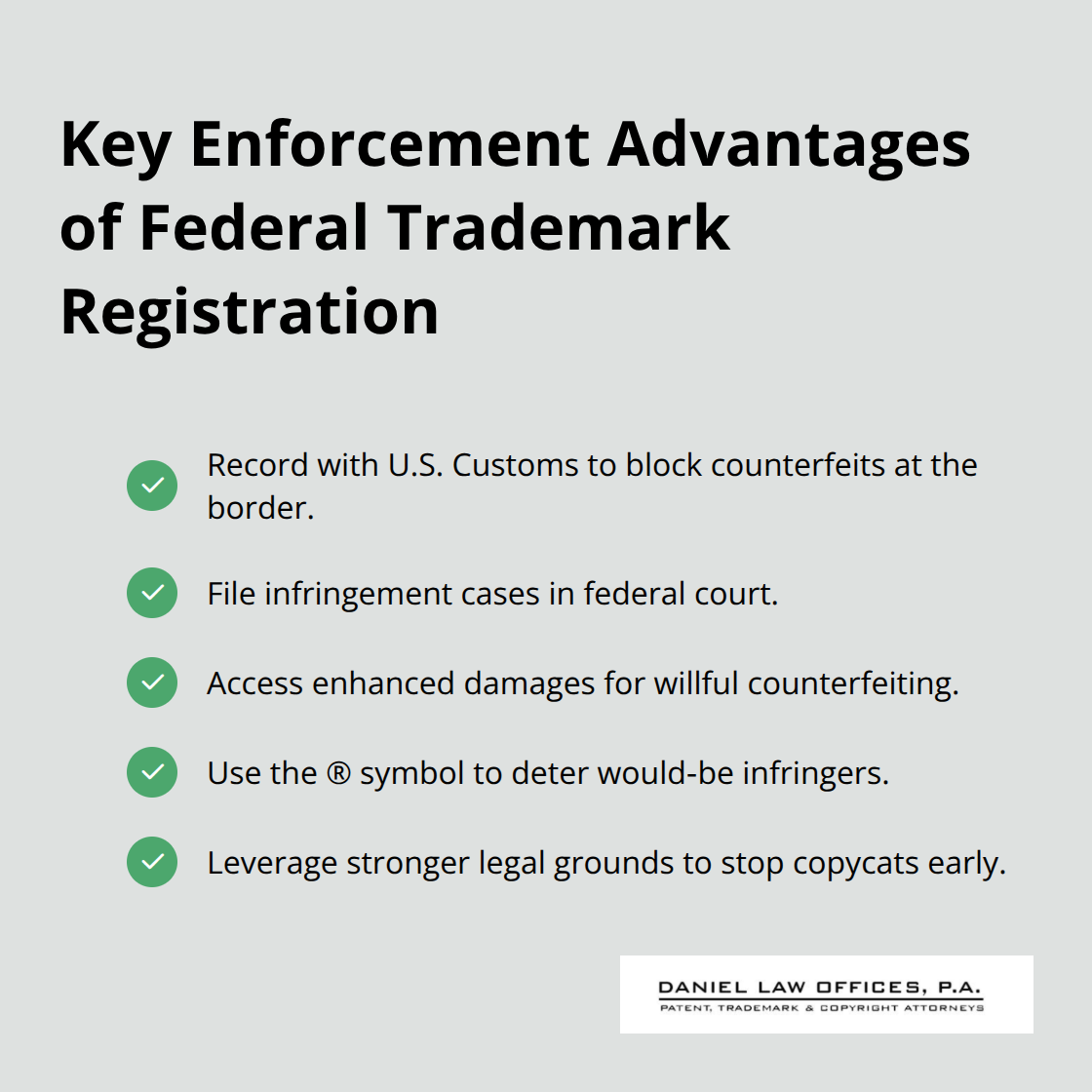
Federal registration unlocks several enforcement mechanisms unavailable to unregistered marks. You can record your registration with U.S. Customs and Border Protection to block counterfeit goods at the border before they reach consumers. You gain the right to pursue infringement cases in federal court rather than state court, which often provides stronger legal grounds and access to enhanced damages for willful counterfeiting. The ® symbol signals federal protection and can deter competitors from attempting infringement in the first place.
The Gap Between Federal and Common Law Protection
Without registration, you rely on common law rights that apply only in the geographic areas where you’ve actually used the mark-a fragmented protection that leaves your brand vulnerable as you expand regionally or nationally. Federal registration closes this gap entirely. Your protection extends across all fifty states and U.S. territories from the moment the USPTO approves your application. This nationwide scope matters significantly when you plan to grow beyond your local market or when competitors operate across state lines.
Moving Forward with Your Registration Strategy
Understanding what federal registration protects sets the stage for the next critical decision: determining whether you’re ready to file and what steps the registration process actually involves.
How Trademark Registration Transforms Your Brand’s Market Value
What Federal Registration Means for Your Bottom Line
A registered trademark fundamentally changes how your brand operates in the marketplace. According to Forbes, Apple’s brand valuation exceeded $200 billion and accounts for over 20 percent of its market capitalization, demonstrating that strong trademark protection directly translates to tangible business value. When you register your trademark federally, you create a documented asset that appears in the USPTO database and signals credibility to consumers, retailers, and potential business partners. This public record of ownership builds consumer trust because customers recognize the ® symbol as proof that your brand meets federal standards and belongs exclusively to you. That distinction matters when consumers choose between your product and a competitor’s knockoff.
Platform Access and Retail Advantages
Retailers and e-commerce platforms like Amazon and Walmart prioritize brands with federal registrations through their brand registry programs, which give you preferential placement and better tools to monitor and control how your products appear online. Without registration, you have no formal claim to these platform protections, leaving your shelf space vulnerable to confusion and counterfeit versions. The platforms themselves require federal registration before you can access their brand protection features, meaning registration becomes a prerequisite for serious e-commerce growth.
Licensing and Revenue Expansion
A registered trademark becomes a licensing and franchising engine that generates revenue streams entirely separate from your core business. Companies with strong trademark portfolios license their marks to manufacturers, franchisees, and merchandise partners, creating income without the operational overhead of producing goods directly. The World Intellectual Property Organization reports that Nestlé operates over 2,000 registered brands globally, many of which generate licensing revenue through partnerships with distributors and retailers who pay to use those marks. Your registration establishes the legal foundation that allows you to confidently grant exclusive rights to partners, knowing the USPTO backs your ownership claim.
Building Business Value for Future Sale
When you sell your business, a registered trademark increases the acquisition price because buyers view it as a protected asset they can continue operating without rebranding costs or legal uncertainty. The combination of consumer recognition, platform access, and licensing potential means your trademark registration pays dividends across multiple business dimensions, far beyond the initial filing cost. These market advantages set the stage for understanding the actual steps required to secure federal protection and what timeline you should expect.
How to Register Your Trademark in Orlando, Florida
Start with a Comprehensive Trademark Search
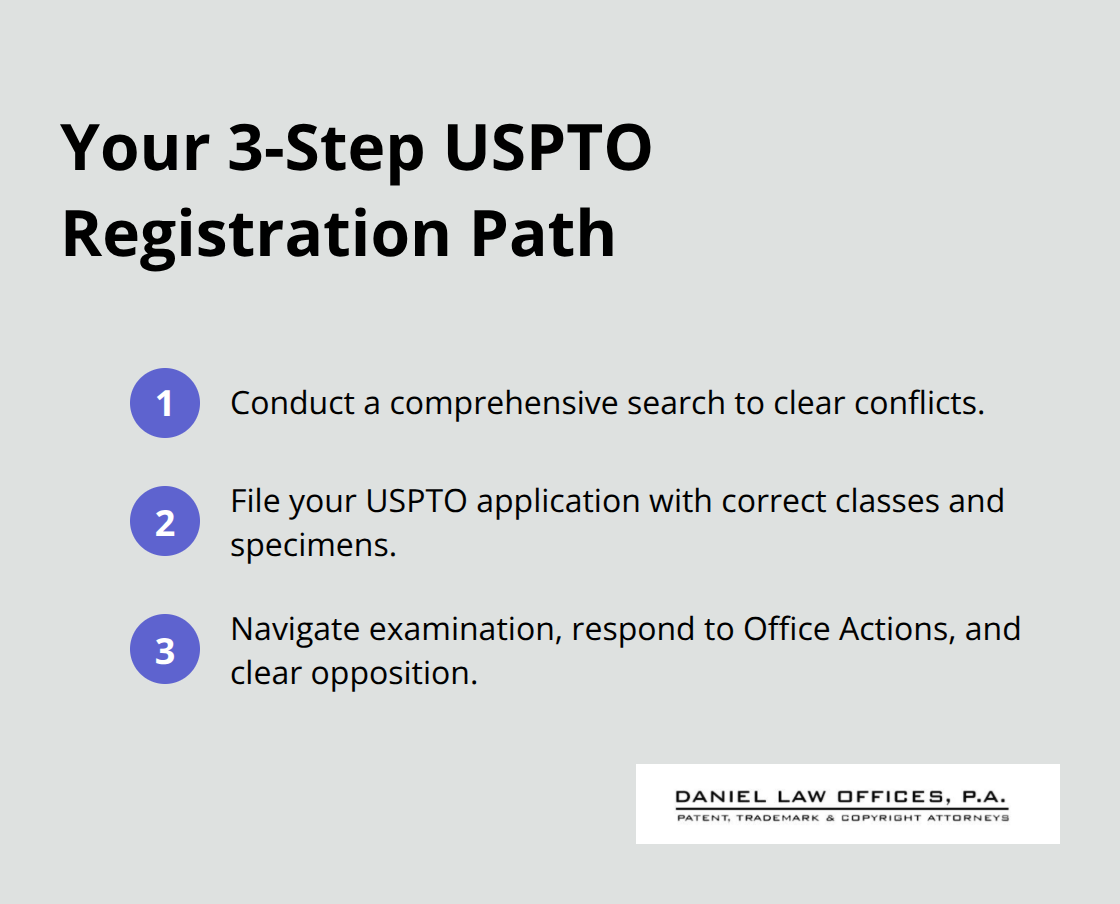
Filing a trademark with the USPTO involves three distinct phases, each with specific requirements and timelines that directly affect when your brand receives protection. The first phase requires a comprehensive trademark search across the USPTO database, state records, and the internet to identify any existing marks that could conflict with yours.
This search costs between $200 and $500 if you conduct it yourself using the free USPTO TESS database, or $500 to $1,500 if you hire a patent attorney to perform a thorough search that includes common law usage and state registrations. Skipping this step wastes money because the USPTO will reject your application if your mark conflicts with an existing registration, forcing you to start over with a new mark and paying the filing fee again.
File Your Application with the USPTO
Once your search confirms no conflicts, you file your application with the USPTO, which includes your mark, the goods or services it covers, and specimens showing actual use in commerce. The filing fee ranges from $250 to $350 per class of goods or services, meaning a brand covering both apparel and software requires two separate filings and two separate fees. Your application moves into the examination phase, which typically takes four to six months from filing, though the USPTO can extend this period if it issues an Office Action requesting clarification or modifications to your application.
Navigate the Examination and Opposition Phases
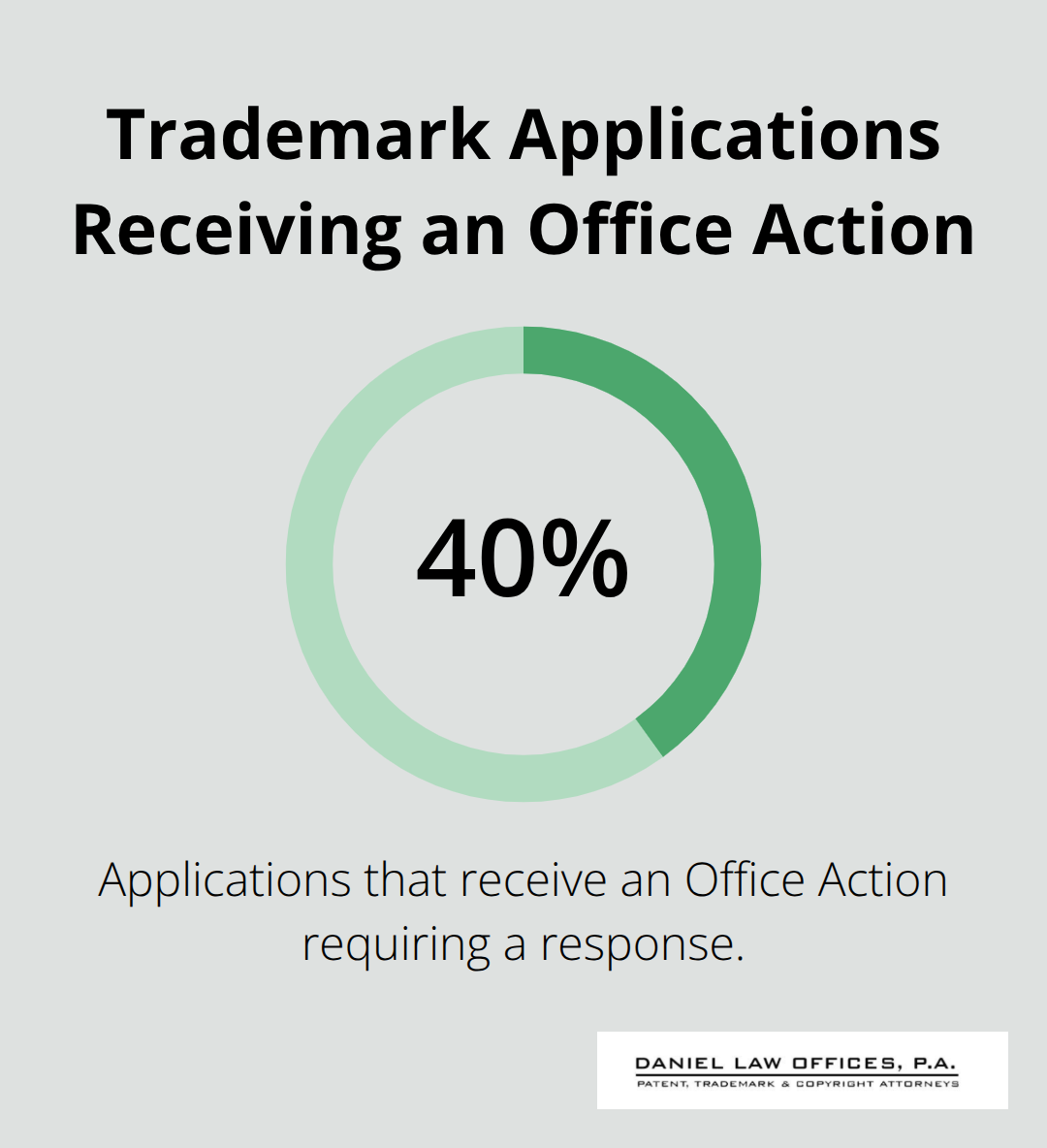
An Office Action occurs in roughly 40 percent of applications and requires you to respond within six months with evidence addressing the examiner’s concerns, which adds three to six months to your timeline. Once the examiner approves your mark, the USPTO publishes it in the Official Gazette for a 30-day opposition period during which competitors can challenge your registration if they believe your mark infringes their rights.
If no opposition emerges, your mark proceeds to registration within two to three weeks.
Understand Your Timeline and Investment
Total timeline from filing to registration typically ranges from eight to fourteen months under normal circumstances, though complex cases with Office Actions can extend to two years. The complete cost to register a single trademark class ranges from $750 to $2,000 if you handle it yourself with USPTO forms, or $1,500 to $3,500 if you work with a patent attorney who manages the entire process. A registered patent attorney can handle correspondence with the USPTO and respond to any Office Actions to keep your application moving forward efficiently.
Final Thoughts
Trademark registration advantages transform your brand from an unprotected asset into documented property that generates real business value. Federal registration creates a legal presumption of ownership that eliminates costly disputes, provides nationwide protection that closes gaps in your market position, and supplies enforcement tools that stop infringement before it damages your reputation. After five years of continuous use, your mark achieves incontestable status, making it virtually impossible for competitors to challenge your ownership on common grounds.
The registration process takes eight to fourteen months and costs between $750 and $3,500 depending on whether you manage it yourself or work with professional guidance. That investment pays dividends immediately through platform access on Amazon and Walmart, continues throughout your business lifecycle through consumer trust and competitive protection, and increases your acquisition price when you eventually sell your business. Your registered trademark becomes a licensing engine that generates revenue streams independent from your core operations.
Conduct a comprehensive trademark search to confirm no conflicts exist, then file your application with the USPTO. Daniel Law Offices, P.A. helps Orlando, Florida business owners register and protect their trademarks through every phase of the process, moving you efficiently through examination and avoiding costly mistakes. The sooner you register, the sooner your brand receives the protection it deserves.