



How to Patent a Process: Complete Guide
Your process is valuable intellectual property, and protecting it legally separates your business from competitors who might copy your methods.
Learning how to patent a process requires understanding what the USPTO will accept, what documentation you need, and how to avoid costly mistakes that delay approval. We at Daniel Law Offices, P.A. guide Orlando, Florida businesses through this process every day, and we’ve seen firsthand how proper patent protection transforms competitive advantage into lasting legal protection.
What Qualifies as a Patentable Process
The Four Requirements the USPTO Actually Enforces
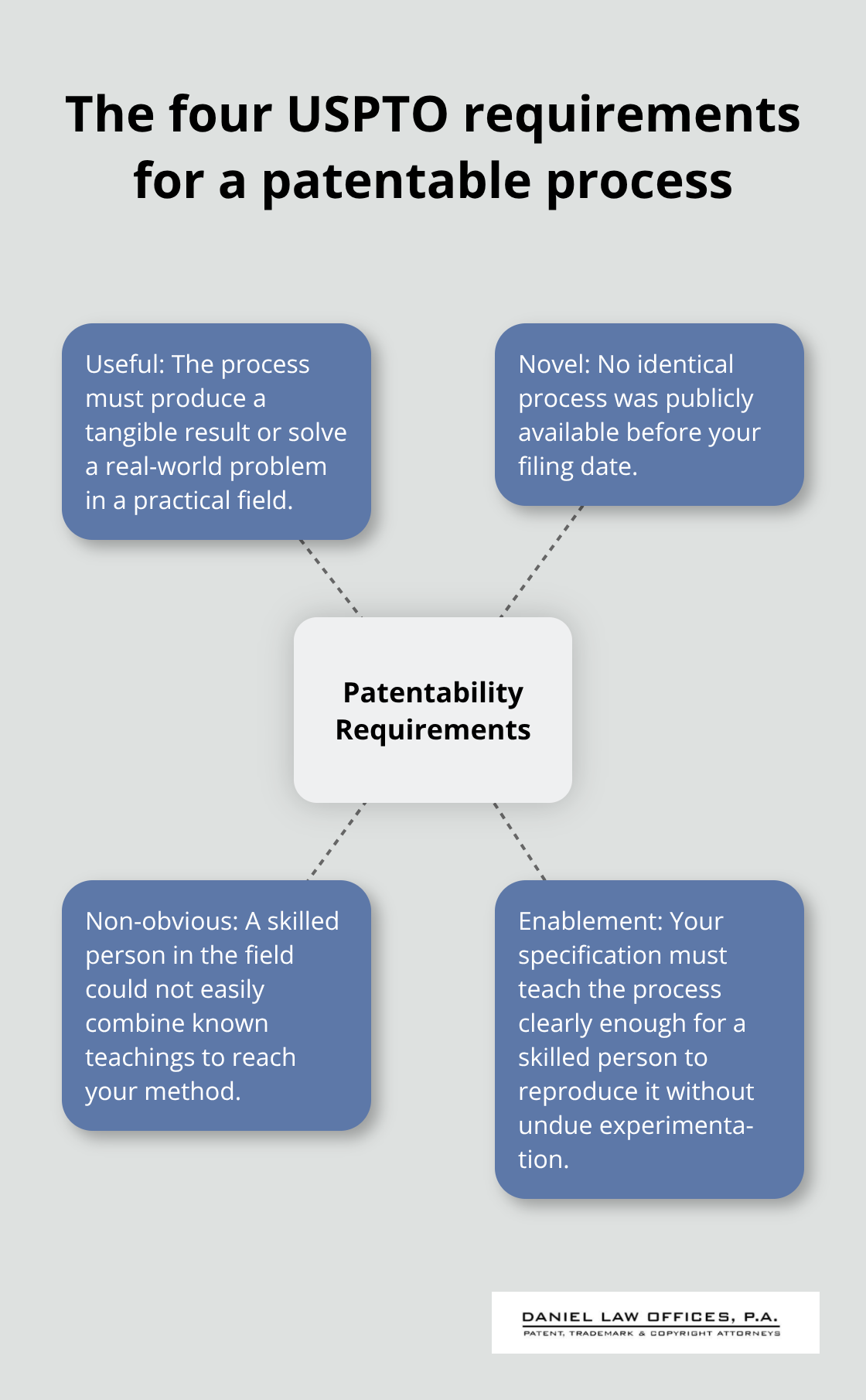
The USPTO applies four strict patentability requirements to every process application, and missing even one disqualifies your invention. Your process must be useful, meaning it produces a tangible result or solves a real problem in manufacturing, business, or another practical field. It must be novel, which means no identical process existed in public before your filing date. It must be non-obvious, requiring that someone skilled in your industry couldn’t easily combine existing knowledge to arrive at your method. Finally, your specification must describe the process clearly enough that someone trained in the field could reproduce it without guesswork. These aren’t flexible guidelines-examiners at the USPTO enforce them rigorously, and applications that fail any requirement face rejection.
How Process Patents Stand Apart from Design and Utility Patents
Process patents protect the steps you take to achieve an outcome, not the machine or product itself. A design patent, by contrast, protects only the ornamental appearance of something, which is why it won’t work for protecting how you manufacture or deliver your service. Utility patents can cover machines or compositions of matter, but when your invention is fundamentally a sequence of steps-a method of treatment, a manufacturing technique, or a business workflow-you need a process patent specifically. The USPTO distinguishes these carefully because the claims you write, the drawings you submit, and the examination timeline all differ. Process patents typically take 18 to 36 months from filing to first examination action, and many Orlando, Florida manufacturers and service providers overlook this category entirely, filing for design protection when process protection is what they actually need. Understanding this distinction upfront prevents wasted time and money pursuing the wrong patent type.
Why Protecting Your Process Prevents Competitors from Stealing Your Advantage
Once granted, a process patent gives you the exclusive right to prevent others from making, using, or selling products made through your patented method for 20 years from your filing date. Competitors cannot legally replicate your steps without risking infringement liability. A patent is far stronger than a trade secret because trade secrets remain vulnerable if someone reverse-engineers your process or an employee leaves and shares your methods. Patents create a public record that establishes your ownership and date of invention, which strengthens your negotiating position when licensing opportunities arise. The USPTO data shows that patented inventions generate substantially more licensing revenue than unprotected processes, and businesses with granted patents attract investor interest more readily than those relying on confidentiality alone. Without patent protection, your competitive advantage erodes the moment someone figures out what you’re doing.
What Happens Next in the Patent Process
Now that you understand what qualifies for protection, the real work begins. You need to search existing patents to confirm your process is truly novel, then document every step with precision before filing with the USPTO.
Building Your Patent Search and Filing Strategy in Orlando, Florida
Start Your Prior Art Search Before Filing
Starting your prior art search immediately separates inventors who obtain patents from those who waste months on applications destined for rejection. The USPTO Patent Public Search database is free and searchable by keyword, classification code, or inventor name, but most Orlando, Florida business owners underestimate how thoroughly they need to search. You should search not just the US patent database but also international sources through WIPO PatentScope, since the USPTO examiner will find prior art from anywhere in the world.
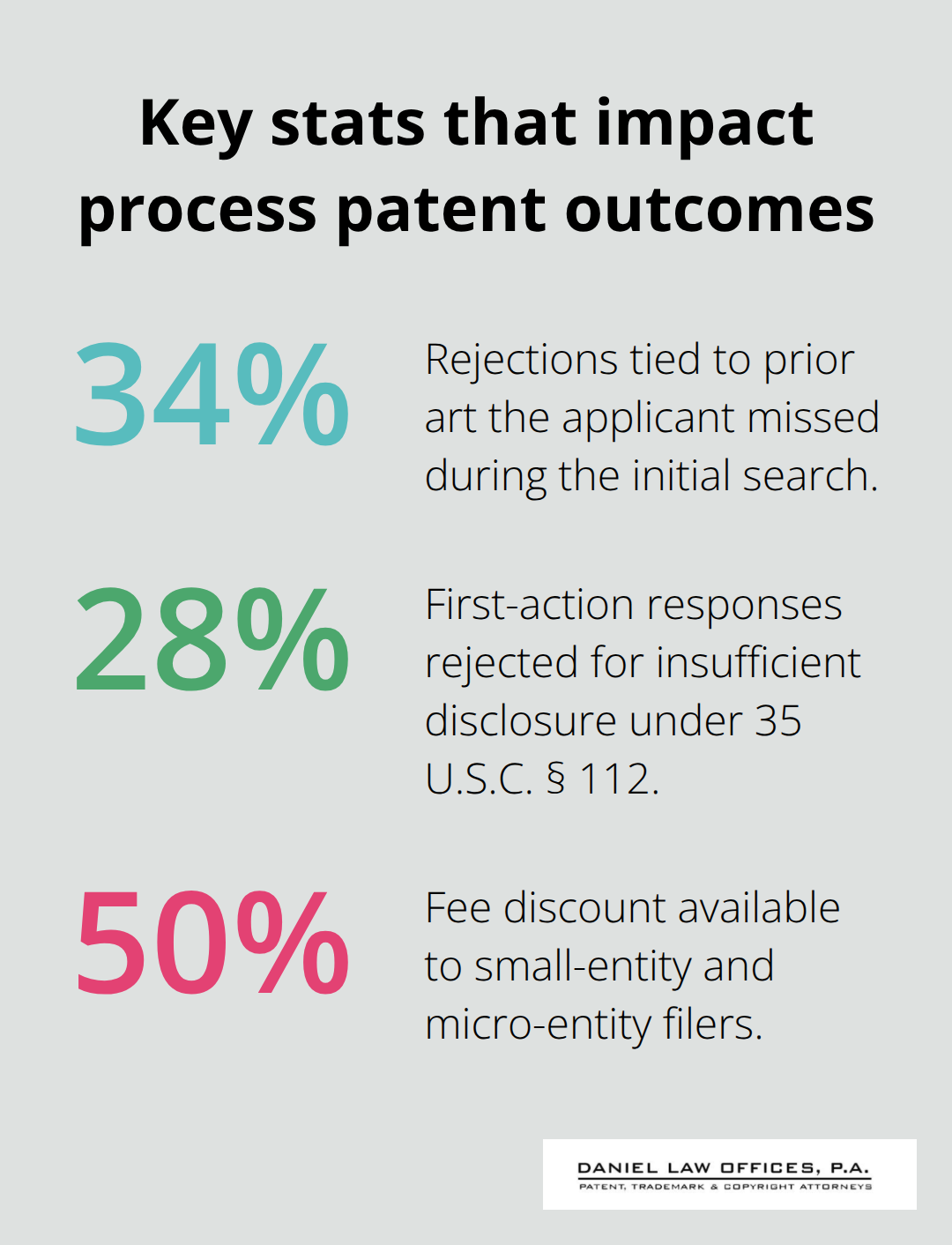
Many inventors stop after one search; the right approach involves multiple searches using different keyword combinations and CPC classifications related to your process. A 2024 analysis of abandoned applications shows that 34% of rejections stem from prior art the applicant missed during their initial search, meaning inadequate searching directly correlates with failed filings. If your process involves specific manufacturing steps, search using both the general method name and the individual steps separately-a coating process might be found under adhesion, bonding, or surface treatment depending on how the prior patent was classified.
Document Why Your Process Differs from Existing Patents
Once you identify relevant prior art, document why your process differs; this comparison becomes your strongest argument against rejection later. Some inventors hire professional search firms or patent resource centers for deeper analysis, which typically costs between $500 and $2,000 but prevents filing an application that will almost certainly fail.
Write Your Specification with Complete Technical Detail
After confirming novelty, your specification must describe every step of your process with enough detail that someone skilled in your industry could reproduce it without guesswork-this is the USPTO’s enablement requirement under 35 U.S.C. § 112. Write out the exact sequence of actions, temperatures, pressures, timing, materials, and any variations that still produce the same result. Include why each step matters, what problem it solves, and how it differs from conventional methods.
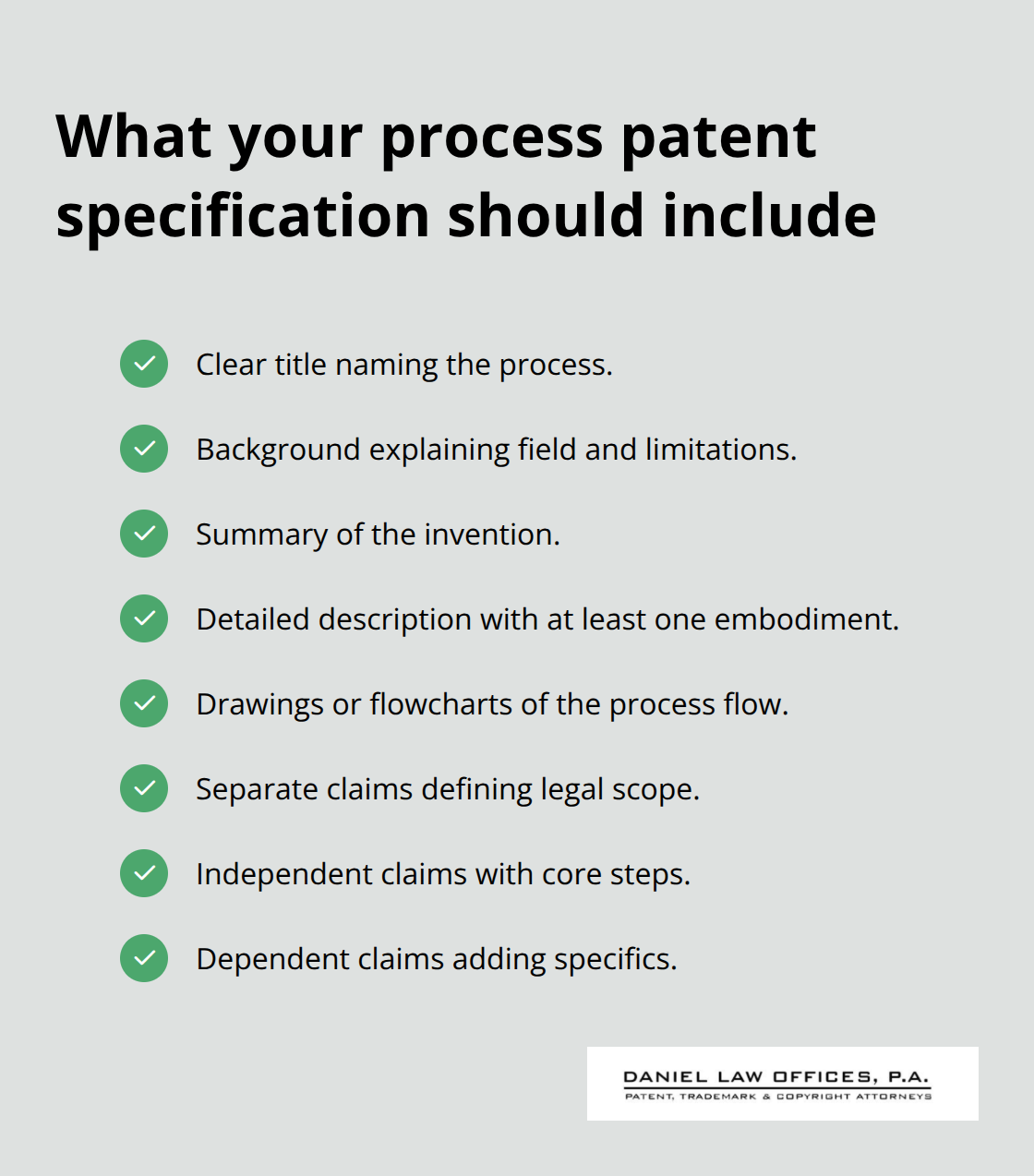
The specification should contain a title, background section explaining the field and existing limitations, a brief summary of your invention, a detailed description with at least one embodiment, and drawings or flowcharts showing the process flow. Claims are separate from the specification and define the legal boundaries of your protection; independent claims state the core steps, while dependent claims add specific details.
File Through Patent Center with Proper Documentation
File your application through Patent Center, the USPTO’s modern electronic platform, which costs less than paper filing and processes faster. A nonprovisional utility patent application for a process requires the specification, drawings, an oath or declaration signed by each inventor, and an Information Disclosure Statement listing all prior art you found-filing this statement is a legal obligation and prevents future invalidity challenges.
The filing fee for a nonprovisional application ranges from $320 to $1,600 depending on your entity status, with small-entity and micro-entity filers receiving 50% discounts. Expect 18 months before publication and 24 to 36 months before your first substantive examination action from the USPTO, though some technology centers move faster.
Craft Your Claims with Precision
Prepare your claims with precision because vague language invites rejections; the transition phrase matters-saying your process comprises certain steps is broader than saying it consists of those steps, which excludes unlisted alternatives. Filing electronically through Patent Center rather than paper reduces fees by approximately $200 to $400 per application and eliminates formatting surcharges that commonly delay examination. With your application filed and your claims defined, you now enter the examination phase where the USPTO reviews your work and either grants protection or raises objections that require your response.
Common Mistakes to Avoid When Patenting a Process in Orlando, Florida
Vague Specifications That Fail the Enablement Test
Inventors filing process patents submit specifications so vague that examiners cannot understand the actual steps, which violates the enablement requirement under 35 U.S.C. § 112. This happens when you describe your process in general terms like “apply coating” or “heat the mixture” without specifying temperatures, durations, pressure ranges, material specifications, or why each parameter matters. The USPTO rejects approximately 28% of first-action responses for insufficient disclosure because inventors assume the examiner knows their industry. The examiner does not. If your specification says “mix ingredients thoroughly,” the examiner will reject it because someone reading your patent cannot reproduce your exact process without experimentation.
Instead, write “combine 2.5 kilograms of compound A with 1.8 kilograms of compound B at 65 degrees Celsius for 12 minutes while maintaining a pH of 6.2 to 6.8.” This level of detail prevents rejection and strengthens your claims against infringement challenges later. Precision in your specification transforms a weak application into one that withstands examination and protects your competitive advantage.
Shallow Prior Art Searches Before Filing
Inventors commonly search only the USPTO database using one or two keyword combinations, missing relevant patents in international databases or patents classified under different terminology. When you file without a thorough search, the examiner finds prior art during examination that you missed, triggering rejections that force you to narrow your claims and often destroy the commercial value of your patent. The data shows that 34% of abandoned applications stem from prior art rejections that a comprehensive pre-filing search would have revealed.
Search WIPO PatentScope, the European Patent Office database, and the USPTO using multiple CPC classifications and synonym combinations. If your process involves coating, search under adhesion, bonding, surface treatment, and film formation separately because prior patents may use different terminology. Hiring a patent resource center or search firm costs $500 to $2,000 but eliminates the risk of filing an application destined for rejection. A thorough search at the start saves months of wasted examination time later.
Filing Too Quickly Without Proper Preparation
Rushing the filing timeline to claim an invention-date advantage introduces errors that examiners catch immediately. Filing a nonprovisional application with incomplete drawings, missing claims on separate sheets, or an unsigned oath delays examination and costs you money in amendment fees. A provisional application offers a better path if you need a quick priority date-it costs $320 and establishes your filing date while you have 12 months to perfect your nonprovisional application.
Rushing causes applicants to omit best-mode disclosure, file claims with indefinite language, or submit specifications missing critical embodiments. All of these trigger rejections and force you to respond to office actions that proper preparation would have prevented. Taking time to navigate the patent submission process correctly the first time protects your investment and increases your chances of grant.
Final Thoughts
Patenting a process in Orlando, Florida demands four essential actions: confirming your process meets the USPTO’s patentability standards, conducting a thorough prior art search before filing, documenting every step with technical precision, and submitting your application through Patent Center with complete supporting materials. The most successful applicants treat the specification as their foundation, writing with enough detail that someone skilled in their industry could reproduce the process without guesswork. They search multiple databases using varied terminology and CPC classifications rather than relying on a single keyword search, and they file electronically to reduce costs and processing time.
After you file your nonprovisional application, expect 18 months before publication and 24 to 36 months before your first substantive examination action. During this time, the USPTO examiner assesses your claims against the four patentability requirements and may issue office actions requesting amendments or arguing against rejections-your timely responses determine whether your application succeeds or fails. Once allowed, you pay the issue fee and your patent grants, giving you 20 years of exclusive rights from your filing date, with maintenance fees due at 3.5, 7.5, and 11.5 years after grant to keep your patent active.
We at Daniel Law Offices, P.A. guide Orlando, Florida inventors and businesses through every stage of how to patent a process, from initial patentability assessment through grant and beyond. Our registered patent attorney handles comprehensive patent searches, drafts applications tailored to your invention, and manages the entire prosecution process with the USPTO. Contact us to discuss your process and learn how we can protect your competitive advantage.