



Understanding the US Patent Application Guidance for Inventors
Filing a patent application with the USPTO requires understanding specific rules and standards that many inventors overlook. The US patent application guidance outlines what makes an invention patentable and how to properly submit your application.
At Daniel Law Offices, P.A., we’ve seen firsthand how confusion about these requirements leads to rejected applications and wasted resources. This guide breaks down the guidance into actionable steps so you can protect your innovation correctly.
What Makes an Invention Patentable
The USPTO evaluates every patent application against four core requirements: novelty, non-obviousness, usefulness, and patentable subject matter. Your invention must be genuinely new-about 8% of applications face rejection solely for lack of novelty according to USPTO data, which is why a thorough prior art search before filing is non-negotiable. Non-obviousness means your invention cannot be an obvious combination of existing technologies that a skilled person in your field would naturally think to combine. Usefulness requires that your invention has a real-world application and isn’t merely theoretical. Patentable subject matter excludes laws of nature and abstract ideas, so a mathematical formula alone won’t qualify, but a machine that uses that formula will.
How Your Specification and Claims Determine Success
The quality of your written application directly impacts approval odds. According to USPTO data, well-written specifications increase approval chances by about 30% compared to weaker disclosures, and strong claims reduce initial rejections by around 25%.
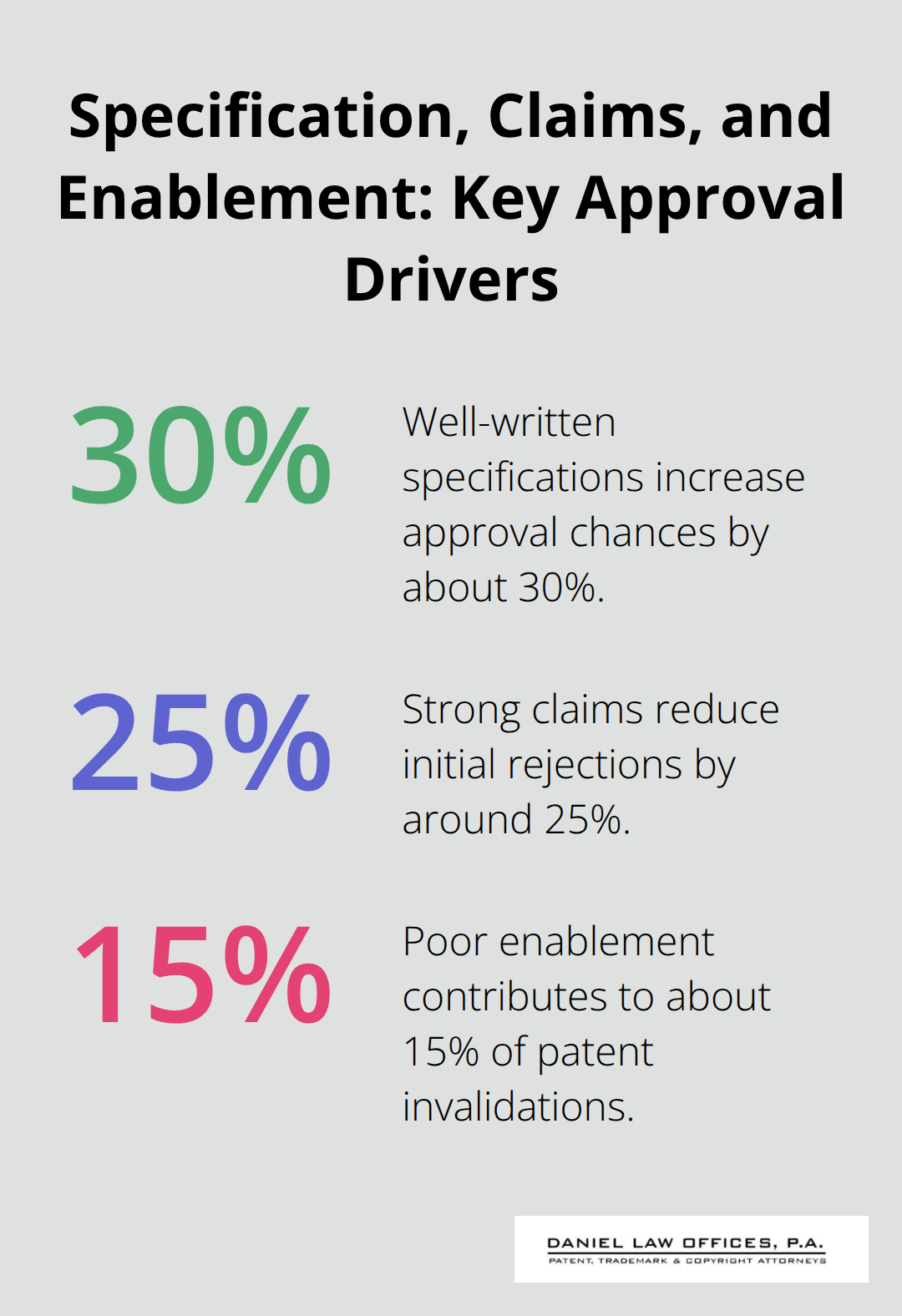
Your specification must describe exactly how your invention works, what problem it solves, and how someone skilled in your field can reproduce it without undue experimentation-this is called enablement, and poor disclosure contributes to about 15% of patent invalidations in litigation. Your claims establish the legal boundaries of your protection; independent claims should cover the broadest scope of your invention, while dependent claims protect specific embodiments. Vague or incomplete claims give examiners room to reject you, so precision matters.
The Role of Drawings in Your Application
High-quality drawings strengthen your application substantially. Submissions with proper USPTO-compliant drawings correlate to about a 20% higher approval rate, and over 90% of successful applications include visuals that label every element mentioned in the claims. Each drawing must show multiple views and identify every component referenced in your specification and claims. Poor drawings force examiners to request clarifications, which delays your timeline and increases rejection risk.
What Happens During Examination and Response
After you file, the USPTO typically sends a first office action within about 15 months, and approximately 86% of applications receive at least one non-final rejection-this is normal and expected. Examiners spend roughly 19 hours reviewing each application, focusing on prior art searches and claim analysis. You have six months to respond to any office action, and your response must address every point the examiner raised or your application gets abandoned. Applicant-initiated interviews with examiners can increase approval chances by around 30%, making direct communication a powerful strategy that many inventors skip.
Filing Method and Timeline Considerations
The entire process commonly takes 2 to 4 years depending on complexity and how many rounds of rejections and amendments occur. Electronic filing via Patent Center processes applications about 15% faster than paper filings and avoids a $400 non-electronic filing fee, so submit electronically. Understanding these timelines helps you plan your commercialization strategy and decide whether to file a provisional application first to establish an earlier priority date while you refine your invention further.
How to Start Your Patent Search and Build a Strong Application
Conduct a Comprehensive Prior Art Search
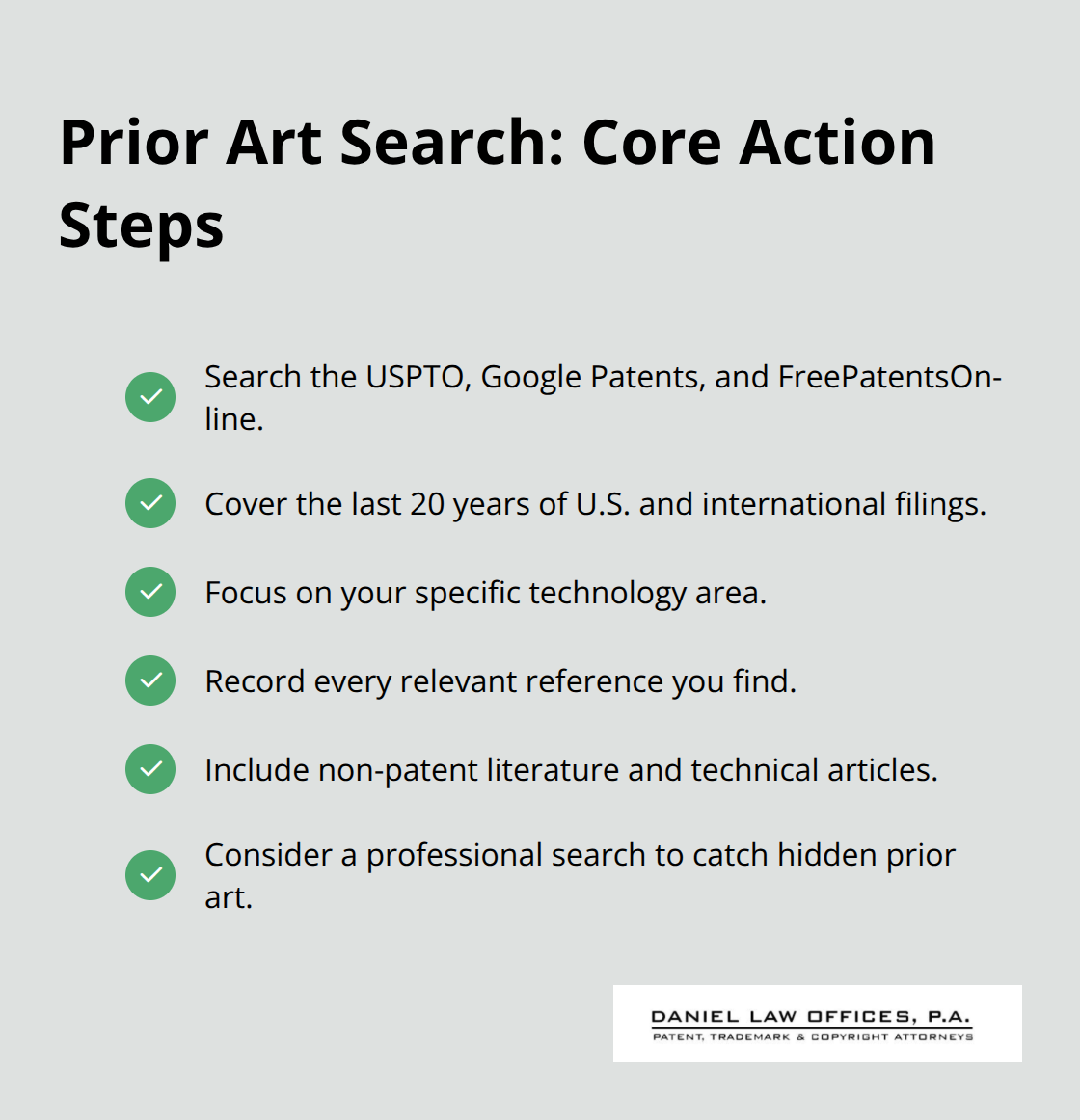
A thorough patent search forms the foundation of a strong application-skipping this step invites rejection later. USPTO data shows that about 8% of applications face rejection for lack of novelty, but this percentage drops significantly when inventors search before filing. Start with the USPTO free patent database, then expand to Google Patents and FreePatentsOnline to cover US and international patents from the last 20 years. Focus on patents within your technology area and document every reference you find, including non-patent literature and technical articles. Many inventors conduct only surface-level searches, a mistake that costs thousands in attorney fees when rejections arrive during prosecution. A professional search service identifies hidden prior art that free tools miss, and the cost (typically $500 to $2,000) proves far cheaper than fighting unnecessary rejections.
Organize Your Technical Documentation with Precision
Once your search confirms novelty, organize your technical documentation because vague specifications trigger rejections. Your specification should run approximately 10,000 words and describe exactly how your invention works, what problem it solves, and how someone in your field can build it without guesswork. The USPTO calls this enablement, and examiners scrutinize it carefully. Create multiple high-quality drawings that label every component mentioned in your claims; submissions with proper USPTO-compliant visuals correlate to about 20% higher approval rates. Prepare your independent and dependent claims in draft form before filing, with independent claims covering your broadest protection and dependent claims protecting specific variations.
Work with a Patent Attorney to Strengthen Your Application
At this stage, many inventors benefit from working with a patent attorney who reviews your search results, strengthens your specification language, and ensures your claims withstand examination. A registered patent attorney can transform rough technical descriptions into legally sound filings that give your innovation the protection it deserves. This professional guidance helps you avoid common pitfalls that weaken applications or lead to unnecessary rejections during prosecution. With your search complete, documentation organized, and claims drafted, you’re ready to move forward with the actual filing process and understand what happens when the USPTO begins its examination.
Common Mistakes Inventors Make When Filing Patents in Orlando, Florida
Prior Art Searches That Fall Short
Inventors in Orlando, Florida and across the country repeatedly make three preventable mistakes that sink their patent applications before examination even begins. The first mistake-skipping a thorough prior art search-costs inventors thousands in wasted filing fees and attorney time. You cannot file a strong application without knowing what already exists. According to USPTO data, about 8% of patent applications face rejections due to incomplete documentation or poor preparation, but this statistic masks a darker reality: many of those rejections could have been predicted with a proper search beforehand. Free tools like Google Patents and the USPTO database cover only a fraction of what’s out there, and inventors who rely solely on these miss references in non-patent literature, foreign patents, and technical journals that examiners will find. A professional search service costs $500 to $2,000 upfront-a fraction of what you’ll spend fighting rejections later. Start with a professional search before you draft a single claim, because once you file, you cannot add new prior art references to your search strategy without potentially damaging your application’s priority date.
Weak Claims and Incomplete Specifications
The second mistake involves weak claim language and incomplete specifications that give examiners ammunition for rejections. Your claims must be precise enough that a competitor cannot design around your patent yet broad enough to protect your core innovation. Vague language like “describes an improved system” without specific technical detail invites rejections, and strong claims reduce initial rejections by around 25%.
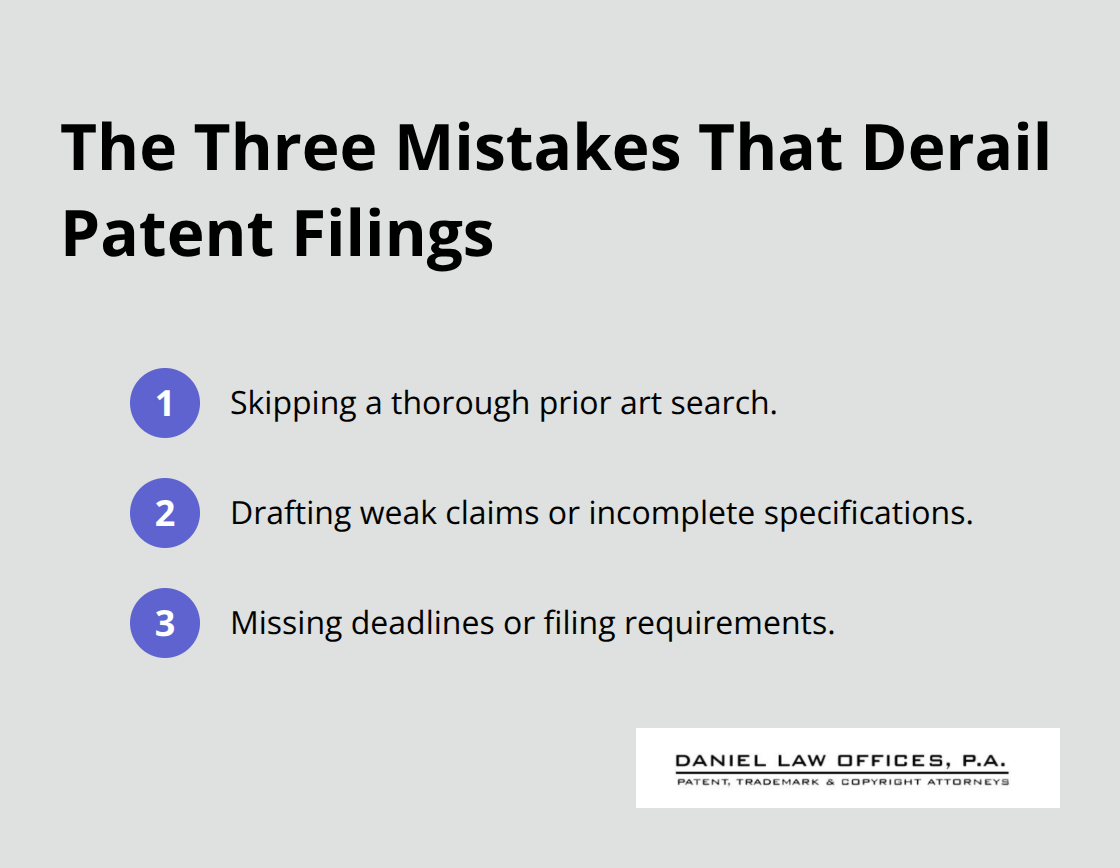
Your specification must contain approximately 10,000 words of precise technical description covering how the invention works, what problem it solves, and how someone skilled in your field can reproduce it without undue experimentation-this enablement requirement trips up about 15% of invalidations in litigation. Examiners scrutinize enablement carefully, so invest time in thorough technical documentation that leaves no room for interpretation.
Missed Deadlines and Filing Requirements
The third mistake-missing deadlines and filing requirements-is equally fatal. You have six months to respond to every office action, or your application is abandoned with no recovery option. Electronic filing through Patent Center processes applications roughly 15% faster than paper submissions and avoids a $400 non-electronic fee, yet many inventors still file by mail or miss the deadline window entirely. Additionally, maintenance fees are due at 3.5, 7.5, and 11.5 years after grant, and the USPTO does not send reminder notices-miss one payment and your patent expires. These three categories of errors share a common thread: they all stem from rushing the process or underestimating the precision the USPTO demands.
Final Thoughts
Filing a patent application demands precision, thorough preparation, and understanding of US patent application guidance from start to finish. The process emphasizes four core principles: conduct a comprehensive prior art search before filing, write specifications and claims with technical clarity, include high-quality drawings that label every component, and respond to office actions within the required six-month window. Skipping any of these steps invites rejection, delays your timeline, and wastes resources you could have invested in bringing your innovation to market.
At Daniel Law Offices, P.A., we help inventors navigate this process by handling comprehensive patent searches to confirm novelty, drafting applications that withstand examiner scrutiny, and guiding you through USPTO prosecution when office actions arrive. Our registered patent attorney works with individual inventors and businesses to transform rough technical ideas into legally sound filings that protect your innovation. We manage the details that trip up most inventors-enablement requirements, claim precision, drawing compliance, and deadline management-so you can focus on developing your product.
Your next step is straightforward: protect your idea before showing prototypes or conducting market surveys with manufacturers or customers. Once you disclose your invention publicly, you lose patent rights in most countries, and the clock starts ticking on your US filing deadline. Contact Daniel Law Offices, P.A. to schedule a consultation about your invention, and we’ll outline a filing plan that positions your innovation for approval and market success.