




Patent Search Importance: Why a Thorough Search Sets Your Patent Up for Success
Most inventors skip the patent search and jump straight to filing. This mistake costs thousands in rejected applications and legal battles down the road.
Understanding patent search importance means catching conflicts before they become problems. At Daniel Law Offices, P.A., we’ve seen how a thorough search transforms an application from risky to solid.
What Happens Without a Patent Search
Rejected Applications Drain Your Resources
Skipping a patent search before filing creates a cascade of expensive problems. The USPTO rejects approximately 40% of patent applications that encounter prior art conflicts during examination. When your application lands in that rejection pile, you’ve already spent filing fees, attorney time, and months waiting for a response. A failed application forces you to start over with a new filing, which requires another fee and potentially significant revisions to your claims. Inventors who filed without searching first face $15,000 to $30,000 in additional legal and filing costs just to correct course. Beyond the immediate financial hit, a rejected application delays your market entry by 12 to 24 months, giving competitors time to move in and establish their own position.
Infringement Litigation Becomes Your Worst Nightmare
Without a pre-filing search, you risk inadvertently infringing on existing patents once you launch your product. Patent infringement litigation averages $2 to $3 million in legal fees alone according to the American Intellectual Property Law Association. If a competitor holds a patent covering technology similar to yours, they can sue for damages, force you to cease production, and demand royalties on past sales. A manufacturer discovered mid-production that their new device infringed three existing patents, resulting in a settlement that cost them $5 million and a complete product redesign. This threat becomes real fast when you haven’t conducted proper due diligence beforehand.
Your Competitive Edge Vanishes Before Launch
Skipping the search means losing competitive advantage before you even enter the market. While you race to launch, your competitors can study your unprotected innovation, design around your concept, and potentially file their own patents first. This turns your innovation into a gift for everyone else. A thorough patent search prevents these costly mistakes and positions your application for approval. The question isn’t whether you can afford to conduct a search-it’s whether you can afford not to.
How a Patent Search Reveals What You’re Actually Protecting
Mapping Your Innovation’s Competitive Landscape
A thorough patent search does far more than check whether your idea already exists. It maps the competitive landscape around your innovation, showing you exactly what space remains available for your claims. The USPTO examines approximately 600,000 patent applications annually, and examiners spend an average of 18 to 20 hours reviewing each one. Your search accelerates this process because examiners waste less time hunting for prior art when your application already acknowledges and distinguishes itself from existing patents. This efficiency translates directly into faster approvals.
How Prior Art Analysis Strengthens Your Application
Applications that include comprehensive prior art analysis face fewer rejections during examination, with approval rates climbing above 70% compared to the 60% baseline for applications lacking this foundation. When you identify existing patents before filing, you position your claims to stand apart from what came before. Examiners recognize this preparation and move through their review faster. Your application becomes stronger because you’ve already done the work of distinguishing your innovation from competitors’ solutions.
The Real Financial Impact of Searching First
A patent search costs between $300 and $1,500 depending on complexity, yet it saves applicants an average of $8,000 to $15,000 in unnecessary prosecution costs and refilings. You’ll identify whether your claims need narrowing, broadening, or complete restructuring before you invest in formal filing. This early intelligence lets you refine your strategy when changes are inexpensive rather than discovering problems after the USPTO rejects your application. Companies that skip searching often file multiple times, each rejection adding months to their timeline and thousands to their legal bills.
Uncovering Freedom-to-Operate Issues Before Launch
A search reveals potential freedom-to-operate issues that could sink your product launch. If your innovation infringes existing patents, a search uncovers this threat while you still have time to redesign or license the conflicting technology. This proactive approach protects your market entry and prevents the litigation costs that plague companies who launch blindly. Understanding what patents already exist in your space means you can navigate your market with confidence rather than fear.
Moving Forward with Confidence
Once you understand your competitive landscape and strengthen your application through prior art analysis, the next step focuses on conducting that search properly. The tools and methods you use determine whether you catch all relevant conflicts or miss critical prior art that could derail your filing later.
How to Conduct a Proper Patent Search
Start with the Right Databases
The USPTO database contains over 12 million patents, and searching it properly requires more than typing keywords into a search bar. The free USPTO Patent Full-Text and Image Database lets you search by inventor name, filing date, technology classification, and specific claims language. Many inventors stop here and assume they’ve completed due diligence, but this approach misses international patents that could affect your freedom to operate. The reality is that 60% of patent activity occurs outside the United States, meaning a search limited to the USPTO leaves massive blind spots in your competitive analysis.
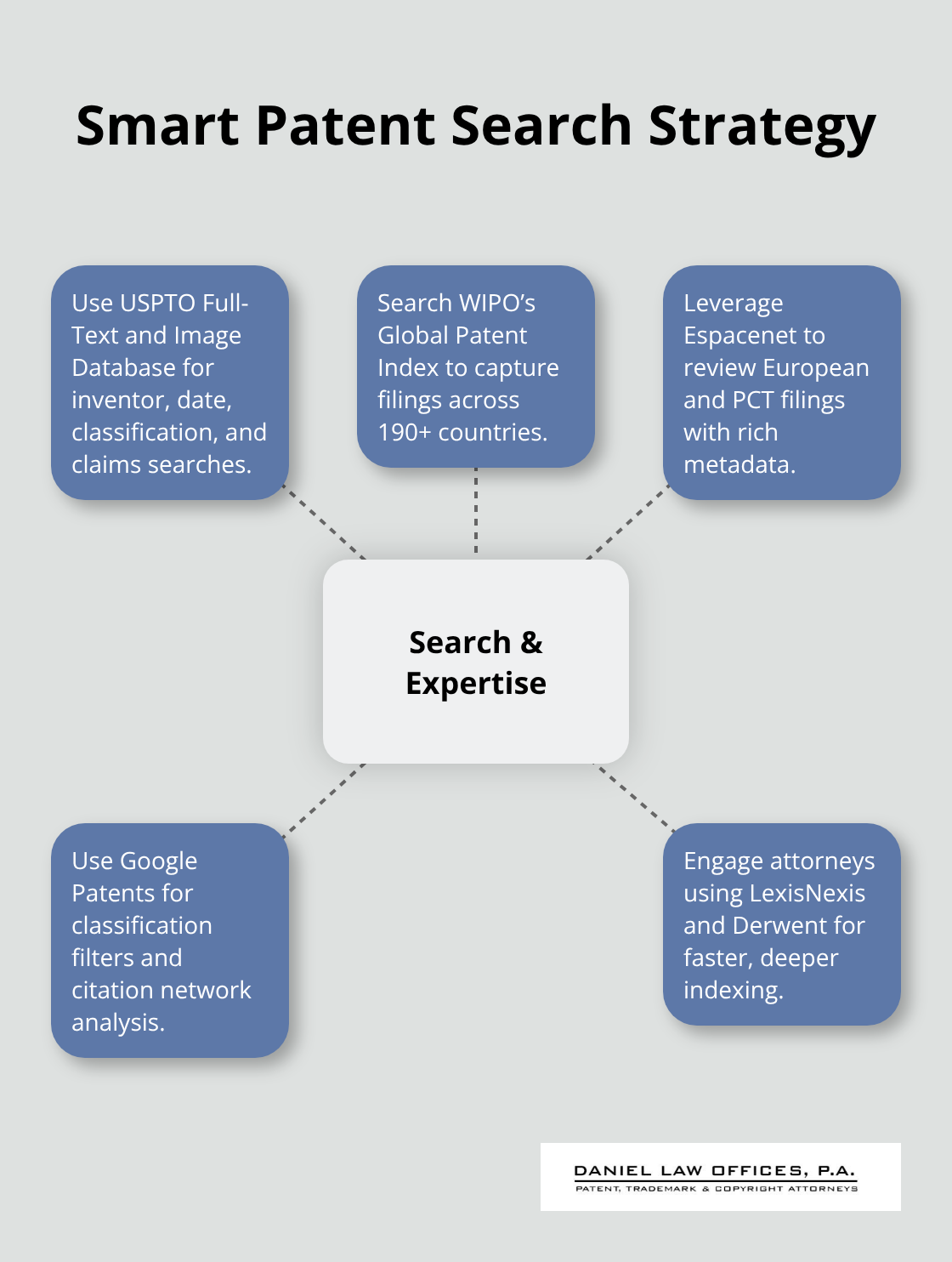
You need to search international registries through WIPO’s Global Patent Index, which covers patents filed in over 190 countries, or use the Espacenet database run by the European Patent Office to review European and international filings. Google Patents also provides free access to millions of documents with better search functionality than the USPTO’s native tools, allowing you to filter by classification codes and examine citation networks that show how patents reference each other.
Understand the Time and Complexity Involved
A comprehensive search takes 8 to 12 hours for straightforward innovations and significantly longer for complex technologies spanning multiple classification codes. Attempting this alone without experience often results in incomplete findings that cost you thousands later when prior art emerges during examination. The scope of work expands quickly once you realize how many classification codes apply to your technology and how many variations of your core concept exist across patent databases.
Work with Patent Professionals for Thorough Results
Working with a registered patent attorney produces the smarter investment. Patent professionals conduct searches using subscription databases like LexisNexis and Derwent that index patents faster and more thoroughly than free tools. They understand how examiners interpret claims language and prior art relevance, and they know which classification codes apply to your technology. These professionals search systematically rather than relying on guesswork about keyword combinations.
Patent professionals also document every step of the search process, creating a record that strengthens your application when filed and protects you if infringement disputes arise later. Documentation matters because if litigation occurs, your search report proves you conducted due diligence before launch, which can reduce damages in infringement cases and demonstrates good faith to judges and juries. A professional search report typically costs $800 to $1,500 but saves far more by preventing the rejection cycles and redesigns that plague self-conducted searches.
Organize Your Findings for Maximum Impact
After the search completes, organize all findings into a searchable format with notes on how each patent relates to your claims, what distinguishes your innovation, and which prior art references you’ll cite in your application. This documentation becomes your roadmap during prosecution and your defense if anyone questions whether your patent is valid. A well-organized search file (one that includes clear categorization and cross-references) transforms raw data into actionable intelligence that strengthens every stage of your patent journey.
Final Thoughts
Skipping a patent search isn’t a time-saver-it’s a financial disaster waiting to happen. The patent search importance becomes crystal clear once you calculate the real costs: rejected applications, infringement litigation averaging $2 to $3 million, and market delays that hand your competitive advantage to rivals. A search costs $300 to $1,500 upfront but prevents $8,000 to $15,000 in unnecessary prosecution expenses and refilings.
The inventors and businesses that succeed protect their innovations early by conducting thorough searches before filing, documenting their findings systematically, and understanding their competitive landscape before launch. This approach transforms a risky application into a solid one that examiners approve faster and that holds up if anyone challenges its validity later. We at Daniel Law Offices, P.A. guide clients through this entire process, conducting comprehensive searches using subscription databases that free tools can’t match and identifying prior art that matters.
The question isn’t whether you can afford a patent search-it’s whether you can afford to file without one. Contact Daniel Law Offices, P.A. to start your search today and protect what you’ve built.