




Patent Rejection Attorney in Orlando, FL: Strategies to Turn a Rejection into an Issued Patent
A patent rejection from the USPTO doesn’t mean your innovation is unpatentable. Most rejections can be overcome with the right strategy and expert guidance.
At Daniel Law Offices, P.A., we’ve helped Orlando inventors navigate patent rejections and secure issued patents. This guide covers the tactical options available to you, from amendments and claim narrowing to appeals and continuing applications.
Why the USPTO Rejects Patents and What It Means
Rejection Rates and What They Tell You
The USPTO rejects approximately 70% of patent applications at least once during prosecution, according to USPTO data. This high rate reflects the agency’s rigorous examination standards, not a fundamental flaw in your innovation. Understanding that most applicants face rejection normalizes the process and positions you to respond strategically rather than defensively. The first office action typically arrives within 6–12 months of filing, giving you time to prepare your response strategy.
Three Types of Rejections Require Different Tactics
Rejections fall into three distinct categories that require different tactical responses. Non-final rejections arrive first and allow you to amend claims, submit new arguments, or provide additional evidence without losing your filing date priority. Final rejections indicate the examiner believes your claims still fail patentability standards after your initial response, but this designation does not prevent further action-you can file a Request for Continued Examination, appeal to the Patent Trial and Appeal Board, or pursue a continuation application. Restriction requirements represent a third scenario where the examiner finds your application covers multiple inventions and demands you choose which one to pursue in the current application, allowing you to file a separate application for the abandoned subject matter later.
Four Primary Reasons Examiners Reject Applications
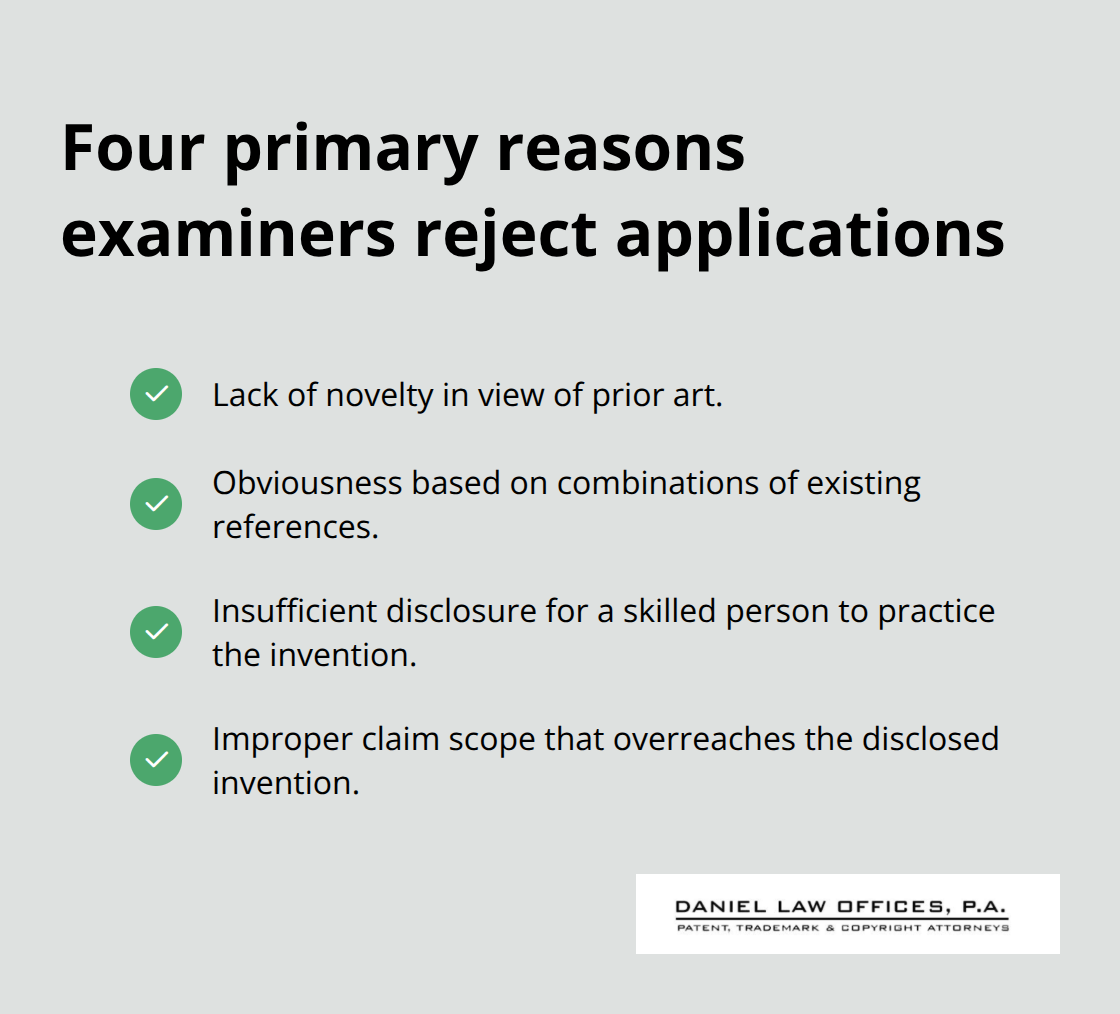
The examiner rejects applications for four primary reasons: lack of novelty, obviousness, insufficient disclosure, and improper claim scope. Lack of novelty means your invention already exists in prior art-earlier patents, published articles, or products sold more than one year before your filing date. Obviousness rejections argue that your invention would be obvious to someone skilled in your field when combining existing references, and the examiner must explain specifically how prior art teaches each element. Insufficient disclosure occurs when your written description fails to provide enough technical detail for a skilled person to build or use the invention without undue experimentation.
Timeline and Cost Expectations
Typical prosecution takes 2–4 years total, with costs ranging from $2,000–$5,000 per substantive response beyond the initial filing fee. Each rejection you receive is actually an opportunity: the examiner provides specific citations and reasoning that reveal exactly which prior art threatens your claims and where your disclosure needs strengthening. This feedback gives you a roadmap for targeted amendments rather than guesswork, and understanding these specific objections positions you to craft responses that address the examiner’s actual concerns rather than making broad, unfocused changes to your application.
How to Respond When the USPTO Rejects Your Patent Claims
Amend Your Claims to Address Specific Objections
When you receive a non-final rejection, amend your claims strategically rather than accepting the examiner’s position as final. The examiner provides specific citations to prior art and articulates exactly which elements of your invention lack novelty or appear obvious, which means you have a roadmap for targeted amendments that address those precise objections. Narrowing your claims to exclude the cited prior art is often the fastest path forward, but avoid over-narrowing in your first response because you can always narrow further in subsequent office actions if needed.
If the examiner cites a patent issued in 2015 that discloses a similar component, you can amend your claims to specify novel features or technical parameters that distinguish your invention from that reference. For example, if prior art teaches a valve with a 5-millimeter opening but your invention uses a 3-millimeter opening with specific material composition, amend your claims to include those distinguishing features. File your response within the required timeframe, typically three months from the office action date, because missing deadlines can result in abandonment of your application and loss of your filing date priority.
Use Patent Office Interviews to Clarify Examiner Concerns
Patent Office interviews with your examiner offer a tactical advantage that many applicants overlook. You can request a telephone or video interview after filing your written response, or even before filing it, to discuss the examiner’s concerns directly without the formality of written arguments. During the call, ask the examiner to explain which specific claim elements create problems and what additional evidence or claim language would address those concerns.
Some examiners provide substantial guidance during these conversations that never appears in writing, and this informal feedback often clarifies whether the examiner views your invention as fundamentally unpatentable or simply poorly claimed. These interviews frequently reveal the examiner’s actual position more clearly than office actions alone.
Choose Your Path After a Final Rejection
If a non-final rejection becomes final after your first response, you face three main options: file a Request for Continued Examination to keep prosecution open on the same application, file a continuation application that allows you to pursue different claim scope while preserving your original filing date, or appeal to the Patent Trial and Appeal Board.
A Request for Continued Examination costs $2,000 and allows one more round of amendments and arguments on the existing application, making it suitable when you believe minor claim adjustments will satisfy the examiner. A continuation application preserves your priority date but launches a separate prosecution track, which costs another filing fee of $330 for large entities and gives you flexibility to pursue broader claims in the new application while narrowing claims in the original one to potentially reach allowance faster. This strategy of running parallel prosecution paths sometimes results in one application issuing while the other remains under examination, giving you earlier patent protection on narrower claims while the broader claims continue negotiation with the examiner.
When final rejections persist despite your amendments, the Patent Trial and Appeal Board becomes your next tactical option, and understanding when to appeal versus when to file a continuation application requires careful analysis of your specific circumstances and long-term patent strategy.
When Standard Responses Fail
Appeal to the Patent Trial and Appeal Board
The Patent Trial and Appeal Board represents your most direct path to overturn a final rejection without launching a new application. You become eligible to appeal after the examiner rejects any claim twice, according to 35 U.S.C. 134(a), which means you can appeal immediately after a final rejection if you received a non-final rejection beforehand. The appeal process starts with filing a Notice of Appeal on form AIA/31 and paying the required appeal fee, then submitting an Appeal Brief within two months of filing the notice. Missing this deadline results in dismissal or abandonment, though you can request a one-month extension if circumstances warrant it.
The Patent Trial and Appeal Board provides an appeal brief template and detailed instructions on its website, which removes much of the guesswork from formatting and compliance. Your appeal brief must address the examiner’s specific rejections and explain why the cited prior art does not render your claims unpatentable, distinguishing your invention with concrete technical features rather than general arguments about market demand or commercial potential. After you submit the brief, the examiner files an answer defending the rejection, and you can then request an oral hearing before the Board using form AIA/32 to present arguments directly.
The Board may affirm all rejections, reverse them completely, or affirm in part. A complete reversal triggers immediate action by the examiner to issue your patent without further delays. If the Board affirms some rejections, you can file a Request for Continued Examination to pursue amendments on remand, effectively continuing prosecution after the appeal concludes.
Reexamination and Post-Grant Review Options
Reexamination and post-grant review serve different purposes and apply to different timelines. Reexamination allows you or a third party to request that the USPTO re-examine your patent after it issues, raising new prior art or arguments about novelty and obviousness. This option remains available for the life of your patent. Post-grant review applies only to patents issued after March 16, 2013, and must be filed within nine months of patent issuance, making it a time-sensitive option if a competitor threatens your market position immediately after grant.
Why Litigation Against the USPTO Rarely Succeeds
Litigation against a USPTO decision is rarely the right choice because courts defer heavily to examiner determinations under the arbitrary and capricious standard. You must show the examiner’s decision was fundamentally unreasonable rather than merely wrong. The Federal Circuit has upheld most examiner rejections on appeal, making litigation an expensive and low-probability path unless your case involves a novel legal question about patent eligibility or claim scope that creates precedential value.
Strategic Priorities for Patent Protection
Exhausting administrative remedies through the Patent Trial and Appeal Board should precede any consideration of litigation, since the Board’s reversal rate substantially exceeds the Federal Circuit’s reversal rate. Board decisions also cost significantly less to obtain than federal court litigation. The Patent Trial and Appeal Board offers your strongest tactical advantage when standard responses and amendments fail to move your application toward allowance.
Final Thoughts
Patent rejection does not end your path to protection. The strategies outlined here-from targeted amendments to Patent Trial and Appeal Board appeals-provide concrete tactical options at each stage of prosecution. We at Daniel Law Offices, P.A. analyze examiner office actions, identify which prior art actually threatens your claims, and craft responses that address specific objections rather than making unfocused changes to your application.
Your next step depends on where you stand in the prosecution timeline. If you received a non-final rejection, file amendments within the required timeframe and request a Patent Office interview to clarify examiner concerns directly. If a final rejection has arrived, evaluate whether a Request for Continued Examination, continuation application, or Patent Trial and Appeal Board appeal best serves your long-term patent strategy, since each path carries different costs and timelines based on your innovation’s market timeline and the strength of your distinguishing features.
A patent rejection attorney in Orlando helps you navigate these decisions without the guesswork and positions your application for success. Contact Daniel Law Offices, P.A. to discuss your specific rejection and develop a prosecution strategy tailored to your innovation and business goals.