



Orlando Patent Procurement Guide: A Practical Look at the Patent Application Process
Getting a patent approved requires understanding the USPTO’s requirements and preparing your application correctly from the start. This Orlando patent procurement guide walks through each stage of the process, from evaluating whether your invention qualifies for protection to handling examiner feedback.
We at Daniel Law Offices, P.A. help inventors navigate these steps efficiently and avoid common pitfalls that delay or derail applications.
Understanding Patent Eligibility and Prior Art in Orlando, Florida
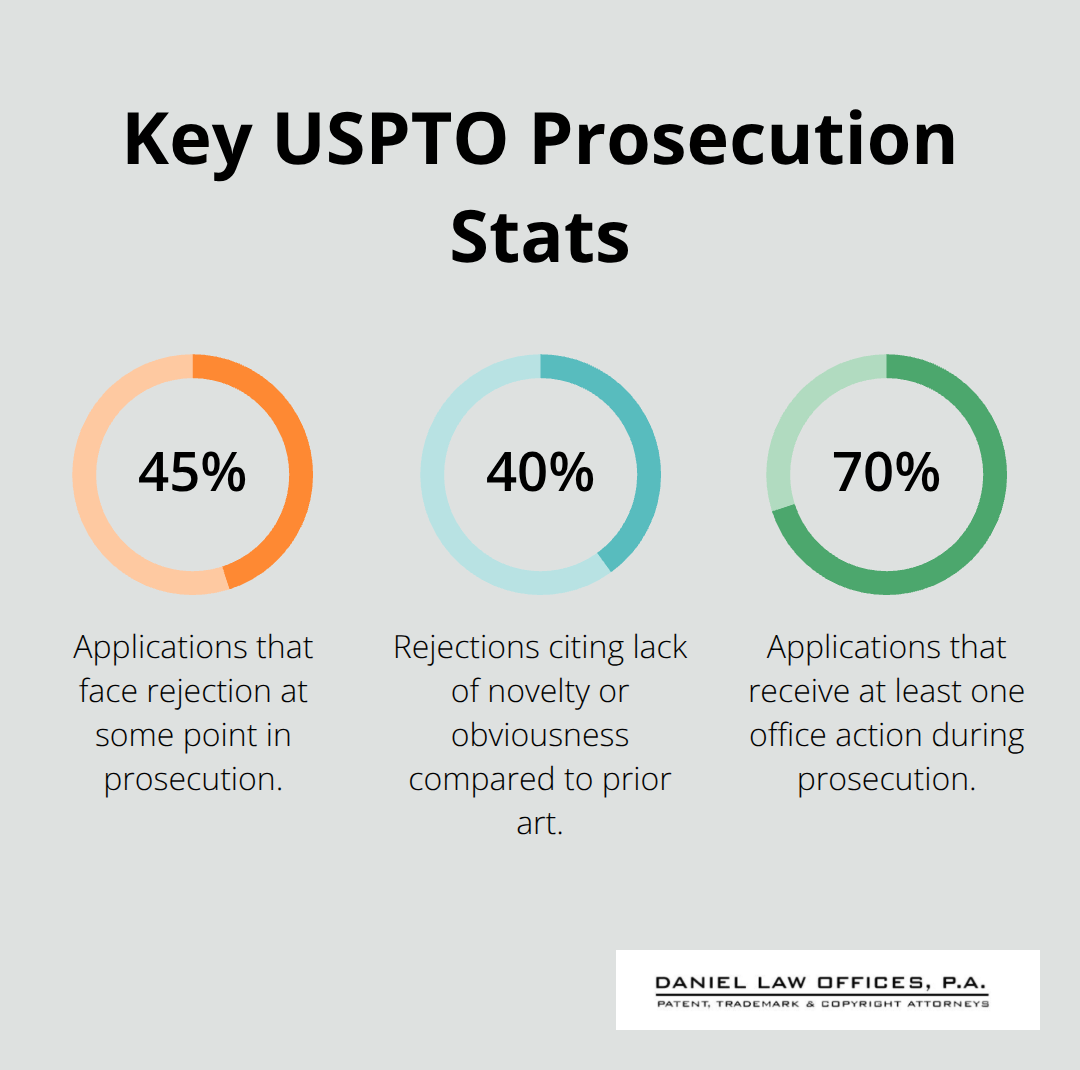
The USPTO receives over 600,000 patent applications annually, and roughly 45% face rejection at some point in prosecution. The difference between applications that move forward and those that stall often comes down to one thing: understanding patentability from the start.
Your invention must fall into one of five statutory categories established by the Patent Act: a process, a machine, a manufacture, a composition of matter, or an improvement of any of these. Abstract ideas, laws of nature, and mathematical formulas alone cannot receive patent protection, no matter how innovative they seem.
Software Patents and Tangible Results
Software patents face intense scrutiny because examiners view them as abstract concepts unless you tie them to a concrete technological application or hardware component. This means your documentation must clearly show how your invention produces a tangible, real-world result beyond pure theory. The distinction matters enormously-a patent examiner will reject software that merely performs calculations, but will approve software that controls a physical device or improves an existing technological process.
Conducting Your Patent Search
Before filing anything, conduct a thorough patent search through the USPTO’s database and Google Patents. This step costs between $300 and $1,500 depending on complexity, but skipping it wastes thousands on an application destined for rejection. Search for patents similar to yours using keywords, classifications, and inventor names. Pay attention to patents filed in the last five years, as they represent your most direct competition.
The USPTO examiner will find prior art you missed, so finding it yourself first gives you time to adjust your claims and strengthen your application. Many inventors discover that their invention already exists in some form, and that intelligence prevents wasted filing fees. When you search, look beyond just patents-check published applications and non-patent literature like academic papers and product manuals, since these also count as prior art under patent law.
Common Rejection Reasons
The most common rejection reason, cited in nearly 40% of rejections, is lack of novelty or obviousness compared to prior art. Your invention must differ meaningfully from what already exists, not just combine existing elements in an obvious way. The second major rejection category involves inadequate disclosure: your written description fails to teach someone skilled in your field how to make and use your invention. This happens frequently when inventors rush their technical descriptions or assume examiners will understand unstated details.
Specification problems-unclear claims, missing drawings, or vague terminology-account for another significant chunk of rejections. The USPTO requires precise language describing exactly what your invention does and what makes it different. Strengthening these descriptions before submission dramatically improves approval odds and reduces back-and-forth with examiners. With proper preparation and attention to these common pitfalls, you position your application for success before it even reaches the USPTO.
Preparing Your Patent Application Materials
Create Technical Drawings That Meet USPTO Standards
Technical drawings and written descriptions form the backbone of any patent application, and they must meet the USPTO’s strict standards for enablement. Your drawings need to show every element of your invention with enough detail that someone skilled in your field could replicate it based solely on your documentation. The USPTO requires drawings for nearly all inventions except some business methods, and examiners will reject applications with vague or incomplete illustrations.
Professional technical drawings cost $200 to $500 per drawing but prevent rejections that waste months and thousands in additional attorney fees. Your written description must explain not just what your invention is, but how it works and why it works better than existing solutions. Use clear, technical language without unnecessary jargon. The specification should address potential variations and alternative embodiments so examiners see the full scope of your innovation.
Many inventors fail here by writing descriptions so brief or abstract that examiners cannot understand the invention’s practical operation. Thorough, detailed specifications move through examination faster than minimal descriptions.
Write Specifications That Examiners Understand
Your written description carries as much weight as your drawings in the examination process. Examiners need to understand not only what your invention does but also how someone in your field could build and use it based on your words alone. Vague language, missing steps, or unexplained technical processes trigger rejection requests that extend timelines significantly.
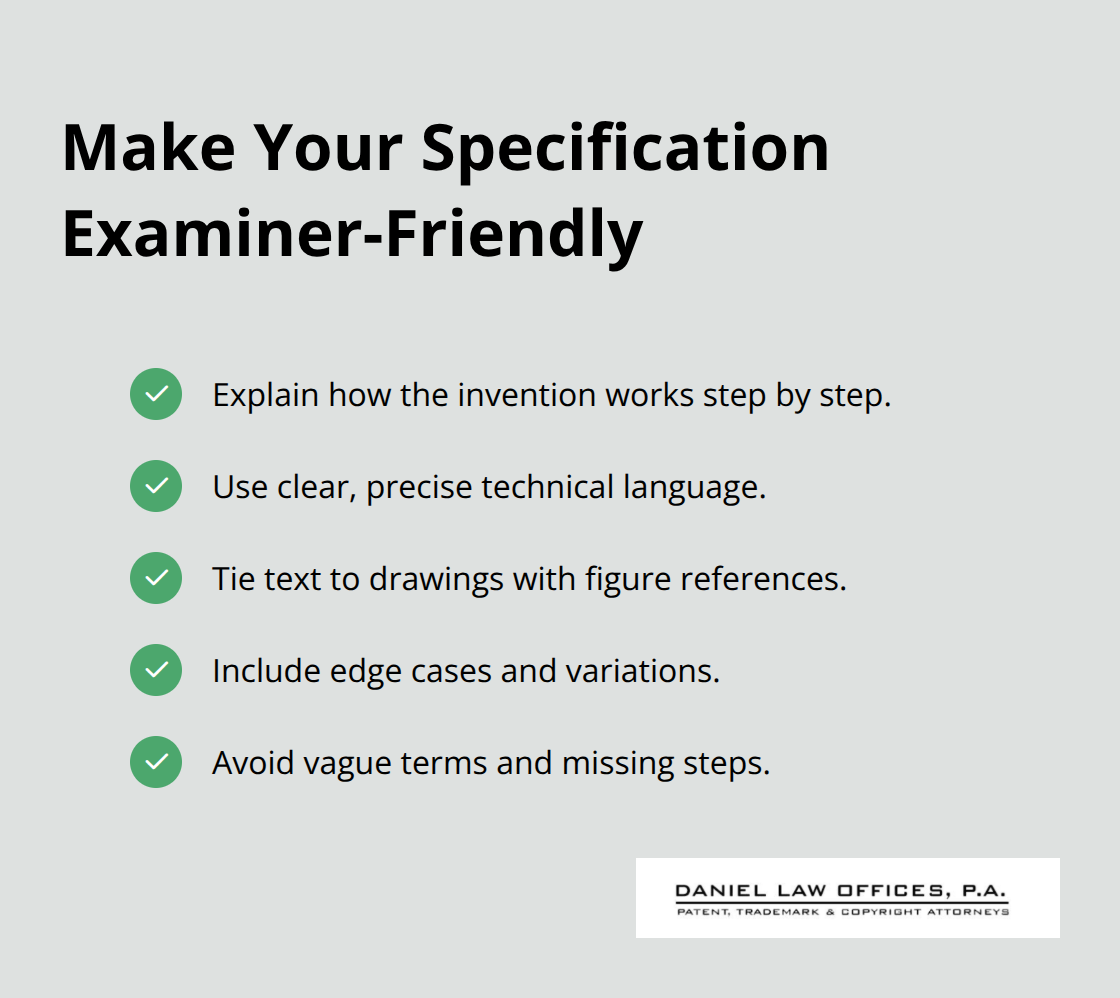
Structure your specification to flow logically from the problem your invention solves, through the technical solution, to specific examples of how it works. Include drawings references throughout your text so examiners can connect your written explanation to visual representations. Address edge cases and variations your invention can handle-this demonstrates you understand your creation’s full potential and scope.
Document Your Invention’s Novelty With Dated Evidence
Gathering evidence of novelty requires more than knowing your invention is new-you must document proof. Collect dated records showing when you conceived the idea, including lab notebooks, prototype photos, emails, or development notes with timestamps. This evidence protects you against competitors who might claim earlier invention.
Beyond internal documentation, compile market research showing no existing products perform your invention’s function. Search patent databases and competitor websites to build a paper trail demonstrating your invention’s uniqueness. Organize all materials chronologically in a single folder with clear labels and index files.
Organize Materials for Efficient Examination
Create a summary document listing every piece of evidence and its location so your attorney can quickly reference materials during examination. Poor organization causes delays-examiners request clarification when they cannot easily find supporting information, adding weeks to prosecution timelines. Store originals safely and maintain digital backups of everything.
This organized approach allows your legal team to respond to USPTO office actions within the required timeframes without scrambling to locate documentation or reconstruct your invention’s development history. With your materials properly prepared and organized, you’re ready to navigate the actual filing process with the USPTO.
Filing and Prosecuting Your Patent Application
The moment you submit your application to the USPTO, your invention enters a formal examination process that typically lasts 18 to 36 months. The USPTO charges a filing fee of $320 for small entities as of 2026, plus additional fees for excess claims if your application contains more than 20 independent claims. Most inventors underestimate how active they must be during prosecution-the examiner will not approve your patent simply because your application is thorough. Instead, expect an office action within four to six months of filing, which is the examiner’s formal response requesting clarification, modifications, or arguing that your invention lacks novelty or non-obviousness compared to prior art.
Understanding Office Actions and Response Strategy
This is where many applications fail: inventors panic at the first rejection and either abandon their application or accept unfavorable claim restrictions. The reality is that roughly 70% of patent applications face at least one office action, making response strategy the true determinant of success. When your office action arrives, you have three months to respond-this deadline is absolute and the USPTO will not extend it without exceptional circumstances.
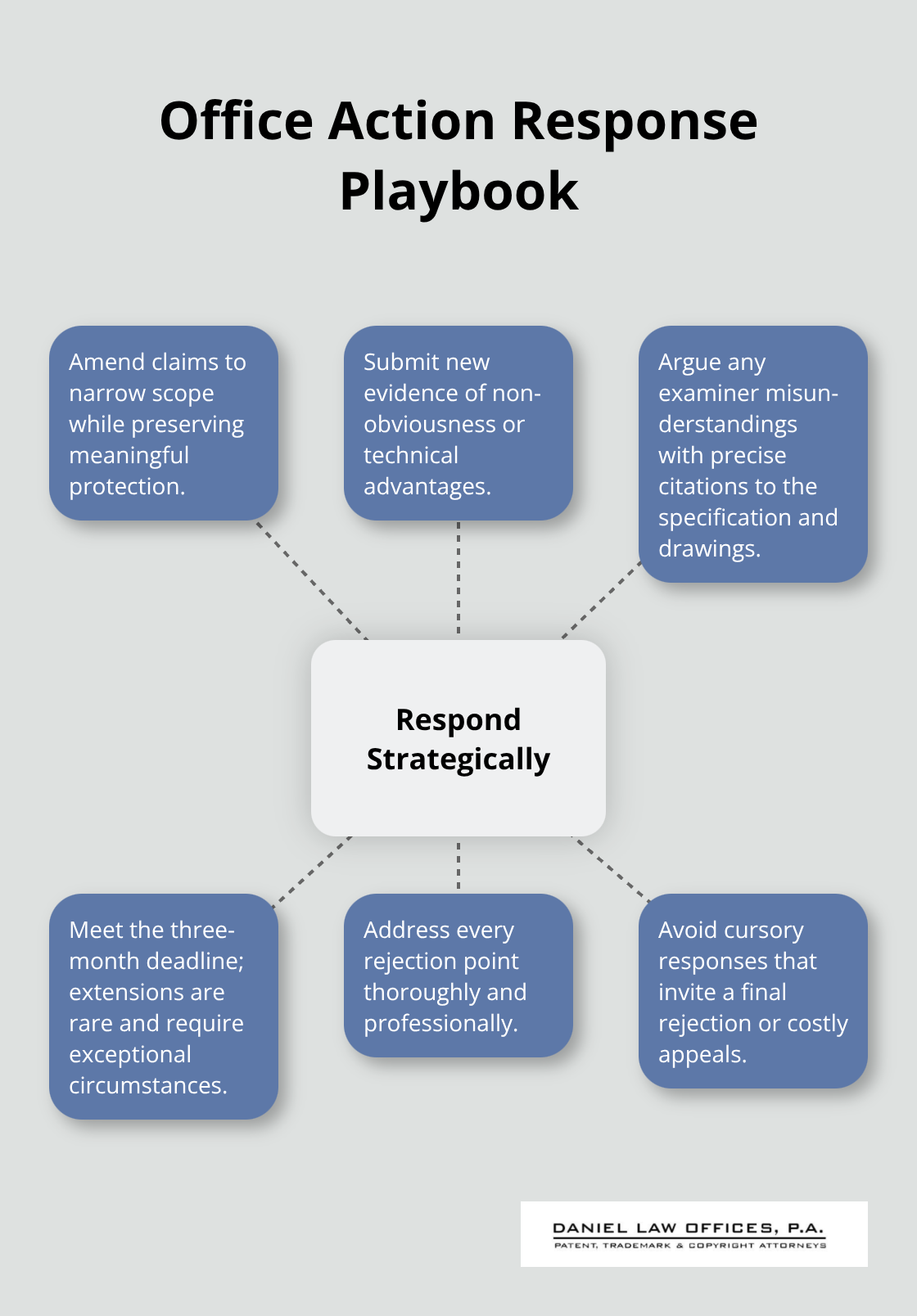
Your response must address every rejection point the examiner raised, whether that means amending your claims to narrow the scope of protection, submitting new evidence of non-obviousness, or arguing that the examiner misunderstood your invention’s technical operation. Weak responses waste this critical opportunity; a poorly argued response virtually guarantees a final rejection that forces you into expensive appeal proceedings.
Crafting Claims That Survive Examination
Your patent claims deserve obsessive attention because they define exactly what the patent protects and what competitors can legally design around. Claims are written in dense legal language that differs fundamentally from your specification’s descriptive narrative-independent claims stand alone and describe your invention in broadest possible terms, while dependent claims narrow the scope by adding specific limitations. The examiner will push back on broad claims by citing prior art, so your strategy must balance claiming as much protection as possible while remaining narrow enough to distinguish your invention from existing patents and publications.
Many inventors make the mistake of claiming features that already exist in prior art documents, which guarantees rejection. Your specification must support every limitation in your claims through written description and drawings-if your claims recite a specific measurement, material, or technical step that your specification never mentions, the examiner will reject the claims as unsupported. A thorough claim chart during prosecution maps every claim element to specific portions of your specification and drawings, ensuring nothing floats without foundation.
Building Specification Support for Your Claims
The distinction between adequate and inadequate specifications often determines whether you receive a broad patent that provides real market protection or a narrow patent that competitors easily design around. Your written description must connect directly to every technical element you claim in your patent. Examiners scrutinize this connection intensely, and gaps between your claims and specification create rejection vulnerabilities that extend prosecution timelines significantly.
Strategic Filing Approaches
A provisional application first costs only $180 for small entities and buys you 12 months to perfect your full application while establishing an early priority date. This tactical move allows you to test your invention’s market viability before committing to the full examination process. Many Orlando-area inventors overlook this strategy despite its significant advantages in managing both costs and timelines.
Final Thoughts
Patent protection requires executing each step correctly, from conducting thorough prior art searches through responding strategically to examiner office actions. The applications that succeed share common characteristics: detailed technical drawings, comprehensive written specifications, well-crafted claims supported by your documentation, and proactive responses to USPTO feedback. Skipping any of these elements creates vulnerabilities that examiners exploit, extending prosecution timelines and increasing costs substantially.
After your patent application reaches the USPTO, your work shifts from preparation to active engagement with the examination process. Monitor your USPTO account regularly for office actions, which typically arrive within four to six months, and respond promptly to every examiner request with clear arguments and supporting evidence rather than minimal answers that invite further rejections. If your application faces rejection, evaluate whether narrowing your claims or submitting additional evidence strengthens your position before accepting restrictions you may regret later. Consider filing a provisional application first if you need time to refine your invention or test market viability before committing to full examination costs.
This Orlando patent procurement guide emphasizes that successful patent protection combines thorough preparation with strategic prosecution decisions. Contact Daniel Law Offices, P.A. to discuss your invention’s patentability and develop a filing strategy tailored to your specific situation and business goals.