




Orlando Patent Landscape 2025: What It Means for Inventors
Orlando’s patent landscape in 2025 is shifting rapidly, with more inventors filing applications and new industries emerging as innovation hubs. If you’re developing something valuable, understanding these changes isn’t optional-it’s how you protect your competitive edge.
We at Daniel Law Offices, P.A. see firsthand how the right patent strategy separates successful innovators from those who miss critical opportunities. This guide walks you through what’s happening locally and how to avoid the mistakes that cost inventors time and money.
Orlando’s Patent Activity in 2025
Orlando’s patent filing landscape has grown measurably over the past two years, driven by expansion in aerospace, technology, and entertainment sectors. The 2025 data shows that inventors in central Florida file applications at a steady pace, though the region still lags behind major innovation hubs like Silicon Valley and Boston. What matters most for you as a local inventor is not just the raw numbers but where the real opportunities sit.
Aerospace, Entertainment, and Software Lead Local Innovation
The aerospace and defense industries continue to anchor Orlando’s innovation economy, with companies developing drone technology, avionics systems, and unmanned systems generating substantial patent activity. The entertainment and virtual reality sector accelerates alongside this, particularly around augmented reality experiences for theme parks and immersive gaming platforms. Software and AI-related patents emerge as a third major category, reflecting broader national trends but with Orlando-specific applications in tourism tech and hospitality automation.
The University of Central Florida serves as a significant source of patentable research, particularly in engineering and computer science. This creates opportunities for inventors to collaborate on university-backed innovations that can lead to licensed patents and commercialization pathways.
How Orlando Stacks Against National Trends
National patent filing data shows the USPTO processed over 600,000 applications in recent years, with utility patents accounting for roughly 90 percent of all filings. Orlando’s contribution represents a fraction of this national volume, but the growth rate in central Florida outpaces many comparable mid-sized metropolitan areas.
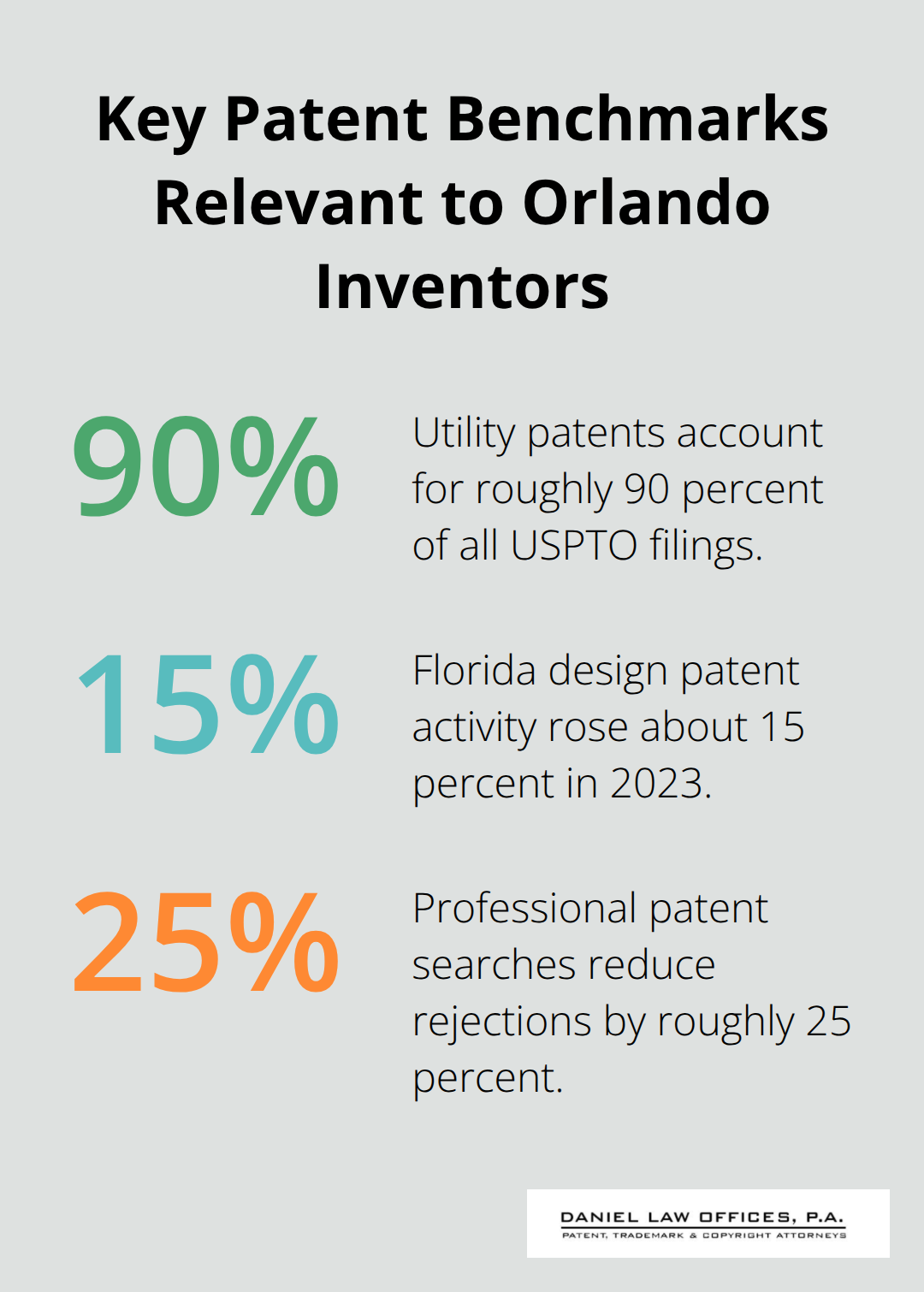
Design patents gain traction locally, with Florida design patent activity rising about 15 percent in 2023, particularly in furniture, automotive, and consumer electronics-sectors where Orlando manufacturers and designers compete directly. This growth signals that local inventors recognize the value of protecting ornamental designs alongside functional innovations, a strategic shift that reduces overall patenting costs while still providing meaningful market protection.
Why Search Quality Matters in Florida Courts
The middle district of Florida applies rigorous patent scrutiny in litigation, meaning applications filed from Orlando need particularly strong novelty statements and thorough prior art documentation to withstand court challenges later. Professional patent searches that cover 15 to 20 databases, including European and Japanese patent records, reduce rejections by roughly 25 percent compared to superficial searches, making this upfront investment essential for Orlando applicants competing in global markets.
Understanding these local dynamics positions you to make smarter filing decisions-and the mistakes inventors make when they skip critical steps can derail even the strongest innovations.
Why Patents Drive Revenue and Market Control
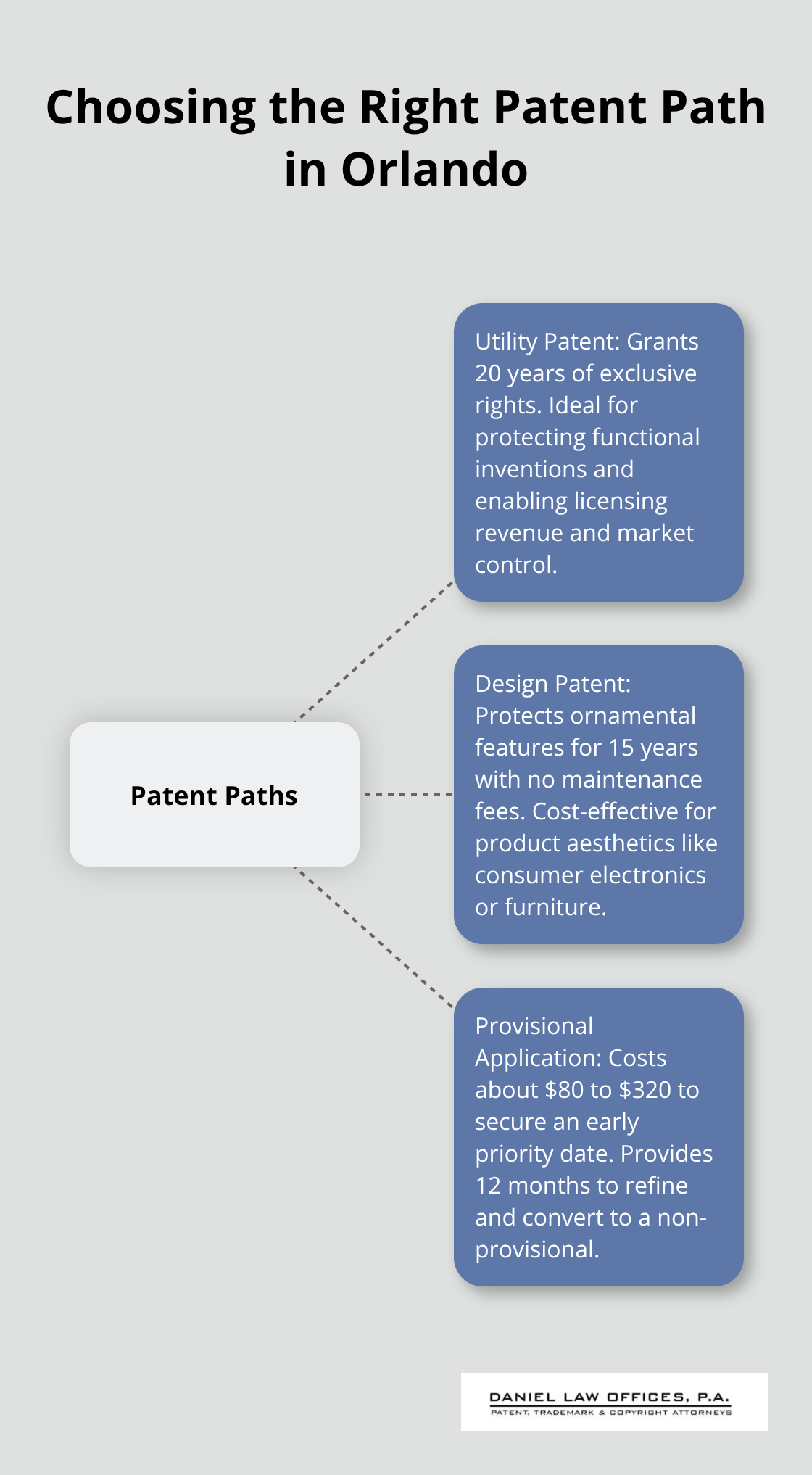
Patents transform ideas into defensible assets that directly impact your bottom line. Orlando inventors who file early and thoroughly gain measurable financial advantages over competitors who delay or cut corners on documentation. The American Bar Association data shows utility patent costs typically run between $8,000 and $15,000 when working with qualified counsel, but that investment returns multiples through licensing revenue, investor confidence, and market exclusivity. A patent grant gives you 20 years of monopoly rights for utility patents or 15 years for design patents, meaning you control who manufactures, sells, or licenses your invention during that entire window. Without patent protection, a competitor can copy your design tomorrow and undercut your pricing, erasing your first-mover advantage within months.
The Financial Case for Patents
The financial case sharpens when you factor in maintenance fees. Utility patent maintenance costs run roughly $2,150 at 3.5 years, $4,040 at 7.5 years, and $8,280 at 11.5 years to keep your patent enforceable. These amounts sound steep until you calculate licensing income from a single patent covering a profitable product category. Even modest licensing deals at 2 to 5 percent of gross sales on products protected by your patent easily cover maintenance costs while generating passive revenue. Orlando aerospace and drone manufacturers routinely license patented technologies to competitors rather than compete head-to-head, converting their R&D spending into recurring royalty streams. Design patents cost less to maintain since they require zero maintenance fees after grant, making them attractive for protecting consumer electronics or furniture designs where ornamental features drive purchasing decisions. The competitive advantage compounds when you hold multiple patents across product lines, creating a barrier that forces competitors to either license from you or redesign entirely around your claims.
Filing First Establishes Your Priority Date
Filing your patent application establishes a priority date that no competitor can challenge once your application publishes. The filing date matters enormously in patent law because two inventors cannot both hold valid patents on the same invention, and the first to file wins protection under current US law. Orlando startups competing in AR and VR entertainment technology understand this urgency because innovation moves fast in those sectors and second-to-file inventors lose all rights regardless of who invented first. Provisional patent applications accelerate this process by letting you claim an early filing date for just $80 to $320 while you continue developing your product over the next 12 months before converting to a full non-provisional application. This strategy works especially well for fast-moving Orlando tech companies that need to secure IP rights without committing to expensive full specifications immediately.
How Prior Art Searches Prevent Costly Rejections
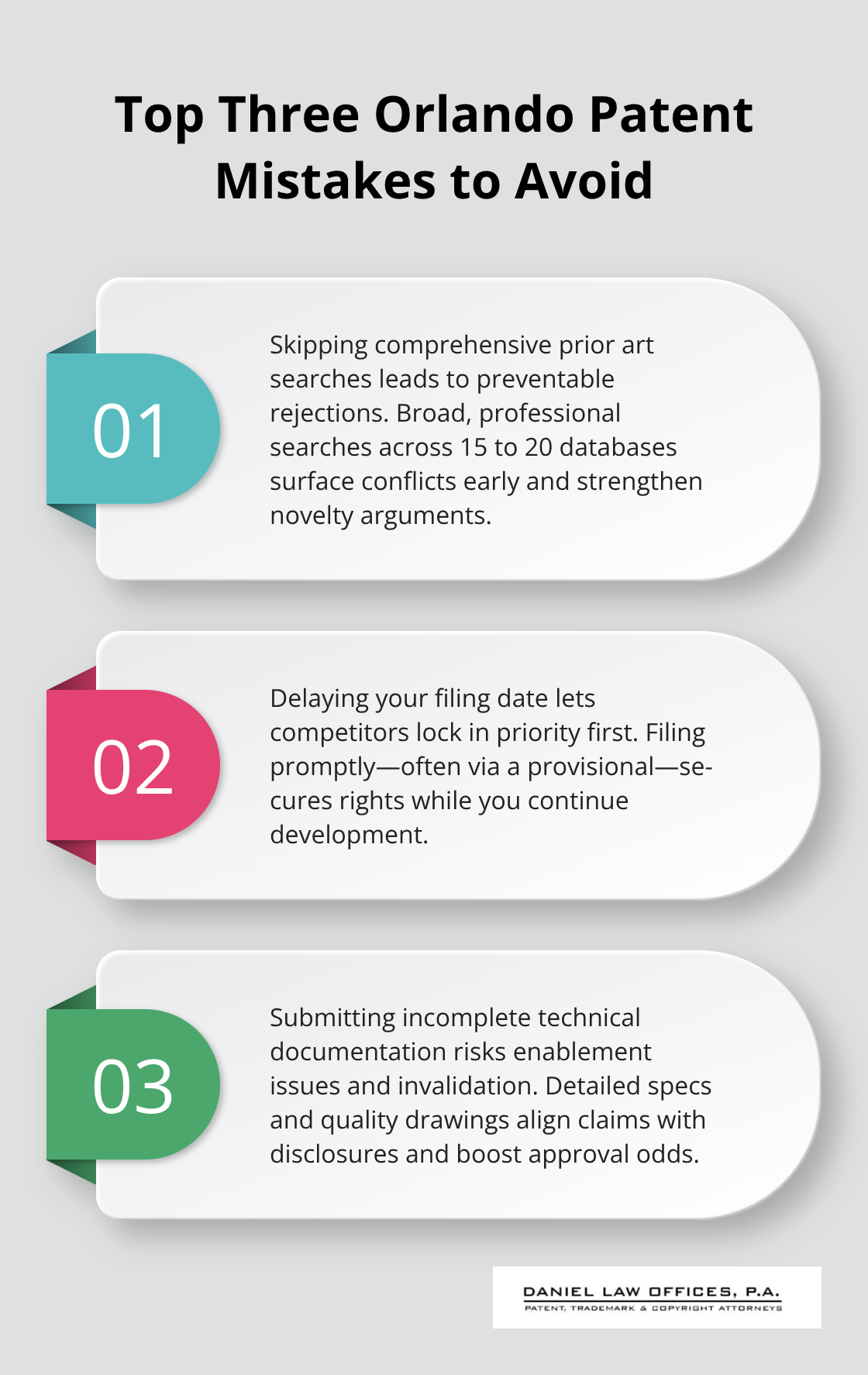
Professional prior art searches conducted before filing reduce rejections by roughly 25 percent according to USPTO data, meaning you avoid wasting months responding to Office Actions that could have been prevented with upfront research. The middle district of Florida courts scrutinize patent validity heavily, so applications from Orlando inventors benefit enormously from thorough documentation that anticipates examiner objections and demonstrates novelty against the broadest possible prior art universe (including European and Japanese patents that many amateur searches miss entirely). Comprehensive searches covering 15 to 20 databases cost between $2,000 and $5,000 upfront but save far more in rejected applications and extended prosecution timelines. Orlando inventors who skip this step face substantially higher rejection rates and longer prosecution periods, ultimately spending more money to reach the same outcome. The investment in quality searches pays dividends immediately through faster approvals and stronger patent grants that withstand future litigation challenges in Florida courts.
Orlando Patent Mistakes That Cost Inventors Thousands
Most Orlando inventors make one critical error that cascades into months of delays and thousands in wasted fees: they underestimate how thoroughly they need to search existing patents before filing. The USPTO data shows roughly 8 percent of applications face rejection for insufficient prior art documentation, but that statistic masks a deeper problem specific to Orlando applicants filing in the middle district of Florida, where courts apply rigorous scrutiny to patent validity. Many local inventors conduct surface-level searches using free library resources or basic USPTO keyword searches, missing European patents, Japanese patents, and non-patent literature that examiners will inevitably find during prosecution.
The Cost of Skipping Comprehensive Prior Art Searches
A professional search covering 15 to 20 databases costs between $2,000 and $5,000 upfront, but skipping this step virtually guarantees you’ll face 2 to 4 Office Actions demanding responses within six months each. This extends your prosecution timeline by 18 to 36 months while you scramble to address rejections that a comprehensive search would have prevented. Orlando aerospace and software developers competing globally cannot afford this mistake because their innovations often overlap with international prior art, and the examiner will find what you missed.
Delaying Your Filing Date Hands Control to Competitors
The second mistake Orlando inventors consistently make involves delaying their filing date, particularly when working with university partners or collaborators. Filing establishes your priority date immediately, and waiting even three months can mean a competitor files first and locks you out entirely under current US law. Provisional patent applications let you secure an early filing date for just $80 to $320 while continuing development, a strategy that Orlando startups in AR and VR entertainment technology use routinely to move fast without committing to expensive full specifications immediately. Delaying converts your first-mover advantage into a liability because innovation moves quickly in technology sectors, and the first inventor to file controls the patent regardless of who actually invented first.
Incomplete Technical Documentation Leads to Invalidation
The third mistake involves submitting incomplete technical documentation that fails to enable someone skilled in your field to reproduce your invention. The USPTO requires applications to disclose your invention’s best mode and provide sufficient detail for reproduction, and missing technical specifications accounts for roughly 15 percent of patent invalidations in litigation. Orlando inventors often rush their specifications to cut costs or move quickly, then face rejections citing inadequate disclosure or claims that don’t match their drawings and written description.
High-quality technical drawings appear in roughly 90 percent of successful applications and boost approval odds by about 20 percent when they meet USPTO formatting requirements, yet many local applicants submit amateur sketches that fail to verify every claim element with proper numbering and annotation. Detailed specifications should run approximately 10,000 words for utility patents and must address how your invention differs from prior art, what problems it solves, and how someone would manufacture or use it without trial and error.
Professional Preparation Reduces Rejections Significantly
Applications prepared by registered patent attorneys show about 10 percent higher approval rates and roughly 25 percent fewer initial rejections than amateur drafts, which reflects the difference between describing your invention adequately and describing it in language that examiners and future litigators will accept. Daniel Law Offices, P.A. assists Orlando inventors through comprehensive prior art searches, strategic filing timing, and thorough application preparation that anticipates examiner concerns before they arise during prosecution.
Final Thoughts
Orlando’s patent landscape in 2025 rewards inventors who act decisively and avoid preventable mistakes that derail applications. Conduct thorough prior art searches covering international databases, file your application promptly to establish priority, and document your invention with technical precision that enables reproduction. The middle district of Florida applies rigorous scrutiny to patent validity, so weak applications fail in court even if they pass initial examination.
A utility patent grants 20 years of exclusive rights that transform your innovation into a defensible asset generating licensing revenue and investor confidence. Design patents protect ornamental features for 15 years without maintenance fees, making them cost-effective for product aesthetics. Provisional applications cost just $80 to $320 and secure your priority date while you continue development-a strategy that Orlando startups use to move fast without committing to expensive full specifications immediately.
Contact us for a patent search and filing consultation to evaluate your invention’s patentability and develop a protection strategy aligned with your business goals. We at Daniel Law Offices, P.A. guide Orlando inventors through comprehensive searches, strategic filing decisions, and thorough application preparation that anticipates examiner concerns before prosecution begins. The inventors who succeed in the Orlando patent landscape 2025 act now rather than waiting for a competitor to file first.