




How to Submit a Patent Application Successfully
Patent submission can feel overwhelming, especially when you’re navigating USPTO requirements and technical specifications for the first time. The difference between a successful application and one that faces rejection often comes down to preparation and understanding what examiners actually look for.
We at Daniel Law Offices, P.A. have guided countless inventors through this process. This guide walks you through each stage-from checking if your invention qualifies for protection to handling office actions and deciding whether to appeal.
Establishing Your Invention’s Patent Foundation in Orlando, Florida
Patentability hinges on three concrete requirements: your invention must be novel, non-obvious, and useful. The USPTO rejects roughly 8% of applications due to lack of novelty alone, according to USPTO data, which means thousands of inventors each year find their ideas already exist in the patent system. Before spending time and money on filing, you need to verify that your invention genuinely offers something different from what’s already patented. Novelty means no single prior patent or published work can contain every element of your invention. Non-obviousness is harder to prove but equally important-your invention must represent a meaningful advance that wouldn’t be obvious to someone skilled in your field. Usefulness is straightforward: your invention must have a practical application. Many inventors skip or rush the novelty check because they believe their idea is unique, then face rejection months later when an examiner finds a similar patent filed years earlier. This is expensive and avoidable.
Prior Art Search Saves Time and Money
A comprehensive prior art search tests your invention’s true standing. The USPTO database contains millions of granted patents and published applications you can search for free, and supplementing that with international databases through WIPO PatentScope broadens your coverage significantly. A thorough search typically costs between $500 and $2,000 if you hire a professional to conduct it, according to USPTO guidance, and this investment often prevents costly rejections down the line. Many inventors attempt their own searches but miss relevant patents because they don’t know which terminology or classification codes to use. When you search, focus on the language used in existing patents’ claims rather than just the title or abstract. If you find a patent that looks similar, read the actual claims carefully-they define what the patent actually covers. Document everything you find, including what you eliminated and why your invention differs. This documentation becomes invaluable when responding to office actions if an examiner raises concerns about novelty. The Orange County Library System Patent and Trademark Resource Center assisted over 500 inventors in 2022, offering free access to search tools and guidance if you’re located in that region.
Why Applications Fail at the Examination Stage
About 60% of patent applications receive at least one non-final rejection from the USPTO, according to USPTO statistics, and most stem from incomplete technical disclosures, overly broad or poorly worded claims, or inadequate drawings. Obviousness rejections appear frequently when applicants fail to clearly articulate why their solution is non-obvious compared to existing patents. An examiner sees thousands of applications and recognizes when an inventor has simply combined known elements without genuine innovation. If your drawings lack detail or fail to show how every claimed feature works, the examiner will reject the application for insufficient enablement.
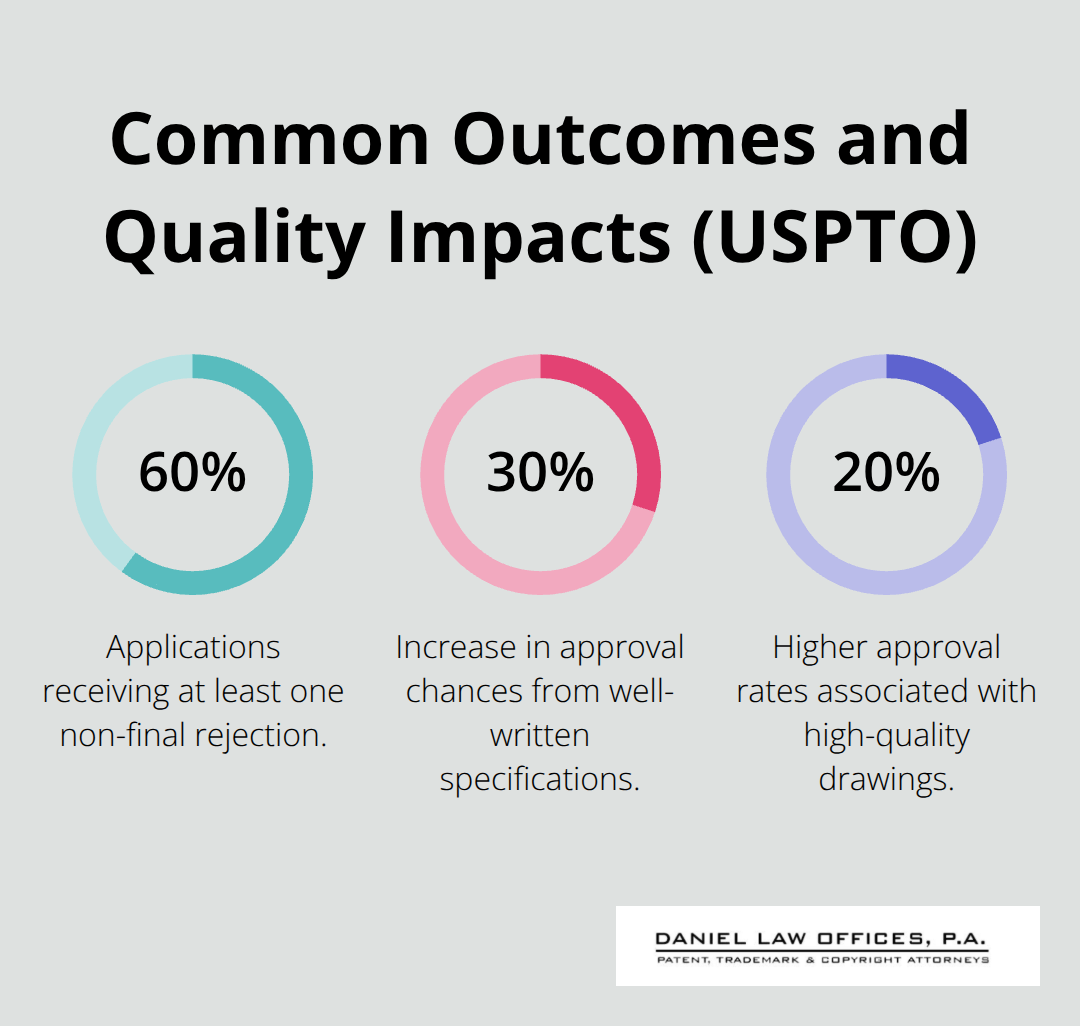
Applications prepared with professional guidance are roughly 10% more likely to gain approval without major revisions, according to USPTO data, largely because professionals understand what examiners actually scrutinize. Well-written specifications boost approval chances by about 30%, and well-drafted claims reduce initial rejections by approximately 25%, also per USPTO research. High-quality drawings correlate with about 20% higher approval rates without additional office actions. These numbers reflect a clear pattern: precision and completeness matter far more than clever wording or optimism about your invention’s merit.
Moving Forward With Your Application
Once you confirm your invention meets patentability standards and you’ve documented your prior art search thoroughly, you’re ready to prepare the actual application materials. The next stage requires you to gather technical documentation, create detailed drawings, and write claims that protect your invention without overreaching into territory already covered by existing patents. This preparation phase determines whether your application sails through examination or encounters significant obstacles.
Building a Strong Patent Application in Orlando, Florida
Create Drawings That Examiners Approve
Your technical documentation and drawings form the backbone of a patent application, and they directly influence whether an examiner approves your filing or requests revisions. The USPTO explicitly states that drawings correlate with roughly a 20% higher approval rate without additional office actions, which means investing time in quality illustrations pays dividends. Create drawings that clearly depict every single claimed feature of your invention. Black-and-white drawings work best unless color proves essential to understanding your invention, and each drawing must follow MPEP guidelines including proper margins, sheet size, and consistent numbering. Include multiple views-front, side, perspective, cross-sections-to show how components interact and function. Label every part with reference numerals that match your written description precisely.
Write Specifications That Enable Reproduction
Your specification needs sufficient technical detail that someone skilled in your field could actually build or use your invention based solely on what you’ve written. This means including exact measurements, materials, temperatures, pressures, or whatever specifications make your invention work. Many inventors write vague descriptions because they fear competitors will copy their work, but vague descriptions lead to rejections for lack of enablement. The USPTO data shows well-written specifications increase approval chances by about 30%, so precision directly improves your odds. Avoid introducing new technical matter in your specification that wasn’t disclosed in your claims, as this violates USPTO rules and triggers automatic rejection.
Draft Claims With Strategic Breadth
Your claims deserve the most careful attention because they legally define what your invention covers. Independent claims should be broad enough to protect your core function but narrow enough to avoid existing patents-this balance is critical. Add dependent claims that narrow the scope for valuable variations or embodiments of your invention. Well-drafted claims reduce initial rejections by approximately 25% according to USPTO research, and even a single misworded term can narrow your protection or render claims invalid. Avoid introducing new technical matter in your claims that wasn’t disclosed in your specification, as this violates USPTO rules and triggers automatic rejection.
File Your Application Electronically
When you file through Patent Center electronically, you avoid a $400 non-electronic filing fee and your application processes about 15% faster than paper filings. Register as an eFiler and prepare your complete package in PDF format with proper file naming. Submit your Application Data Sheet, specification, claims, drawings, an oath or declaration using form PTO/AIA/01 or PTO/AIA/08 (notarized if required), and the appropriate filing fees. For a nonprovisional utility patent in 2025, basic filing fees run $320 for large entities, $160 for small entities, and $80 for micro-entities, with additional fees for claims exceeding 20 or pages exceeding 100.
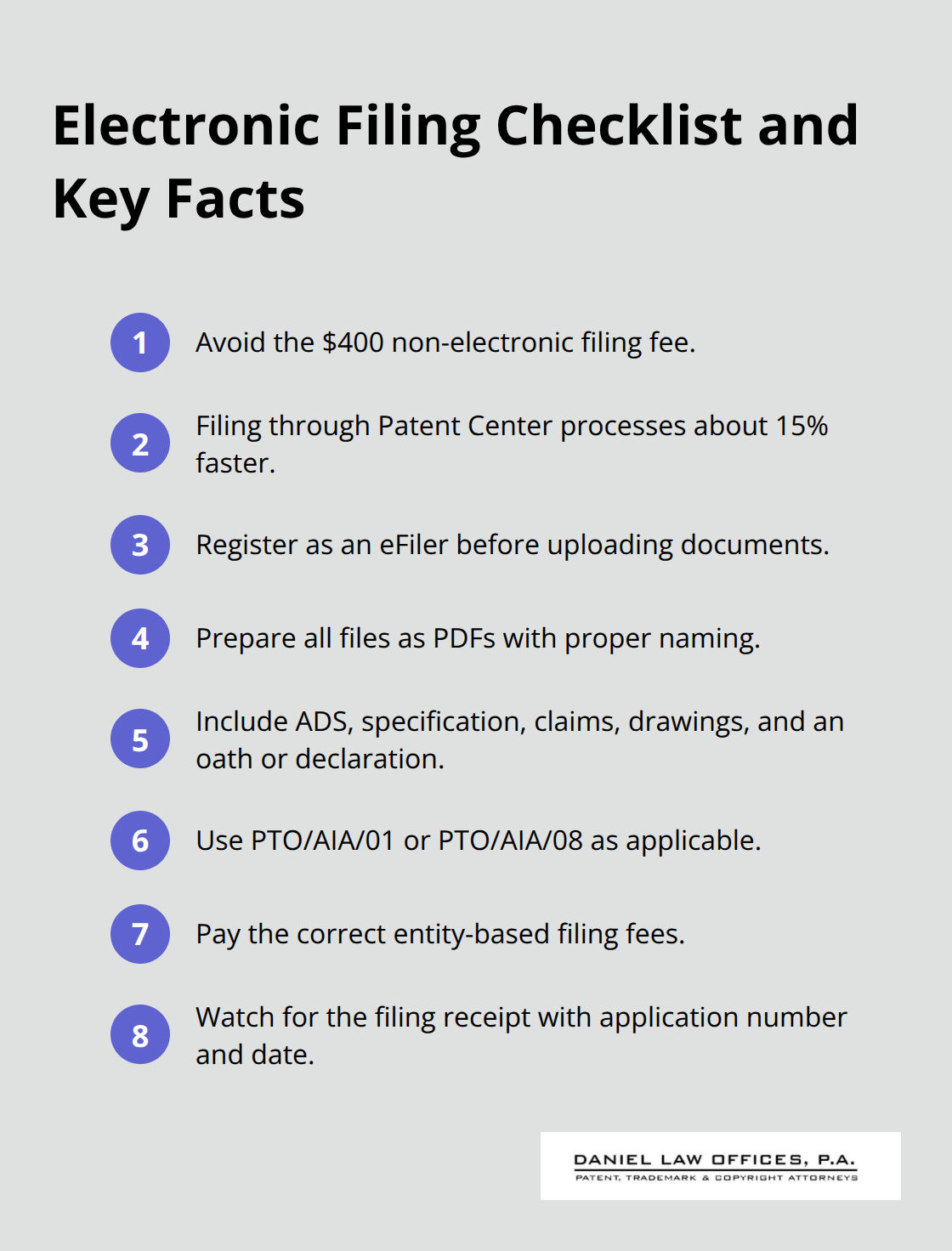
The USPTO assigns an examiner within weeks and issues a filing receipt with your application number and filing date, which establishes your priority.
Prepare for the Examination Process Ahead
Once you submit your application, the USPTO examination process begins. An examiner will review your drawings, specification, and claims against existing patents and published applications. The examiner may issue a First Action on the Merits outlining objections or rejections, which requires a timely response to keep your application moving forward. Understanding what happens next-and how to respond effectively to office actions-determines whether your patent grant comes quickly or faces significant delays.
Working Through Patent Rejections and Office Actions in Orlando, Florida
After the USPTO assigns an examiner to your application, you’ll typically receive a First Action on the Merits within months. This action outlines exactly what the examiner found problematic about your filing. About 60% of applications receive at least one non-final rejection according to USPTO data, so encountering objections is normal and doesn’t signal failure. The examiner might cite prior art you missed, claim language that’s too broad, drawings that lack sufficient detail, or a specification that doesn’t adequately enable someone skilled in your field to reproduce the invention.
Understanding Your Response Timeline
You have six months to respond, though you can request extensions of time by paying additional fees that escalate based on how many months you need. One month extensions cost $235 for large entities or $94 for micro-entities, while five months cost $3,395 or $1,358 respectively according to the 2025 USPTO fee schedule. Failing to respond within your deadline abandons the application, though revival is possible if you can prove the delay was unintentional. Most rejections aren’t permanent roadblocks-you respond by amending your claims to narrow their scope, strengthening your specification with additional technical detail, or providing arguments explaining why the examiner’s rejection misses the mark. Many applications gain approval through strategic amendments after initial rejection rather than proceeding unchanged through examination.
Navigating Final Rejections and Your Options
If the examiner issues a Final Action rejecting your application after your first response, you have three viable paths forward. Filing a Request for Continued Examination (RCE) allows you to submit new evidence, revised claims, or additional arguments for roughly $2,000 to $3,000 in fees depending on your entity status and claim count. This approach works well when you’ve identified weaknesses in your original response and can strengthen specific areas.
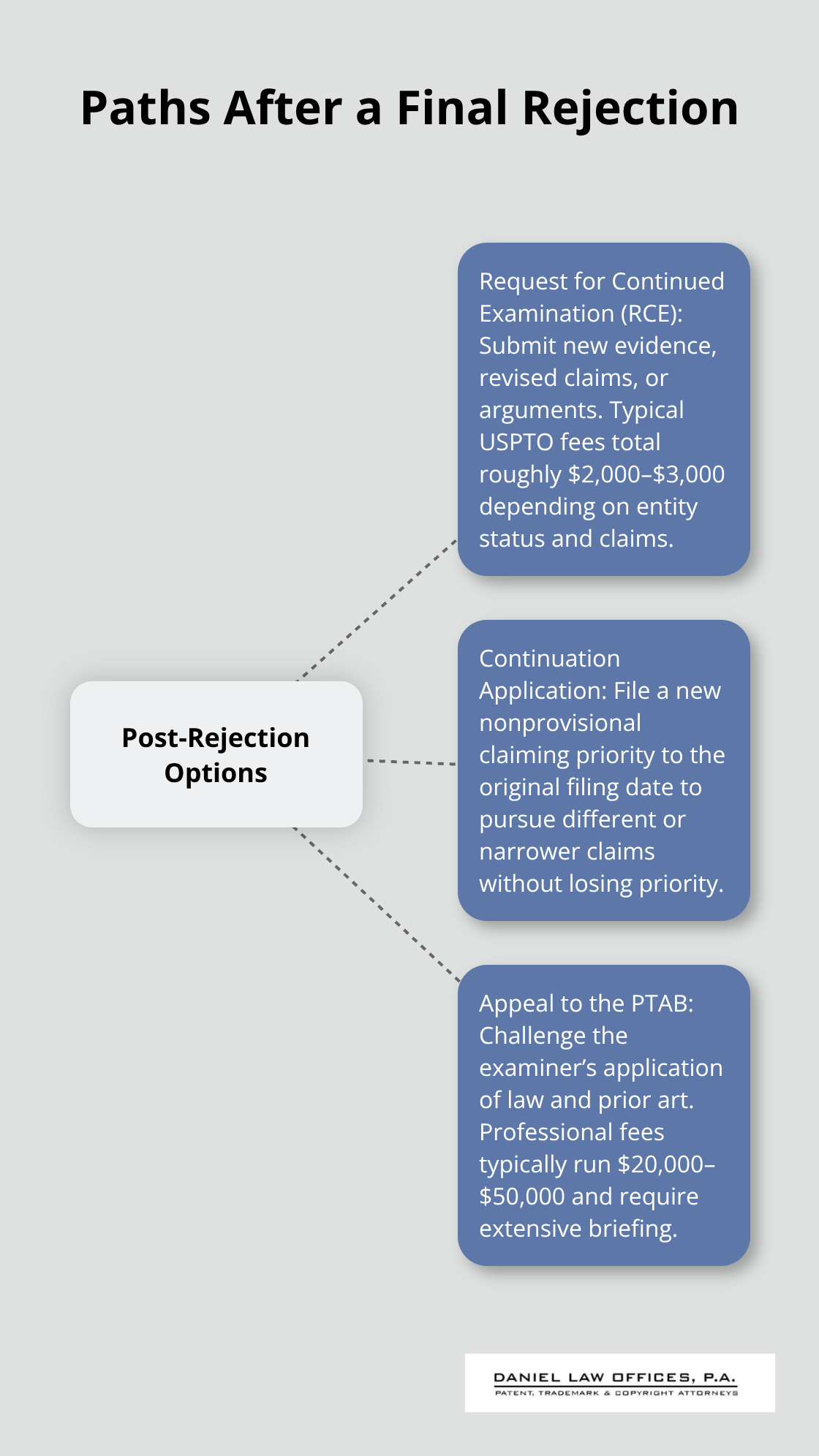
Alternatively, you can file a continuation application, which is a new nonprovisional application that claims priority to your original filing date while pursuing different claim language or a narrower scope. Continuation applications let you explore different claim strategies without losing your priority rights. Some inventors pursue both an RCE on the original application while simultaneously filing a continuation with alternative claims, spreading their chances across two parallel prosecution paths.
When to Appeal Your Rejection
A third option involves appealing to the Patent Trial and Appeal Board (PTAB), which reviews whether the examiner correctly applied USPTO rules and prior art. PTAB appeals are expensive and time-consuming, typically costing $20,000 to $50,000 in professional fees and requiring months of written briefing, so most inventors reserve appeals for situations where they have strong legal arguments that the examiner fundamentally misapplied the law.
Moving Toward Patent Issuance
After allowance, you’ll receive a Notice of Allowance requiring you to pay the issue fee, which runs $1,290 for large entities or $516 for micro-entities, plus any publication fees. Your patent issues within weeks of payment and provides protection for 20 years from your original filing date. Daniel Law Offices, P.A. assists clients through each stage of this prosecution process, helping you craft effective responses to office actions and determine the best strategy when facing rejections.
Final Thoughts
Patent submission success rests on three foundational elements: thorough preparation before filing, precise documentation during application assembly, and strategic responses when examiners raise concerns. The data confirms this reality-applications prepared with professional guidance are roughly 10% more likely to gain approval without major revisions, well-written specifications boost approval chances by about 30%, and high-quality drawings correlate with 20% higher approval rates without additional office actions. These improvements represent the difference between a patent that grants smoothly and one that consumes years navigating rejections and amendments.
Your application enters Patent Center monitoring immediately after submission, and the First Action on the Merits typically arrives within months. About 60% of applications receive at least one non-final rejection, so examiners will likely request claim amendments, additional technical detail, or stronger arguments distinguishing your invention from prior art. Understanding your six-month response timeline (with possible extensions available) and knowing your options when facing rejections prevents costly mistakes like missing deadlines or abandoning applications prematurely.
We at Daniel Law Offices, P.A. assist individual inventors and businesses in securing and protecting their valuable ideas through patents. Our registered patent attorney guides clients through comprehensive prior art searches, drafting and filing applications with the USPTO, and navigating the entire patent prosecution process. Contact Daniel Law Offices, P.A. to discuss how we can streamline your patent journey and maximize your chances of successful protection.