



How to Navigate the Patent Submission Process
Filing a patent is one of the most important decisions you’ll make to protect your invention. The patent submission process involves multiple steps, and getting even one detail wrong can delay or derail your application.
At Daniel Law Offices, P.A., we’ve guided countless inventors through this journey. This guide walks you through each stage so you can file with confidence.
Understanding Patent Eligibility and Requirements in Orlando, Florida
Not every invention qualifies for patent protection, and understanding what the USPTO will accept saves you time and money before you file. The USPTO grants patents only for inventions that are new, useful, and non-obvious. Your invention must differ meaningfully from everything already patented or publicly disclosed. According to the USPTO, about 8% of applications face rejection for lack of novelty, meaning the examiner found prior art that already covered your idea. This happens because many inventors skip the patent search phase and assume their invention is unique. The reality is harsh: if someone invented it first, filed first, or disclosed it publicly before you, your patent application faces rejection regardless of how well you draft it.
What Makes an Invention Patentable
Three main patent types exist in the United States, and choosing the wrong one undermines your protection strategy. Utility patents protect how an invention works and last 20 years from your filing date, making them the most common choice for mechanical, electrical, and software-based inventions. Design patents protect only the ornamental appearance of an article and last 15 years from the date the patent issues, which is shorter but appropriate if your competitive advantage is visual. Plant patents cover new varieties of asexually reproduced plants and also last 20 years from filing. Many inventors mistakenly believe software cannot be patented, but the USPTO grants patents for software when it’s tied to a device or solves a practical, technical problem. Provisional applications offer a low-cost entry point by establishing an early filing date for just $80 to $320 depending on your entity size, but you must convert them to a non-provisional filing within 12 months or you lose that priority date entirely. About half of provisional filings never convert to non-provisional applications, suggesting many inventors file provisionally without a clear plan for the full process.
Common Rejection Reasons and Prevention Strategies
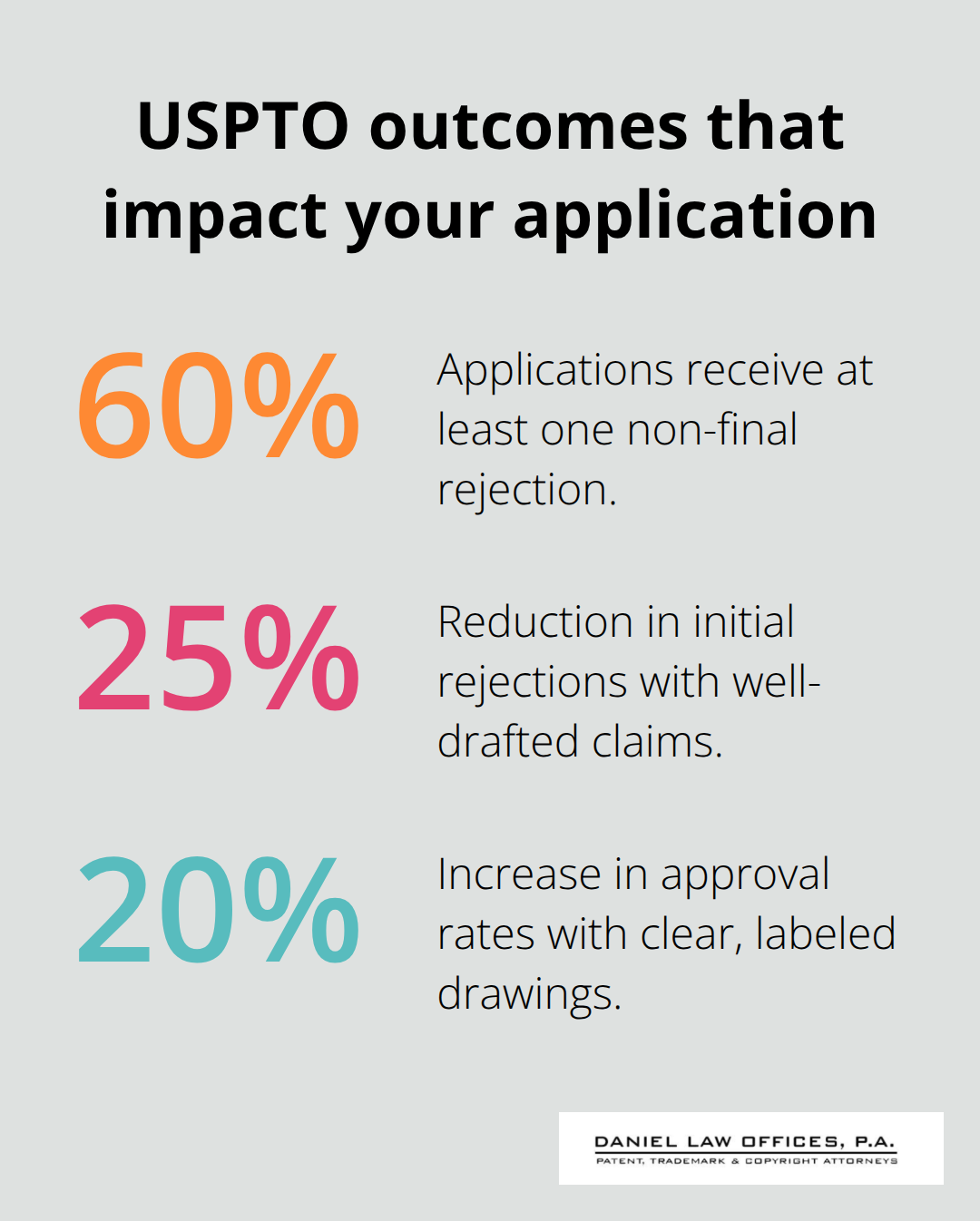
The most common rejection reasons stem from poor preparation rather than fundamental flaws in your invention. Incomplete disclosures cause roughly 15% of patent invalidations in litigation because you failed to explain how your invention actually works or how to build it. Vague claims language creates another major problem-examiners need precise, unambiguous wording to understand what you’re protecting, and broad ranges or unclear terms invite rejections. According to the USPTO, about 60% of applications receive at least one non-final rejection, but well-drafted claims reduce initial rejections by about 25%. Inadequate drawings represent a third critical failure point. Clear, labeled drawings with multiple views and cross-sections correlate with a 20% increase in approval rates without additional office actions.
Many inventors submit rough sketches thinking examiners will figure out the details, but that approach fails consistently. Missing or unclear documentation of your invention’s best mode (the most effective way to make it work) contributes to rejections and later invalidations in court. Finally, formatting errors and improper filing procedures cost inventors thousands in delays. Electronic filing through the USPTO Patent Center processes about 15% faster than paper submissions and eliminates the $400 non-electronic filing fee. Paper filers incur unnecessary costs and slower processing for no benefit.
The Patent Search: Your First Critical Step
Before you invest time and money drafting your application, you need to know whether your invention truly qualifies as novel. A thorough patent search reveals what already exists in your field and helps you understand the competitive landscape. The USPTO database contains millions of granted patents and published applications, and searching it yourself provides a starting point. However, your own search may not uncover all relevant references that a USPTO examiner would cite during prosecution. Many inventors discover too late that a similar patent already exists, forcing them to narrow their claims or abandon the application entirely. Patent law attorneys in Orlando, Florida can assist you in conducting comprehensive searches to ensure novelty before you file, helping you avoid costly mistakes and understand what protection you can realistically obtain.
Conducting a Comprehensive Patent Search in Orlando, Florida
Skipping the patent search phase wastes thousands of dollars on an application that will face rejection. The USPTO estimates about 8% of applications get rejected for lack of novelty, but that statistic masks the real problem: many inventors never discover the conflicting patents until an examiner cites them during prosecution. At that point, you’ve already paid filing fees, spent months waiting for examination, and now face the choice of narrowing your claims so dramatically that your protection becomes worthless or abandoning the application entirely. A proper search before filing reveals what already exists in your technology space and forces you to make an honest assessment about whether your invention truly differs from prior art.
Why a Patent Search Matters Before Filing
A thorough patent search prevents costly mistakes before you invest in the full application process. The Orange County Library System’s Patent and Trademark Resource Center assisted over 500 inventors in 2022, providing free access to search tools and trained staff who understand patent databases. However, your own search using the USPTO Patent Public Search tool has inherent limitations. You might miss references buried under different classification codes, overlook published applications that haven’t yet issued as granted patents, or misinterpret the claims language of existing patents to understand their true scope. The USPTO data shows that professional assistance increases the likelihood of approval without major revisions by about 10%-a modest number that understates the value because it doesn’t account for the time and money saved by identifying fatal flaws before you file.
How to Search the USPTO Database Effectively
Start your search in the USPTO Patent Public Search database by entering your invention’s key technical terms, then expand to international databases through WIPO PatentScope to see what competitors have patented globally. When you review search results, focus on the claims language of existing patents, not just their titles or abstracts, because the claims define exactly what protection those patents cover and where your invention might differentiate. Many inventors misread prior art and conclude their invention is unique when they’ve actually just failed to understand what the existing patent actually protects. Search results require careful interpretation-the abstract tells you the general concept, but the claims tell you the legal boundaries of protection.
What to Do If Similar Patents Already Exist
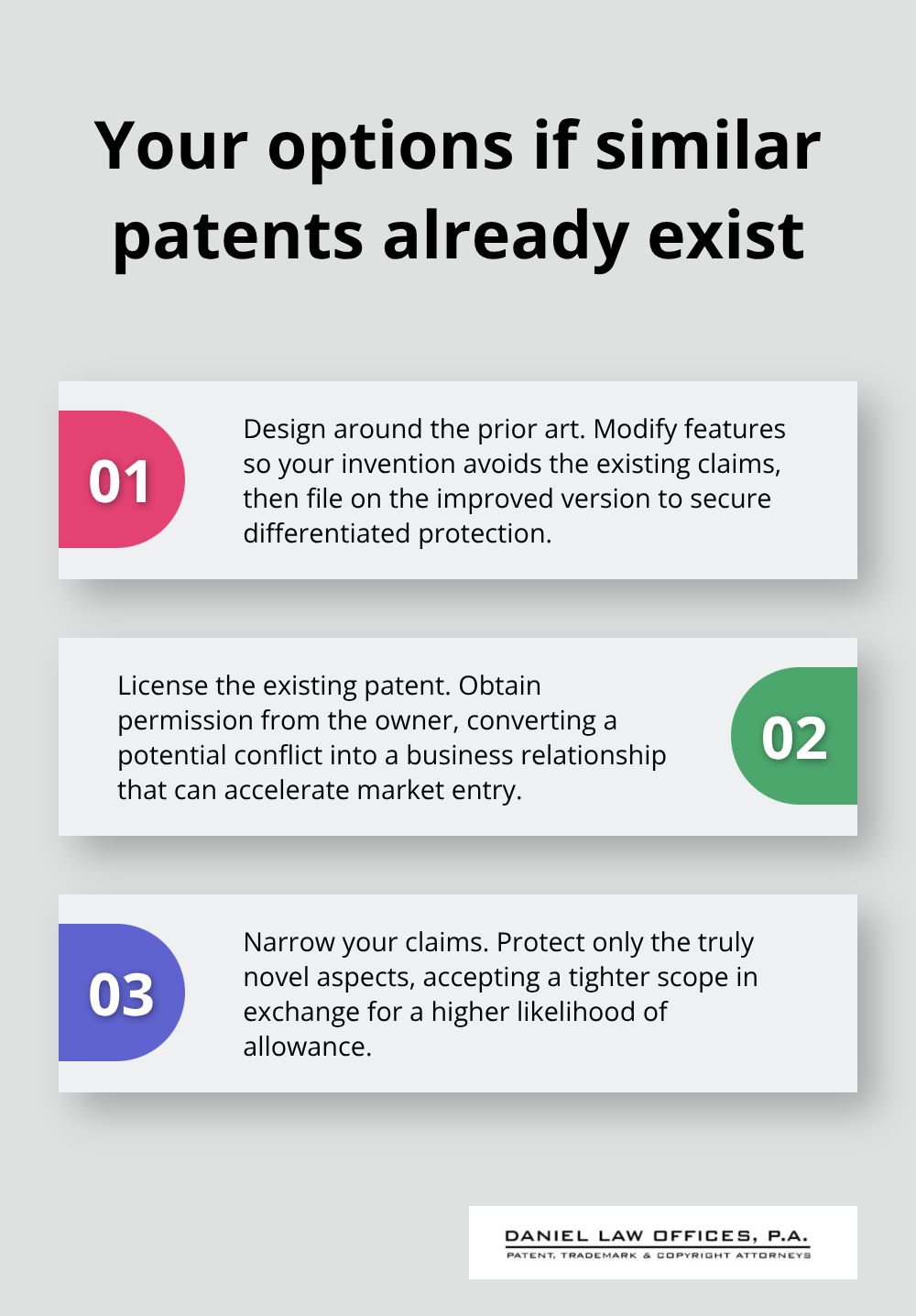
If your search reveals similar patents already exist, you face three realistic paths forward. First, you can design around the existing patent by modifying your invention to avoid infringing the claims of the prior art, then file your own patent on the improved version. Second, you can license the existing patent from its owner, which transforms you from competitor to licensee and generates revenue for both parties. Third, you can narrow your claims significantly to protect only the aspects of your invention that genuinely differ from what’s already patented, accepting weaker protection in exchange for a granted patent. Each path requires honest evaluation of your invention’s commercial value and your willingness to accept limited protection or modification.
Getting Professional Help with Your Search
Daniel Law Offices, P.A. conducts comprehensive patent searches as part of the application preparation process, helping clients understand novelty before they commit resources to prosecution and ensuring they grasp what protection they can realistically obtain in their technology area. A thorough search completed before you draft your application saves time, money, and frustration during the examination phase. With your novelty assessment complete and a clear understanding of the competitive landscape, you’re ready to move forward with preparing your actual patent application.
Preparing and Filing Your Patent Application in Orlando, Florida
Your patent search revealed that your invention is novel and worth protecting. Now comes the phase where most inventors stumble: transforming your idea into a legally enforceable document that the USPTO will grant. The difference between a rejected application and an approved one often hinges on documentation quality and claim precision, not the invention itself.
Gathering Complete Technical Specifications
You need complete technical specifications that explain exactly how your invention works, what materials or components it uses, and the measurements or parameters that define it. Vague descriptions like small or lightweight fail because examiners need concrete details to understand enablement-your obligation to teach someone skilled in your field how to make and use your invention. The USPTO data shows that inadequate enablement contributes to roughly 15% of patent invalidations in litigation, meaning weak documentation today becomes expensive problems in court later.
Include multiple embodiments and alternative implementations in your specification because this approach broadens your protection and reduces the risk that a competitor can design around your patent. Drawings are not optional decorations; they are critical components that must be labeled consistently with your written description, include multiple views and cross-sections, and meet specific formatting requirements. High-quality drawings correlate with approximately a 20% increase in approval rates without additional office actions, yet many inventors submit sketches that would embarrass a middle schooler.
Your specification should include the title of your invention, background explaining the problem it solves, a brief summary, the detailed description with best mode disclosure, at least one claim, and an abstract. Well-written specifications are associated with roughly a 30% higher chance of approval without major revisions according to USPTO data, making this investment of time genuinely worthwhile.
Drafting Claims That Protect Your Invention
Claims define the legal scope of your patent and require precision that most inventors cannot achieve alone. Start with broad independent claims that describe your invention in general terms, then narrow with dependent claims that add specific limitations-a structure that maximizes protection while maintaining enforceability. Vague language or broad ranges invite rejections because examiners need unambiguous wording to understand exactly what you’re claiming, and imprecise claims make your patent worthless in court even if you manage to get it granted.
The USPTO reports that well-drafted claims reduce initial rejections by about 25%, and this statistic understates the real benefit because poor claims also increase examination time and examiner interactions. Most inventors writing claims for the first time produce language so unclear that examiners cannot determine whether the claims are patentable, forcing multiple rounds of revision. A registered patent attorney understands claim drafting as a specialized skill developed through years of practice, not something you master by reading USPTO guidelines.
Filing Your Application Correctly
Electronic filing through the USPTO Patent Center is mandatory for serious inventors because paper filings incur an additional non-electronic filing fee of $400 and process about 15% slower than electronic submissions, giving you no advantage whatsoever for accepting that penalty. File in DOCX format as the USPTO encourages, because non-DOCX filings can trigger surcharges up to $400 that you will pay for no benefit.
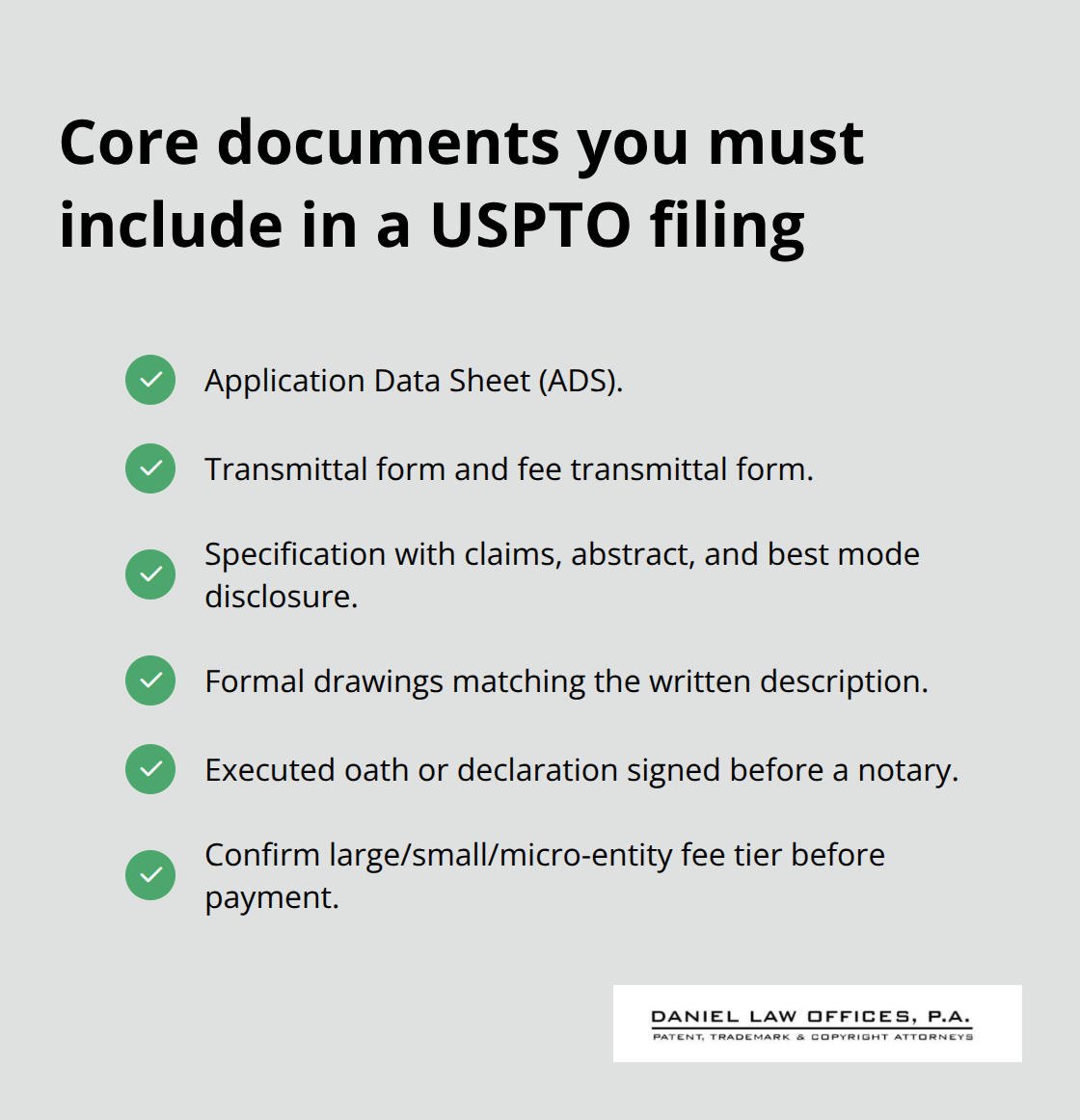
Your application requires specific forms including the Application Data Sheet, a transmittal form, a fee transmittal form, your specification, drawings, and an executed oath or declaration signed before a notary. Filing fees depend on your entity status: as of 2023, large entities pay $320, small entities pay $160, and micro-entities pay $80 for a non-provisional utility patent, with additional charges for excess claims or pages beyond standard limits (these fees may have changed since publication).
Many inventors miss deadlines or submit incomplete applications because they underestimate complexity, resulting in a Notice to File Missing Parts or Notice of Incomplete Application that forces you to correct errors within strict deadlines or risk abandonment. Patent application preparation and filing ensures your submission is complete, properly formatted, and positioned for examination success rather than rejection based on procedural errors.
Final Thoughts
The patent submission process demands attention to detail at every stage, from your initial search through final filing. Skipping steps or cutting corners costs thousands in rejected applications, wasted examination time, and weakened protection that fails when you need it most. Your invention deserves protection built on a foundation of thorough preparation, not rushed assumptions.
Novelty matters before you file, not after. A comprehensive patent search reveals what already exists and forces honest assessment about whether your invention truly qualifies for protection. Once you confirm novelty, complete technical specifications with precise language, clear drawings, and multiple embodiments transform your idea into a legally defensible document that examiners can evaluate fairly.
We at Daniel Law Offices, P.A. guide inventors through the entire patent submission process, starting with comprehensive searches that assess novelty and continuing through application drafting, filing, and prosecution. Contact us to discuss your invention and develop a protection strategy tailored to your commercial goals and budget.