




How to Navigate the Intellectual Property Patent Process
The intellectual property patent application process protects inventors’ innovations while securing exclusive rights to their creations. Patent applications filed through the USPTO increased by 2.1% in 2023, reaching over 695,000 submissions.
We at Daniel Law Offices, P.A. guide inventors through each step of patent prosecution. Understanding proper procedures prevents costly mistakes and strengthens your application’s success rate.
Understanding the Patent Application Process in Orlando, Florida
Types of Patents Available for Inventors
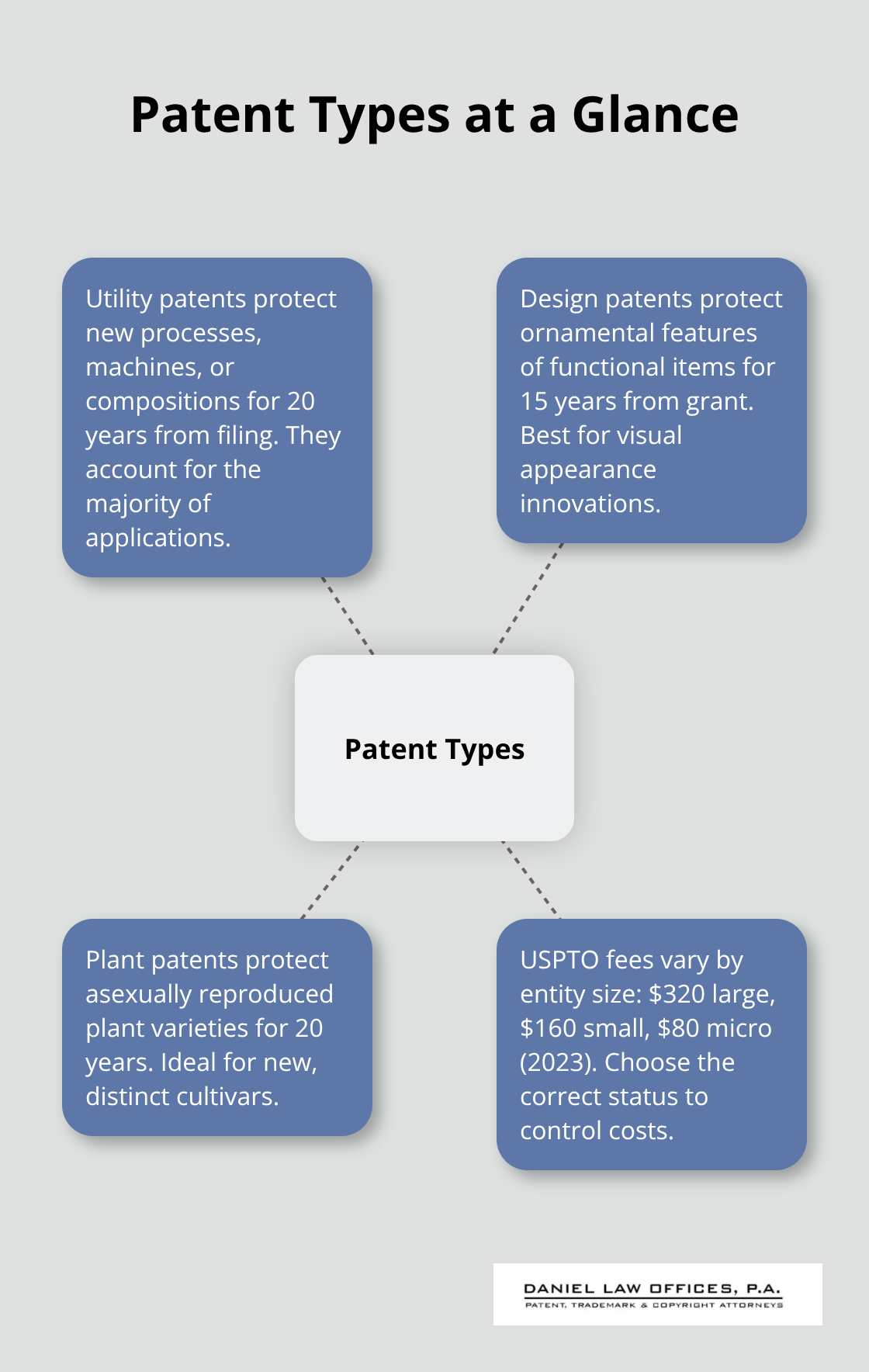
Three distinct patent types protect different innovations, and inventors who select the wrong type waste time and money. Utility patents cover 90% of USPTO applications and protect new processes, machines, or chemical compositions for 20 years from the date you file. Design patents protect ornamental features of functional items for 15 years, while plant patents cover asexually reproduced plant varieties for 20 years. The USPTO sets different fees based on entity size: utility patents cost $320 for large entities, $160 for small entities, and $80 for micro entities as of 2023.
Patent Prosecution Timeline in Central Florida
Patent prosecution typically spans 18 to 36 months from the date you file to grant, though complex applications take longer. The USPTO issues first office actions within 14 to 18 months for most applications, and 60% of applications receive at least one rejection that requires response within three to six months. Provisional applications provide a 12-month window to file non-provisional applications, but only 50% of inventors convert their provisionals within this timeframe (making this a critical decision point for many inventors).
Required Documentation Standards
Patent applications require detailed specifications, claims that define protection scope, and formal drawings that meet USPTO standards. Applications with professional drawings achieve 20% higher approval rates without additional office actions. The specification must enable someone skilled in the field to make and use the invention, and inadequate enablement causes 15% of patent invalidations during litigation. Electronic submission through Patent Center reduces processing time by 15% compared to paper submissions.
Essential Forms and Fee Calculations
All applications must include oath or declaration forms, assignment documents if applicable, and proper fee calculations based on entity size and claim counts. The USPTO requires inventors to submit these documents in standardized formats as outlined in the Manual of Patent Examining Procedure. Fee structures vary significantly between entity types, and incorrect calculations can delay your application or result in abandonment.
Once you understand these foundational elements of patent applications, the next step involves thorough research to verify your invention’s novelty and avoid potential infringement issues.
Conducting Patent Research and Prior Art Searches
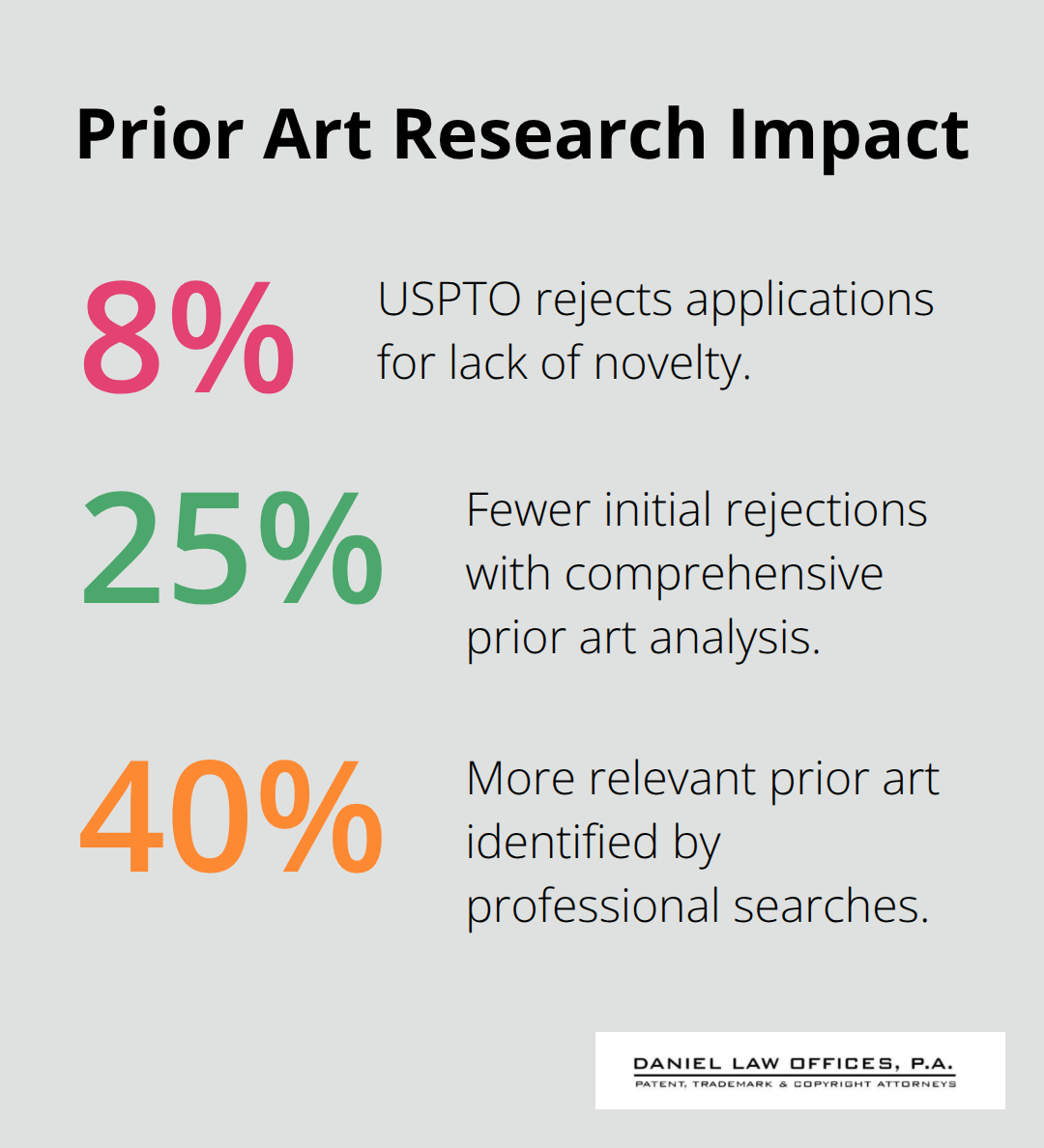
Patent research determines whether your invention qualifies for protection and prevents costly rejections. The USPTO rejects 8% of applications due to lack of novelty, which makes thorough prior art searches essential. Patent searches through the USPTO database reveal existing patents, published applications, and non-patent literature that could invalidate your invention. Applications with comprehensive prior art analysis face 25% fewer initial rejections, while inventors who skip this step waste thousands in fees and attorney costs.
USPTO Database Navigation Methods
The USPTO Patent Center provides free access to over 11 million patents and published applications that date back to 1976. Patent classification systems organize inventions into specific categories, with Cooperative Patent Classification codes that replaced older systems in 2013. Search multiple classification codes related to your invention, then expand to adjacent categories where similar technologies appear. International patent databases from the European Patent Office and World Intellectual Property Organization contain additional prior art that affects patentability (professional patent searches cost $1,500 to $3,000 but identify 40% more relevant prior art than inventor-conducted searches).
Patent Classification System Analysis
Classification codes group similar inventions together and streamline your search process. The Cooperative Patent Classification system contains over 250,000 classification entries that cover every technological field. Start with broad classification codes, then narrow your search to specific subclasses. Cross-reference multiple classification systems to catch patents that examiners might miss during prosecution. Document classification codes you search and save promising patents for detailed analysis.
Freedom to Operate Assessment
Analyzing existing patents requires comparison of your invention’s claims against published patents within your field. Each patent claim defines specific protection boundaries, and any overlap creates infringement risk. Focus on independent claims first, as these establish broadest protection scope. The KSR International Co. v. Teleflex Inc. decision changed obviousness standards and made combination patents harder to obtain. Freedom to operate searches examine active patents that could block commercialization, while patentability searches focus on novelty (document all results with patent numbers, publication dates, and relevant claim language for future reference during prosecution).
International Prior Art Sources
Patent protection extends beyond U.S. borders, and international databases contain prior art that affects your application. The European Patent Office database includes patents from 38 member countries, while WIPO Global Brand Database covers international applications. Japanese and Chinese patent databases contain millions of additional references that USPTO examiners review. Search international databases using English translations and classification codes to identify relevant prior art that could impact your patent application.
Patent research reveals potential obstacles and strengthens your application, but even thorough searches cannot prevent all prosecution challenges that arise from common application mistakes.
Common Patent Application Mistakes and How to Avoid Them
Patent claims define your invention’s protection boundaries, and poorly written claims cause 40% of application rejections during prosecution. Independent claims must stand alone and describe your invention’s broadest features, while dependent claims add specific details that narrow protection scope. Vague or overly broad claims often lead to rejections or limited protection, while claims written in ambiguous language like generally, substantially, or approximately create enforcement problems and invite validity challenges during litigation. The USPTO Manual of Patent Examining Procedure requires precise claim language, and ambiguous terms force examiners to issue rejections that delay prosecution by six to twelve months.
Specification Requirements That Determine Success
Patent specifications must enable someone skilled in your field to make and use your invention without undue experimentation. Inadequate enablement accounts for 15% of patent invalidations during litigation, which makes detailed descriptions essential for strong patents. Include multiple embodiments, alternative designs, and specific examples that demonstrate your invention’s functionality. The best mode requirement demands disclosure of your preferred way to practice the invention, and failure to meet this standard can invalidate your patent years after grant. Specifications should contain 8,000 to 15,000 words for complex inventions, with detailed drawings that support every claim element.
Filing Deadlines and Fee Payment Consequences
Missing USPTO deadlines abandons your application permanently, and the agency provides no grace periods for late responses. Office action responses require submission within three months, though six-month extensions cost additional fees that range from $400 to $1,600 depending on entity size.
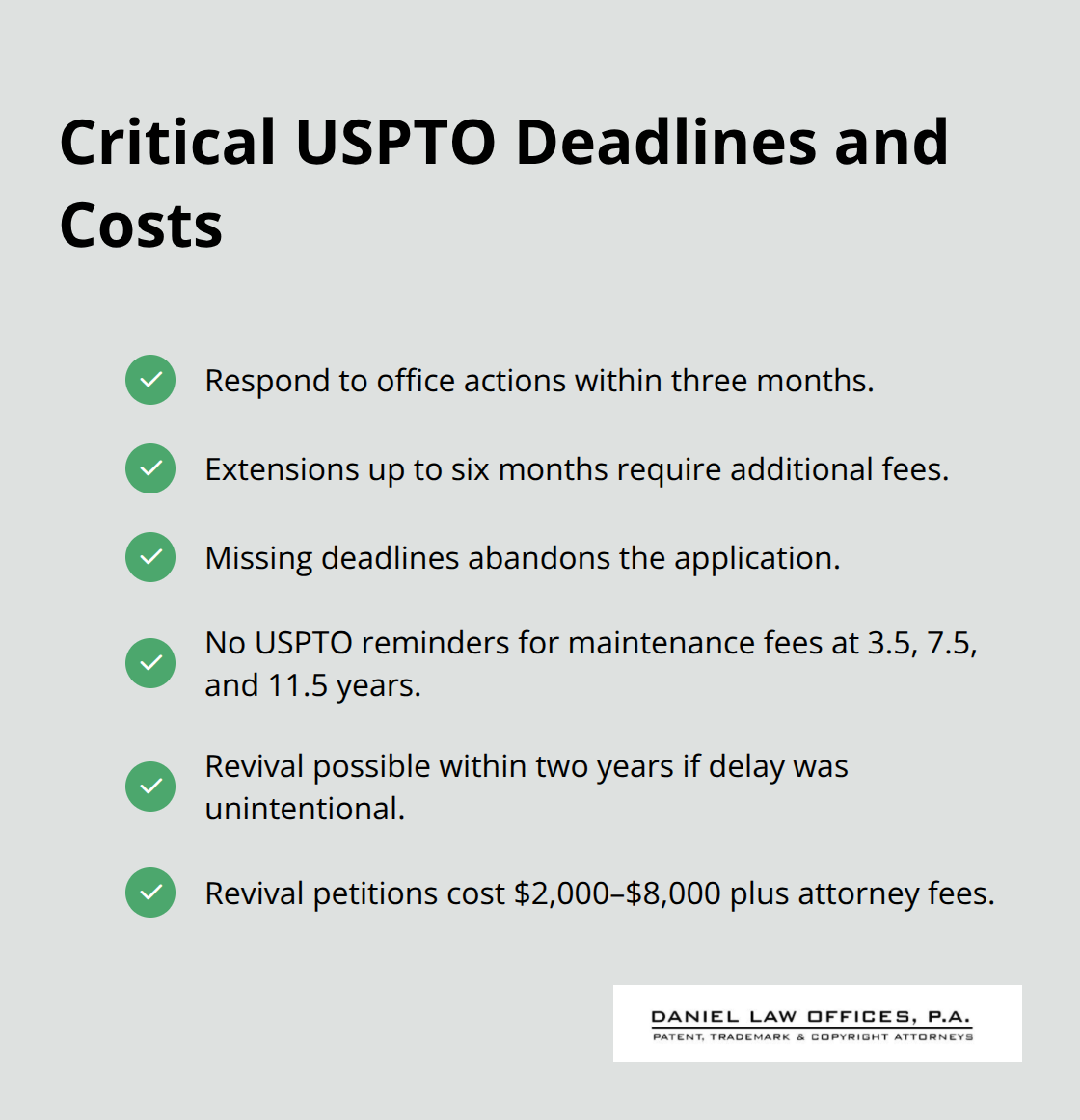
Maintenance fees come due at 3.5, 7.5, and 11.5 years after patent grant, and the USPTO sends no reminder notices to patent owners. Applications abandoned for missed deadlines can be revived within two years if you can prove the delay was unintentional (but revival petitions cost $2,000 to $8,000 plus attorney fees that often exceed the original application costs).
Prior Art Search Failures That Destroy Applications
Inventors who skip comprehensive prior art searches face rejection rates 25% higher than those who conduct thorough research. The USPTO database contains over 11 million patents and published applications, but many inventors search only obvious keywords and miss relevant prior art. Patent examiners access international databases and non-patent literature that inventors often overlook during their searches. Professional patent searches cost $1,500 to $3,000 but identify 40% more relevant prior art than inventor-conducted searches (making this investment worthwhile for complex inventions with significant commercial potential).
Final Thoughts
The intellectual property patent application process demands careful preparation, thorough research, and precise execution to protect your innovations effectively. Applications with professional preparation achieve 30% higher approval rates without major revisions, while comprehensive prior art searches reduce initial rejections by 25%. Filing deadlines require strict adherence, as missed responses abandon applications permanently and cost thousands in revival fees.
Qualified patent attorneys significantly improve your chances of securing strong patent protection. We at Daniel Law Offices, P.A. guide inventors through comprehensive patent searches, application drafting, and USPTO prosecution to protect valuable ideas and innovations. Our registered patent attorney helps navigate the complexities of intellectual property law while maintaining strict filing requirements and deadlines.
Patent protection represents a significant investment that requires ongoing maintenance through fee payments at 3.5, 7.5, and 11.5 years after grant (with no reminder notices from the USPTO). Professional legal guidance transforms innovative concepts into enforceable intellectual property rights that provide competitive advantages and revenue opportunities for years to come. Strong patent applications protect your innovations and create lasting value for your business.