



How to Navigate Prior Art in Patent Law
Prior art stands as one of the biggest obstacles inventors face when filing patents. The USPTO rejects thousands of applications annually because applicants fail to properly address existing prior art patent law requirements.
At Daniel Law Offices, P.A., we help inventors understand what prior art means, where to find it, and how to overcome rejections based on it. This guide walks you through the entire process.
Understanding Prior Art and Its Role in Patent Law
What Counts as Prior Art
Prior art is any information publicly disclosed before your patent’s filing date that could affect whether your invention is truly new. The USPTO doesn’t limit prior art to patents alone. Scientific journals, product manuals, conference presentations, website documentation, and abandoned patent applications all qualify. What matters is whether someone skilled in your field could access it and understand how to use it.
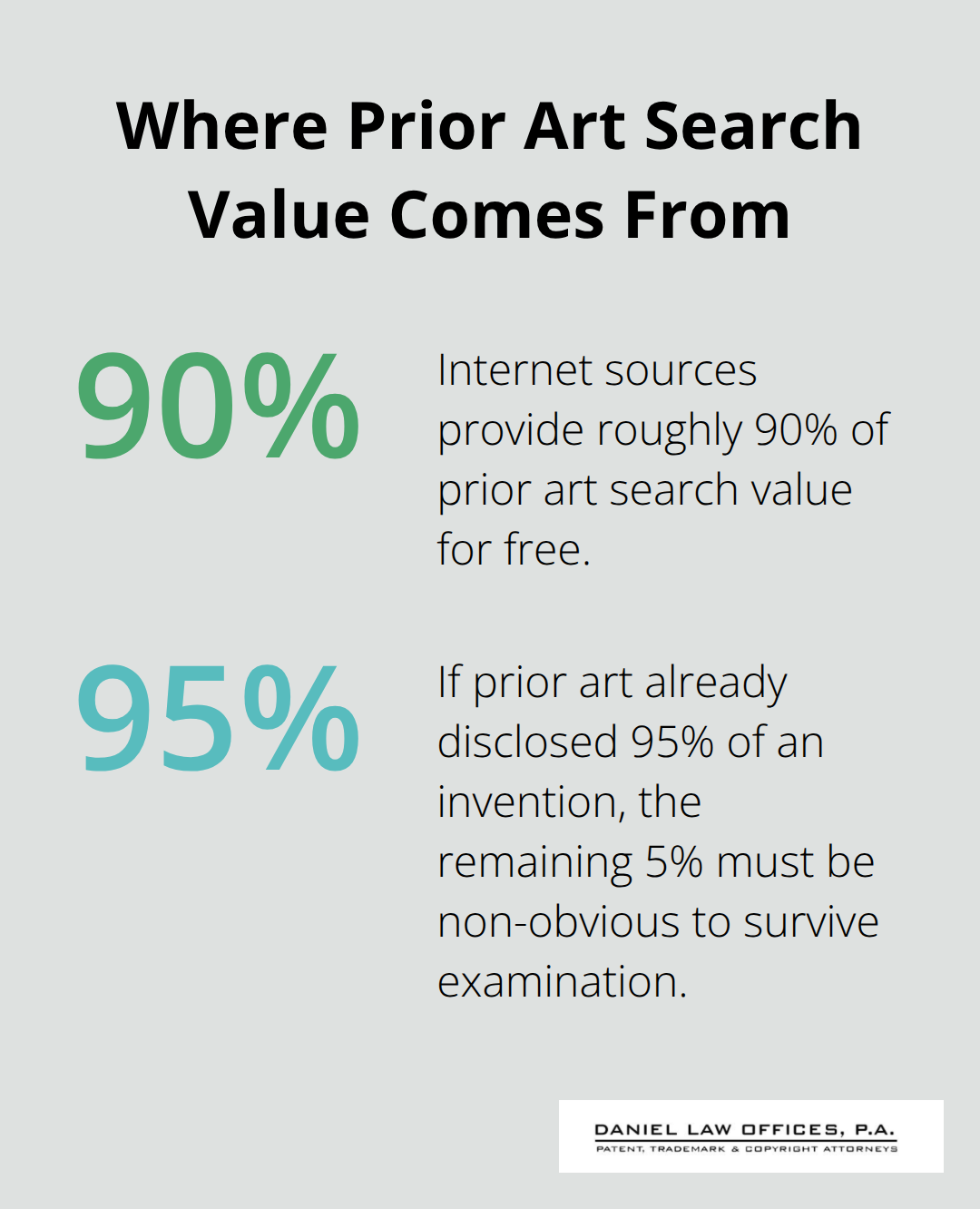
The internet has fundamentally changed prior art searches. Research on patent examination practices shows that the internet provides roughly 90% of prior art search value for free, which means most relevant prior art is discoverable without expensive database subscriptions. This reality shifts the burden on inventors and their patent counsel to conduct thorough searches before filing.
The 18-month publication window creates a timing problem you should understand. When the USPTO publishes your application, it becomes prior art for competing inventors, even if your patent hasn’t been granted yet. This means critical prior art may appear after you’ve filed, making search timing and strategy essential.
Where Prior Art Lives
Patent databases form the obvious starting point. Google Patents, the USPTO’s official PatFT database, the European Patent Office’s Espacenet, and WIPO’s PATENTSCOPE cover millions of documents. However, non-patent literature often matters more than inventors realize. The USPTO’s Scientific and Technical Information Center maintains collections of books, journals, and technical articles that examiners use to reject applications.
If your invention touches software, the Federal Register Notice on Prior Art Resources for Software-Related Patent Applications identifies specialized sources examiners consult. Foreign patents in your invention’s field carry equal weight to US patents under current law, particularly after the America Invents Act eliminated the Hilmer doctrine. This means you cannot ignore Japanese, European, or German patents just because your market is domestic. The Internet Archive Wayback Machine is officially recognized by the USPTO as valid internet prior art, which means archived product pages or technical documentation from years past can destroy patentability.
How Prior Art Blocks Patents
Novelty and non-obviousness form the two-part test the USPTO applies. Prior art destroys novelty if a single document discloses every element of your invention. Non-obviousness fails when prior art references, combined together, would make your invention obvious to someone skilled in your field. This distinction matters because you might overcome a novelty rejection more easily than an obviousness rejection.
The USPTO rejects thousands of applications annually because applicants fail to anticipate how examiners will combine prior art references to attack their claims. Many inventors assume minor improvements automatically deserve patent protection. They don’t. The patent office measures improvement against what already exists, not against the inventor’s original idea. If prior art already disclosed 95% of your invention, the remaining 5% must be non-obvious to survive examination.
Conducting Your Search Before Filing
Conducting a comprehensive prior art search before you file your application prevents costly rejections later. You need to identify what already exists in your field and understand how your invention differs from it. This upfront work allows you to draft stronger claims and anticipate examiner objections. When you file without this foundation, you force yourself to respond reactively to office actions rather than proactively shaping your application strategy.
How to Search for Prior Art in Orlando, Florida That Actually Matters
Start With Keywords, Not Databases
Most inventors jump straight into Google Patents without defining what they’re actually looking for. You need to write down every word that describes your invention, including synonyms, technical variations, and translations if your field uses international terminology. A software patent inventor might search for algorithm, computation method, data processing, software routine, and machine learning simultaneously. This foundational step prevents you from missing relevant references simply because examiners use different terminology than you do. Once you have 15 to 20 keywords, you’re ready to search systematically.
Search the Right Databases in the Right Order
Google Patents and the USPTO’s PatFT database should be your starting point because they’re free and comprehensive. The European Patent Office’s Espacenet and WIPO’s PATENTSCOPE are equally critical because foreign patents count as prior art in the United States. You should conduct separate searches in each database using your keyword combinations, then compile your results into a single spreadsheet tracking the patent number, title, filing date, and relevance to your invention. This organizational discipline matters more than most inventors realize.
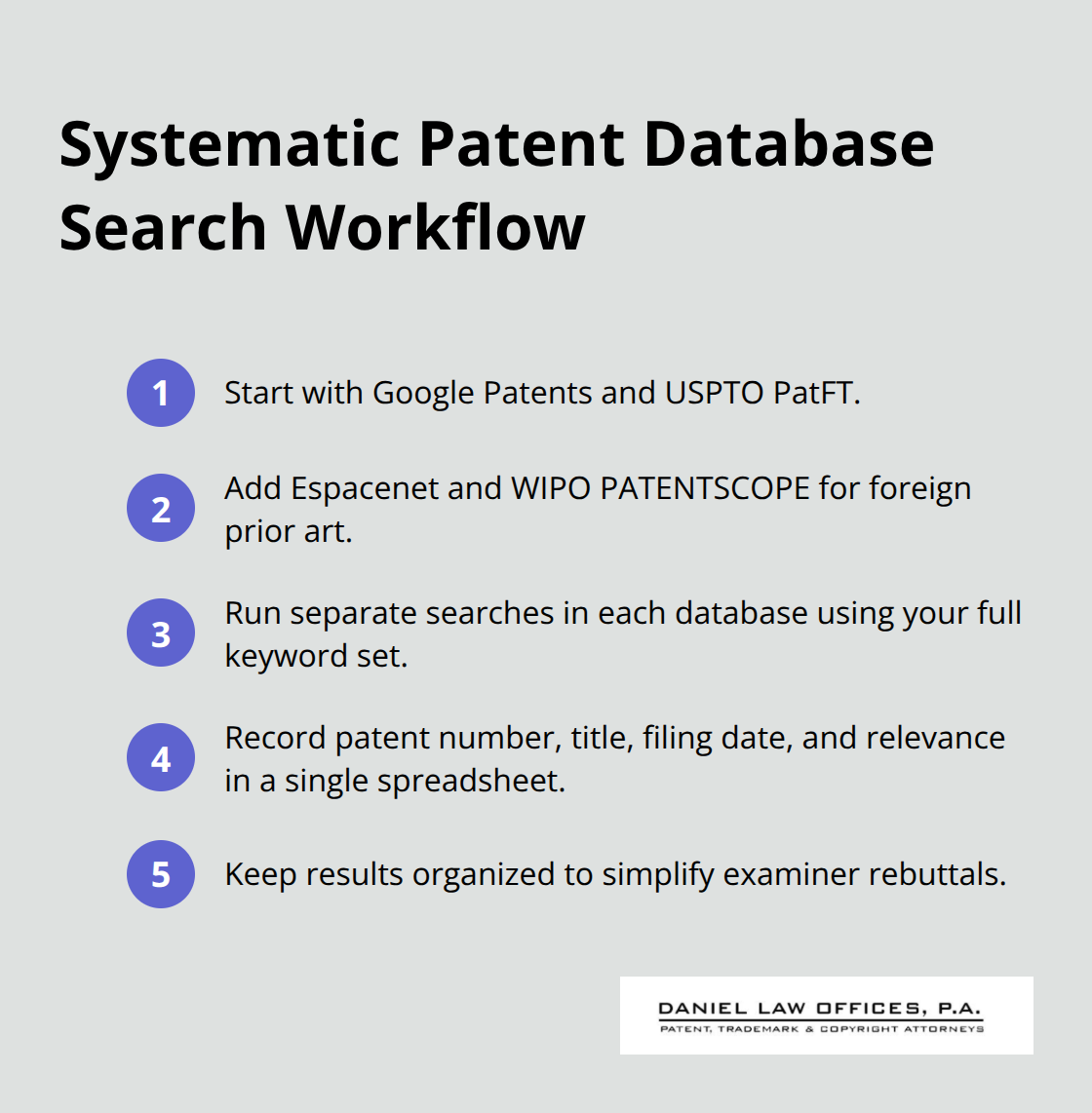
When an examiner rejects your application, you’ll need to explain why each prior art reference doesn’t destroy your invention’s novelty or non-obviousness. A disorganized search makes that conversation painful.
Look Beyond Patents to Non-Patent Literature
Non-patent literature often decides patentability more than patents do. Google Scholar indexes millions of scientific articles, conference papers, and technical journals that the USPTO considers prior art. You should search your field’s major journals and look for product white papers, technical specifications, and implementation guides published by competitors. If your invention relates to a specific industry, check whether trade associations or standards organizations have published technical documentation. The STIC, maintained by the USPTO, curates extensive non-patent literature collections that examiners consult during examination. Many inventors skip this step and later discover during prosecution that a published research paper from five years ago destroys their non-obviousness argument.
Forward and backward citation searching strengthens your results considerably. When you find a relevant patent, examine its cited references and the patents that cite it. This cross-referencing reveals the entire landscape of prior art in your field rather than just isolated documents.
Recognize the Limits of Your Search
Completeness in prior art searching is impossible, which sounds frustrating but actually liberates you from paralysis. The USPTO’s 18-month publication window means new prior art emerges after you file. Foreign patents you haven’t discovered yet exist in jurisdictions with limited English indexing. Abandoned applications that were published may be difficult to locate. Rather than chasing perfect comprehensiveness, you should document your search methodology thoroughly and save all references you find. This documentation protects you later if an examiner introduces prior art you didn’t locate. You can argue that your search was reasonable given available resources and that the newly cited reference doesn’t actually apply to your claims.
Stop searching when each new keyword variation yields only duplicates of references you’ve already found. That convergence signals you’ve covered your field adequately. A reasonable prior art search typically requires 12 to 20 hours of systematic work across multiple databases and non-patent sources. If you’ve spent that time and found consistent patterns in your results, you have sufficient information to move forward with application strategy or to consult with a patent attorney about your findings.
Once you’ve completed your search and compiled your prior art landscape, the real work begins: understanding how to use these findings to strengthen your patent application and anticipate examiner objections before they arrive.
How to Turn Prior Art Into Your Strongest Defense in Orlando, Florida
When the USPTO office action arrives citing prior art against your claims, most inventors panic. They see the cited references as proof their invention cannot be patented. This reaction is wrong. Prior art citations are negotiation points, not death sentences. The examiner has selected specific references to argue your invention lacks novelty or non-obviousness, but examiners make mistakes about claim scope, reference applicability, and technical interpretation constantly. Your job is to identify those mistakes and exploit them systematically. Inventors who treat office actions as technical puzzles rather than rejections solve them far more effectively than those who assume the examiner’s position is unassailable.
The office action itself provides your roadmap. The examiner explains exactly which claim elements each prior art reference allegedly discloses and why those references make your invention obvious. This specificity is your advantage. If the examiner claims reference A discloses element X but the reference’s actual language contradicts that claim, you have a direct response.
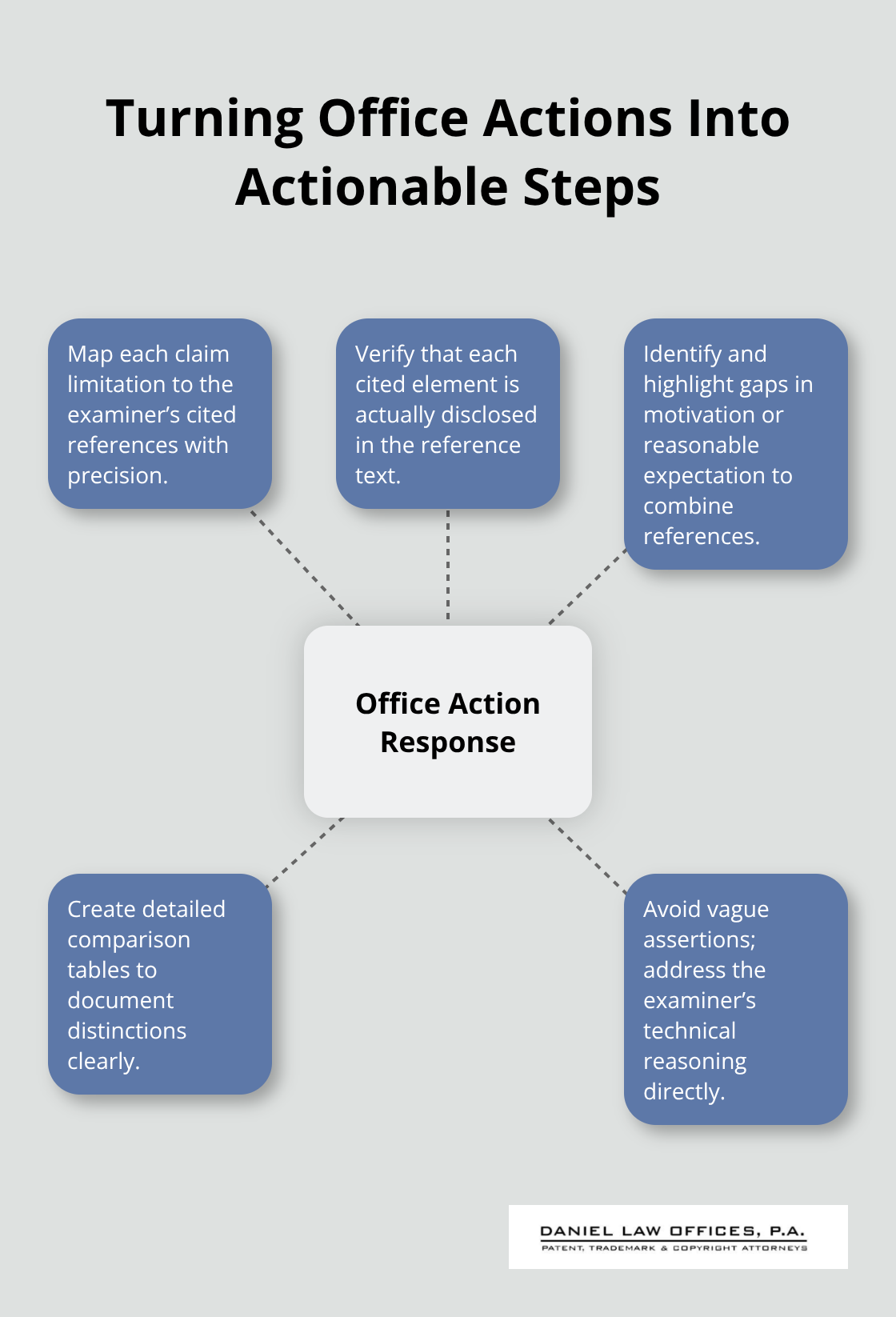
Read each cited reference word-for-word and create a detailed comparison document showing precisely how your claims differ from what the examiner cited. Many applicants respond to office actions with vague arguments about unexpected results or commercial success without addressing the examiner’s specific technical reasoning. That approach fails. Instead, map each claim limitation against each prior art reference and document where the reference falls short.
Understand the Examiner’s Technical Reasoning
The USPTO’s examination guidelines require examiners to establish a prima facie case of obviousness by identifying specific claim elements in the prior art and explaining why combining references would be obvious to someone skilled in your field. If the examiner’s reasoning contains logical gaps, your response should highlight those gaps with precision. The examiner must articulate a coherent technical argument, not merely assert that your invention is obvious. When you read the office action, look for the examiner’s explanation of motivation and expectation. Did the examiner explain why someone in your field would have looked at reference B while reading reference A? Did the examiner show that combining these references would have produced your claimed result with a reasonable expectation of success? If the examiner’s explanation is conclusory rather than technical, your response should challenge it directly.
Distinguish Claims From Prior Art References
Your response strategy depends on whether the rejection attacks novelty or non-obviousness. Novelty rejections claim a single prior art reference discloses every element of your claimed invention. If this is the case, your response must show that at least one claim element is absent from the cited reference or interpreted differently than the examiner suggests. This is often easier than it sounds because claim language and reference language rarely align perfectly. If your claim recites a method performed on a processor with at least 2 gigabytes of memory and the cited reference mentions processing data without specifying memory requirements, you have a distinction. Document this difference clearly and explain why the reference’s teaching does not render your specific claim obvious or anticipated.
Non-obviousness rejections combine multiple references, arguing that a person skilled in your field would have been motivated to combine them with a reasonable expectation of success. These rejections are harder to overcome because the examiner has flexibility in how references interact. Your response should attack the examiner’s motivation and expectation arguments directly. The Federal Circuit’s KSR International decision emphasized that market demands can support obviousness, but the examiner must still articulate why combining specific references would be obvious to a skilled artisan.
Build Your Response With Evidence
Evidence of non-obviousness can shift the balance significantly. Commercial success, industry recognition, and solving a long-felt need in your field all count as objective evidence of non-obviousness when you can connect them to your claimed invention. If your product achieved market success after filing, document sales figures, customer adoption rates, or competitive responses. These facts matter more than theoretical arguments about why your invention should be patentable. The USPTO’s examination manual states that objective evidence of non-obviousness carries weight when the applicant shows a nexus between the evidence and the claimed invention.
If your prior art search identified a decades-old problem that no one solved before your invention, that history supports your non-obviousness argument. Many applicants also improve their position by amending claims to narrow their scope and distinguish prior art more clearly. A broader claim covering multiple approaches may be obvious when a narrower claim covering your specific technical implementation is not. Examiners often accept narrowed claims that avoid the closest prior art while still protecting your core invention.
Make Strategic Decisions About Claim Scope
This strategy requires judgment about what matters most to your invention’s value. If you patent a narrow version that covers only your specific implementation, competitors can design around it. If you insist on broad coverage and lose all claims, you have nothing. The balance depends on your invention’s technical field and competitive landscape. A patent attorney can help you understand these trade-offs and make strategic decisions about claim scope based on the prior art landscape and the invention’s commercial importance. When you work with counsel to respond to office actions, you gain access to someone who understands how examiners typically interpret claim language and which arguments succeed in your specific technical field.
Final Thoughts
Prior art patent law requires systematic thinking and strategic action from the moment you conceive your invention. The inventors who navigate it successfully treat prior art not as an obstacle but as a map showing exactly where their invention fits in the technological landscape. Your search identifies what exists, your application strategy distinguishes what’s new, and your office action responses defend what matters.
Prior art searching and response strategy are not optional tasks you complete after filing-they shape your entire patent protection approach. When you understand prior art before filing, you draft stronger claims, anticipate examiner objections, and respond to office actions with precision rather than panic. When you skip this work, you force yourself into reactive prosecution where the examiner controls the conversation.
We at Daniel Law Offices, P.A. help inventors and businesses navigate prior art from the beginning through patent protection and prosecution. Our registered patent attorney conducts comprehensive patent searches to establish what already exists in your field, then guides you through the entire patent prosecution process with strategies grounded in prior art analysis. Contact us to discuss how we can help you secure patent protection for your innovation and navigate prior art patent law with confidence.