



How to Do a Patent Search: Complete Guide
Filing a patent without searching first is like walking into a minefield blindfolded. Most inventors skip this step and face rejection, wasted time, and thousands in legal fees.
At Daniel Law Offices, P.A., we’ve seen how to do a patent search separate successful filers from those who waste resources. A proper search reveals what already exists, confirms your invention is truly novel, and strengthens your application from day one.
Why Patent Searches Matter
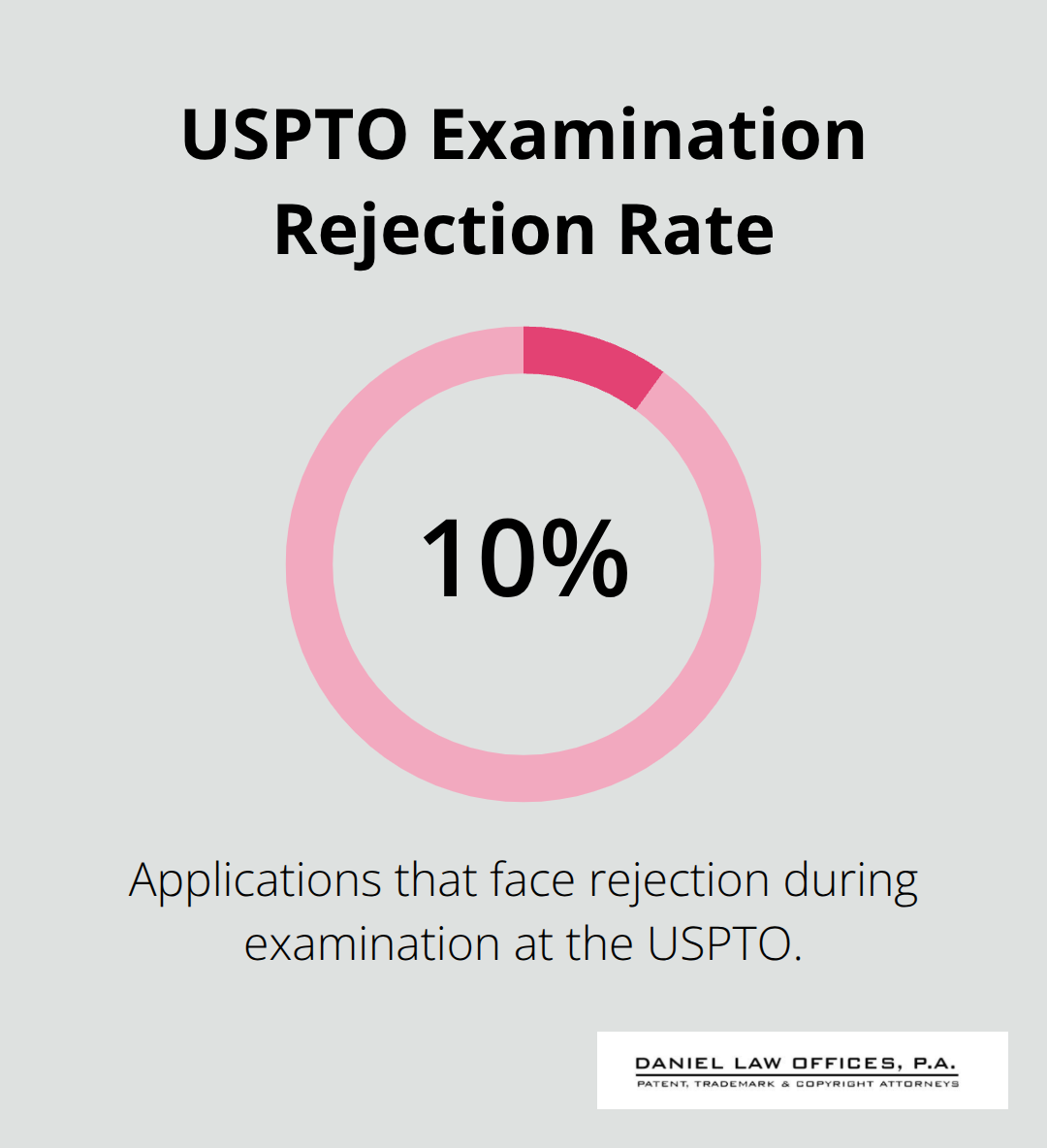
The USPTO receives over 650,000 patent applications annually, yet roughly 10% face rejections during examination. Many of these rejections stem from applicants who fail to identify existing prior art before filing. When you skip a patent search, you gamble with your filing fee, your time, and potentially thousands in attorney fees down the road.
A thorough search upfront eliminates this risk entirely.
What existing patents reveal about your invention
The Patent Public Search tool grants free access to over 12 million issued US patents and millions of published applications. Searching this database before filing shows you exactly what competitors and prior inventors have already claimed. If a patent exists that covers your core invention, you discover this critical fact before spending money on an application that will inevitably face rejection. More importantly, reviewing existing patents reveals how other inventors solved similar problems, which often points toward design variations or technical approaches that remain unpatented. Many inventors find that while their exact invention may be patented, they can modify specific features to avoid infringement and still obtain protection for their unique contribution. This intelligence shapes your filing strategy from the beginning and prevents wasted effort pursuing a dead end.
Patentability assessment saves time and money
Conducting a search forces you to think critically about what makes your invention truly novel. The USPTO examines applications against all prior art-patents, published applications, and even non-patent literature like academic papers and technical manuals. If your search uncovers a single prior patent that describes your invention’s core elements, the examiner will almost certainly find it too. Identifying this obstacle before filing means you can either abandon the invention, redesign it to create genuine novelty, or proceed with realistic expectations about prosecution costs. Applications that proceed without a search often face multiple rounds of rejections and Office Actions, extending the prosecution timeline from 18–24 months to 3+ years. Each Office Action requires attorney response, adding $1,500 to $5,000 per response. A search that costs under $500 prevents these cascading expenses. Additionally, a well-documented search demonstrates diligence to the examiner, sometimes reducing the number of rejections or Office Actions you face during prosecution.
Moving from search to strategy
Once you complete your patent search and understand the competitive landscape, the real work begins. You must analyze what you found, document your methodology, and determine whether your invention truly stands apart from existing patents. This analysis forms the foundation for your filing strategy and determines whether you should move forward with an application or pursue a different direction entirely.
How to Conduct a Patent Search Step-by-Step
The USPTO’s Patent Public Search tool is your foundation, and it costs nothing. Open the Basic search interface and enter keywords describing your invention. If you’re developing a new water filtration system, start with terms like water filter, filtration technology, or purification device. The tool searches over 12 million issued patents and millions of published applications simultaneously. Run your initial search and expect hundreds or thousands of results-this is normal and necessary. Skim the first 50 to 100 results by reading patent titles and abstracts on their front pages. You’re looking for patents that closely resemble your invention’s core function or design.
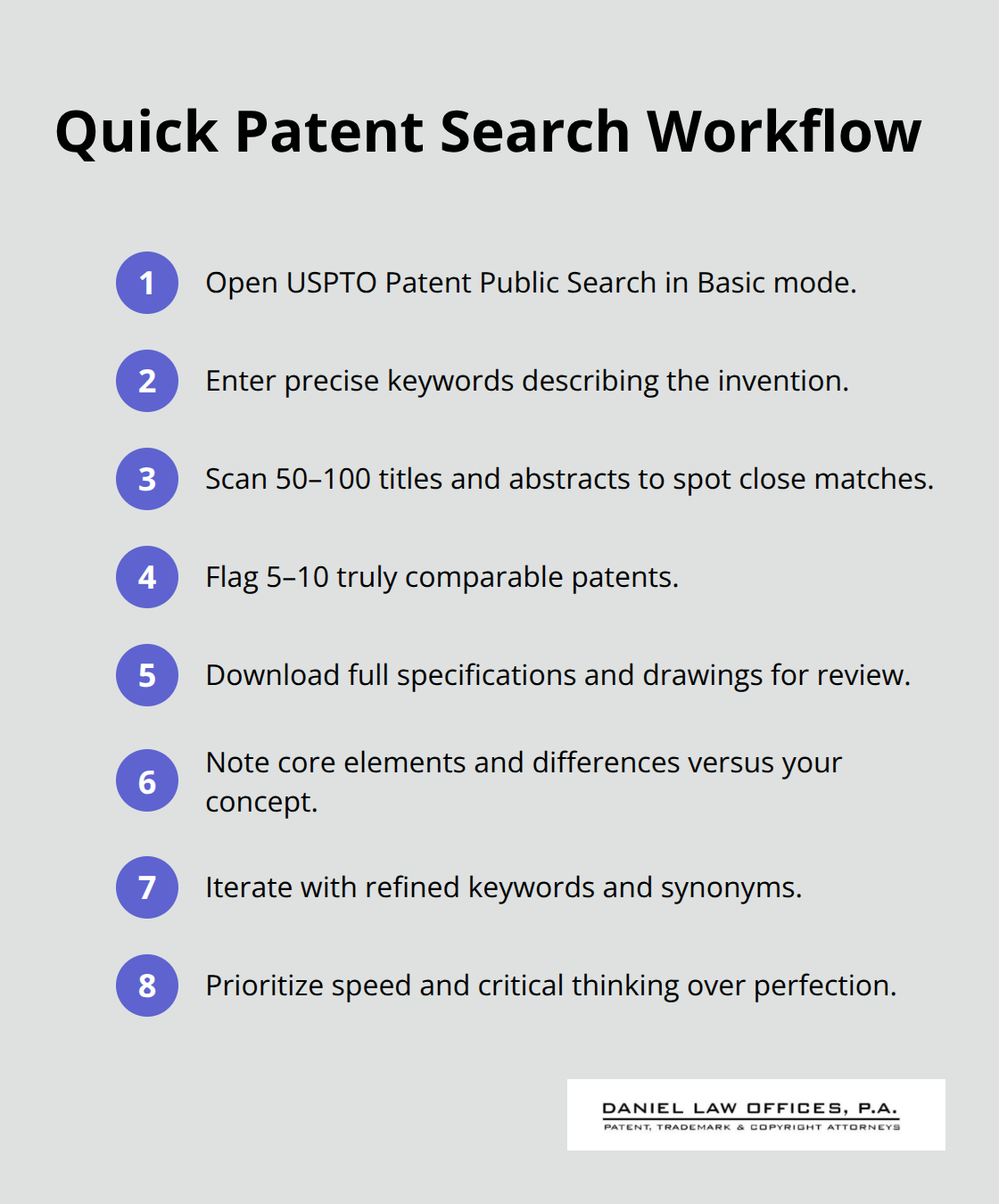
Most results will be irrelevant, but scanning quickly trains your eye to spot the dangerous ones. Once you identify 5 to 10 patents that genuinely compete with your concept, download their full specifications and drawings. This first pass typically takes 30 minutes to two hours depending on your invention’s complexity. The goal isn’t perfection here-it’s speed combined with critical thinking about what you’re reading.
Refine with classifications and forward citations
After your keyword sweep, switch to the Advanced search mode and add CPC classifications. The CPC system organizes patents by technical field, and using it narrows results dramatically. If your water filter patent search returned 2,000 results, filtering by the relevant CPC code might reduce that to 200 highly relevant patents. Find your invention’s CPC code by searching the USPTO’s classification database or reviewing the front page of patents you already identified-they list their assigned CPC codes. Plug that code into the Advanced search using the field syntax .CPC and run the search again. This second pass is where you find the truly competitive prior art. Now examine the patents you’ve flagged by looking at their cited references and forward citations. Patents that cite your flagged results often describe similar solutions or improvements, expanding your picture of what’s already protected. The USPTO’s Patent Public Search tool lets you click through these citation links directly, making this exploration efficient. Spend another hour or two following citation chains until you see the same patents appearing repeatedly-that signals you’ve covered the landscape. Document every patent you review, including its patent number, title, filing date, and why it matters to your invention. This documentation becomes critical evidence that you conducted diligent prior art research.
International patents and non-patent sources complete the picture
Your search cannot stop at US patents. The European Patent Office’s Espacenet database contains over 140 million patent publications worldwide and is free to search. Use the same keywords and classifications you employed in the USPTO database, and search for patents filed in key markets like Europe, Japan, and China. If your water filter invention might compete internationally, discovering a Japanese patent that covers your exact approach before you file is invaluable-it affects your filing strategy across borders. Additionally, search non-patent literature like academic journals, technical manuals, and industry publications. The USPTO examiner will search these sources, and so should you. Google Scholar offers free access to millions of academic papers, and a targeted search for water filtration innovations might reveal published research that predates any patent filing. This broader search typically adds another 2 to 4 hours to your timeline but prevents nasty surprises during examination. Compile your complete findings into a single document that lists every relevant patent and non-patent reference you discovered, organized by relevance and filing date. This document serves as proof that you conducted a thorough, professional search and becomes invaluable if you need to discuss your findings with a patent attorney or firm.
Moving from search results to strategic decisions
The patents and references you’ve compiled now form the foundation for your next critical step. You must analyze what you found, document your methodology, and determine whether your invention truly stands apart from existing patents. This analysis shapes your filing strategy and determines whether you should move forward with an application or pursue a different direction entirely.
Common Mistakes to Avoid During Patent Searches
Most inventors conducting their first patent search make one critical error: they stop too soon. A quick keyword search in the USPTO database feels thorough until an examiner rejects your application citing a prior patent you somehow missed. The reality is that incomplete search strategies plague applications far more than most filers realize.
Incomplete search strategies create blind spots
Many inventors search only US patents and ignore the international landscape entirely, missing relevant prior art that exists in Europe, Japan, or China. Others search keywords alone without touching classifications, which means they skip entire categories of related patents organized by technical field. The USPTO receives roughly 10% rejection rates partly because applicants conducted searches that felt adequate but lacked depth.
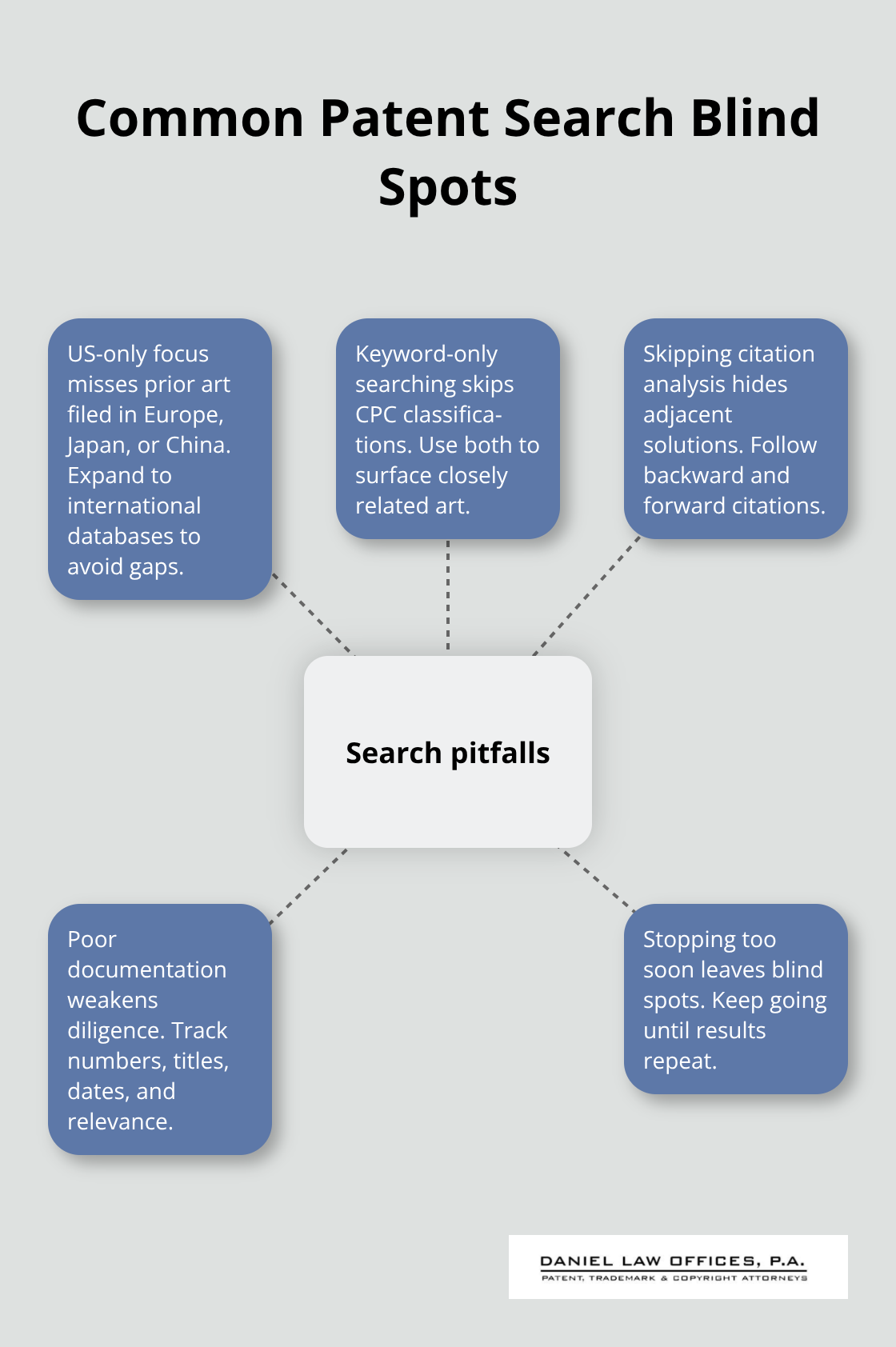
A genuine search requires multiple approaches: keyword searches, classification-based filtering, citation analysis, and international database exploration. Skipping any of these components creates blind spots that examiners will exploit during prosecution. Additionally, many inventors document their search poorly or not at all, which weakens their position if they later need to defend patentability decisions or discuss their findings with a patent attorney.
Misinterpreting patent claims and scope
The second major mistake involves misinterpreting what you actually find. Inventors frequently spot a patent that seems similar and assume their invention is unpatentable, when in reality the prior patent covers different claims or technical approaches. Patent claims define the actual legal scope of protection, and two patents can address the same problem while claiming entirely different solutions.
Reading only the title and abstract guarantees you’ll misunderstand whether a prior patent truly blocks your invention. You must examine the full specification, drawings, and especially the claims section to determine if genuine overlap exists. Similarly, inventors often overestimate how much a non-patent reference threatens patentability. A published academic paper or technical manual can constitute prior art, but only if it discloses all essential elements of your invention in a single source.
Combining references and obviousness standards
Combining multiple references requires an examiner to prove that combining them would be obvious to someone skilled in your field, which is a much higher bar. Misinterpreting these distinctions leads inventors to either abandon viable inventions or proceed with unrealistic expectations about prosecution difficulty.
The solution is straightforward: review full patent documents carefully, understand what the claims actually protect, and when uncertainty arises, consult with a registered patent attorney who can assess whether prior art truly threatens your application. A registered patent attorney can help you interpret your findings and determine your next steps with confidence.
Final Thoughts
A thorough patent search separates inventors who succeed from those who face costly rejections and delays. The time you invest upfront-typically 4 to 8 hours for a comprehensive search-prevents months of prosecution delays and thousands in unexpected attorney fees. Your search results form the foundation for every decision that follows, so document what you found and analyze whether genuine overlap exists with prior patents.
At some point during this process, working with a registered patent attorney becomes invaluable. If your search uncovers patents that seem to compete with your invention, an attorney can interpret patent claims and assess whether real infringement risk exists. When you’re uncertain whether your findings block patentability or want professional guidance on filing strategy, Daniel Law Offices, P.A. helps you make informed decisions rather than guessing.
After completing your search and deciding to move forward, gather your search documentation and compile your invention’s technical specifications and drawings. This preparation accelerates the application process and demonstrates to the examiner that you conducted diligent prior art research before filing your patent application.