




How to Create an Effective IP Strategy Document
Your intellectual property is one of your most valuable business assets, yet many companies lack a clear plan to protect it. An IP strategy document serves as your roadmap for safeguarding patents, trademarks, and trade secrets while managing the costs involved.
At Daniel Law Offices, P.A. in Orlando, Florida, we help businesses build comprehensive IP strategies that actually work. This guide walks you through the essential components and steps needed to create a document that protects what matters most.
Building Your IP Asset Inventory in Orlando, Florida
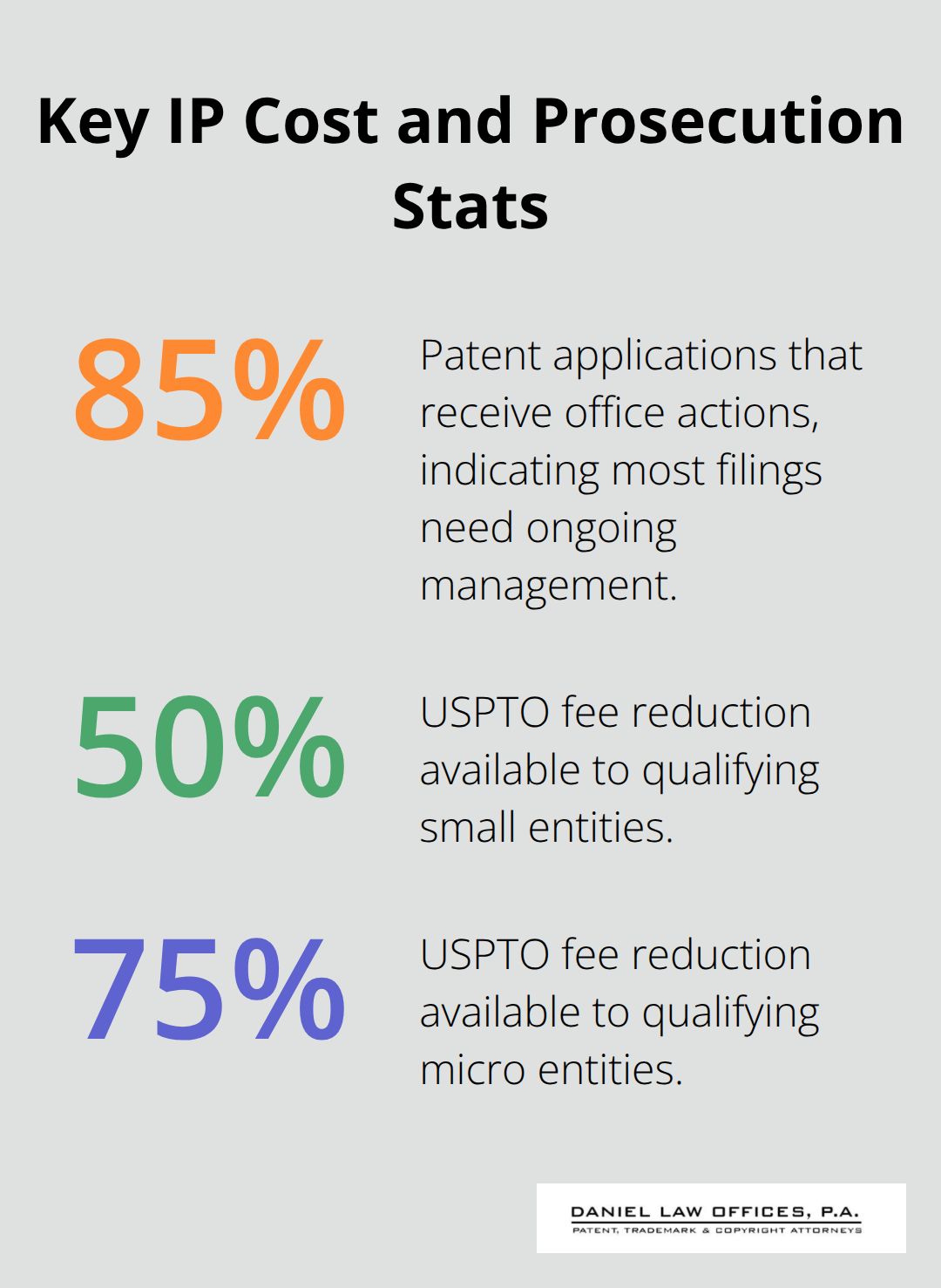
Starting an IP strategy without cataloging what you actually own is like navigating without a map. The first step is conducting a thorough asset inventory that identifies every patent, trademark, trade secret, domain name, and proprietary process your business has created or licensed. This inventory should list what you own, where it’s protected (which states or countries), when protection expires, and what it costs to maintain. According to the American Intellectual Property Law Association, office actions occur in roughly 85% of patent applications, which means most patents require ongoing management and associated costs. Without knowing your current portfolio inside and out, you cannot make intelligent decisions about where to invest protection dollars next.
Map Protection Costs Across Your Portfolio
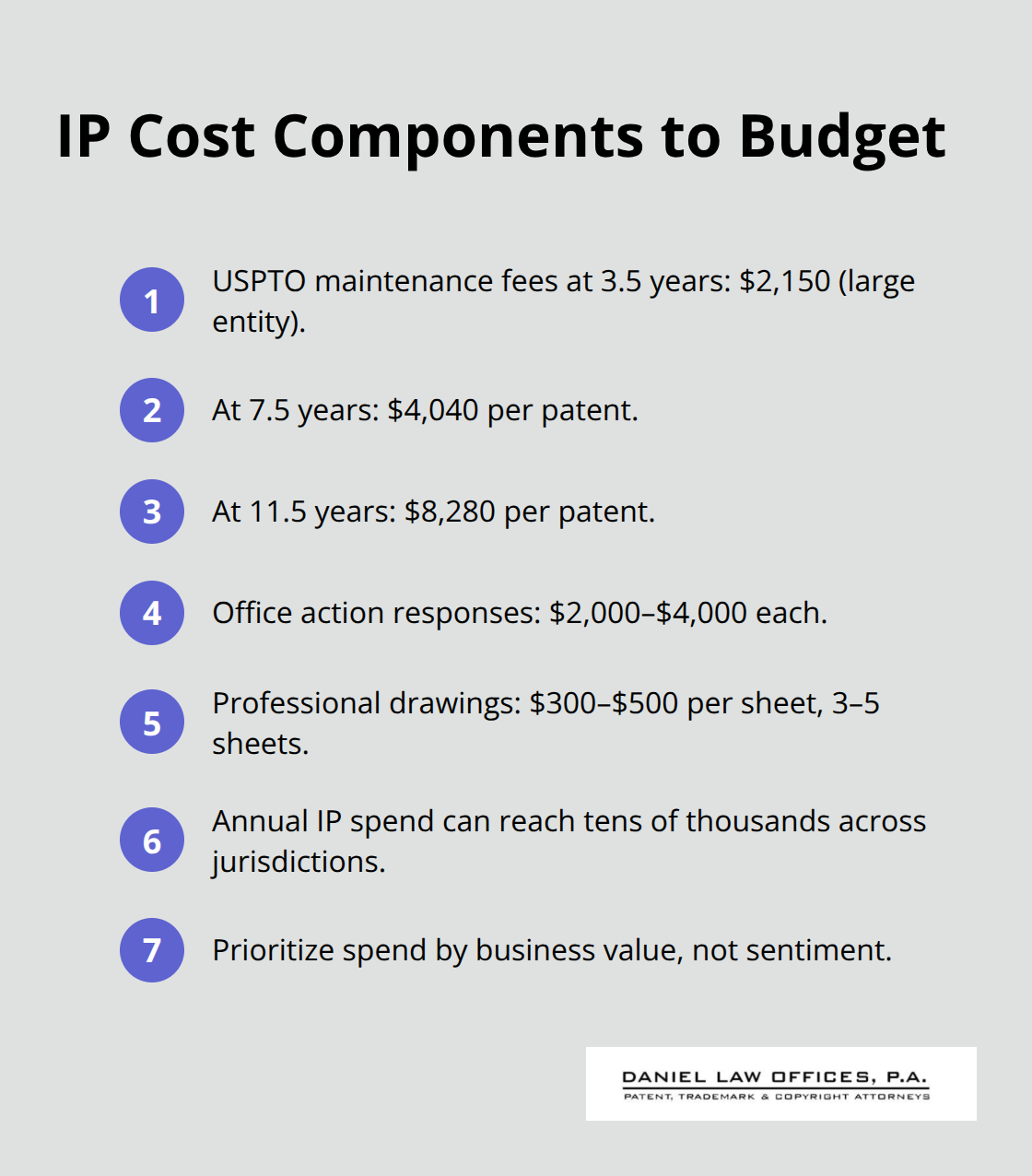
Patent maintenance fees represent a significant ongoing expense that many companies overlook during strategy planning. The United States Patent and Trademark Office charges maintenance fees at 3.5 years ($2,150 for large entities), 7.5 years ($4,040), and 11.5 years ($8,280) for each patent you want to keep active. Small entities pay half these amounts, and micro entities receive roughly 75% discounts, which is why establishing small or micro entity status early can save thousands across your portfolio. Beyond maintenance, you need to budget for attorney responses to office actions, which typically cost $2,000 to $4,000 per action, and most applications experience at least one. Professional patent drawings alone run $300 to $500 per sheet across 3 to 5 sheets. When you tally these costs for multiple patents across multiple jurisdictions, your total annual IP spending can easily reach tens of thousands of dollars. Your strategy document must account for these real numbers and prioritize which assets deserve continued investment based on actual business value, not sentiment.
Identify What Actually Deserves Protection
Not every invention or brand element needs patent or trademark protection, and protecting low-value assets drains resources from genuinely strategic ones. Start with identifying which aspects of your offering are truly unique and potentially protectable-if something is not unique, someone else may already own the IP and you would need permission to use it. A professional prior art search costs $1,000 to $3,000 and typically takes 10 to 15 hours for straightforward inventions, but this investment is associated with roughly a 20% higher likelihood of approval without major revisions, according to patent research data. Your strategy should distinguish between revenue-generating IP assets and dormant ones, then decide which dormant patents to abandon rather than pay maintenance fees indefinitely. For trademarks, protect multiple brand elements-your logo, product names, slogans-and register them in the specific markets where you actually operate, not everywhere possible. This targeted approach keeps costs manageable while ensuring your most valuable differentiators remain legally defended.
Prioritize Assets That Drive Real Business Value
The next step in your inventory process involves assessing which IP assets actually generate revenue or provide competitive advantage. Some patents sit dormant while others form the foundation of your market position; your strategy document should reflect this reality. Conduct a straightforward ROI analysis on each asset: does this patent protect a product line that generates sales, or does it cover an abandoned project? Does this trademark appear on products customers recognize, or does it exist only in your filing cabinet? This assessment helps you make tough decisions about maintenance costs and future protection investments. Companies that treat IP as a strategic business asset rather than a legal checkbox tend to allocate resources more effectively and avoid wasting money on assets that no longer serve their objectives.
Your inventory and cost analysis form the foundation for the next critical step: defining clear protection goals and timelines that align with your business growth plans.
Turning Your Inventory Into a Strategic Roadmap
Search Competitor IP to Reveal Market Gaps
Now that you’ve cataloged your IP assets and mapped their costs, the real work begins: building a strategy that actually guides your decisions. Search the USPTO database and international trademark registries to see which patents and trademarks your competitors actively maintain across the jurisdictions where you operate. This reveals gaps in your own portfolio and shows which technologies or brand elements matter most in your industry. If three major competitors all hold patents in a specific area of your market but you do not, that absence represents either an opportunity to innovate around their protection or a risk that you cannot freely operate without licensing.
Account for Technical Complexity in Your Budget
Biotech patents average 2.3 office actions according to the American Intellectual Property Law Association, which tells you that complex technical fields require more aggressive prosecution planning and higher budgets than simpler mechanical inventions. Your strategy document should map these competitive realities directly: which of your assets face real design-around threats, and which are genuinely defensible? This competitive intelligence transforms your inventory from a list into a battle plan.
Build an Action Plan With Clear Milestones
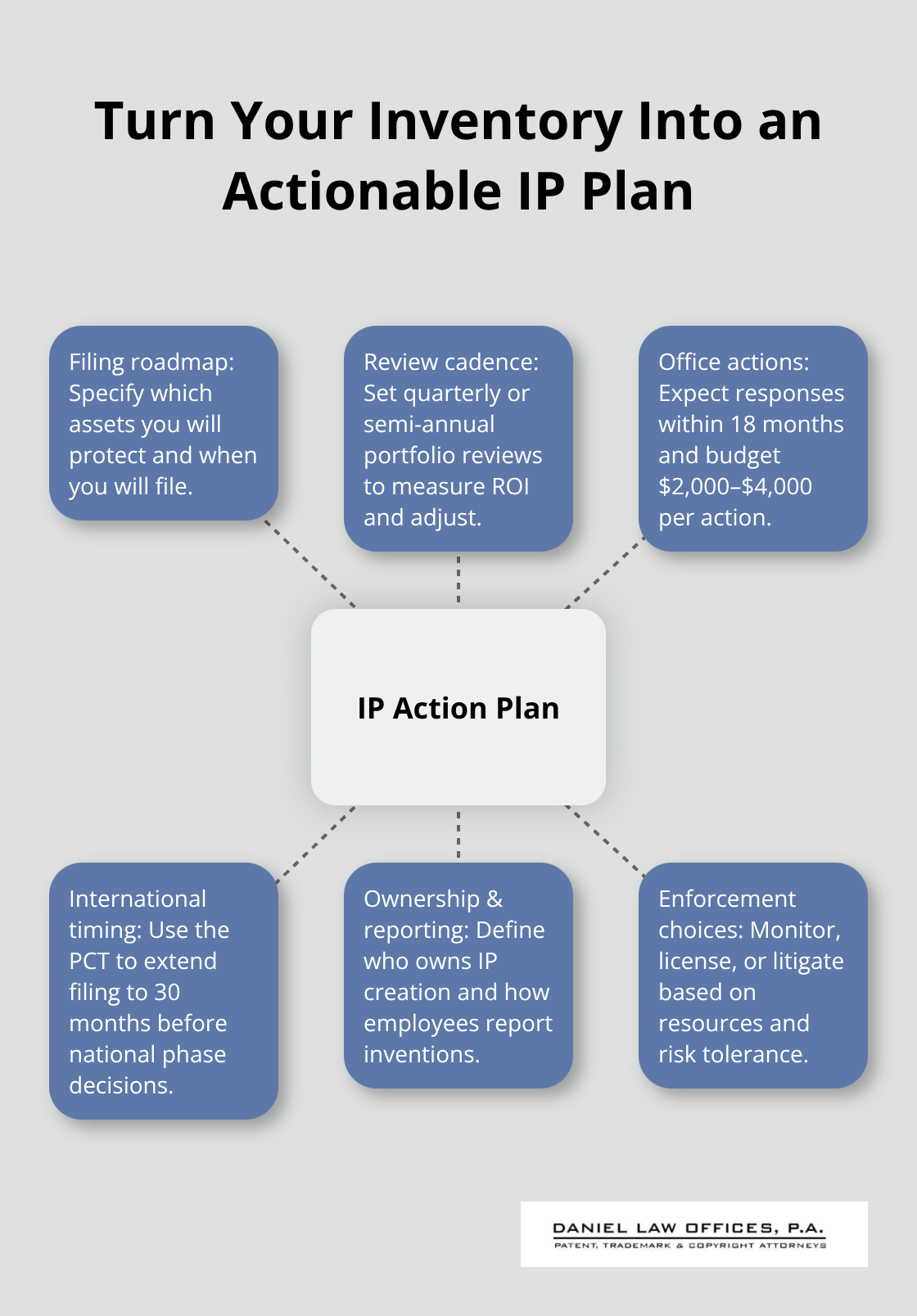
Create a detailed action plan that specifies which new assets you will pursue protection for, when you will file applications, and which existing patents you will abandon because they no longer serve business objectives. Set quarterly or semi-annual review dates to assess whether your IP generates the expected competitive advantage or licensing revenue. Include timelines for responding to office actions, which typically arrive within 18 months of filing, and budget for the $2,000 to $4,000 cost of each response. If you operate internationally, the Patent Cooperation Treaty extends your filing window to 30 months before you commit to full prosecution in multiple countries, which spreads your decision-making and costs over time. Your action plan should also specify who owns IP creation and capture within your organization, how employees report inventions, and what happens to rights if your company is acquired or restructured. Without these operational details, your strategy remains theoretical.
Execute With Discipline and Accountability
The difference between companies that build strong IP positions and those that do not often comes down to execution discipline, not clever strategy. Your document must include specific budget allocations by asset type and jurisdiction, clear decision criteria for what gets protected versus abandoned, and accountability for maintaining deadlines. Many businesses treat IP strategy as a one-time exercise, then ignore it until a crisis forces attention. Instead, plan for annual portfolio reviews where you assess ROI on each patent and trademark, eliminate non-performers, and reallocate resources toward emerging innovations. This iterative approach keeps your IP spending aligned with actual business priorities rather than historical decisions.
When you build your action plan, be ruthlessly honest about costs: a single patent family across the United States, Europe, and key Asian markets can easily cost $15,000 to $25,000 in total prosecution and maintenance fees over five years (based on typical Orlando patent attorney rates of $200 to $400 per hour). Small entity status cuts USPTO fees by 50 percent, and micro entity status cuts them by 75 percent, so confirm your eligibility early and lock in those savings. Your strategy should also address what happens when competitors infringe your IP: will you monitor for violations, enforce through licensing, or pursue litigation? Each approach requires different resource commitments. A proactive monitoring program costs roughly $200 to $500 per year but catches infringement early, while litigation can exceed $500,000 for a single case.
Plan for Enforcement and Ongoing Monitoring
Your action plan transforms your asset inventory into a living document that guides quarterly decisions and helps you allocate limited resources where they actually matter. The next critical phase involves identifying which brand elements need trademark protection and establishing the monitoring systems that catch infringement before it damages your market position.
What Mistakes Derail IP Strategy Documents in Orlando, Florida
Fail to Document IP Creation and Lose Ownership Rights
Most businesses fail at IP strategy not because they lack valuable innovations, but because they treat IP creation as something that happens randomly rather than systematically. Companies invest heavily in research and development, then fail to document which employee invented what, when the invention occurred, and whether the company actually owns the resulting IP. This documentation gap creates chaos later: when you try to file a patent application, you cannot clearly establish who conceived the invention or prove your ownership if multiple people contributed. The USPTO requires detailed inventor information, and if your records are vague or contradictory, examiners will reject your application or delay it by months while you scramble to clarify facts that should have been recorded when the work happened. Worse, if a co-founder or key employee leaves and disputes ownership, you may face litigation that costs far more than any patent would ever be worth.
A simple invention disclosure system where employees report innovations immediately captures the date, the problem solved, the technical approach, and all contributors. This takes 15 minutes per invention but protects your ownership rights permanently. Without this discipline, your IP strategy document remains theoretical because you cannot actually protect what you do not clearly own.
Neglect Trademark Registration and Watch Your Brand Disappear
Trademark protection receives even less attention than patent documentation, yet brand erosion happens quickly once competitors realize your marks are unregistered and therefore vulnerable. Many companies use distinctive logos, product names, and slogans for years without filing trademark applications, assuming common law rights are sufficient. Common law trademark rights do exist but are limited to the geographic areas where you actively use the mark, they are weaker in court proceedings than registered marks, and they offer zero protection against someone else registering your brand name in a different state or country where you plan to expand.
The USPTO charges $350 to $400 per trademark application for most businesses, yet companies regularly spend $50,000 on rebranding campaigns when they discover a competitor already registered their chosen name in key markets. Your strategy document must identify which brand elements actually drive customer recognition and sales, then prioritize registering those marks in the specific jurisdictions where you operate and plan to expand within the next three to five years. If you operate nationally or internationally, skip the temptation to register everywhere at once; instead, map your realistic market footprint and register there first. Patent maintenance fees and attorney responses to office actions will consume most of your IP budget, so allocate trademark dollars strategically rather than spreading limited resources across dozens of registrations that may never provide business value.
Underestimate Patent Maintenance Costs and Abandon Valuable Patents
Patent maintenance costs lead companies to abandon valuable patents prematurely or maintain worthless ones indefinitely. The American Intellectual Property Law Association reports that office actions occur in roughly 85% of patent applications, meaning each patent typically requires at least $2,000 to $4,000 in attorney fees to respond to examiner rejections. Then comes maintenance: $2,150 at 3.5 years, $4,040 at 7.5 years, and $8,280 at 11.5 years for each large-entity patent. A single patent family across the United States, Europe, and Asia can cost $15,000 to $25,000 over its lifetime.
Your strategy document must ruthlessly evaluate which patents actually protect products you sell or technologies you license; if a patent covers a discontinued product or an abandoned research direction, abandon the patent rather than pay maintenance fees indefinitely. Small entity status cuts USPTO fees in half, and micro entity status cuts them by 75 percent, so confirm your eligibility and lock in savings immediately. Most importantly, budget realistically: a company with five active patents across multiple jurisdictions should expect to spend $20,000 to $40,000 annually on maintenance and prosecution costs alone, separate from attorney time for licensing, enforcement, or strategy work. Without this honest accounting, your IP strategy becomes a wish list rather than an actionable plan.
Final Thoughts
An effective IP strategy document transforms your intellectual property from scattered assets into a coordinated defense system that protects revenue and prevents costly mistakes. The core takeaway is simple: document what you own, map your costs honestly, identify which assets actually drive business value, and execute with discipline. Companies that skip this work inevitably waste money maintaining patents that no longer serve their objectives, fail to register trademarks before competitors claim them, and lose ownership rights because they never documented who invented what.
Building an IP strategy document requires you to conduct a thorough audit of your current portfolio, search competitor IP to reveal gaps and threats, and create an action plan with specific milestones and budget allocations. You must account for real costs: patent maintenance fees, office action responses, trademark registrations, and professional drawings add up quickly across multiple jurisdictions. Small entity status and micro entity status can cut USPTO fees by 50 to 75 percent, so confirm your eligibility immediately (this decision alone can save thousands of dollars over your patent lifetime).
Contact Daniel Law Offices, P.A. in Orlando, Florida to develop an IP strategy document that turns your innovations and brand into lasting competitive advantage. We help businesses catalog current IP assets, map annual costs, and identify which patents and trademarks actually protect products you sell or technologies you license. Your next step is straightforward: reach out to us and transform your intellectual property into a strategic asset aligned with your business objectives.