




How to Conduct a Patent Assignee Search
Finding the right patent owner matters when you’re researching intellectual property or protecting your own innovations. A patent assignee search reveals who currently holds rights to a patent, which can shift over time as companies buy and sell intellectual property.
At Daniel Law Offices, P.A., we help clients navigate these searches to uncover ownership details that impact licensing, litigation, and business strategy. This guide walks you through the process step by step.
What a Patent Assignee Search Actually Reveals
Understanding Patent Ownership
A patent assignee search identifies who legally owns a patent at any given moment. The USPTO Patent Public Search database tracks this information through assignee records that show the current patent holder. Patent ownership shifts constantly-companies acquire patents from competitors, inventors sell their rights to larger corporations, and subsidiaries inherit portfolios from parent companies. A search reveals not just who owns a patent today, but the complete chain of ownership changes over time. The USPTO Patent Assignment Search tool specifically documents these transfers with dates and recorded documents, giving you a transparent view of how patent rights have moved between entities.
Why Businesses Conduct Assignee Searches
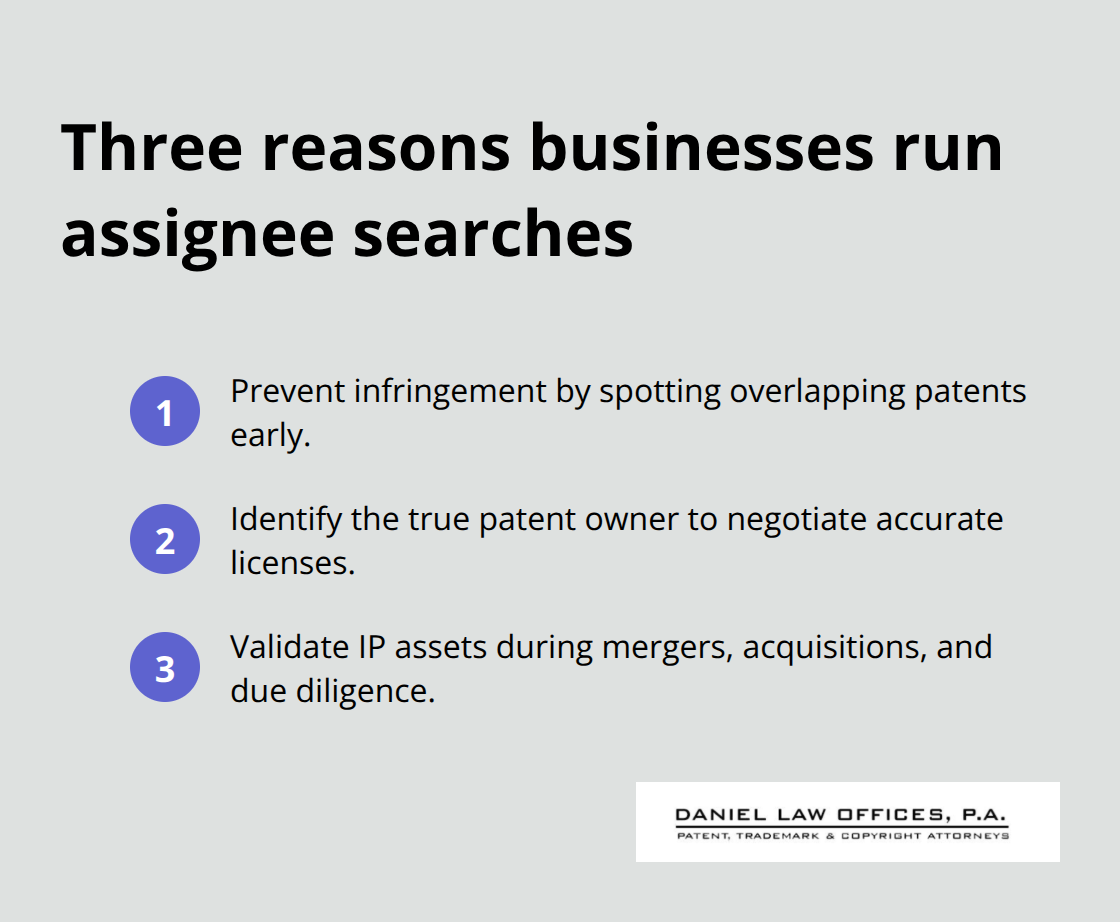
Businesses conduct these searches for three concrete reasons. First, companies protecting their own innovations need to know if competitors already hold patents covering similar technology-this prevents costly infringement lawsuits. Second, inventors licensing their work must identify the actual patent owner to negotiate deals, since ownership records determine who has authority to grant licenses. Third, organizations evaluating acquisitions use assignee searches to map the intellectual property assets they’re actually purchasing (a company’s real value often lies in its patent portfolio).
How Assignee Searches Differ from Other Patent Searches
A patent assignee search differs fundamentally from a general patent search because it focuses on ownership rather than technology or invention features. A technology search might find all patents related to wireless charging, while an assignee search identifies which companies hold those patents and when ownership changed hands. This distinction matters because two searches for the same technology could yield identical patents but reveal completely different ownership structures. Understanding this difference helps you select the right search approach for your situation-whether you’re investigating competitors, evaluating licensing opportunities, or conducting due diligence on potential acquisitions. The next section walks you through the actual process of conducting an assignee search using the tools available to you.
How to Search for Patent Assignees Using the USPTO Database
Accessing the USPTO Patent Public Search System
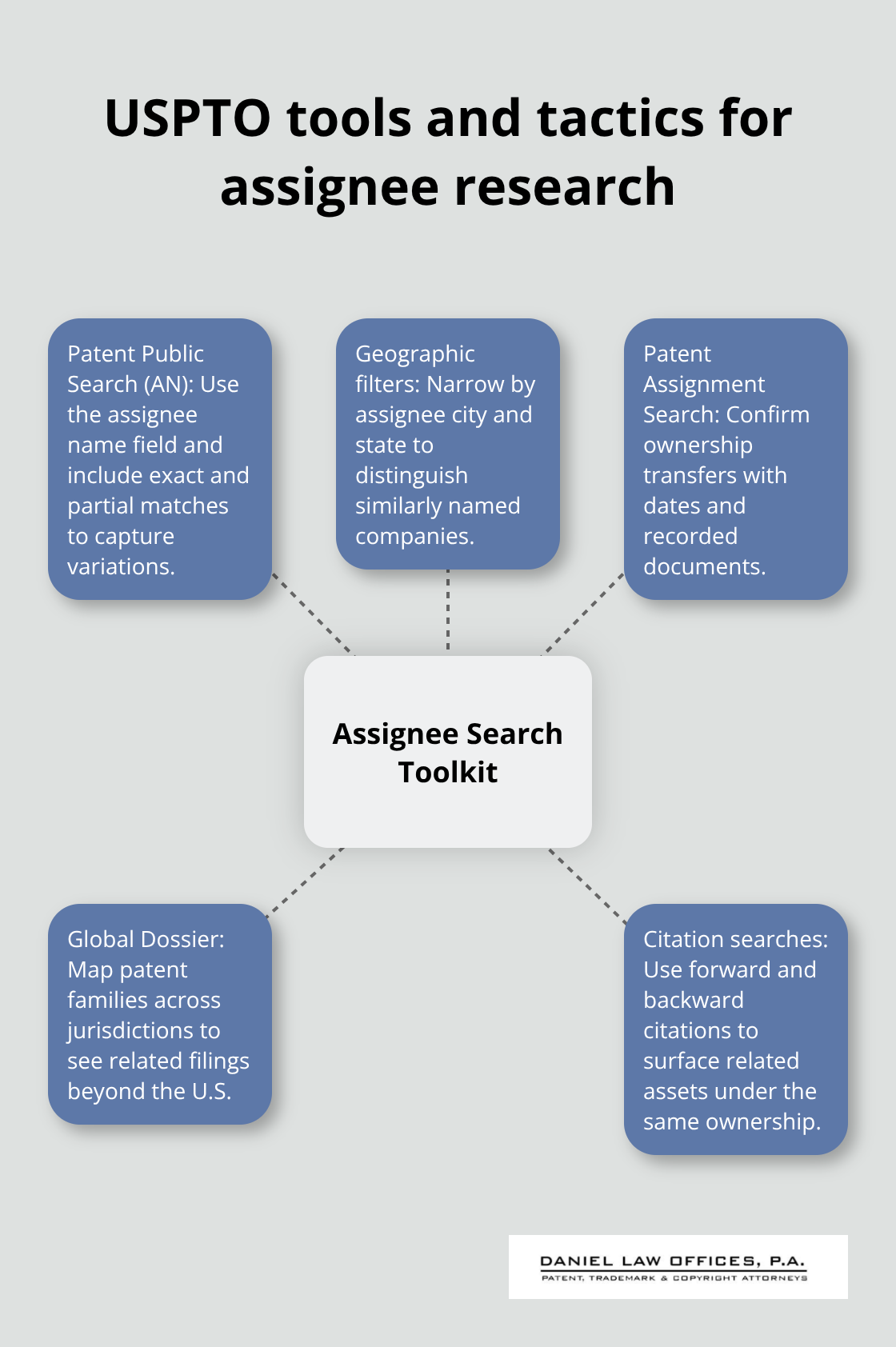
Start your assignee search directly in the USPTO Patent Public Search database rather than wasting time with inferior tools. The USPTO updated this system as of February 23, 2026, making it the most current source for ownership information. Access the advanced search function and locate the assignee name field, abbreviated as AN in most interfaces. Type the company name exactly as it appears in official records, though the database accepts partial matches. If you’re searching for a subsidiary or acquired company, search multiple name variations since ownership transfers don’t always update uniformly across all patent records. A company acquired in 2020 might retain its original name on patents filed before the acquisition, requiring you to search both the old and new corporate names to capture the complete portfolio.
Using Geographic Filters to Narrow Results
Geographic filtering matters more than most searchers realize. The USPTO allows you to narrow results by the assignee’s city and state, which eliminates confusion when multiple companies share similar names. If you’re investigating a Florida-based competitor, filter by location to focus your results. After running your initial search, examine the front page of each patent or published application to verify the assignee name, filing date, and current status.
Tracking Ownership Changes Through Assignment Records
The Patent Assignment Search tool, separate from the main database, shows when ownership actually changed hands with specific dates and recorded documents. A patent might list Company A as the assignee, but Company B acquired those rights three years ago-this distinction is critical for understanding true ownership. Forward and backward citation searches reveal which patents reference each other, exposing related assets under the same ownership that keyword searches might miss.
Mapping Patent Families Across Jurisdictions
The USPTO’s Global Dossier tool consolidates patent family information across multiple jurisdictions, showing you if a company holds related patents in Europe, Japan, or other markets. Most searchers stop after finding one relevant patent and miss the broader portfolio, which means they underestimate the assignee’s actual IP position. Patent families often contain dozens of variations covering different aspects of the same core technology, and understanding the full scope changes your licensing strategy or litigation risk assessment significantly. Spend time mapping the entire family of related patents rather than treating each patent as an isolated result. This comprehensive approach reveals the true depth of an assignee’s intellectual property holdings and prepares you for the next critical step: evaluating what you’ve found and determining your next move.
Common Mistakes to Avoid When Searching for Patent Assignees
Incomplete or Incorrect Assignee Names Create Blind Spots
Most patent searches fail because searchers enter incomplete or slightly incorrect company names into the database. The USPTO database is literal-if you search for Apple Inc. but the patent records list Apple Computer Inc., you’ll miss hundreds of relevant patents. Corporate name variations multiply across decades of filings. A company might appear as XYZ Technologies, XYZ Tech, XYZ Corp, and simply XYZ depending on when the patent was filed and which USPTO form was used. Search each variation separately. If you’re investigating a competitor based in Orlando, Florida, the patent might list their old name from before a merger or rebranding. You should also search subsidiaries under parent company names as well-a patent assigned to a subsidiary may not appear when you search only the parent corporation’s name. The solution is methodical: before you start, compile every known name variation for your target company, including former names, abbreviations, and any subsidiaries. Then run separate searches for each one. Most searchers skip this step and conclude a company has fewer patents than they actually hold, which creates serious blind spots in competitive analysis or licensing negotiations.
Assignment History Changes Reveal Hidden Ownership Chains
A patent might display Company A as the current assignee, but Company B acquired those rights years ago and never updated all the records uniformly across every database. The Patent Assignment Search tool and Global Dossier reveal these transfers, but many searchers never consult them. Forward and backward citation searches expose related patents that might belong to the same owner but don’t appear in simple name-based queries. You might find one patent easily, then miss dozens of related patents in the same technology family because you failed to trace the ownership chain. Each ownership transfer creates a gap in your research if you don’t actively investigate the assignment history. The Patent Assignment Search tool documents these transfers with specific dates and recorded documents, giving you transparency into how rights moved between entities over time.
International Patent Databases Contain Critical Ownership Data
Failing to search beyond the USPTO into European patents via Espacenet or Japanese patents through the Japan Patent Office means you ignore 40 to 60 percent of the global patent landscape for many technology areas. Each jurisdiction maintains its own assignee records, and a company’s international portfolio often reveals their true strategic focus better than US filings alone. Geographic search limitations create incomplete pictures. Conduct your search across USPTO, Espacenet, and at minimum Google Patents for international coverage before concluding your research is complete. A company’s European patent portfolio might contain dozens of assets that never received US protection, yet those patents could affect your business strategy significantly (especially if you operate internationally). The Global Dossier tool consolidates patent family information across multiple jurisdictions, showing you if a company holds related patents in Europe, Japan, or other markets. Most searchers stop after finding one relevant patent and miss the broader portfolio, which means they underestimate the assignee’s actual IP position.
Final Thoughts
A patent assignee search reveals ownership patterns that directly impact your business decisions, whether you’re protecting innovations, negotiating licenses, or evaluating acquisitions. The process requires methodical work across multiple databases and careful attention to name variations and assignment history. Most searchers stop too early, missing critical ownership transfers or international filings that change the entire picture of who controls a technology space.
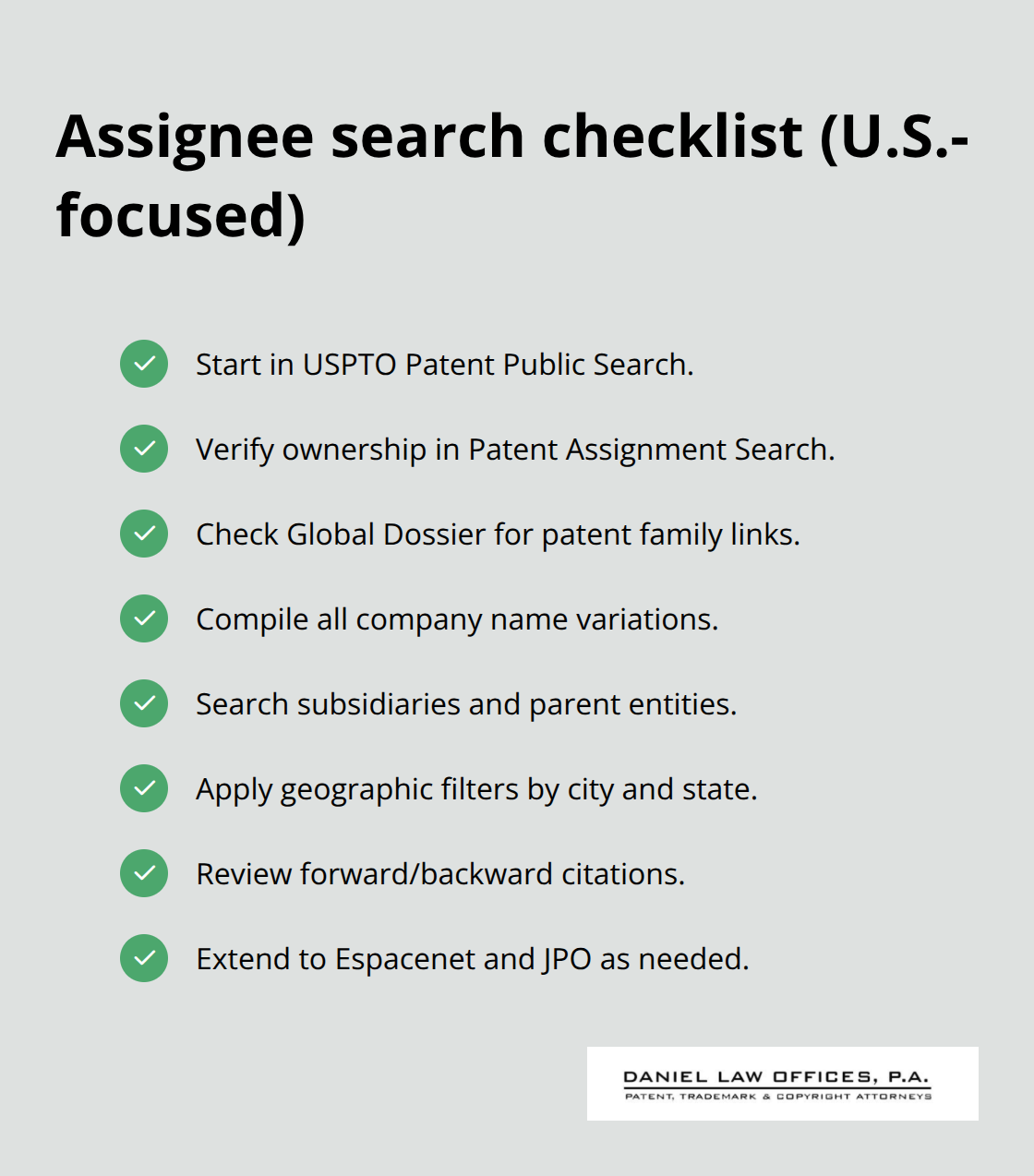
Conducting a thorough patent assignee search means searching beyond the obvious. Start with the USPTO Patent Public Search database, then verify results through the Patent Assignment Search tool and Global Dossier. Search every name variation your target company has used, trace ownership changes across time, and extend your research into European and international databases-a complete search takes more time than a quick lookup, but incomplete research leads to costly mistakes in licensing negotiations, competitive analysis, or acquisition due diligence.
We at Daniel Law Offices, P.A. help clients move from search results to actionable strategy. Contact Daniel Law Offices, P.A. to discuss how we can support your patent strategy and guide you through interpreting what you’ve found for your specific situation.