



Copyright Registration Orlando, Florida: A Practical Guide for Creators
If you create software, photos, books, music, videos, or brand visuals in Central Florida, copyright registration Orlando, Florida questions come up fast. Copyright protection starts when an original work is fixed, but registration with the U.S. Copyright Office is what turns that automatic protection into a stronger courtroom position.
At Daniel Law Offices, P.A., we help inventors, startups, and businesses in Orlando and across Florida protect creative works alongside patents and trademarks. This guide explains what copyright registration actually does, how the process works, and the mistakes that leave creators exposed.
What Copyright Registration Actually Does
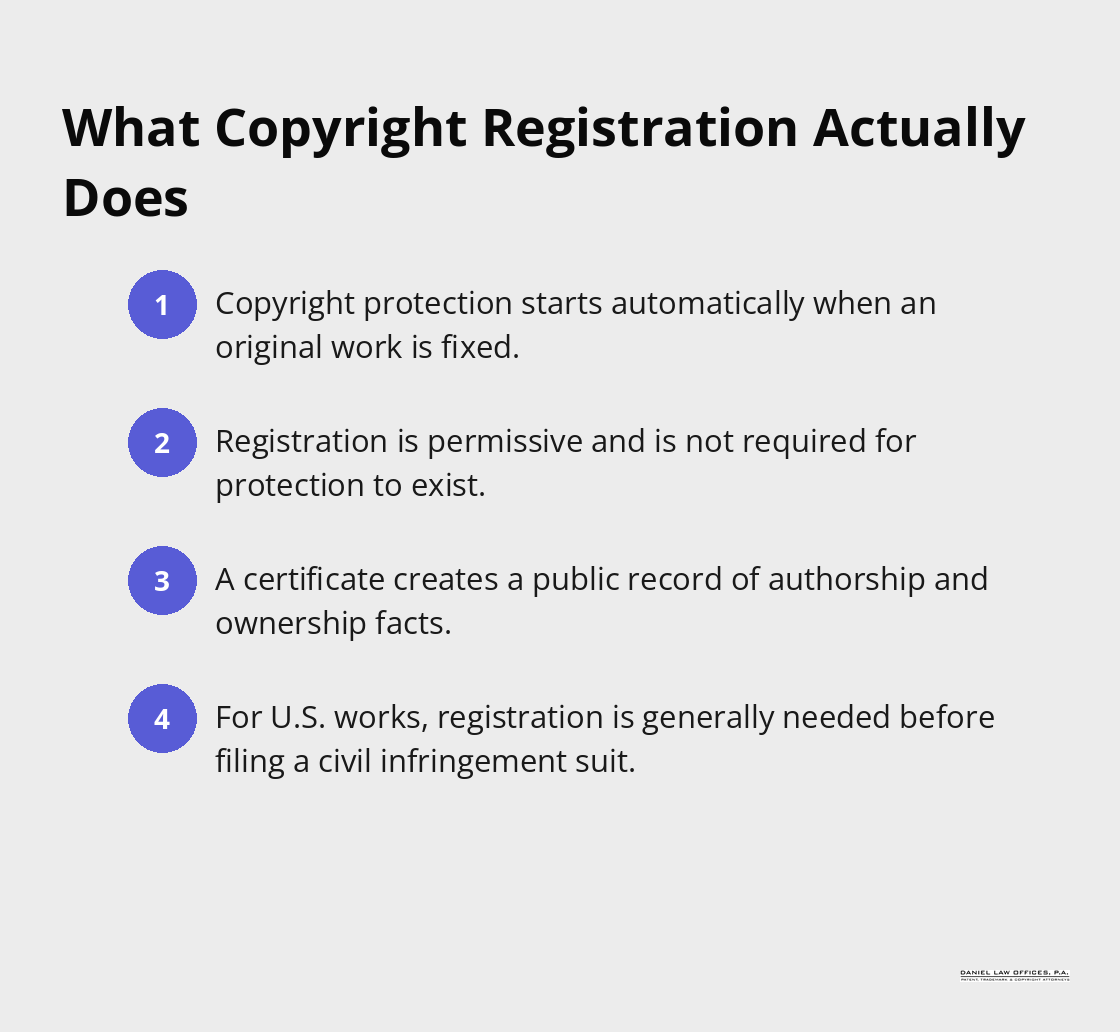
Copyright protection in the United States exists automatically from the moment an original work of authorship is fixed in a tangible medium of expression. Registration is separate. Under 17 U.S.C. § 408, registration is permissive and is not a condition of copyright protection, but it creates a public record of your claim and unlocks important enforcement tools. Many creators treat registration as paperwork they can postpone. In practice, the certificate is often what makes a later dispute manageable, especially when you need to show ownership quickly to a platform, licensee, investor, or opposing counsel.
An original work of authorship is a work independently created by a human author that shows at least a minimal degree of creativity. A work is fixed when it is captured, by or under the author’s authority, in a form that can be perceived, reproduced, or communicated for more than a short time. Ideas, procedures, processes, systems, methods of operation, concepts, principles, and discoveries are not protected by copyright, no matter how they are described. That line matters for Orlando startups. You can protect the creative expression in source code comments, user-interface artwork, manuals, and marketing videos, while patent or trade-secret strategies may still be needed for the underlying functional idea.
Automatic Protection Versus a Public Record
Many Orlando creators assume an unpublished draft or a private file has no copyright until they file something. That is not how U.S. law works. Protection attaches at fixation. What registration adds is a certificate and a public record of key facts about authorship, ownership, title, year of creation, and publication status.
Categories of Works You Can Register
17 U.S.C. § 102 lists major categories of works of authorship, including literary works; musical works; dramatic works; pantomimes and choreographic works; pictorial, graphic, and sculptural works; motion pictures and other audiovisual works; sound recordings; and architectural works. The Copyright Office views these categories broadly for registration. Computer programs and certain compilations can be registered as literary works, and maps or technical drawings can be registered as pictorial or graphic works.
Exclusive Rights Registration Helps You Enforce
A copyright owner has exclusive rights under 17 U.S.C. § 106 to reproduce the work, prepare derivative works, distribute copies to the public, and, for many categories, perform or display the work publicly. Registration does not create those rights, but it is often the practical gateway to enforcing them in federal court for United States works.
How the Copyright Registration Process Actually Works
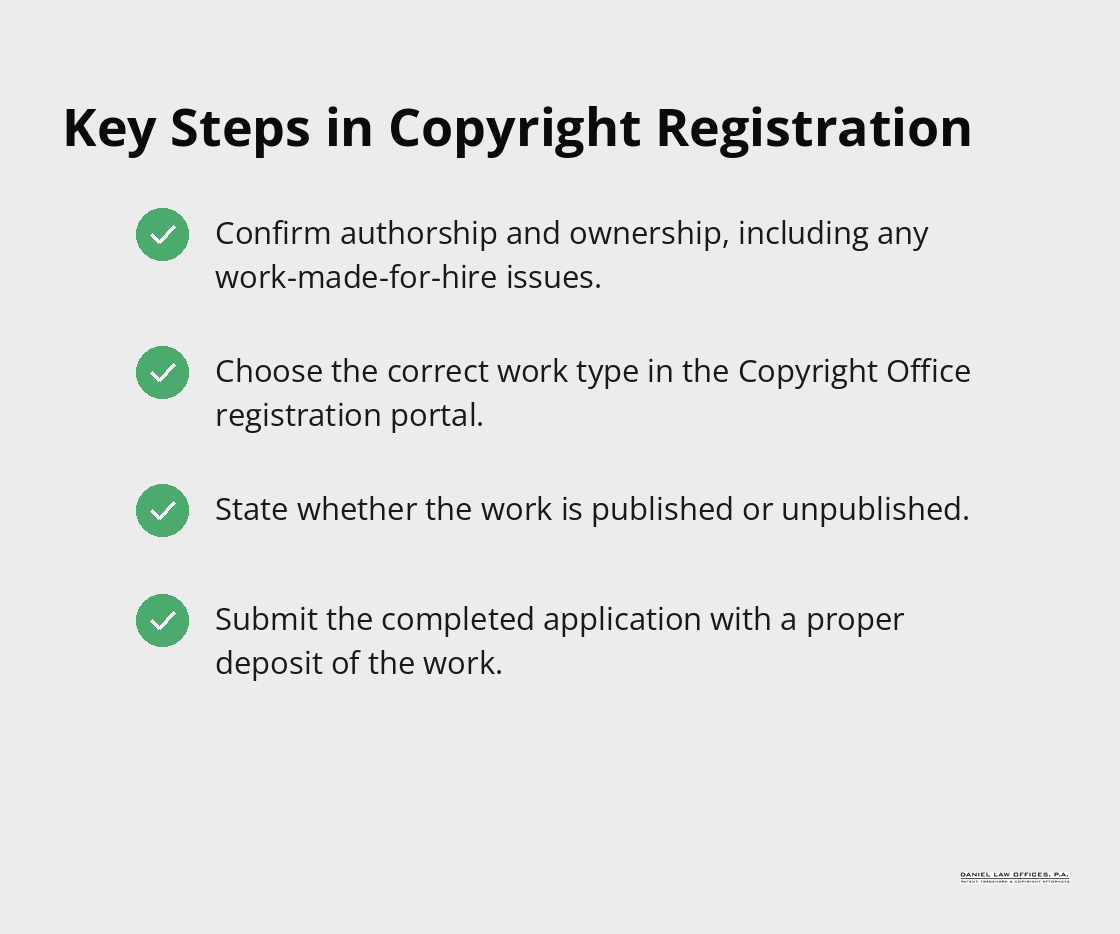
The U.S. Copyright Office handles registration through its Electronic Copyright Office system at copyright.gov. An application generally includes a completed application, a nonreturnable deposit of the work, and the other materials the Office requires for the claim you are filing. You can apply as the author, as the owner of an exclusive right, or through an authorized agent. Preparing the deposit carefully is as important as filling out the form. Incomplete deposits and mismatched descriptions of the work are among the most common reasons examination slows down or the public record ends up weaker than the creator expected.
For creators in Orlando, Florida, the federal process is the same whether you write code in Winter Park, shoot photos in Lake Nona, or produce video in downtown Orlando. State residence does not change the Copyright Office rules, but local businesses often need registration before licensing content, raising investment, or responding to online copying. Theme parks, hospitality brands, software companies, and independent creators all face the same basic federal framework, even though their commercial uses differ.
Choose the Right Work Type and Application Path
Literary works, visual arts, performing arts, motion pictures, photographs, and sound recordings follow different deposit and application paths inside the registration portal. Group registration options exist for some categories, such as certain published photographs or other groups the Office currently allows. Selecting the wrong type can delay examination or force a new filing.
Published Versus Unpublished Filings
You must determine whether the work is published or unpublished when you register. That classification affects deposit requirements and how the public record reads. Published and unpublished works are both eligible for registration during the subsistence of copyright, but the deposit you send and the facts you state must match the work’s actual status.
Who Owns the Claim You Are Registering
Under 17 U.S.C. § 201, copyright initially vests in the author or authors. For a work made for hire, the employer or other person for whom the work was prepared is considered the author, and that person owns the copyright unless the parties expressly agreed otherwise in a signed written instrument. Joint authors of a joint work are coowners. Getting ownership wrong on the application creates a record problem that can haunt later enforcement or transfer deals.
How Long Copyright Lasts After Creation
For works created on or after January 1, 1978, copyright generally endures for the life of the author plus 70 years after the author’s death. For a joint work that is not a work made for hire, the term is measured by the life of the last surviving author plus 70 years. For anonymous works, pseudonymous works, and works made for hire, the term is 95 years from first publication or 120 years from creation, whichever expires first.
What Derails Copyright Registration and Later Enforcement
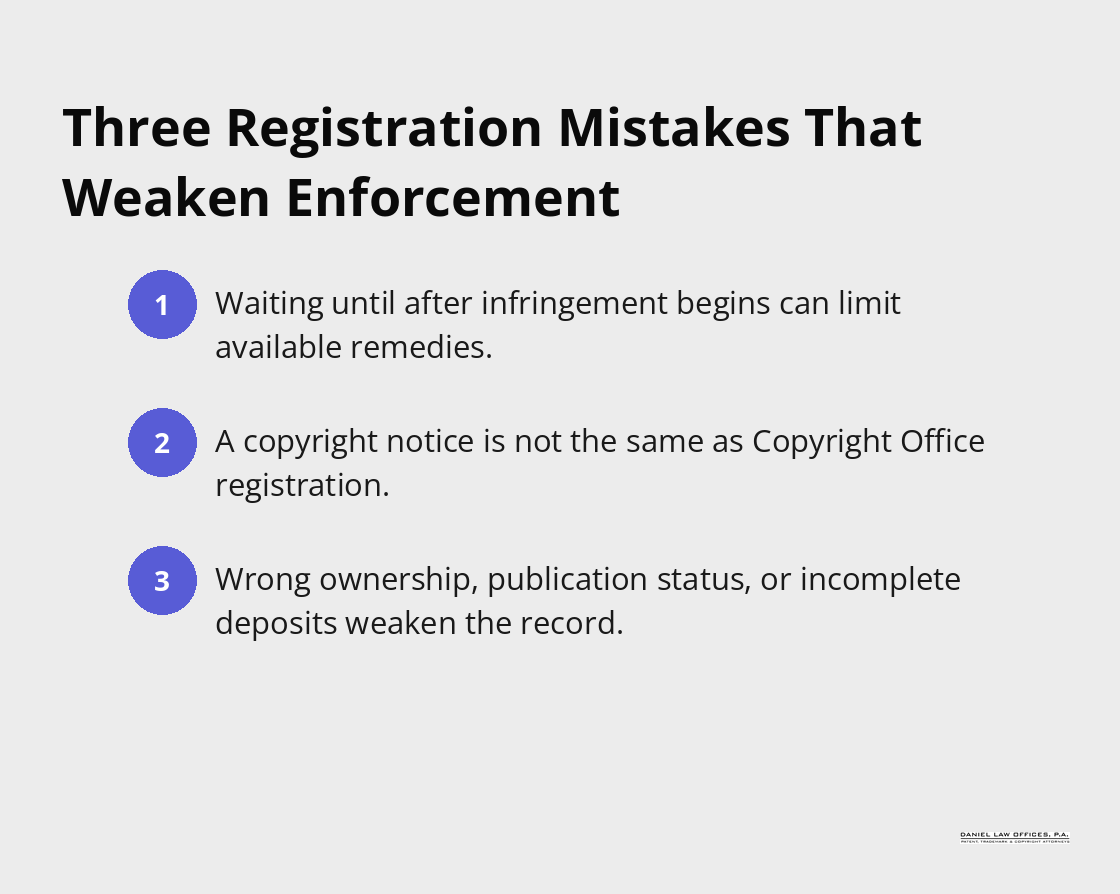
Most registration problems are avoidable. They usually come from ownership confusion, incomplete deposits, waiting too long before infringement, or assuming a copyright notice alone is enough. Creators in Orlando, Florida often discover these issues only after someone copies a site, product photo set, software module, or marketing video. By then, the strongest remedy window may already be narrower than it would have been with an earlier registration.
Waiting Until After Infringement to Register
For a United States work, 17 U.S.C. § 411 generally requires preregistration or registration before a civil infringement action may be instituted. If the Copyright Office refuses registration after a proper deposit, application, and required materials are delivered, the applicant may still sue after serving notice on the Register of Copyrights. Timing still matters for remedies. Under 17 U.S.C. § 412, statutory damages and related monetary remedies under the Copyright Act are generally unavailable for infringement that began before the effective date of registration, subject to limited statutory exceptions such as registration within three months after first publication.
In plain terms, registering early preserves the strongest set of remedies if copying happens later. Waiting until after you discover infringement can leave you with a narrower recovery path even if you eventually register and sue.
Confusing Copyright Notice With Registration
A copyright notice can still be useful as a practical warning, but notice is not the same as registration and is not what opens the federal courthouse door for United States works. Relying on a © symbol, a website footer, or a watermark alone does not create the public registration record or the statutory advantages described in Copyright Office Circular 1.
Misstating Authorship, Publication, or Deposit
Applications fail or create weak records when the claimant is wrong, when preexisting material is not identified, when the deposit is incomplete, or when published and unpublished status is mislabeled. Because a timely registration certificate can serve as prima facie evidence of the validity of the copyright and of the facts stated in the certificate when registration is made before or within five years of publication, inaccurate facts undermine the very presumption registration is meant to provide.
Ignoring Preexisting Material in Derivative Works
If your filing covers a revision, translation, adaptation, or other derivative work, the new authorship must be identified carefully. A derivative work incorporates some or all of a preexisting work and adds new original authorship. Leaving preexisting material unexplained can overstate the claim and create a certificate that does not match what you actually own. That mismatch becomes painful when you later need the registration as evidence.
Final Thoughts
Copyright registration Orlando, Florida creators need is not mysterious, but it is easy to postpone until copying has already started. Protection begins at fixation; registration builds the public record and the enforcement posture that matter when a dispute becomes real.
If you are building software, content, product designs expressed in creative works, or a media brand in Orlando or elsewhere in Florida, review ownership, publication status, and registration timing before you launch or license the work. Clear records make later transfers, investor diligence, and enforcement far simpler. A short ownership audit before filing often prevents years of cleanup after a dispute starts.
If you want help deciding what to register and how to structure the claim, contact Daniel Law Offices, P.A. to speak with our team in Orlando, Florida. We guide clients through copyright registration strategy alongside patent and trademark protection so you can move forward with confidence.