




Trademark Specimen of Use Orlando, Florida: What the USPTO Accepts as Proof That Your Mark Is in Use
A trademark specimen in Orlando, Florida is the real-world proof that a brand name, logo, or slogan is actually being used in commerce, and it is one of the most common reasons the United States Patent and Trademark Office refuses a registration. Business owners often assume that a clean logo file or a mockup of packaging is enough. It is not. The Office wants to see how the mark appears in the marketplace, and the rules about what qualifies are specific.
At Daniel Law Offices, P.A., we help Orlando businesses and inventors protect their brands so you can move forward with confidence. This guide explains what a trademark specimen is, what the federal regulation says the Office will accept for goods and for services, and the mistakes that most often lead to a refusal.
What a Trademark Specimen in Orlando, Florida Actually Is
When an applicant asks to register a mark based on use in commerce, the application must show that the mark is really being used. The specimen is the sample that does the showing. It is separate from the drawing, which is the clean depiction of the mark itself, and it must come from real use rather than from a design file prepared in advance.
Why the Office Requires Proof of Use
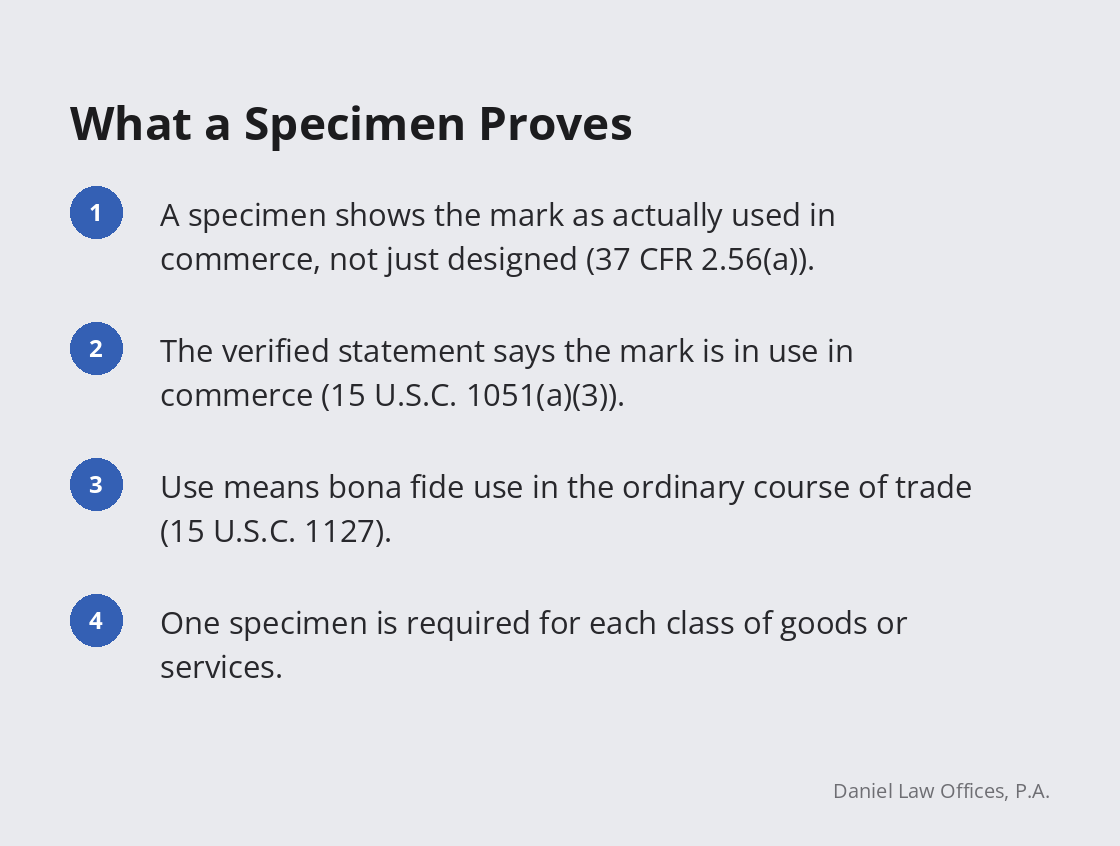
Federal law builds the requirement into the statute. Under 15 U.S.C. 1051(a)(1), the owner of a trademark used in commerce may request registration on the principal register by filing an application, together with a verified statement and such number of specimens or facsimiles of the mark as used as may be required by the Director. The verified statement, under section 1051(a)(3), must specify that the mark is in use in commerce. The specimen is the evidence behind that sworn statement.
What Counts as Use
The Lanham Act defines use of a mark in 15 U.S.C. 1127 as the bona fide use of the mark made in the ordinary course of trade, and not made merely to reserve a right in a mark. This definition explains why a business that has only printed samples, designed a logo, or announced a future launch usually cannot show a specimen. The mark must be used in actual business dealings with customers.
One Specimen for Each Class
The regulation at 37 CFR 2.56(a) provides that an application based on use must include one specimen per class showing the mark as actually used in commerce on or in connection with the goods or services identified. The Office may request additional specimens when reasonably necessary to proper examination. An applicant who lists goods or services in more than one class should prepare a specimen for each.
What the Office Accepts for Goods and for Services
The same regulation separates goods from services, and the rules are different. Using the wrong type of specimen for the kind of mark is one of the most frequent reasons for a refusal.
Specimens for Goods
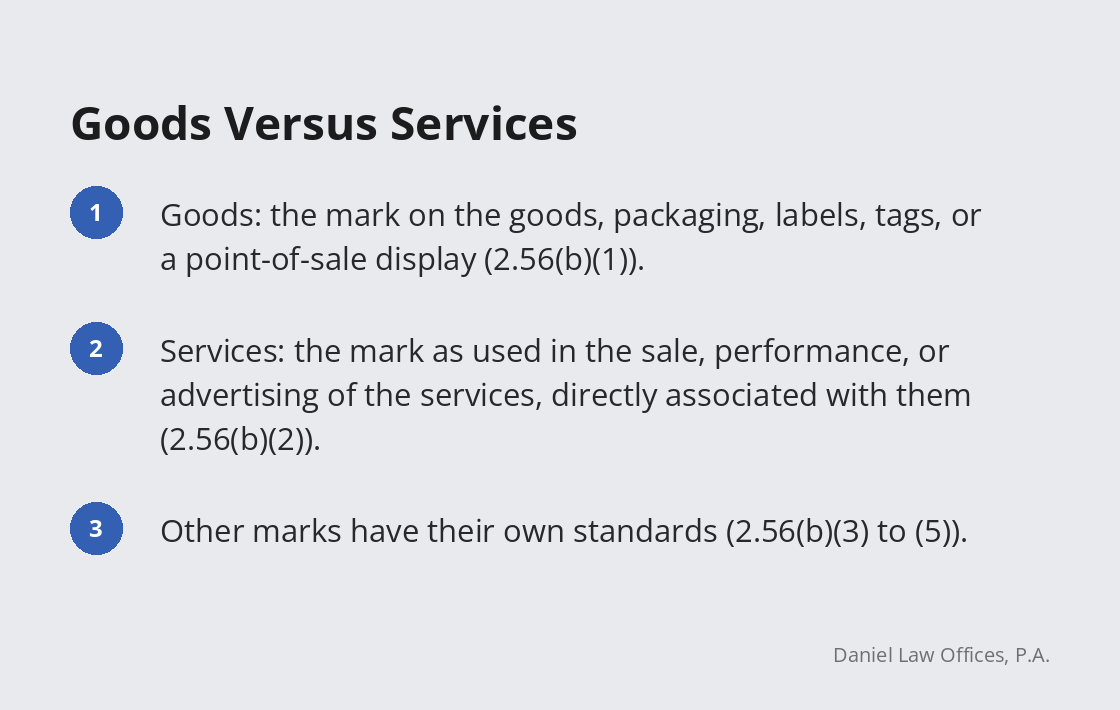
Under 37 CFR 2.56(b)(1), a trademark specimen must show use of the mark on the goods, on containers or packaging for the goods, on labels or tags affixed to the goods, or on a display associated with the goods. The regulation adds that, to constitute a display associated with the goods, the specimen must show use of the mark directly associated with the goods and that such use must be of a point-of-sale nature. A product photograph that shows the brand name printed on the item or on its label is the classic example.
When the Mark Cannot Go on the Goods
Section 2.56(b)(1) also states that the Office may accept another document related to the goods or the sale of the goods when it is impracticable to place the mark on the goods, packaging, or displays. This exception is narrow. It is meant for items such as bulk commodities or products that cannot physically carry a label, and an applicant who uses it should be ready to explain why the usual options were impractical.
Specimens for Services
For services, 37 CFR 2.56(b)(2) requires that the specimen show the mark as used in the sale of the services, including use in the performance or rendering of the services, or in the advertising of the services, and that it show a direct association between the mark and the services. A website that describes the services under the mark, a brochure, or a photograph of signage at the place where the services are performed can work, as long as the mark is clearly tied to the services being offered.
Other Types of Marks
The regulation also contains separate standards for collective trademarks and service marks, collective membership marks, and certification marks in paragraphs (b)(3) through (b)(5). For example, a collective membership mark specimen must show use by members to indicate membership in the collective organization. Orlando organizations that operate trade associations or certification programs should look closely at the standard for the type of mark they want to register.
Common Specimen Mistakes That Lead to Refusals
Most refusals can be avoided with attention to detail. The following mistakes appear again and again in trademark applications from small and growing businesses.
Submitting a Mockup or Rendering
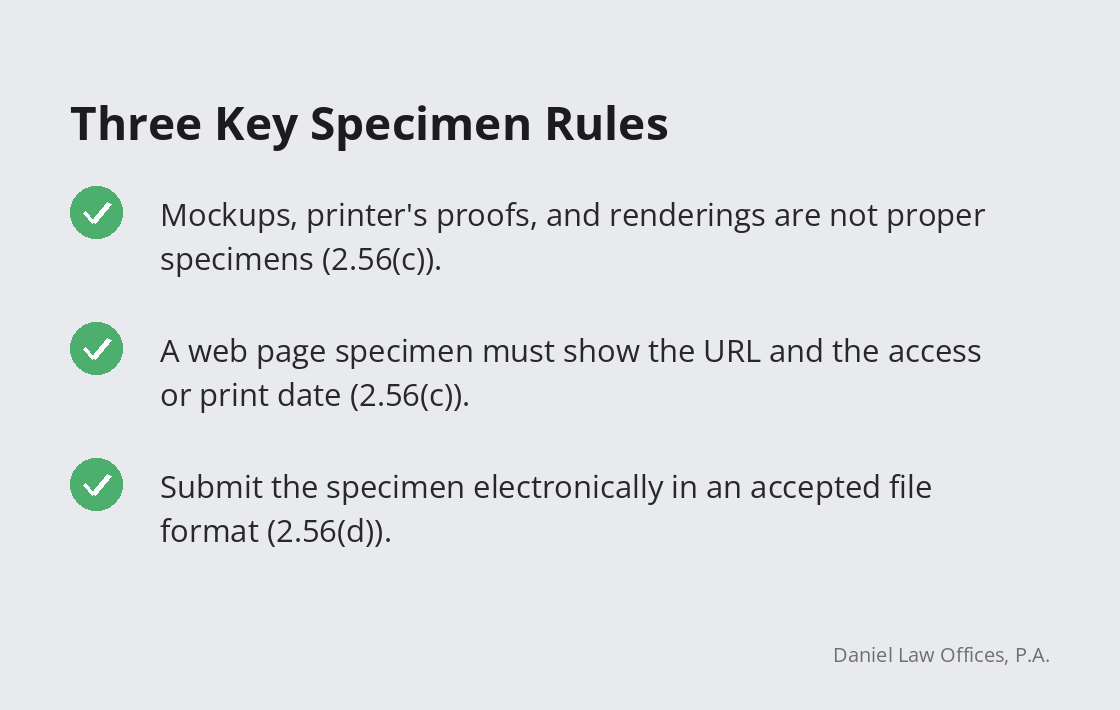
Section 2.56(c) states that an artist’s rendering, a printer’s proof, a computer illustration, a digital image, or a similar mockup of how the mark may be displayed is not a proper specimen. Neither is a photocopy of the drawing. If the product is not yet on the market, the business is not ready to file a use-based application and may want to consider other filing options that do not require current use, which a trademark lawyer can explain.
Leaving Out Required Web Page Details
The same paragraph provides that a clear and legible photocopy, photograph, web page printout, or other similar reproduction of an actual specimen is acceptable, but that a web page must include the URL and access or print date. Applicants who capture a screenshot without the web address and the date create an avoidable problem. The reproduction must also show the entire specimen or enough of it that the nature of the specimen, the mark, and the good or service with which the mark is used are identifiable.
Choosing the Wrong Kind of Specimen
An advertisement alone generally is not enough for goods, because the regulation requires use on the goods, packaging, tags, labels, or a point-of-sale display. A product label does not by itself prove use for services unless it shows the mark in connection with the sale or rendering of the services. Matching the specimen to the type of mark avoids many refusals.
Not Matching the Mark in the Drawing
The mark on the specimen should match the mark in the drawing. If the wording, stylization, or logo differs, the Office may question whether the specimen shows the same mark. Review the drawing and the specimen side by side before filing.
Missing the Electronic Filing Requirements
Under section 2.56(d), a specimen generally must be submitted through TEAS in a file format designated as acceptable by the Office, with limited exceptions such as scent or flavor marks and paper submissions permitted under other regulations. Unreadable files or unsupported formats can delay an application.
Final Thoughts
A trademark specimen is the proof that backs up a sworn statement that a mark is in use in commerce. The Office requires one specimen per class, it expects real use rather than a mockup, and it applies different standards to goods and services. Goods must show the mark on the goods, packaging, labels, tags, or a point-of-sale display, and services must show a direct association between the mark and the services. A clear photo or properly captured web page, with the mark visible and the details included, makes the difference.
If you are planning to register a trademark for your Orlando business, contact Daniel Law Offices, P.A. to speak with our team. We will review your materials, explain what the Office is likely to accept, and help you move forward with confidence.