




Patent Assignment Orlando, Florida: How Patent Ownership Is Transferred and Recorded
Patent assignment in Orlando, Florida is one of those topics inventors tend to ignore until a deal, an investor, or a dispute forces the question of who actually owns an invention. A patent or a pending application is a valuable business asset, and the way ownership moves from one person or company to another follows specific federal rules. If the paperwork is missing, vague, or never recorded, the person who believes they own the invention can discover too late that their position is far weaker than they assumed. Understanding how assignment works gives you real control over one of the most important assets your business holds.
At Daniel Law Offices, P.A., we help inventors, founders, and growing companies keep their patent ownership clean, documented, and ready for whatever comes next, so you can move forward with confidence. This guide explains what a patent assignment actually is, how ownership is transferred and recorded with the United States Patent and Trademark Office, and the common mistakes that leave a cloud over title.
What Patent Assignment Actually Means
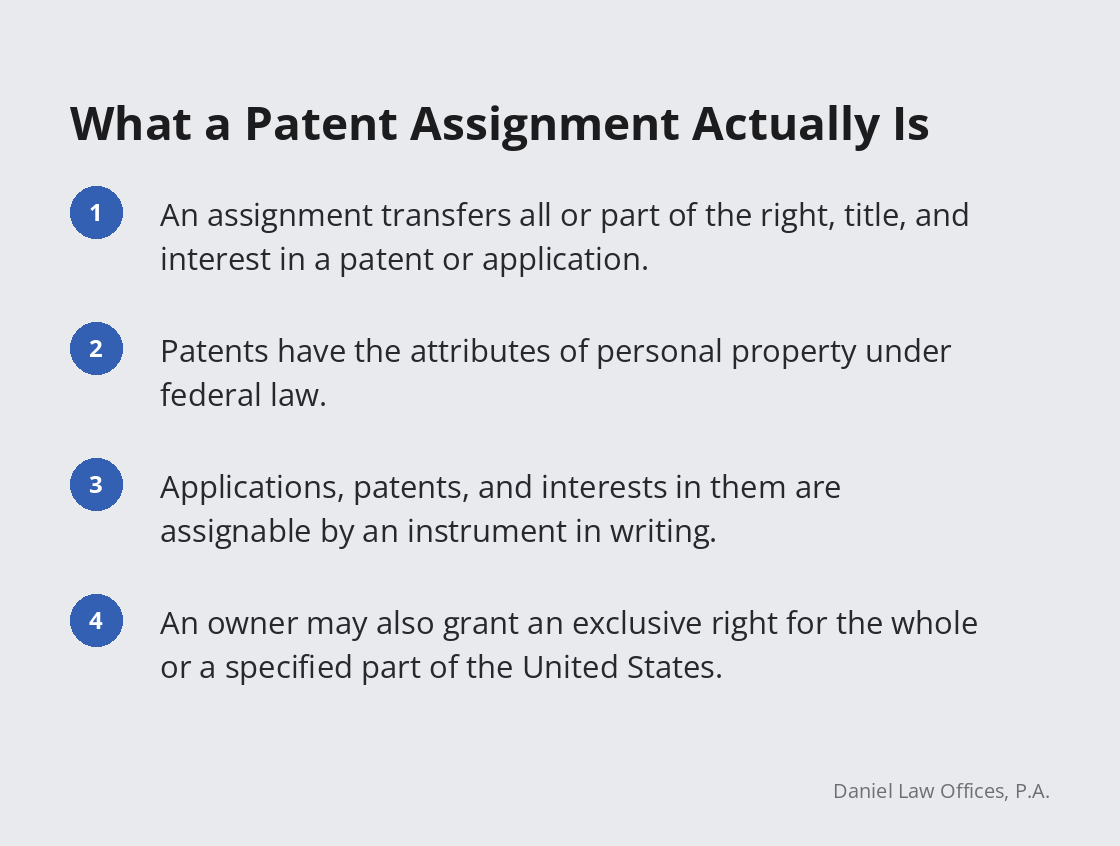
An assignment is a transfer of ownership. When an inventor or company assigns a patent or patent application, it hands over its right, title, and interest in that property to someone else, called the assignee. Federal regulations at 37 C.F.R. Section 3.1 define an assignment as a transfer by a party of all or part of its right, title, and interest in a patent or patent application.
Patents Are Treated as Personal Property
The starting point is 35 U.S.C. Section 261, which provides that patents have the attributes of personal property. That simple phrase means that ownership questions are resolved by looking at documents and records, not by asking who came up with the idea or who has been using the technology the longest.
Assignment Must Be in Writing
Section 261 also states that applications for patent, patents, or any interest in them are assignable in law by an instrument in writing. A handshake, an email exchange that never clearly transfers rights, or a verbal promise made during a startup’s early days does not do the job on its own. The written instrument should clearly identify the parties, describe what is being transferred, and be signed by the person giving up ownership.
Assignment Versus Other Grants of Rights
Not every agreement involving a patent is an assignment. Section 261 recognizes that an owner may also grant and convey an exclusive right under a patent or application to the whole or any specified part of the United States. Other arrangements simply allow someone to use the invention while the owner keeps title. The label on the document is less important than what it actually does, so the language should make plain whether ownership is changing hands or whether the owner is keeping title and granting narrower rights.
How to Transfer and Record Patent Ownership
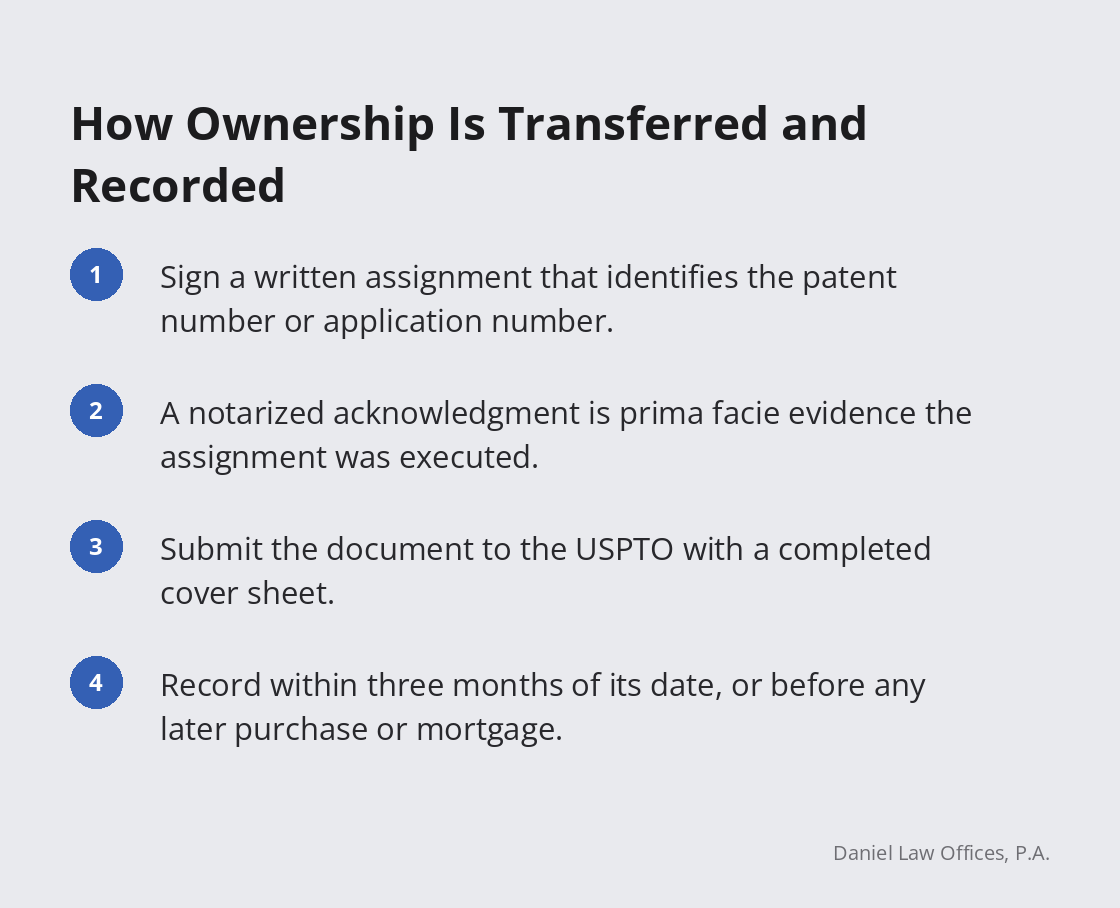
Transferring ownership is a two-part process. The first part is the private agreement between the parties, which creates the transfer. The second part is recording that agreement with the USPTO so the public record reflects who owns the patent or application. Section 261 directs the USPTO to maintain a register of interests in patents and applications and to record any document related to them upon request.
Drafting a Clear Assignment Document
A well-drafted assignment identifies exactly which property is being transferred. Under 37 C.F.R. Section 3.21, an assignment relating to a patent must identify the patent by its patent number, and an assignment relating to a national patent application must identify the application by its application number. The document should also address related rights, such as continuing applications and foreign counterparts, so that nothing important is left behind. Section 261 adds that a certificate of acknowledgment before a person authorized to administer oaths, such as a notary, is prima facie evidence that the assignment was executed, which can make the document far easier to rely on later.
Recording the Assignment With the USPTO
Recording is done by submitting the document together with a completed cover sheet. Under 37 C.F.R. Sections 3.11, 3.28, and 3.31, assignments of applications and patents accompanied by a completed cover sheet will be recorded, and the cover sheet must identify the patents and applications against which the document is recorded. If the assignment is written in another language, 37 C.F.R. Section 3.26 provides that the USPTO will record it only if it is accompanied by an English translation signed by the person who made the translation.
Why the Three-Month Window Matters
The most important timing rule appears in the final sentence of Section 261. An assignment is void as against any subsequent purchaser or mortgagee for a valuable consideration, without notice, unless it is recorded in the USPTO within three months from its date or prior to the date of the later purchase or mortgage. In practical terms, if you acquire a patent and fail to record the assignment promptly, and the prior owner then sells the same patent to someone else who had no notice of your deal, you may lose priority to that later buyer. Recording within that window is one of the simplest and most effective ways to protect your ownership.
Acting as Applicant and Owner Before the USPTO
Ownership also determines who can control an application. Under 35 U.S.C. Section 118, a person to whom the inventor has assigned, or is under an obligation to assign, the invention may make an application for patent. The USPTO’s rules at 37 C.F.R. Section 3.71 allow an assignee of the entire right, title, and interest to conduct prosecution of a national application as the applicant. In addition, 37 C.F.R. Section 3.81 allows a patent to issue in the name of the assignee when a timely request is made and the assignment has been recorded or submitted for recording.
Common Mistakes That Cloud Patent Ownership
Most ownership problems are not caused by bad faith. They come from rushed timelines, informal startup arrangements, and the assumption that the paperwork can be cleaned up later. Unfortunately, gaps in the chain of title tend to be discovered at precisely the moment when they are hardest to fix, such as when a buyer is waiting to close or when a company needs to prove it has standing to enforce its patent.
Assuming the Company Already Owns the Invention
Founders frequently assume that because they created an invention while building a business, the business owns it. Whether that is true depends on the written agreements in place, including any employment, consulting, or founder agreements. Because Section 261 requires an assignment to be in writing, the safest approach is to treat each inventor as holding his or her rights until a signed assignment says otherwise. A company that wants clean ownership should make sure every inventor has signed an assignment that covers the specific invention and application, rather than relying on general understandings or older documents that may not reach the work in question.
Overlooking Co-Owners
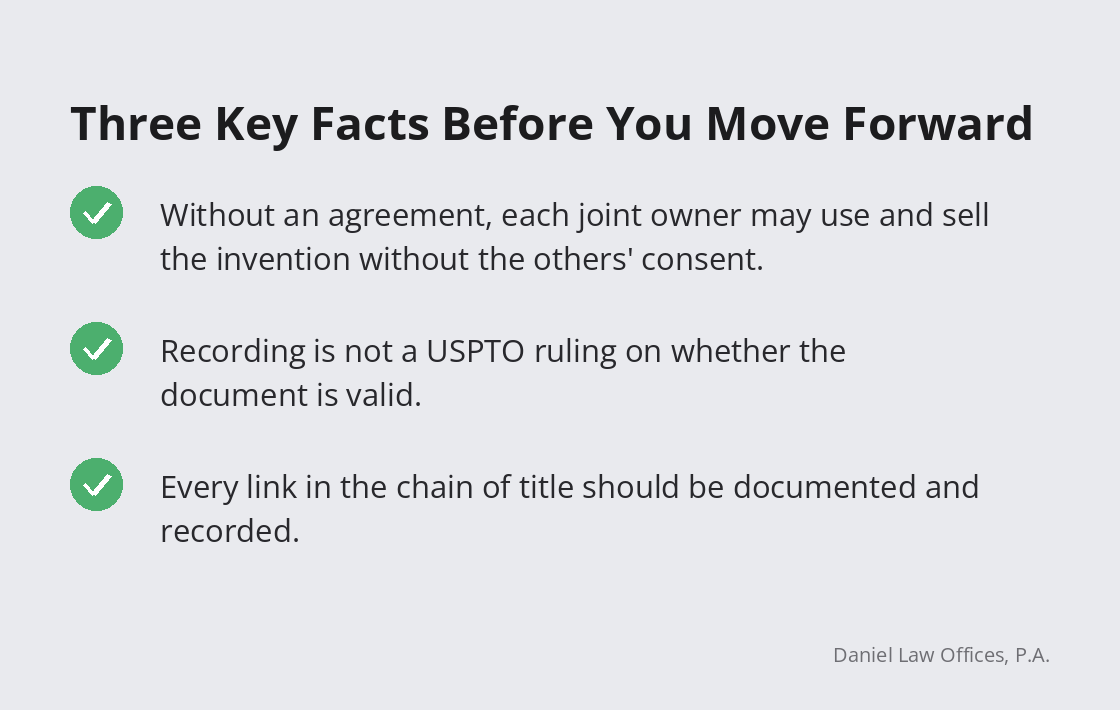
Joint ownership surprises many business owners. Under 35 U.S.C. Section 262, in the absence of an agreement to the contrary, each joint owner of a patent may make, use, offer to sell, or sell the patented invention within the United States, or import it, without the consent of and without accounting to the other owners. That means a co-inventor who never signed an assignment may be free to work with a competitor.
Treating Recording as Proof of Validity
Some owners believe that once a document is recorded, the USPTO has confirmed that it is valid. That is not the case. Under 37 C.F.R. Section 3.54, recording a document is not a determination by the USPTO of the validity of the document or the effect it has on title. Likewise, 37 C.F.R. Section 3.56 provides that conditional assignments, once recorded, are treated as absolute assignments for USPTO purposes until they are cancelled with the written consent of all parties or by a court decree, and the USPTO does not decide whether the conditions have been met. Recording protects your position, but the underlying document still has to be drafted correctly.
Leaving Gaps in the Chain of Title
When a patent has passed through several owners, every link in the chain needs to be documented and, ideally, recorded. You can review the recorded history of a patent through a search of USPTO assignment records, a process we walk through in our guide on how to conduct a patent assignee search. Finding and fixing gaps before a transaction is far easier than explaining them to a buyer or a court afterward.
Final Thoughts
Patent assignment can feel like an administrative detail, but it determines who owns an invention, who can act before the USPTO, and who is in a position to benefit from the patent in the future. A clear written assignment, accurate identification of the patents and applications involved, and prompt recording with the USPTO protect that ownership. Paying attention to co-owners, contractors, and every link in the chain of title keeps a valuable asset from becoming a source of conflict.
Whether you are an individual inventor bringing in a business partner, a startup preparing for investment, or a company acquiring technology, taking the time to document ownership correctly now saves considerable trouble later.
If you are transferring, acquiring, or reviewing ownership of a patent or patent application, contact Daniel Law Offices, P.A. to speak with our team in Orlando, Florida. We will review your documents, help you put a clear assignment in place, and make sure your ownership is properly recorded so you can move forward with confidence.