




Inter Partes Review Orlando, Florida: How a Patent Can Be Challenged at the PTAB
Inter partes review in Orlando, Florida matters to more inventors and business owners than most people expect. If a competitor accuses you of infringing a patent, or if a patent you own suddenly becomes a target, the fight may not stay in federal court. Instead, it can move to the Patent Trial and Appeal Board at the United States Patent and Trademark Office, where a panel decides whether the patent’s claims should have been granted in the first place. Understanding how this process works gives you real control over decisions that can shape the value of an invention for years.
At Daniel Law Offices, P.A., we have seen how much a challenge to a patent can unsettle a growing company, whether it is the patent owner or the business accused of infringement. This guide explains what inter partes review actually is, how a proceeding moves from petition to final decision, and the strategic missteps that can derail either side.
What Inter Partes Review Actually Is
Inter partes review, often called IPR, is a trial-like proceeding created by Congress in the America Invents Act and set out in Chapter 31 of Title 35 of the United States Code. It gives someone other than the patent owner a way to ask the USPTO to take a second look at an issued patent. Rather than litigating validity in front of a jury, the parties present their arguments to administrative patent judges who, under 35 U.S.C. Section 6, must be persons of competent legal knowledge and scientific ability.
IPR is narrower than many people assume. It has its own rules about who can file, what arguments can be raised, and when a petition is allowed, and those limits shape how both sides plan their strategy.
Who Can File a Petition
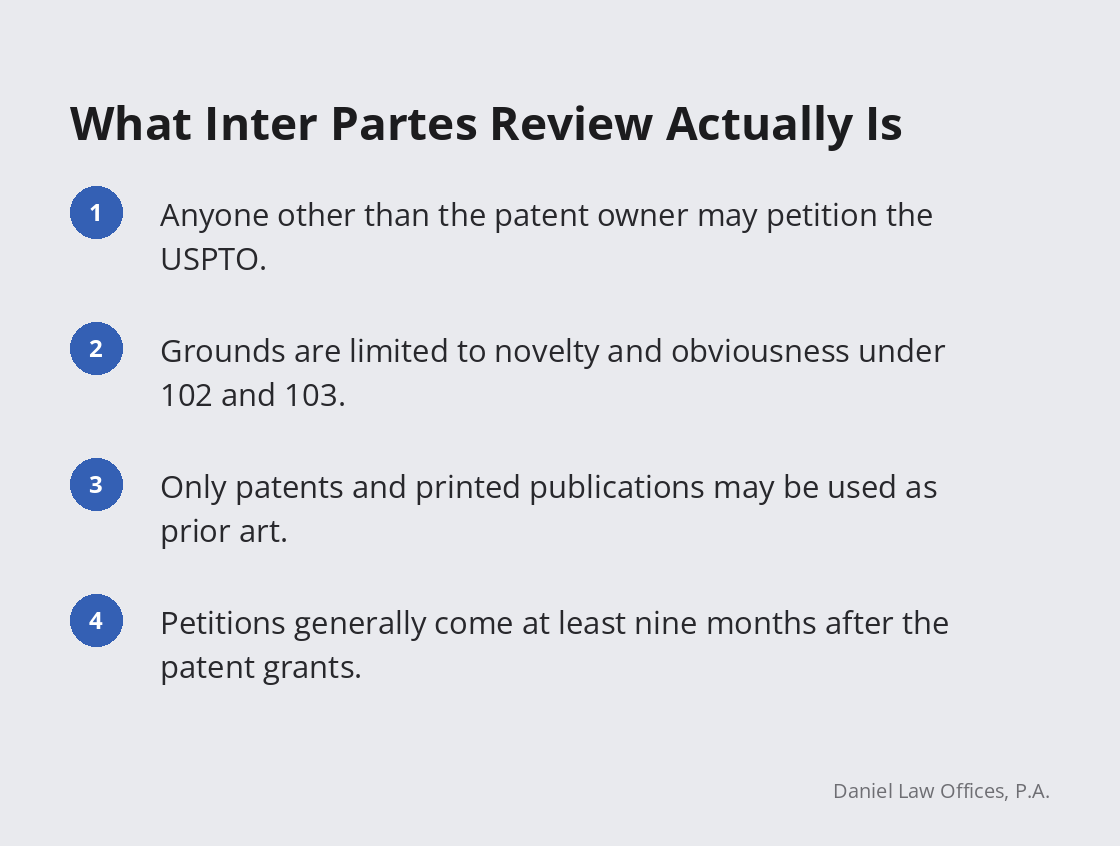
Under 35 U.S.C. Section 311(a), a person who is not the owner of a patent may file a petition with the USPTO to institute an inter partes review. In practice, petitioners are often companies that have been sued for infringement or that expect to be, but the statute does not require a pending lawsuit.
The petition must meet specific requirements. Section 312 requires, among other things, that the petition identify all real parties in interest and identify, in writing and with particularity, each claim challenged, the grounds for the challenge, and the supporting evidence, including copies of the patents and printed publications relied on and any supporting declarations. A thin or poorly organized petition can fail before the merits are ever reached.
What Grounds Can Be Raised
Section 311(b) limits IPR to requests to cancel claims as unpatentable only on a ground that could be raised under Section 102 or 103, meaning lack of novelty or obviousness, and only on the basis of prior art consisting of patents or printed publications. Arguments based on prior public use or sales, or on other patentability requirements, are outside the scope of IPR.
This focus makes the quality of the prior art search central to the process. A petitioner needs patents and publications that clearly disclose or render obvious what the challenged claims cover, and a patent owner needs to understand that art well enough to show why the claims are different. Our article on navigating prior art in patent law explains why that groundwork matters.
When a Petition Can Be Filed
Timing rules cut both ways. Section 311(c) provides that a petition shall be filed after the later of the date that is nine months after the grant of the patent or, if a post-grant review is instituted, the date that post-grant review terminates. Newly issued patents are therefore generally not immediately open to IPR.
There is also an important outer limit for accused infringers. Under Section 315(b), an inter partes review may not be instituted if the petition is filed more than one year after the date on which the petitioner, the real party in interest, or a privy of the petitioner is served with a complaint alleging infringement of the patent. That one-year window often drives early decisions in patent disputes.
How an Inter Partes Review Moves From Petition to Decision
Once a petition is filed, the proceeding follows a structured timeline set partly by statute and partly by USPTO regulations. Each stage offers both sides an opportunity to shape the outcome, and the decisions made in the first few months often carry the most weight.
Knowing what happens at each stage helps a patent owner prepare a defense and helps a petitioner decide whether the process fits the business goals.
The Preliminary Response and the Institution Decision
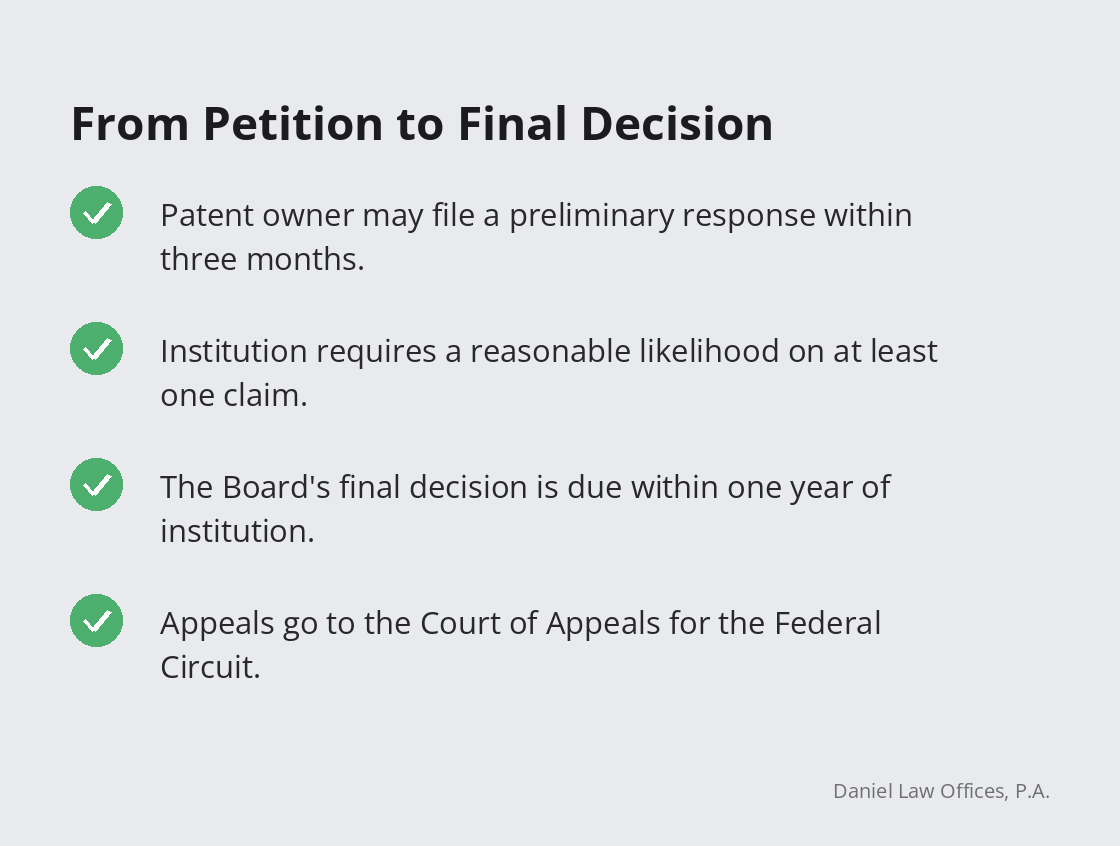
Section 313 gives the patent owner the right to file a preliminary response explaining why no review should be instituted. Under the USPTO’s rule at 37 C.F.R. Section 42.107, that response must be filed no later than three months after the date of a notice indicating that the petition has been granted a filing date, and the patent owner may also choose to waive it to speed things up.
The USPTO then decides whether to begin a trial. Section 314(a) says review may not be instituted unless the information presented shows a reasonable likelihood that the petitioner would prevail with respect to at least one of the challenged claims, and Section 314(b) requires the decision within three months after the preliminary response is received or the deadline for it passes. Under Section 314(d), the decision whether to institute is final and nonappealable. Because the statute sets a minimum threshold rather than requiring institution, the agency’s current institution practices deserve close attention when you plan a filing or a defense.
The Trial Phase Before the PTAB
If review is instituted, the Patent Trial and Appeal Board conducts the trial. Section 316 directs the USPTO to adopt rules that, among other things, limit discovery to depositions of witnesses who submit declarations and what is otherwise necessary in the interest of justice, allow the patent owner to file a response with supporting evidence, and give either party the right to an oral hearing.
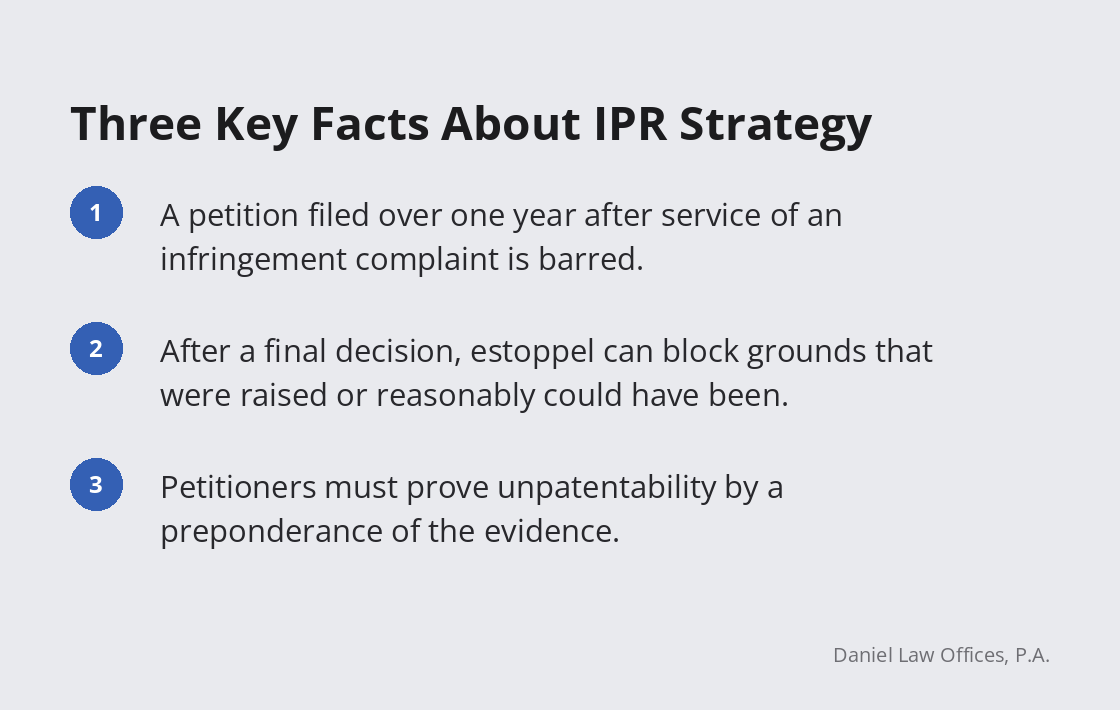
The patent owner may also file one motion to amend the patent to cancel challenged claims or propose a reasonable number of substitute claims. Under Section 316(e), the petitioner has the burden of proving unpatentability by a preponderance of the evidence, which differs from federal court, where Section 282 provides that a patent shall be presumed valid and places the burden of establishing invalidity on the party asserting it.
The Final Written Decision and Appeal
Section 316(a)(11) requires that the final determination be issued not later than one year after the date the review is instituted, although the Director may extend that period by not more than six months for good cause. Under Section 318(a), the Board issues a final written decision on the patentability of each challenged claim and any new claim added by amendment.
A party dissatisfied with that decision may appeal. Section 319 and Section 141(c) direct appeals from a final written decision to the United States Court of Appeals for the Federal Circuit. Once the time for appeal expires or any appeal ends, Section 318(b) requires the Director to issue a certificate canceling claims found unpatentable and confirming claims found patentable.
Strategic Missteps That Can Derail an Inter Partes Review
Inter partes review moves quickly, and the consequences of each decision can extend well beyond the USPTO. Both patent owners and petitioners can lose ground by treating IPR as a side issue rather than a central part of their overall strategy.
The mistakes below are among the most common ways a strong position becomes a weak one.
Missing the One-Year Window After Being Sued
An accused infringer who waits too long can lose the option entirely. Because Section 315(b) bars institution when a petition is filed more than one year after service of an infringement complaint, a company that spends its first year focused only on the court case may discover that IPR is no longer available. Evaluating the patent and the available prior art early keeps that door open.
Section 315(a) adds another trap. An inter partes review may not be instituted if, before the petition is filed, the petitioner or real party in interest filed a civil action challenging the validity of a claim of the patent, although a counterclaim of invalidity does not count as such a civil action. How and when validity is raised in court can therefore affect whether IPR remains possible.
Overlooking Estoppel
Petitioners sometimes treat IPR as a free first attempt, but the statute says otherwise. Under Section 315(e), once a review results in a final written decision, the petitioner and its real party in interest or privy may not assert in a civil action, or in later USPTO proceedings, that a claim is invalid on any ground the petitioner raised or reasonably could have raised during the review. A petition that leaves out strong patent or publication art may effectively forfeit those arguments later.
Settlement can change that picture. Section 317 provides that a review shall be terminated as to a petitioner on a joint request with the patent owner unless the Office has already decided the merits, and that no estoppel attaches to a petitioner whose review is terminated this way. Any settlement agreement made in connection with the termination must be in writing and filed with the Office.
Underestimating the Need for a Strong Record
Patent owners sometimes assume that an issued patent will speak for itself. In IPR, the petitioner only needs to carry its burden by a preponderance of the evidence, and the Board decides patentability based on the written record, declarations, and arguments. A preliminary response, patent owner response, or motion to amend that lacks clear technical explanation can leave claims exposed.
Petitioners face the same challenge from the other side. Prior art references must be explained carefully, combinations must be supported, and declarations must connect the technical evidence to each claim limitation. A disciplined, well-documented approach from the beginning usually leads to stronger results for either party.
Final Thoughts
Inter partes review can strengthen a patent that survives it or remove claims that never should have issued, and it often runs alongside an infringement lawsuit with significant consequences for both sides. The statutory deadlines, the limited grounds, and the estoppel rules make early planning essential.
Whether you own a patent that may be challenged or you are evaluating whether to challenge someone else’s, understanding the process helps you protect your invention, your business, and your options. A careful review of the patent, the prior art, and the timeline is the right place to start.
If you are facing a patent challenge or considering one, contact Daniel Law Offices, P.A. to speak with our team in Orlando, Florida. We will review your situation, explain your options under the patent laws, and help you move forward with confidence.