




Patent Pending Orlando, Florida: What the Label Actually Means for Inventors
Patent pending is one of the most common phrases on product packaging, websites, and pitch decks in Orlando, Florida, yet many inventors are unsure what it actually protects. This guide explains what the label means under federal law, when you can use it, what rights it does and does not give you, and how to use it in a way that supports your patent strategy instead of creating risk.
At Daniel Law Offices, P.A., we help Central Florida inventors and businesses move from idea to issued patent, and we regularly advise clients on how to describe their protection accurately while an application is under review, so you can move forward with confidence.
What Patent Pending Actually Means
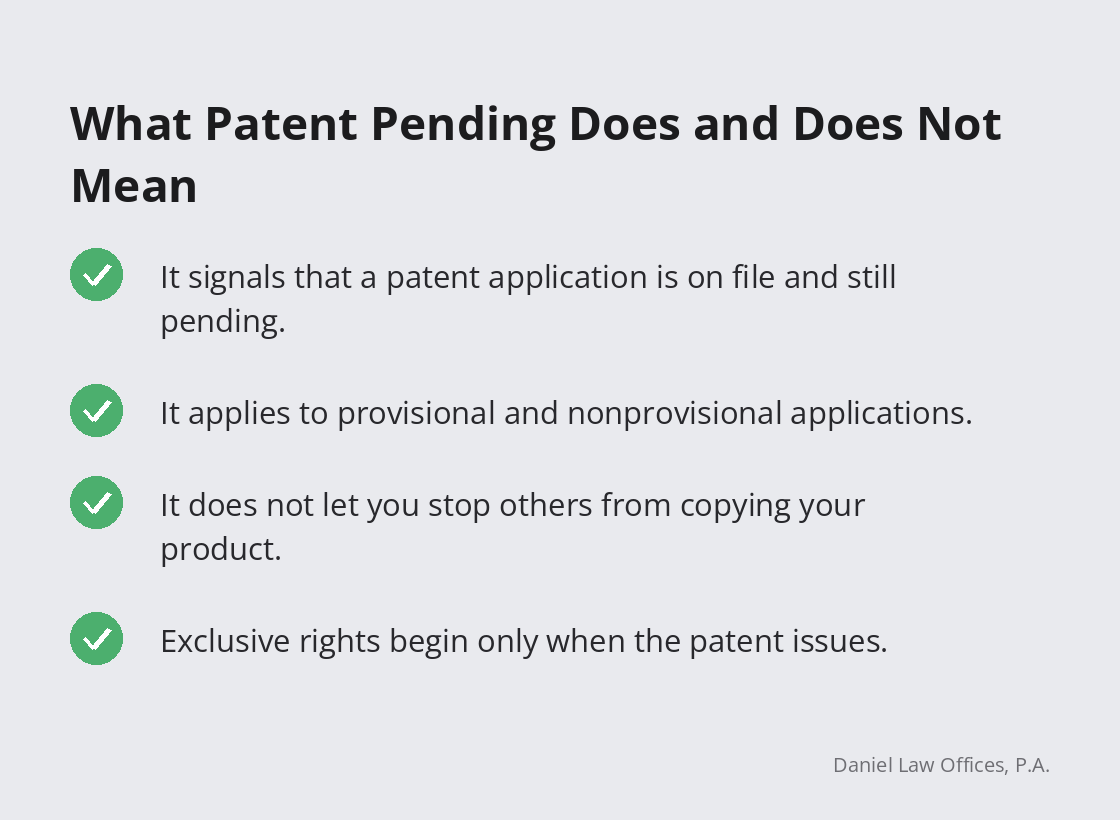
The phrase patent pending tells the public that you have filed an application for a patent with the United States Patent and Trademark Office and that the application is still pending. It does not mean the USPTO has approved anything, and it does not create the exclusive rights that come with an issued patent. Understanding that distinction is the starting point for using the label correctly.
The Label Signals an Application on File
Federal law treats patent pending as a factual statement about the status of an application. Under 35 U.S.C. 292, it is unlawful to use the words “patent applied for,” “patent pending,” or any word importing that an application has been made, in connection with an article, when no application has been made, or if made, is not pending, for the purpose of deceiving the public. In other words, the label should be used only while a real application is on file and still pending at the USPTO.
Because the statute focuses on deception, accuracy matters more than wording. Whether you write patent pending, patent applied for, or a similar phrase, the claim must match the actual status of your filing.
Provisional and Nonprovisional Applications Both Count
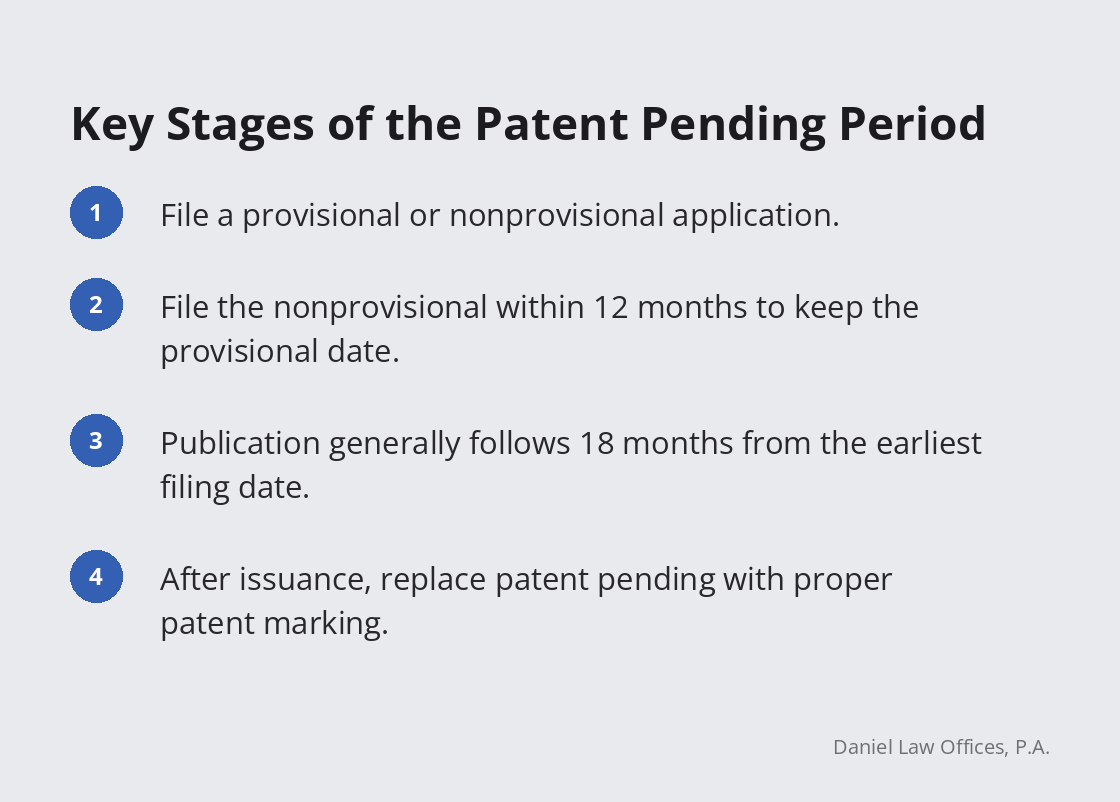
Many Orlando inventors first file a provisional application. Under 35 U.S.C. 111(b), a provisional application must include a specification and drawings as required by the patent statute, but it does not need formal claims. The filing date of a provisional application is the date the USPTO receives a specification, with or without claims. Once that application is on file and pending, you may describe your invention as patent pending, as discussed in our provisional patent overview.
A provisional application has a limited life. Section 111(b) provides that, if no request to convert it is made, a provisional application is generally regarded as abandoned 12 months after its filing date. To keep the benefit of that early date, 35 U.S.C. 119(e) generally requires a nonprovisional application to be filed not later than 12 months after the provisional application and to contain a specific reference to it. If the provisional application lapses without a timely follow-on filing, the pending status that supported your label lapses as well.
What the Label Does Not Do
Patent pending does not let you stop competitors from copying your product. Under 35 U.S.C. 271(a), infringement occurs when someone, without authority, makes, uses, offers to sell, or sells a patented invention within the United States, or imports it, during the term of the patent. Until the USPTO issues a patent, there is no patented invention to infringe.
The patent itself grants the right to exclude others from making, using, offering for sale, selling, or importing the invention, according to 35 U.S.C. 154(a)(1). Under Section 154(a)(2), that right generally runs from the date the patent issues until 20 years from the date the application was filed in the United States, subject to the statute’s other conditions. Patent pending is the waiting period before those rights exist.
How the Patent Pending Period Works
The time between filing and issuance can still carry real strategic value. Publication, notice, and the scope of your claims all influence what you can do with your application before a patent issues.
Publication of Your Application
Under 35 U.S.C. 122(b), each application for a patent is generally published promptly after 18 months from the earliest filing date for which a benefit is sought, and an applicant may request earlier publication. The statute lists exceptions, including provisional applications, design patent applications, applications that are no longer pending, and certain applications where the applicant certifies that the invention will not be the subject of a foreign filing that requires 18-month publication.
Publication matters because it makes your disclosure public and can open the door to the limited provisional rights discussed below. It also means competitors can study your application, so the timing of publication should be part of a deliberate filing plan.
Provisional Rights After Publication
Federal law gives published applications a limited form of protection known as provisional rights. Under 35 U.S.C. 154(d), once a patent issues, the patent owner may pursue relief against a person who, between publication and issuance, made, used, offered for sale, sold, or imported the invention as claimed in the published application, but only if that person had actual notice of the published application.
There is an important condition. Section 154(d)(2) provides that provisional rights are available only if the invention as claimed in the issued patent is substantially identical to the invention as claimed in the published application. Section 154(d)(3) also requires the action to be brought not later than 6 years after the patent issues. If your claims change significantly during examination, provisional rights may not be available, which is one reason careful drafting at the outset matters.
Moving From Pending to Patented
Once a patent issues, the marking rules change. Under 35 U.S.C. 287(a), patent owners and those selling a patented article for them may give notice to the public by marking the article with the word “patent” or the abbreviation “pat.” together with the patent number, or with an internet address that associates the article with the patent number. When the article itself cannot be marked, a label on the article or its package can provide the notice.
Section 287(a) explains why this matters. If a patent owner fails to mark, recovery in an infringement action is limited to infringement occurring after the infringer was notified and continued to infringe, and filing an infringement action counts as notice. Replacing patent pending with proper patent marking as soon as a patent issues helps preserve your full set of remedies.
Common Patent Pending Mistakes to Avoid
Most problems with the patent pending label come from timing and record keeping rather than bad intent. A product line can outlast the application that once supported its label, and marketing materials can lag behind legal developments.
Keeping the Label After an Application Ends
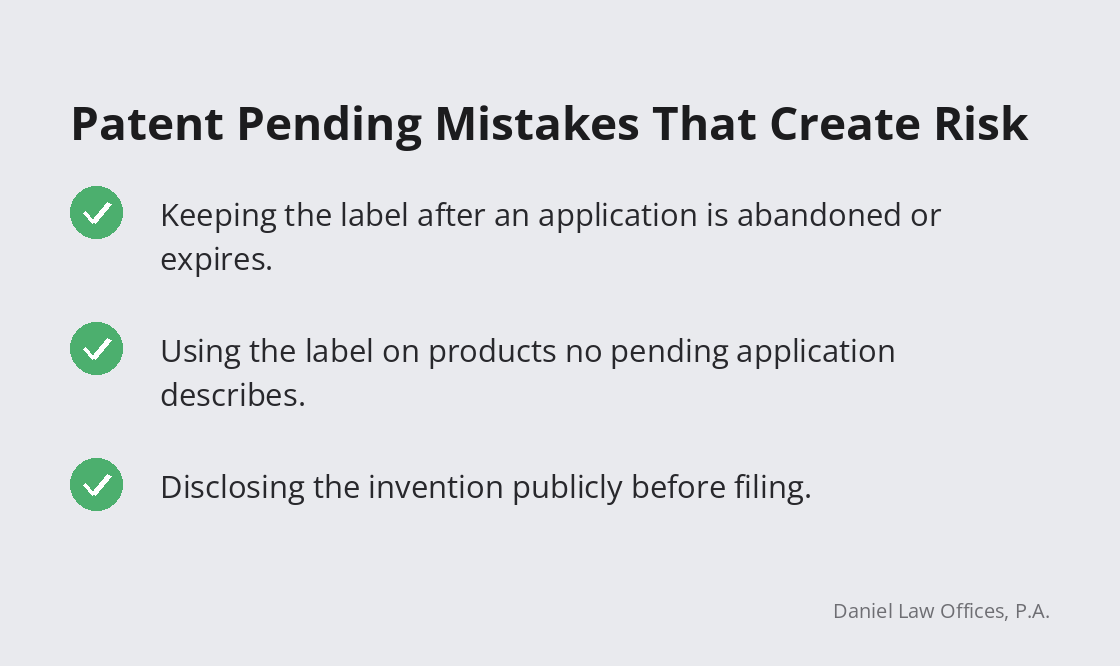
If your provisional application expires without a timely nonprovisional filing, or if a nonprovisional application is abandoned, the application is no longer pending. Under 35 U.S.C. 292, continuing to use patent pending in that situation for the purpose of deceiving the public is unlawful, and Section 292(b) allows a person who has suffered a competitive injury from false marking to bring a civil action. Build a calendar reminder to review packaging, product listings, and websites whenever the status of an application changes.
Overstating What Is Protected
Patent pending covers what is described in your application, not every feature of your product or every future version. Using the label on products that are not described in any pending application, or implying that competitors are already infringing, can mislead customers and investors. Accurate, restrained language protects your credibility and keeps your marketing aligned with your filings.
Disclosing Before You File
Many inventors reveal their idea at trade shows, in crowdfunding campaigns, or in meetings before filing anything. Under 35 U.S.C. 102(b)(1), a disclosure made 1 year or less before the effective filing date is not prior art against the claimed invention if the disclosure was made by the inventor or a joint inventor, or by another who obtained the subject matter from them. That exception is narrower than many people assume, and foreign patent systems may treat early disclosures differently, so filing first and announcing second remains the safer approach.
Final Thoughts
Patent pending is a useful signal, but it is not a patent. It tells the market that you have taken a concrete step to protect your invention, and once your application publishes, it may lay the groundwork for provisional rights. Using the label accurately, updating it when your application status changes, and switching to proper patent marking after issuance keep your strategy on solid legal footing.
The patent pending period also gives you time to refine your business plans, approach investors, and prepare for the rights that come with an issued patent. Treating that period as part of a coordinated strategy, rather than a waiting room, puts you in a stronger position when your patent issues.
If you are developing a product in Orlando, Florida, and want to file an application or confirm that your patent pending label is accurate, contact Daniel Law Offices, P.A. to speak with our team. We will review your invention and your filings and help you move forward with confidence.