



Patent Application Process Overview: From Idea to Issued Patent
Getting a patent issued requires navigating multiple stages, each with specific requirements and deadlines. At Daniel Law Offices, P.A., we guide inventors through the patent application process overview so they understand what to expect from initial filing through final approval.
This guide walks you through each phase, from evaluating whether your invention qualifies for protection to maintaining your patent after it’s granted.
Is Your Invention Actually Patentable in Orlando, Florida?
The Three Requirements That Matter
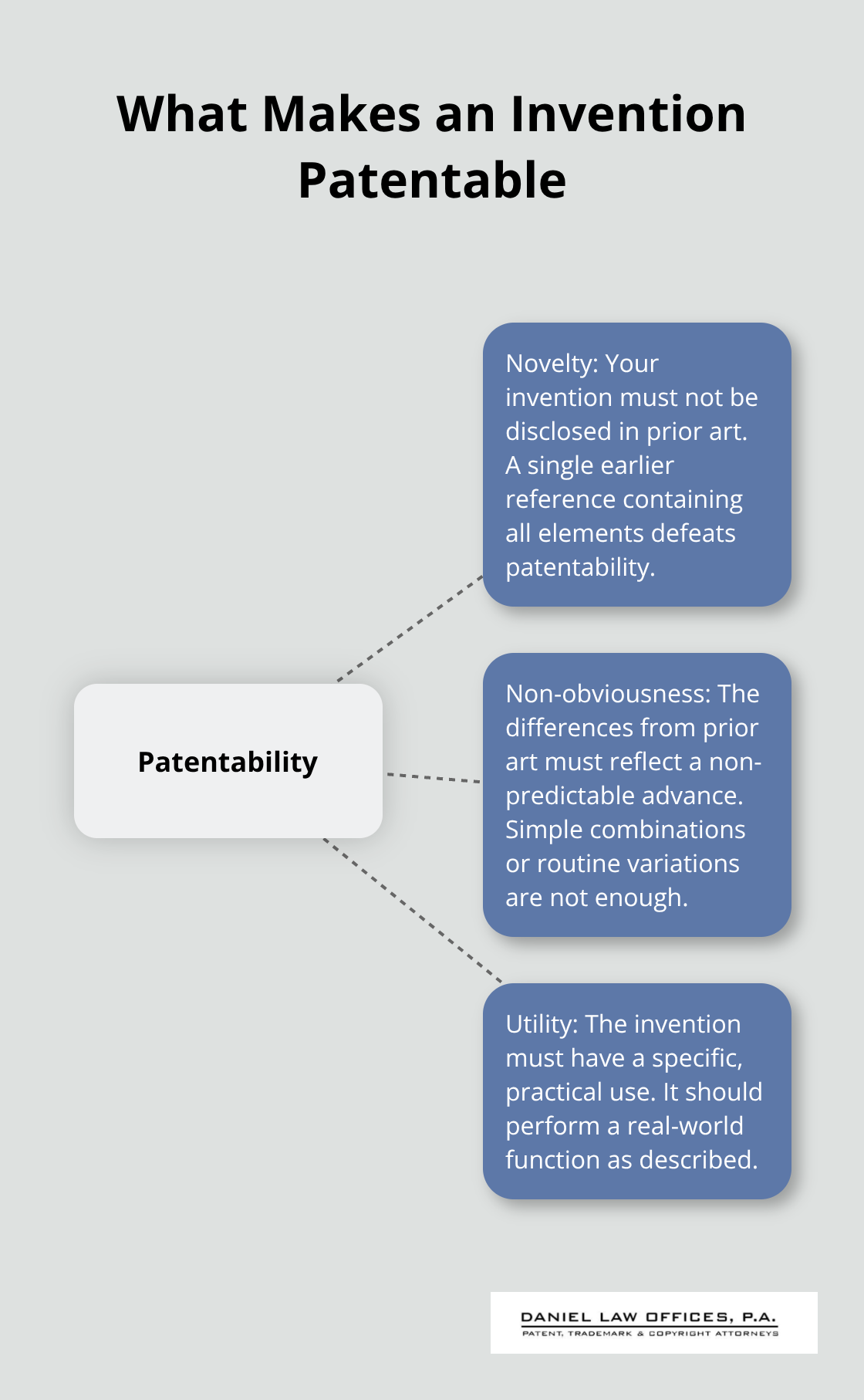
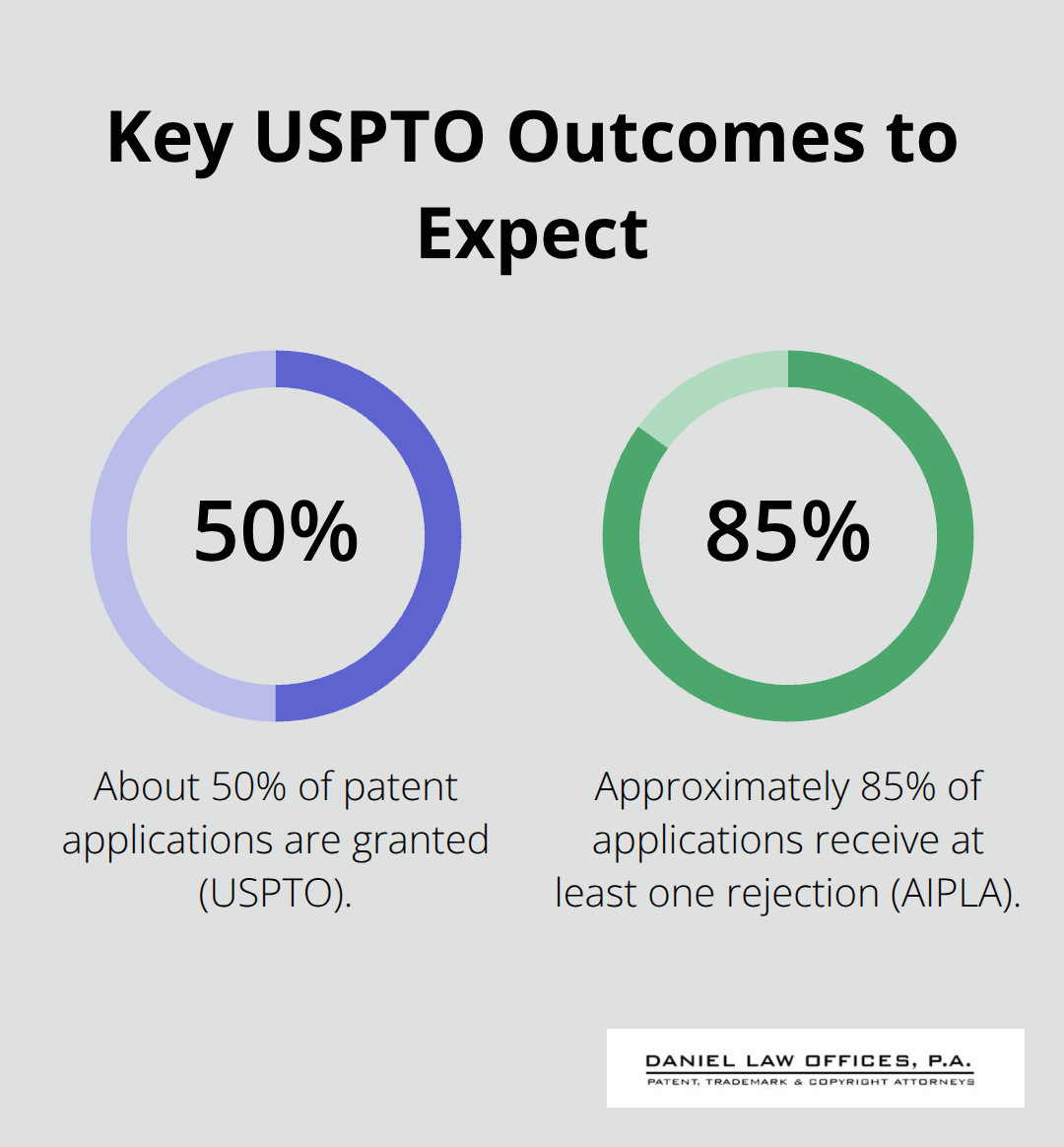
Not every invention qualifies for patent protection, and learning this reality after months of work wastes time and money. The USPTO receives over 600,000 patent applications annually, yet only about 50% are granted, according to the Office of the Chief Economist at the USPTO. Your invention must meet three fundamental requirements: it needs to be novel, meaning it cannot exist in prior art; it must be non-obvious, so it represents a genuine advance rather than a predictable combination of existing elements; and it must have practical utility, serving a real function.
Why Skipping the Patent Search Costs More
Many inventors jump straight to filing without conducting a preliminary eligibility assessment, a costly mistake we see regularly. A thorough patent search before filing costs between $500 and $2,000 and typically takes two to four weeks, yet it prevents filing applications destined for rejection. This search examines granted patents, published applications, academic papers, and commercial products to identify whether your invention truly stands apart.
Accessing Prior Art Information
The USPTO’s own database contains millions of patents dating back to 1790, and modern search tools now include international patents from over 100 countries, making comprehensive prior art research more accessible than ever. When evaluating existing patents and publications, focus on the claims section, not just the abstract or drawings, because claims define what the patent actually protects. A single prior patent containing all the elements of your invention eliminates patentability instantly.
The Timing Problem With Public Disclosure
Publications from trade shows, conferences, or even your own website count as prior art if they occurred more than one year before filing, which is why confidentiality matters during development. Many inventors believe their invention is unique because they invented it independently, but patent law does not reward independent creation-it only rewards being first to file or first to invent within specific timeframes. This distinction separates inventors who protect their ideas from those who lose rights through premature disclosure.
Understanding these eligibility requirements and conducting a proper prior art search positions you to move forward with confidence. The next phase involves gathering the technical documentation and details that will form the foundation of your actual patent application.
Building Your Patent Application in Orlando, Florida
Gather Technical Documentation First
Gathering the right documentation before drafting your application separates applications that sail through examination from those that face rejection after rejection. You need technical drawings or diagrams showing how your invention works, a detailed written description explaining every component and how they interact, and documentation of any prototypes or testing you’ve completed. The USPTO requires drawings that meet specific standards: they must show every aspect of your invention from multiple angles, use consistent line weights, and follow formal drafting rules outlined in 37 CFR 1.84. Many inventors submit amateur sketches, forcing them to pay for professional redrawing later.
Create Precise Specification Writing
Specification writing demands precision-describe not just what your invention does, but why it works differently from existing solutions. Include measurements, materials, manufacturing processes, and any variations that might exist. If you’ve tested your invention, document those results with dates and specifics rather than vague claims about performance. This level of detail protects your application from examiner challenges later.
Work With a Patent Attorney on Your Draft
A patent attorney transforms raw technical information into a legally defensible document that examiners can evaluate fairly. The attorney structures applications to emphasize your invention’s novel aspects while anticipating examiner objections before they arise. This strategic approach increases your chances of approval without unnecessary back-and-forth with the USPTO.
Understand Filing Costs and Options
The filing itself costs between $320 and $1,600 in USPTO fees depending on your business size and application type, with small entities and independent inventors paying significantly less than large corporations according to the USPTO fee schedule. You can file a provisional application first for $320, giving you 12 months to refine your invention and conduct market research before committing to the full utility patent process, which costs substantially more. The provisional route delays examination but provides breathing room to perfect your documentation.
Know Your Timeline After Filing
Once you file the non-provisional application, your filing date becomes official, protecting your priority against anyone else filing similar inventions afterward. Most applications take three to five years from filing to final decision, though this timeline varies widely based on the patent office’s workload and your invention’s technology area. After submission, the USPTO begins its examination process, which brings its own set of challenges and requirements you’ll need to navigate.
How the USPTO Examines Your Patent Application in Orlando, Florida
What Happens After You File
After you file your patent application, the USPTO assigns it to an examiner who scrutinizes every claim, specification, and drawing against existing patents, publications, and prior art. This examination phase typically starts six to twelve months after filing, though some technology areas face longer delays. The examiner’s job is not to approve your patent-it’s to reject it unless you prove your invention meets all legal requirements. This adversarial nature means you must prepare for objections from the start.
The first Office Action from the USPTO will likely contain rejections, and this is completely normal. According to data from the American Intellectual Property Law Association, approximately 85% of patent applications receive at least one rejection before approval. Your response to this initial rejection determines whether your application moves forward efficiently or gets bogged down in years of back-and-forth communication.
Responding to Office Actions Strategically
When the examiner issues an Office Action rejecting your claims, you have three months to respond, though you can request a two-month extension for an additional fee of $2,000 for large entities or $1,000 for small entities according to the USPTO fee schedule. Your response must address each rejection specifically and persuasively. Simply disagreeing with the examiner accomplishes nothing-you need to explain why the cited prior art does not teach every element of your invention, or why your combination of elements is non-obvious in ways the examiner missed.
Many applicants respond with vague arguments about their invention being different or better, which examiners reject immediately. Instead, provide detailed claim charts comparing your invention element-by-element against each cited reference, showing specifically where the prior art falls short. This level of specificity forces the examiner to address your actual arguments rather than dismiss them.
Amending Claims to Overcome Rejections
If the examiner cites multiple patents, your invention might avoid rejection by narrowing your claims to exclude the problematic elements, a strategy called amending around prior art. This narrowing reduces your patent’s scope but still provides valuable protection for your core innovation. The second Office Action often becomes final, meaning you have limited options: you can appeal to the Patent Trial and Appeal Board, file a continuation application to pursue broader claims, or accept the examiner’s rejections and abandon your application.
The appeal process costs approximately $2,000 to $4,000 but frequently succeeds where initial responses failed. Many applicants abandon applications at the final rejection stage without exploring appeals, missing opportunities to secure protection for inventions that actually merit patents. The Patent Trial and Appeal Board reviews your arguments with fresh perspective, and examiners sometimes reverse their positions when presented with well-developed legal arguments about non-obviousness or claim interpretation.
Moving Forward After Examination
Your strategy during examination shapes the patent you ultimately receive. Narrow claims that issue quickly provide less protection than broader claims that require more prosecution effort. The choice between fighting for broader protection and accepting narrower claims depends on your invention’s commercial value and your willingness to invest in the appeal process.
Final Thoughts on Your Patent Application Process Overview
Your patent application process overview concludes when the USPTO issues your patent, but protection actually begins after approval. Once the examiner approves your application, you receive a Notice of Allowance and must pay an issue fee between $960 and $1,800 depending on your entity size within three months according to current USPTO fee schedules. This fee finalizes your patent grant, and the USPTO publishes your patent in the Official Gazette before issuing the actual patent certificate.
After receiving your issued patent, maintenance becomes your responsibility. Unlike trademarks, utility patents require renewal payments at specific intervals (3.5 years, 7.5 years, and 11.5 years after the grant date). These maintenance fees range from $1,600 to $7,700 per payment for large entities, with significantly lower costs for small entities and independent inventors. Missing even one maintenance fee deadline results in patent expiration, eliminating your protection entirely.
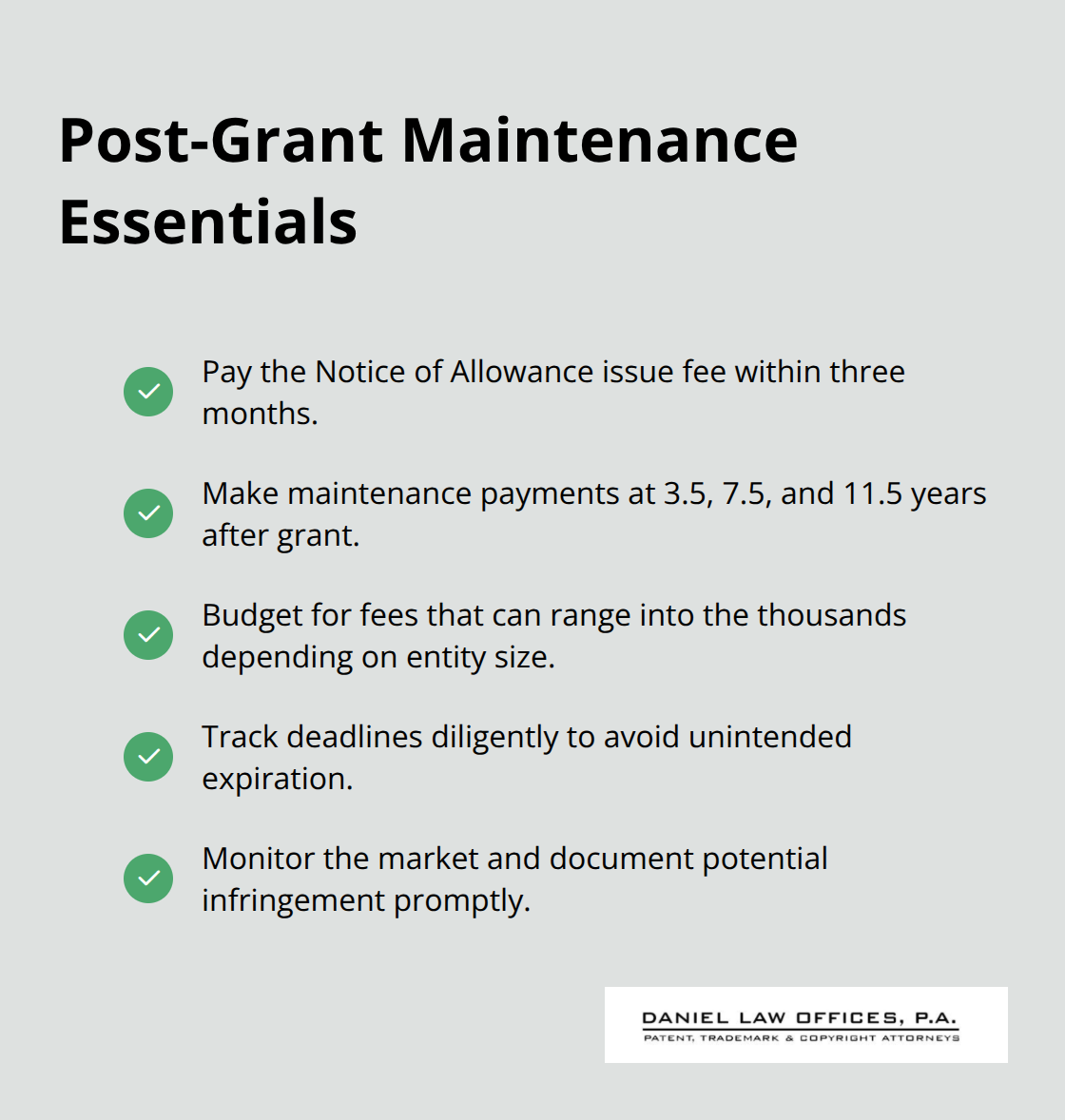
Protecting your innovation long-term means monitoring the market for infringement and enforcing your patent rights when competitors copy your invention. Document any instances where competitors appear to infringe your patent claims, as this evidence becomes critical if litigation becomes necessary. Contact Daniel Law Offices, P.A. to discuss your patent strategy and move forward with confidence.