




IP Litigation Strategies Florida: Crafting a Resilient Defense
Intellectual property disputes in Florida demand a defense strategy built on solid legal footing and thorough preparation. At Daniel Law Offices, P.A., we’ve seen how the right approach from day one can determine the outcome of your case.
IP litigation strategies in Florida require understanding both state-specific rules and the broader landscape of intellectual property law. The difference between a weak defense and a resilient one often comes down to early action and meticulous planning.
What Makes IP Litigation in Florida Different
Federal Courts and Local Procedural Dynamics
Florida’s IP litigation landscape sits at the intersection of federal patent law and state-specific procedural rules that significantly impact your defense timeline and strategy. The state’s federal courts-particularly the Middle District of Florida in Orlando-handle substantial IP caseloads, and judges in these venues have developed distinct preferences for how IP cases should be managed. Unlike generic litigation, IP disputes demand familiarity with claim construction procedures, the Markman hearing process, and how Florida courts apply the America Invents Act standards. Early engagement with an attorney familiar with these specific court dynamics prevents costly missteps.
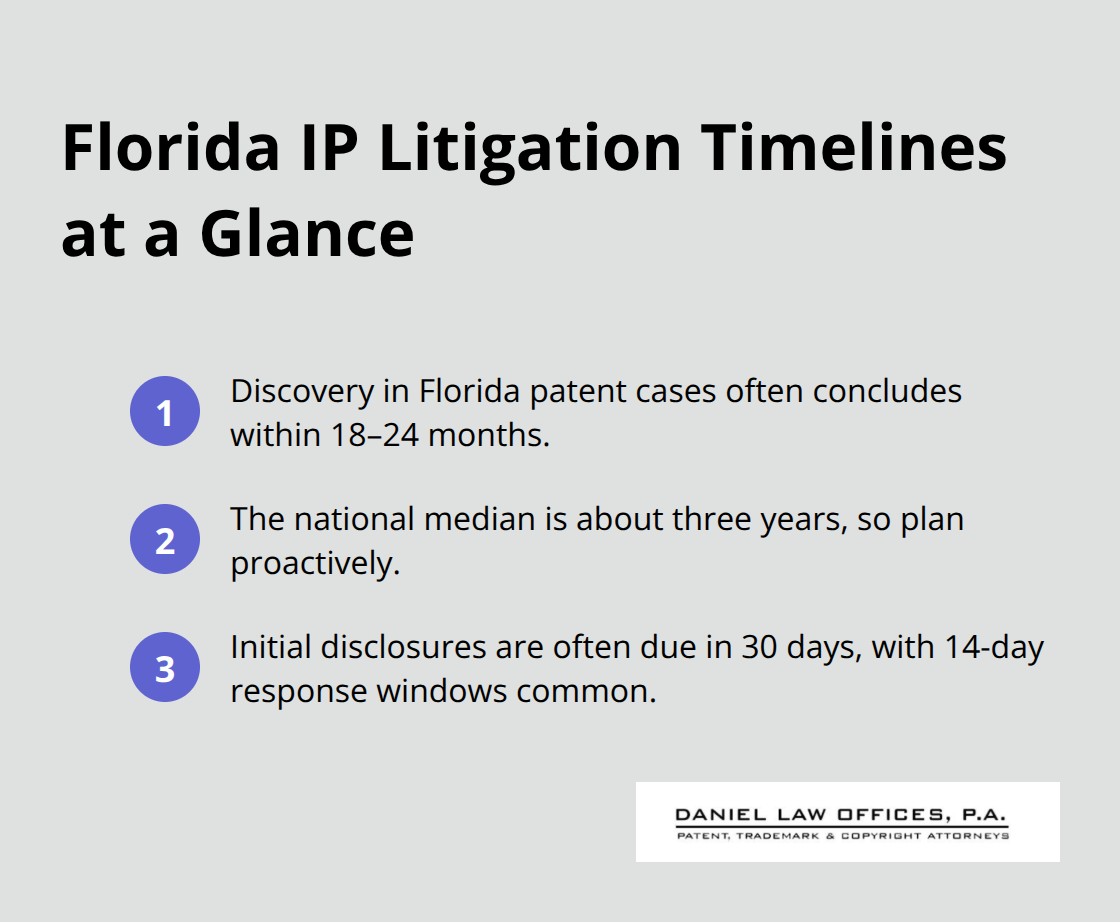
Patent cases filed in Florida’s federal courts typically move faster than the national median, with discovery often concluding within 18–24 months rather than the three-year average reported by the Federal Judicial Center. This accelerated timeline means your defense strategy cannot remain reactive-it must anticipate the opposing party’s moves from the filing date forward.
Distinct Evidentiary Pathways for Different IP Claims
Trademark disputes, patent infringement claims, and trade secret litigation each follow distinct evidentiary pathways in Florida courts. Trademark cases often hinge on consumer confusion evidence and market surveys, while patent disputes require deep technical analysis and prior art documentation. Trade secret cases demand rigorous proof of reasonable protective measures, a standard Florida courts scrutinize carefully.
The most damaging mistakes occur when defendants wait to develop their defense strategy after the complaint arrives. Competent counsel conducts preliminary invalidity analysis, identifies claim construction vulnerabilities, and locates prior art references before litigation officially begins. This pre-litigation groundwork transforms a reactive defense into a proactive one.
Pre-Litigation Preparation as Strategic Foundation
The window to shape the narrative and evidence record closes quickly once litigation commences. Your defense strategy must take shape during the pre-suit phase, when you still control the timing and scope of your investigation. This preparation phase determines whether you enter the courtroom with momentum or scrambling to catch up. The next section examines how to build that strong defense strategy through thorough analysis and strategic positioning.
Building Your Defense Through Prior Art and Claim Analysis
Systematic Prior Art Research Forms Your Foundation
Your defense strategy hinges on what you uncover before the opposing party files suit. Prior art research forms the backbone of any resilient IP defense in Florida, and the depth of this work directly correlates with your courtroom leverage. Conduct systematic searches across the USPTO database, Google Patents, and scientific literature relevant to your industry. The Federal Judicial Center reports that defendants who complete thorough prior art analysis before litigation begins secure significantly better settlement positions than those who scramble after a complaint arrives.
Document every search result meticulously-your goal is not just finding prior art but building an airtight chain demonstrating what existed before the opposing party’s filing date. Patent invalidity defenses depend on prior art that is publicly available, enabling you to establish anticipation or obviousness under 35 U.S.C. sections 102 and 103. In Florida federal courts, judges expect claim construction arguments grounded in prior art references that illuminate how skilled practitioners in the field would have understood the claims at issue. This means your prior art search must extend beyond obvious references to include technical literature, industry standards, and abandoned patent applications that show the state of knowledge in your field.
Reading Claims with Forensic Precision
Identifying weaknesses in the opposing claim requires reading their patent or trademark with forensic precision. Patent claims contain specific language that courts interpret literally-vague terms, narrow dependent claims, and restrictive preambles all create vulnerability points. If the opposing patent claims a process requiring steps A, B, and C in sequence, evidence that your product or process omits step B or performs them in a different order becomes powerful defense material.
For trademark disputes, examine whether the opposing mark actually functions as a source identifier in commerce or whether consumer confusion evidence genuinely supports their infringement allegations. The USPTO’s own prosecution history file-the record of communications between the patent applicant and examiners-often reveals arguments the applicant made that now constrain their claims. Courts apply the doctrine of prosecution history estoppel, meaning statements the applicant made to obtain their patent can limit what they can later claim you infringe. Leverage this aggressively in your defense filings.
Expert Selection and Technical Testimony
Gather technical experts who can testify about industry standards, design practices, and what was obvious to practitioners at the time of filing. Your expert’s credibility matters enormously in Florida federal courts, so select individuals with genuine field experience, published work, or recognized standing in their discipline-not generalists who testify in every case. The strength of your expert testimony directly influences how judges and juries evaluate your invalidity arguments and claim construction positions.
Once you have assembled your prior art evidence and identified your expert witnesses, the next phase demands equal attention: managing the discovery process strategically and preparing your team for depositions and trial.
How to Win Discovery and Depositions in IP Cases
Organize Documents Before Discovery Officially Begins
Discovery in Florida IP litigation consumes enormous resources, and most defendants lose leverage here through poor organization and reactive document review. The Middle District of Florida processes IP cases with aggressive discovery schedules-initial disclosures often arrive within 30 days of the answer, and you have only 14 days to respond. This means your document management system must launch immediately upon receiving the complaint.
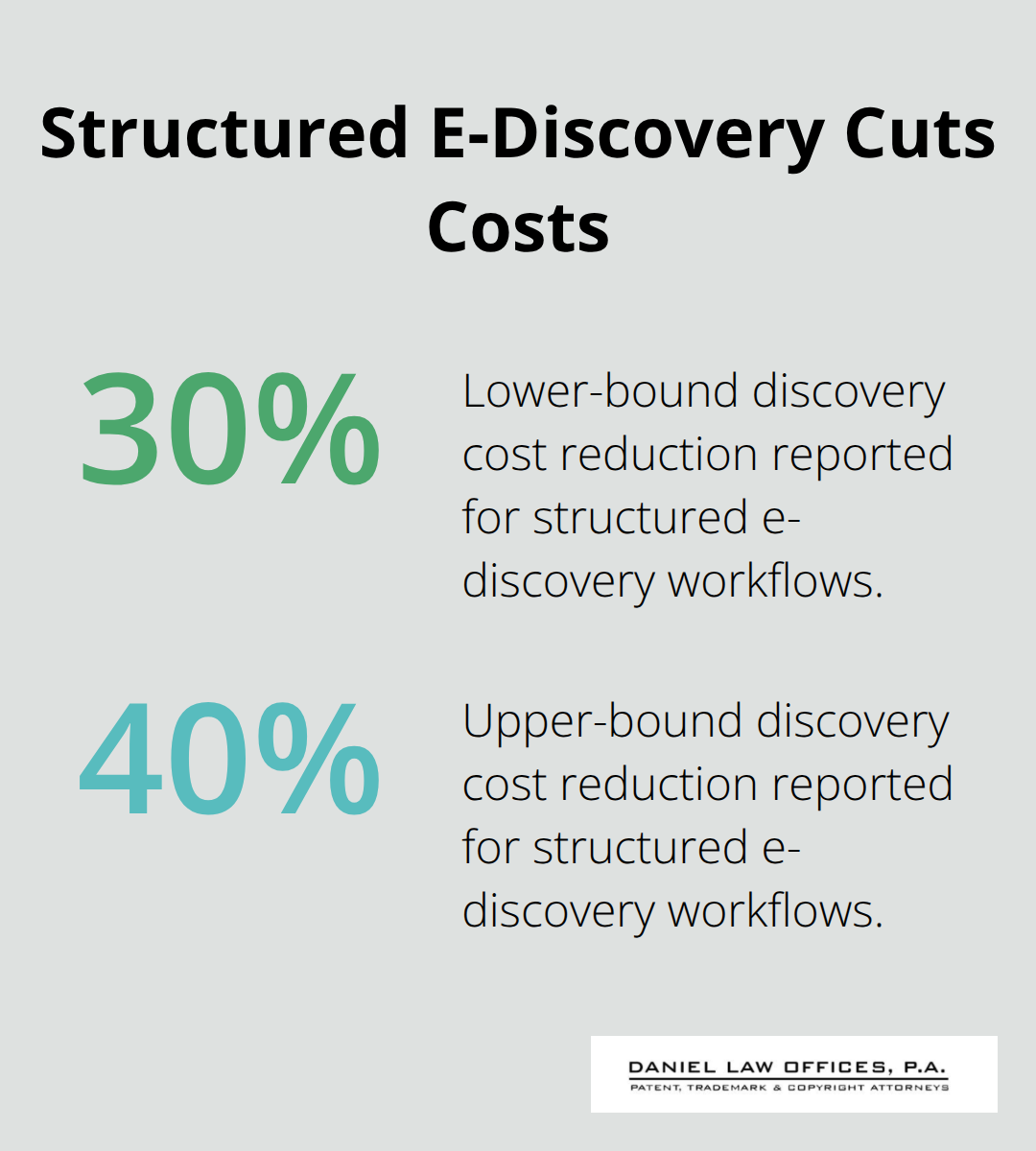
Create a centralized repository with version control, metadata preservation, and privilege log protocols before you touch a single file. The Federal Judicial Center found that defendants who implement structured e-discovery workflows reduce overall discovery costs by 30–40% and dramatically improve their ability to locate exculpatory evidence quickly. Segregate documents by custodian, date range, and relevance category from day one.
Control the Narrative Through Strategic Document Selection
Your goal during discovery extends far beyond compliance-it involves controlling the narrative through strategic document selection and witness testimony. Opposing counsel will scrutinize every communication, design memo, and technical specification you produce. Prepare your team to understand which documents support your defense and which ones require careful explanation during depositions.
The documents you produce shape how opposing counsel frames their case. A design memo showing you conducted freedom-to-operate analysis before launching your product demonstrates diligence and undermines claims of willful infringement. Conversely, silence on this issue invites opposing counsel to argue you proceeded recklessly.
Prepare Witnesses for Aggressive Questioning
Depositions follow document discovery, and this is where opposing counsel will attempt to lock in damaging admissions from your technical team and management. Prepare your deponent witnesses ruthlessly through multiple mock depositions with your trial team, focusing on hostile questioning and trap questions designed to extract concessions.
Opposing counsel will ask about design decisions, prior knowledge of the patent, and any statements suggesting you copied their technology. Instruct witnesses to answer only what was asked, to pause before responding, and to admit when they do not know something rather than speculate. A single unguarded statement about how you became aware of the patent or why you designed your product a particular way can undermine months of preparation. The deposition transcript becomes trial evidence, so every word matters.
Extract Intelligence From Opposing Party Depositions
Depositions also serve as intelligence-gathering for both sides. Use opposing party depositions to understand their damages model, identify weaknesses in their technical understanding, and locate witnesses with credibility problems. Ask detailed questions about how they calculated damages, what prior art they considered, and whether they conducted any freedom-to-operate analysis before launching their product.
These answers often reveal that the opposing party proceeded recklessly without proper diligence-a fact that courts consider when awarding attorney fees in exceptional cases under 35 U.S.C. section 285. This intelligence shapes your trial strategy and settlement negotiations.
Build Your Courtroom Presentation on Discovery Foundations
Your courtroom presentation must rest on this discovery foundation and your claim analysis work. Visual evidence mapping transforms complex technical disputes into comprehensible narratives. Create detailed timelines showing when each party knew what, when design decisions occurred, and when the opposing patent issued.
Use side-by-side claim charts that map the opposing patent language directly to your product specifications, highlighting gaps and differences. Judges in Florida federal courts respond to clarity. A cluttered presentation filled with dense technical jargon loses judicial attention; a clean, visually organized presentation wins cases. Prepare your expert witness to testify with actual product samples, diagrams, and demonstrations whenever possible. Static testimony about technical concepts fails; demonstrating how your product actually works and why it differs from the patent claims succeeds.
Final Thoughts
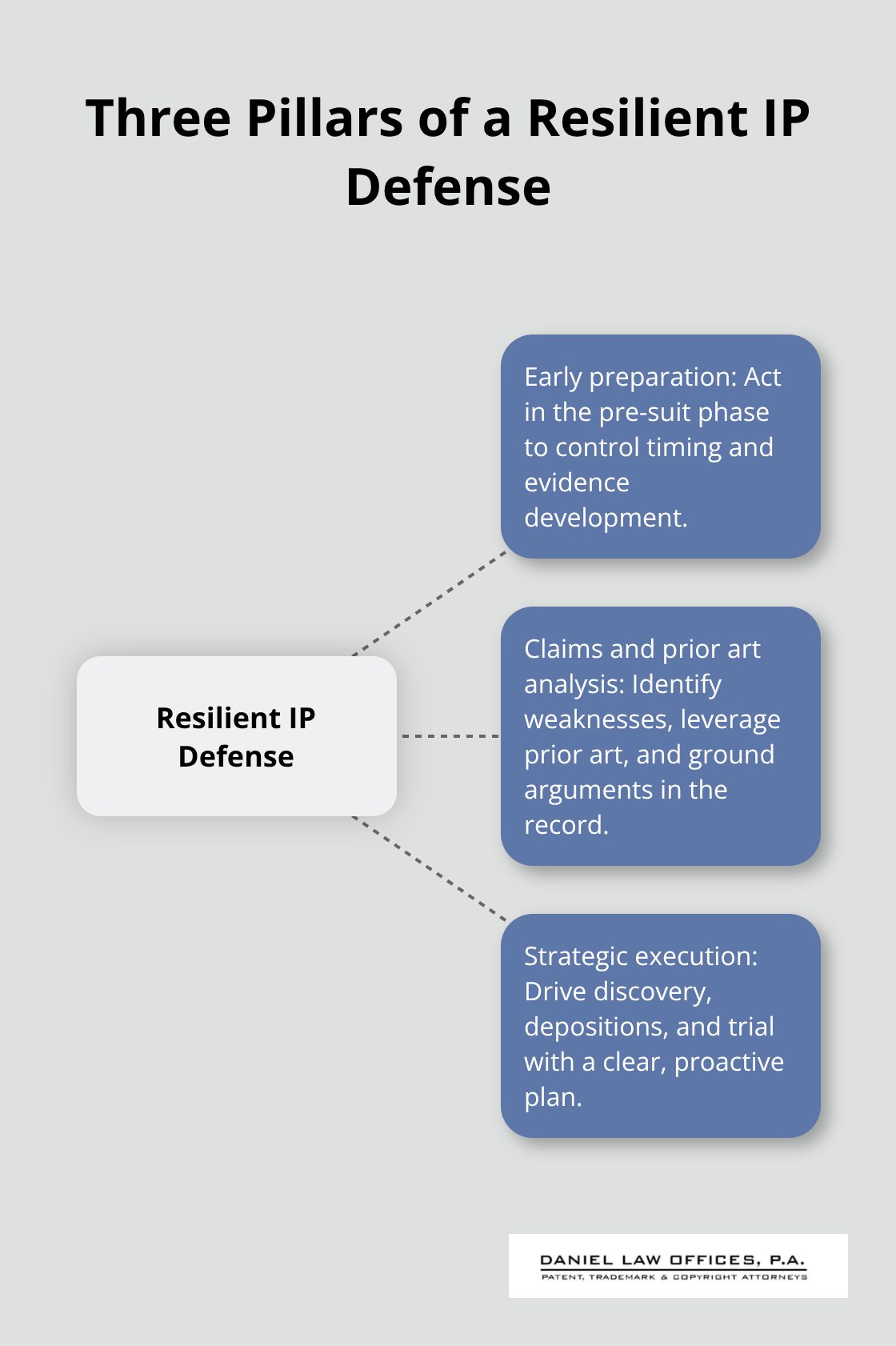
A resilient IP defense in Florida rests on three pillars: early preparation before litigation begins, meticulous analysis of claims and prior art, and strategic execution through discovery and trial. IP litigation strategies Florida courts reward are those grounded in thorough groundwork conducted during the pre-suit phase. Defendants who wait until a complaint arrives have already surrendered their most valuable advantage-the ability to shape the evidence record and narrative on their own timeline.
You win when you locate prior art that invalidates the opposing claim, identify weaknesses in their patent language, and prepare your technical team to withstand aggressive depositions. Your courtroom presentation transforms complex technical disputes into clear, visual narratives that judges understand immediately. These steps separate defendants who settle from positions of strength from those who capitulate under pressure.
If you face an IP dispute or anticipate one, start your prior art research and claim analysis now. We at Daniel Law Offices, P.A. help clients navigate IP protection from the earliest stages, including comprehensive patent searches and trademark registration that establish your legal foundation. Contact us to discuss your IP strategy and ensure your defense rests on solid legal footing.