



Patent Litigation Strategies: Defend, Enforce, Win
Patent disputes can cost your business hundreds of thousands of dollars and years of court time. Whether you’re defending against infringement claims or enforcing your own patents, the right patent litigation strategies make the difference between winning and losing.
At Daniel Law Offices, P.A., we help companies navigate these high-stakes battles with clear, actionable approaches. This guide covers both defensive and offensive tactics to protect what you’ve built.
Understanding Patent Infringement Claims
A patent grants you the exclusive right to make, use, sell, or import your invention for a limited period. Infringement occurs when someone else does any of these things without permission. To win an infringement case, you must prove three things: you own a valid patent, the patent is enforceable, and the accused product or process infringes at least one claim in your patent.
How Courts Determine Infringement
The infringement test is straightforward but unforgiving. Courts examine whether the accused product meets every single element of your patent claim. Miss even one element, and infringement fails. This is why claim construction-the process of interpreting what your patent claims actually cover-becomes the pivotal moment in litigation.
The Markman hearing, where a judge interprets disputed patent terms before trial, often determines the outcome before a jury ever enters the courtroom. If your claims are narrowly construed, the accused product may fall outside your protection. If they’re broadly construed, you have a stronger case. This single hearing can shift the entire trajectory of your litigation, making early preparation and clear claim language during prosecution absolutely vital.
Direct and Indirect Infringement Pathways
Direct infringement is the most obvious form: a competitor manufactures or sells a product that incorporates your patented technology. But indirect infringement pathways exist and matter strategically. Contributory infringement applies when someone sells a component knowing it will be used in an infringing product and the component has no substantial non-infringing use. Inducement to infringe occurs when someone actively encourages or aids infringement.
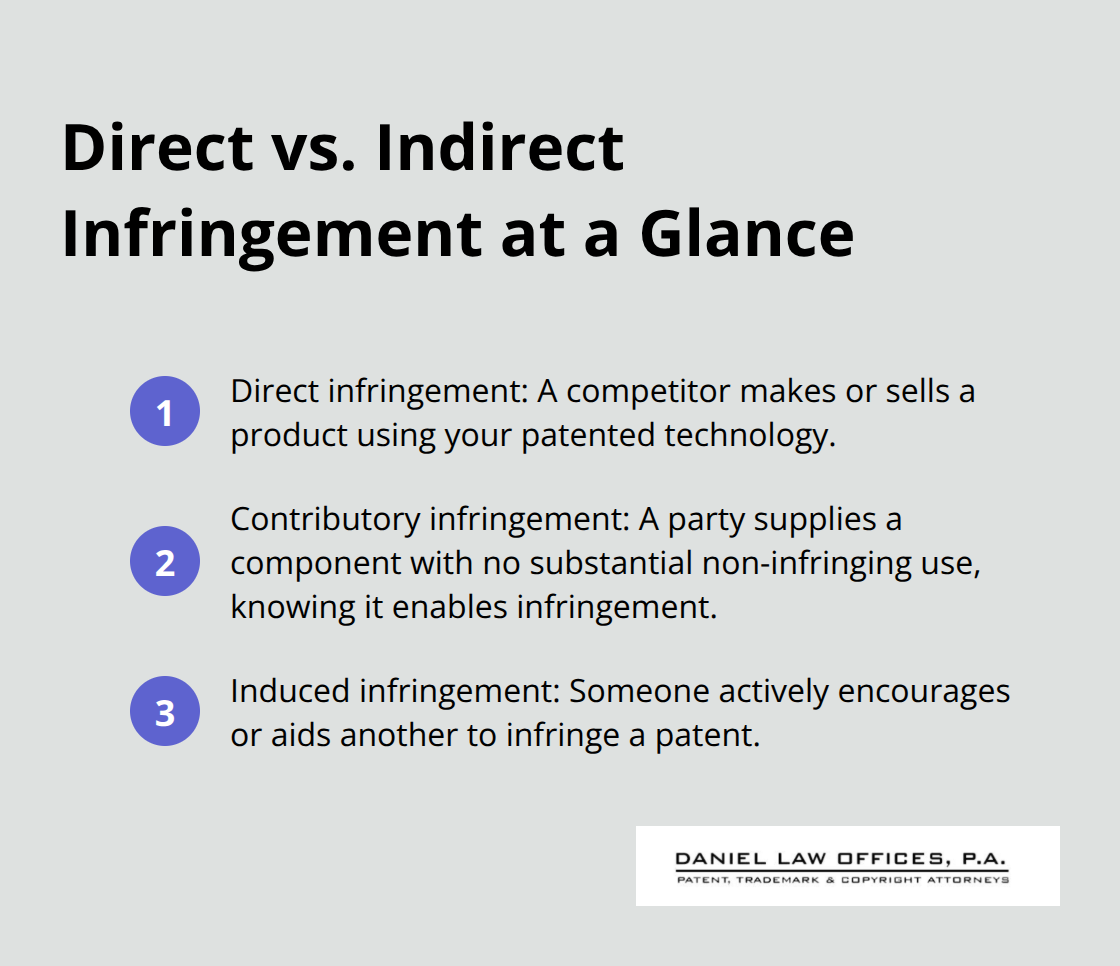
These indirect theories expand your enforcement options but require stronger evidence of knowledge and intent. In practice, direct infringement cases move faster and are simpler to prove, while indirect theories add complexity and discovery costs. US litigation costs typically run into the millions when discovery and attorney fees are included, making forum selection critical.
Litigation Costs Across Jurisdictions
German infringement cases cost between €200,000 and €500,000 and resolve in 9 to 18 months, while US cases can stretch two to three years in districts like Delaware or Northern California. Texas districts move faster at 12 to 18 months. China offers the fastest resolution at 9 to 12 months with average costs around $200,000.
If speed and cost efficiency matter more than damages size, Germany or China become attractive options. If deterrence and high damages are your goal, the US remains the standard despite its expense and timeline.
What Victory Actually Costs
Patent litigation expenses demand brutal honesty about your budget and goals. Discovery alone-the process of exchanging documents and depositions-consumes the bulk of litigation costs and can easily exceed $500,000 in complex cases. Expert witnesses in technical fields charge $300 to $600 per hour and testify across depositions, trial preparation, and trial itself.
If you proceed to trial, expect another $200,000 to $500,000 in attorney fees and costs. The total for a full US trial easily reaches $1 million to $3 million or higher. Damages, when you win, can offset these costs. In the US, patent damages regularly exceed $10 million in high-stakes cases, and the court can award treble damages for willful infringement. However, willfulness is harder to prove post-2016 Federal Circuit decisions, making damages less predictable.
Injunctions as Real Leverage
Injunctions-court orders stopping the defendant from selling the infringing product-provide the real leverage in enforcement. Since the 2006 eBay v. MercSearch decision, permanent injunctions are harder to obtain in the US, shifting focus to monetary damages. Germany grants injunctions readily once infringement is proven, making it attractive for rapid market exclusion. China grants injunctive relief in over 90% of cases where foreign plaintiffs prevail, and foreign parties win roughly 77% of cases in Beijing’s IP Court.
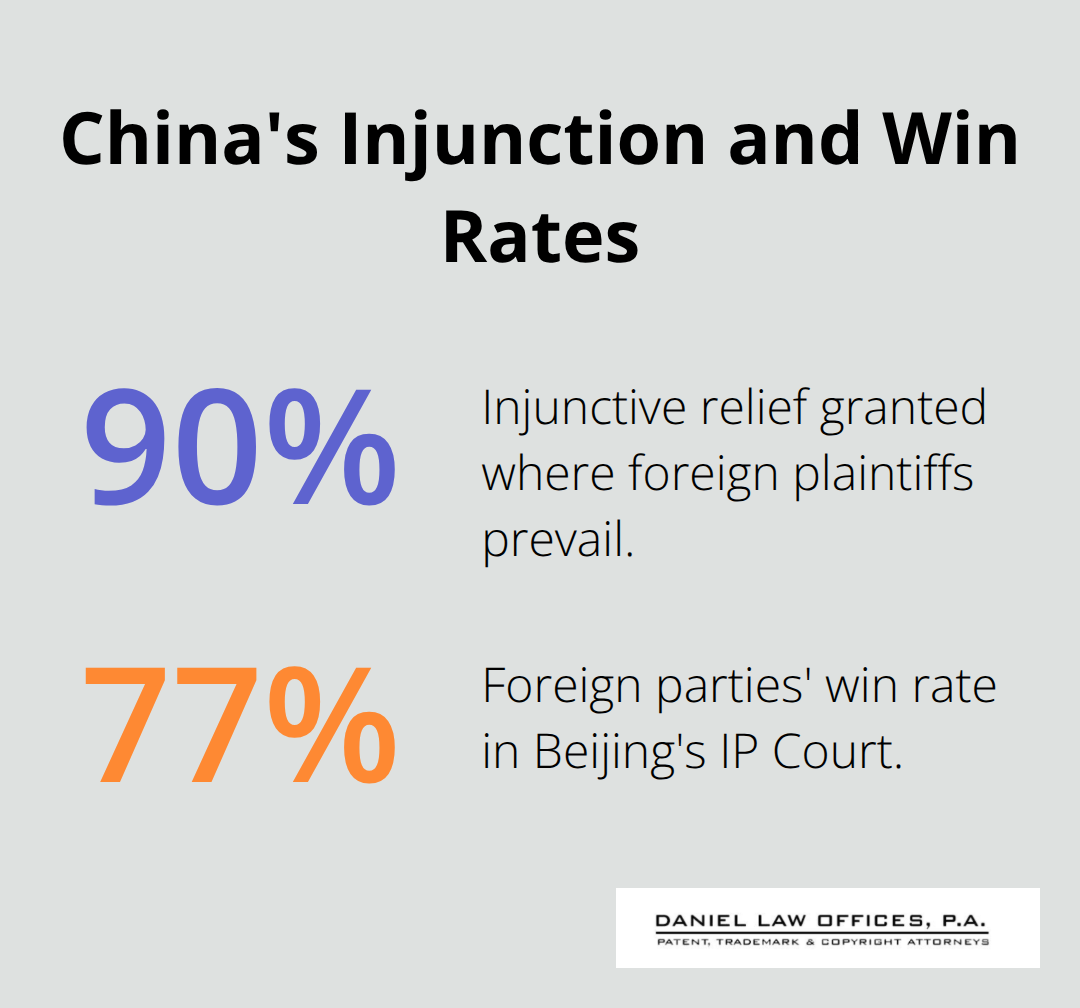
These differences make jurisdiction selection inseparable from your enforcement objectives. Your choice of forum directly shapes whether you pursue fast market exclusion or long-term damages recovery. The next section examines how to defend against infringement claims when you’re the accused party.
How to Build a Strong Defense Against Patent Infringement Claims
When you face patent infringement accusations, your first instinct might be to settle quickly. Resist that urge. A well-constructed defense can eliminate the threat entirely or drastically reduce what you owe. Too many companies capitulate without understanding their actual exposure. The accused product might not infringe the patent at all, the patent itself might be invalid, or a license might already exist that shields you from liability. Each defense path requires different evidence and timing, so your opening move in litigation determines whether you fight from strength or weakness.
Attack the Patent’s Legal Foundation
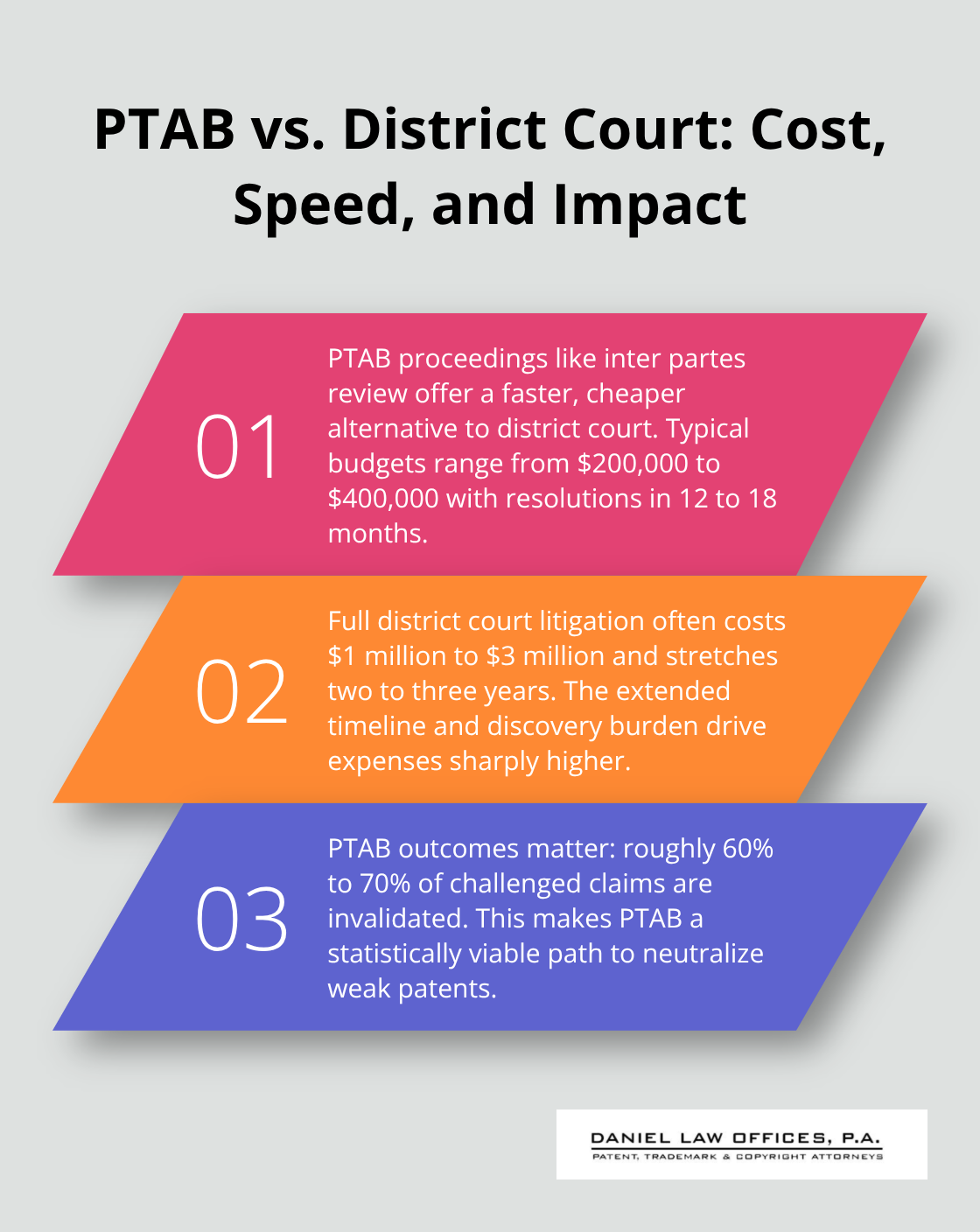
Invalidity defenses target the core legal defects in the patent itself, and they work. Prior art-patents, publications, or products that existed before the filing date-can render claims unpatentable if they disclose every element of your accused product. The Federal Circuit and USPTO Patent Trial and Appeal Board take prior art seriously. If you identify prior art that the patent examiner missed during prosecution, you have a credible path to invalidation. Post-grant proceedings before the PTAB, including inter partes reviews, offer a faster and cheaper alternative to district court litigation. These proceedings typically cost $200,000 to $400,000 and resolve in 12 to 18 months, compared to $1 million to $3 million for full district court litigation stretching two to three years. The PTAB invalidates roughly 60% to 70% of challenged claims, making it a statistically viable offensive defense.
Beyond prior art, look for indefiniteness-if the patent’s language is so vague that competitors cannot reasonably understand what is prohibited, the claims fail. Lack of enablement also works: if the patent specification does not teach someone skilled in the field how to make and use the invention, claims are unenforceable. Many patents contain these legal defects because patent examiners miss them, and discovering them early shifts your negotiating position from defendant to threat.
Prove the Accused Product Does Not Infringe
Non-infringement arguments require precise claim-by-claim analysis. The Markman hearing interprets what each patent claim actually covers, and your non-infringement case depends entirely on that construction. If the claim receives a narrow construction, the accused product often falls outside the patent’s scope. Build detailed technical evidence showing how your product differs from the claim elements. This is not theoretical-bring product specifications, design documents, and technical expert testimony that maps your product’s features against each claim element. If your product omits even a single required element, infringement fails under patent law. Many defendants overlook this and assume they lose automatically. They do not. Courts require the plaintiff to prove infringement by a preponderance of evidence, and gaps in the evidence work in your favor. Document everything your product does and does not do, then present it clearly. Technical depth matters here because judges and juries struggle with complex patent language. Your expert must explain claim elements in plain terms, showing exactly where the accused product diverges from the patent’s scope.
Explore Settlement and Cross-Licensing Early
Settlement negotiations should start immediately after your initial case assessment, not after discovery costs spiral. Early settlement typically costs 30% to 50% of what full litigation consumes. Mediation, where a neutral third party facilitates discussion, succeeds in resolving patent disputes when both sides understand their actual risks. The plaintiff might have a valid patent and infringement case, but damages could be modest if your market share is small or the patent’s remaining term is short. Conversely, you might have a strong invalidity defense, but litigation expenses could exceed the value of fighting. Cross-licensing often makes more sense than litigation. If both parties have patent portfolios, exchanging licenses can eliminate the dispute and create mutual value. This approach works particularly well in technology sectors where multiple patents cover similar innovations. Your goal in early negotiations is clarity: understand the plaintiff’s real damages theory, quantify your defense costs, and evaluate whether settlement or licensing better serves your business. Do not let legal fees consume resources that settlement could preserve.
Move Forward With Strategic Clarity
The strength of your defense depends on how quickly you assess your actual exposure and act on that assessment. A weak invalidity defense combined with clear infringement means settlement or licensing makes financial sense. A strong non-infringement case with solid technical evidence means litigation becomes viable. The path forward shifts based on what the evidence actually shows, not on assumptions or hope. Once you understand your defense position, you can shift your focus to the offensive side of patent strategy-how to enforce your own patents and build leverage in the market.
Enforcing Your Patents Through Strategic Litigation
When you own a strong patent, enforcement becomes your competitive advantage. The decision to litigate infringement is not about anger or principle-it is about protecting your market position and generating returns on your R&D investment. Too many patent holders wait for the infringer to stop voluntarily. They do not. Once the competitor captures market share, builds customer relationships, and entrenches their position, enforcement becomes harder and more expensive. Early action matters because damages are calculated from the date infringement began, but only if you can prove it.
Document Infringement From Day One
The moment you discover infringement, document it thoroughly. Collect emails, product advertisements, sales records, and technical specifications showing when the accused product entered the market and how it compares to your patent claims. This evidence becomes your damages foundation. US patent damages regularly exceed $10 million in significant cases, but only when you can demonstrate lost profits or establish a reasonable royalty rate. Courts do not award damages for pre-suit infringement unless the defendant received actual notice. Send a detailed infringement notice letter to the accused infringer, documenting the patent number, specific claims you believe are infringed, and how the accused product meets each claim element. This letter serves two purposes: it triggers potential damages liability going forward, and it demonstrates good faith before litigation. Many infringers settle after receiving a credible notice because they suddenly face real financial exposure.
Choose Your Forum Strategically
If settlement discussions stall, filing suit in the right jurisdiction dramatically affects your outcome. US district courts in Texas resolve cases in 12 to 18 months, while Delaware and Northern California stretch two to three years. Germany delivers judgments in 9 to 18 months with costs between €200,000 and €500,000. The Unified Patent Court, which launched in June 2023, has already handled over 500 infringement actions and typically resolves cases within about one year across multiple European countries. China resolves cases fastest-9 to 12 months with average costs around $200,000-and grants injunctive relief in over 90% of cases where foreign plaintiffs prevail. Your choice of forum directly determines your timeline and cost structure.
Build Technical Evidence That Wins
Building an enforcement case requires technical precision that most companies underestimate. You need a credible technical witness who can explain your patent claims in terms judges and juries understand. The witness maps each claim element to the accused product’s actual features, showing infringement element-by-element. This is not theoretical work-the witness must have hands-on knowledge of the technology and testify about how the accused product was designed and functions. Damages calculations demand equal rigor. If you lost sales directly to the infringer, you calculate lost profits by showing the customer would have bought from you instead. This requires market data, pricing information, and evidence that you could have supplied the customer. Reasonable royalty analysis works differently: you establish what a willing licensor and licensee would have agreed to pay before infringement began. Industry licensing rates, the patent’s remaining term, the accused product’s market size, and comparable license agreements all feed into this calculation. Courts scrutinize damages claims heavily, so underestimating what you can prove is safer than overstating.
Leverage Injunctions for Market Control
Injunctive relief-a court order stopping the defendant from selling the infringing product-provides leverage that damages alone cannot match. Since eBay v. MercSearch in 2006, US courts rarely grant permanent injunctions unless you prove irreparable harm, inadequacy of damages, balance of equities in your favor, and public interest considerations. Germany and China grant injunctions far more readily. If your business model depends on market exclusion rather than royalty collection, Germany or the Unified Patent Court becomes more attractive than the US. Preliminary injunctions, issued before trial, freeze the defendant’s sales immediately and force settlement discussions. These require showing likelihood of success on the merits, irreparable harm, and balance of equities. Filing suit in a jurisdiction favorable to preliminary injunctions-Germany, China, or the UPC-accelerates settlement leverage compared to the slow US process.
Final Thoughts
Patent litigation strategies succeed when they align with your actual business goals, not with legal theory or emotion. Whether you defend against infringement claims or enforce your own patents, the core principle remains constant: understand your exposure early, quantify your costs and risks, and choose the path that protects your bottom line. Litigation makes sense when you have a strong case, meaningful damages at stake, and the financial capacity to see it through, but settlement and licensing often deliver better outcomes than years of courtroom battles.
US patent infringement cases cost $1 million to $3 million and take two to three years in many districts, while Germany resolves disputes faster and cheaper at €200,000 to €500,000 over 9 to 18 months. China delivers the fastest resolution at 9 to 12 months with average costs around $200,000, making it the logical choice if speed matters more than damages size. Early negotiation typically costs 30 to 50 percent of what full litigation consumes, and cross-licensing eliminates disputes while creating mutual value in technology sectors where multiple patents overlap.
Defending against infringement claims requires attacking the patent’s legal foundation through invalidity arguments, proving non-infringement through technical evidence, or negotiating settlement before discovery costs spiral. Enforcing your patents demands documenting infringement from day one, choosing the right forum for your objectives, building credible technical evidence, and leveraging injunctions when market exclusion matters more than royalties. Contact us at Daniel Law Offices, P.A. to discuss how patent litigation strategies can protect your innovations and enforce your patent rights effectively.