



Provisional patent overview: Understanding Provisional Applications And Benefits
You’ve probably heard the term provisional patent thrown around, but what does it actually mean for your invention?
At Daniel Law Offices, P.A., we help inventors navigate the patent process, and a provisional patent overview reveals something important: these applications offer a faster, cheaper way to establish your priority date while you refine your idea.
The 12-month window they provide can be the difference between protecting your invention and losing it to competitors.
What Exactly Is a Provisional Patent Application
A provisional patent application is a simplified filing with the United States Patent and Trademark Office that establishes an official filing date for your invention without the formal requirements of a full patent application. Unlike utility patents, which require formal claims, an oath or declaration, and an information disclosure statement, a provisional application needs only a descriptive, enabling disclosure and drawings if necessary under 35 U.S.C. §112 and §113. This streamlined approach costs significantly less to file-the USPTO charges basic filing fees of $75 for micro-entities, $150 for small entities, and $300 for large entities as of 2023-compared to utility patent filings that start at $300 to $600 just for the basic filing fee before search and examination costs.
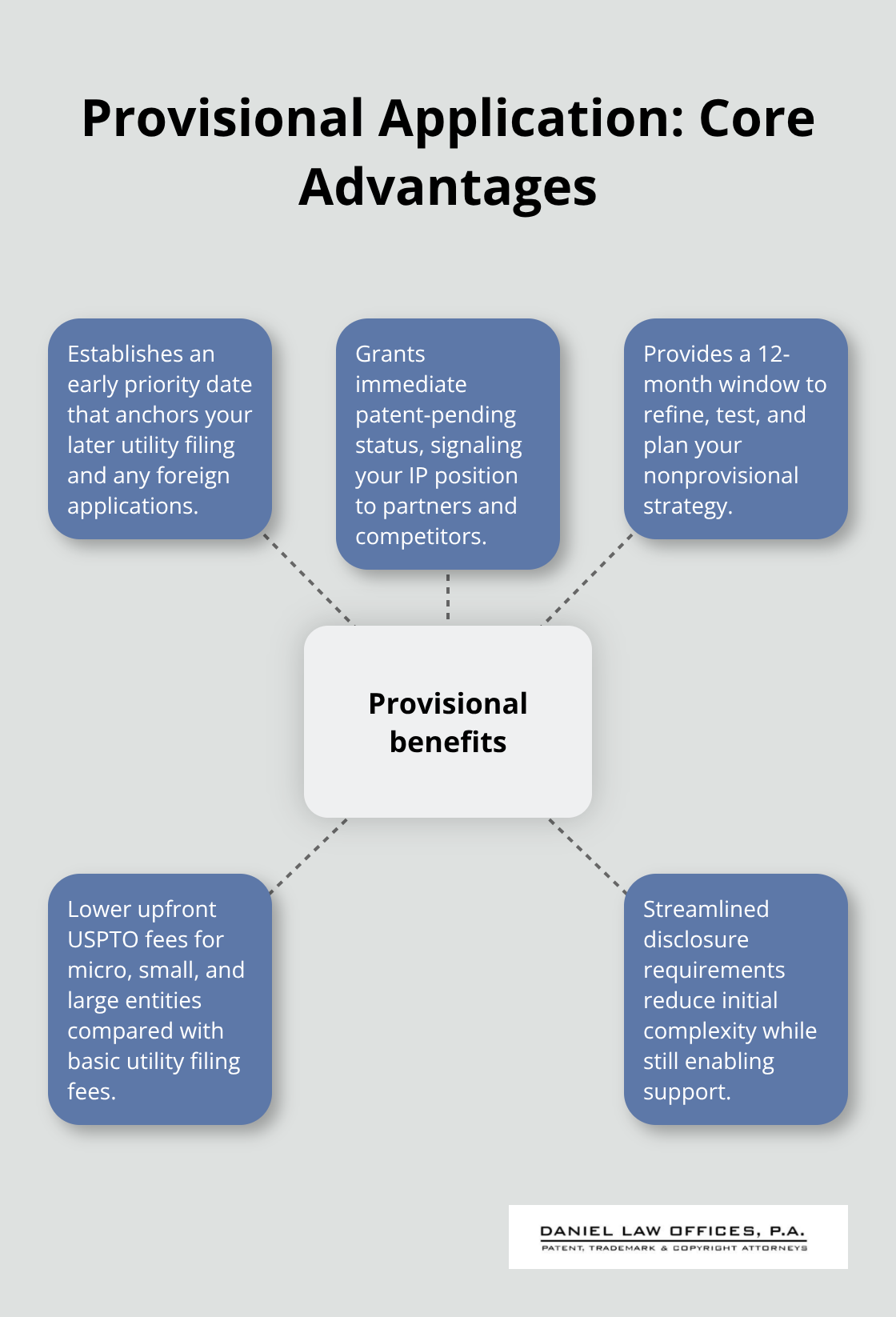
The provisional filing immediately grants you patent-pending status and secures a priority date, which becomes critical if you later file a corresponding nonprovisional utility patent within 12 months. That 12-month window is absolute and cannot be extended; if you miss it, you lose the priority benefits of your provisional filing.
Why the 12-Month Deadline Matters More Than You Think
Filing a provisional application triggers the Paris Convention priority year, which is essential if you plan any international patent protection. Within those 12 months, you must file a nonprovisional application and claim the provisional’s benefit under 35 U.S.C. §119(e) to preserve your early filing date. If you file the nonprovisional after 12 months but within 14 months, you can still restore the provisional benefit through a grantable petition under 37 CFR 1.78, though this adds complexity and cost. The provisional itself is never examined on its merits, so no examiner will scrutinize your claims or prior art references. However, this also means your provisional filing does not lead directly to a patent-it serves as a stepping stone to a utility patent. Many inventors treat the provisional as a placeholder and then scramble to file the nonprovisional near the deadline, which often results in rushed, incomplete applications. A well-prepared provisional with thorough technical descriptions, detailed drawings, and clear enabling language for how to make and use your invention significantly reduces the work and cost during the nonprovisional stage.
Documentation and Inventor Requirements That Trip Up Most Filers
The provisional must name all inventors, and if multiple inventors contributed, each must be named and have genuinely contributed to the invention. The nonprovisional application must include at least one inventor in common with the provisional to claim the provisional date. Many inventors file provisionals with incomplete inventor lists, then discover during nonprovisional preparation that they missed someone, which complicates matters and can jeopardize priority claims. Additionally, public disclosures within 12 months before filing can still support U.S. patentability under 35 U.S.C. §102(b)(1), but they may preclude patenting in foreign countries, a fact that surprises most inventors focused solely on domestic protection. The cover sheet requires identifying the invention, the inventors and their residences, the invention title, your attorney or agent information, a docket number if applicable, your correspondence address, and any U.S. government agency with a property interest; Form PTO/SB/16 is the standard cover sheet. File electronically via Patent Center to receive real-time fee processing and faster handling than mail filing. Applicants who exceed 100 pages or include drawings exceeding 50 sheets incur additional fees, so strategic, concise drafting from the outset keeps costs manageable and increases the likelihood of a smoother transition to nonprovisional examination.
Strategic Drafting Decisions That Protect Your Timeline
The quality of your provisional application directly impacts how much work you face later. Thorough technical descriptions and detailed drawings establish a solid foundation that you can build upon during the nonprovisional stage. Vague or incomplete disclosures force you to add new material later, which can create complications with your priority date and increase attorney fees. Try to include everything you know about how to make and use your invention at the provisional stage. This approach transforms your provisional from a mere placeholder into a genuine stepping stone that accelerates your path to patent protection and reduces the total cost of securing your invention.
Why a Provisional Application Saves Money and Time
The Real Cost Difference Between Provisional and Utility Patents
Filing a provisional application costs a fraction of what you’ll spend on a full utility patent, and the numbers prove it. The USPTO charges $75 for micro-entities, $150 for small entities, and $300 for large entities to file a provisional, compared to $300 to $600 just for the basic utility patent filing fee before you even pay for search and examination fees. That initial cost difference matters, but the real savings come from avoiding premature investment in a full application when your invention is still evolving. Many inventors waste thousands drafting a complete utility patent with formal claims and detailed specifications when they’re uncertain about the final design. A provisional application lets you establish priority at minimal cost, then spend the next 12 months testing, refining, and validating your concept before committing to the expensive nonprovisional stage.
Why Inventors in Orlando’s Key Industries Benefit Most
Inventors in Orlando’s optics, life sciences, and advanced manufacturing sectors find particular value in this approach. Prototyping and market testing often reveal needed design changes that would have cost far more to incorporate into a locked-in utility application. A provisional application lets you validate your invention without the financial burden of a complete patent specification.
Hidden Costs That Drain Your Budget
Beyond the filing fee itself, a strategic provisional avoids hidden costs that plague many inventors. Professional drawings, patent searches, and legal consultations can add $1,000 to $3,000 or more to your total investment. A well-prepared provisional with thorough technical descriptions actually reduces downstream costs because your nonprovisional attorney faces less work rebuilding your disclosure. According to USPTO data, applications with professional drawings have about a 20 percent higher chance of approval without major revisions, meaning your provisional investment pays dividends when you convert to nonprovisional.
Using the 12-Month Window to Your Advantage
The 12-month window also gives you time to conduct a proper patent search using free resources like the USPTO database or Google Patents before filing your utility application (which costs $1,000 to $3,000 when done professionally). Many inventors skip this search initially to save money, then discover prior art during examination and face rejection or costly amendments. Filing a provisional first lets you search and validate novelty without pressure, then move forward confidently.
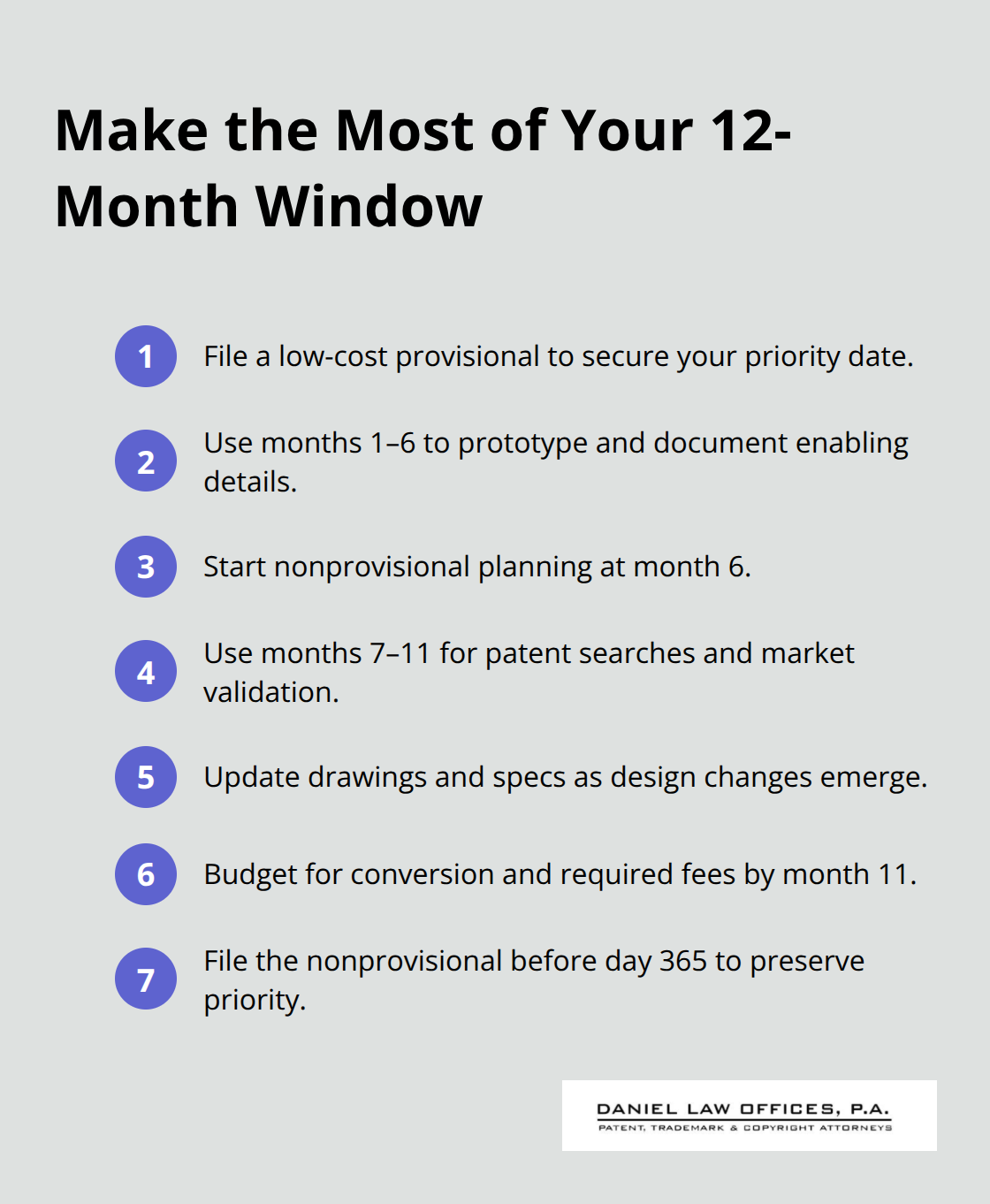
That breathing room transforms a provisional from a cheap placeholder into a strategic tool that protects your timeline and your wallet simultaneously.
What Comes Next in Your Patent Journey
Once you’ve secured your provisional filing and used those 12 months wisely, the real work of converting your invention into a utility patent begins. Understanding what happens during that conversion process-and how to prepare your nonprovisional application to maximize your chances of approval-determines whether your provisional investment truly pays off.
Mistakes That Derail Provisional Filings in Orlando, Florida
Incomplete Technical Descriptions Undermine Your Priority Date
Incomplete technical descriptions remain the single biggest reason provisional applications fail to deliver their promised value. Inventors often rush through the disclosure, assuming they can flesh out details later during the nonprovisional stage. This approach backfires because any new material added to the nonprovisional that wasn’t in the provisional loses the priority date you fought to establish. The USPTO examines whether your original provisional contains an enabling disclosure under 35 U.S.C. §112, meaning someone skilled in your field could reasonably understand how to make and use your invention based on what you filed. Vague descriptions like “use standard manufacturing techniques” or “apply conventional methods” fail this test.
Walk through the actual steps, materials, dimensions, and specifications that define your invention. Include drawings that show the critical components and how they interact. Professional drawings cost $75 to $150 per sheet but increase approval odds by roughly 20 percent according to USPTO data. Inventors in Orlando’s optics and advanced manufacturing sectors especially struggle here because their inventions demand precise technical detail. Skipping this rigor creates a false economy-you save a few hundred dollars upfront but face expensive reconstruction work during nonprovisional prosecution.
The 12-Month Deadline Demands Immediate Action
The 12-month deadline turns lethal when inventors treat it as a suggestion rather than a hard stop. You cannot extend this window, and filing even one day late forfeits your priority date entirely. Many inventors file a provisional, then focus on other business priorities, assuming they have plenty of time. Suddenly month 11 arrives and they scramble to prepare a nonprovisional application, often with incomplete specifications and hastily drafted claims. This rush forces you to choose between filing a weak nonprovisional quickly or missing the deadline altogether.
Start planning your nonprovisional timeline at month 6, not month 11. Use months 7 through 11 to conduct thorough patent searches using free USPTO resources or Google Patents, test your invention for design changes, and gather feedback from potential users or manufacturers. This preparation transforms your provisional into a genuine foundation rather than a placeholder.
Inventor Names and Entity Classification Errors Create Complications
Naming all inventors accurately from day one prevents the complications that arise when you discover during nonprovisional preparation that someone contributed but wasn’t listed originally. Each inventor must have genuinely contributed to the invention, and the nonprovisional must include at least one inventor in common with the provisional to preserve priority. Many inventors file provisionals with incomplete inventor lists, then face delays and jeopardized priority claims during the conversion process.
Incorrect entity-size claims on your cover sheet also trigger rejections-approximately 8 percent of applications face rejection for this reason according to USPTO data. Verify whether you qualify as a micro-entity, small entity, or large entity before filing, as misclassification wastes time and money on resubmission.
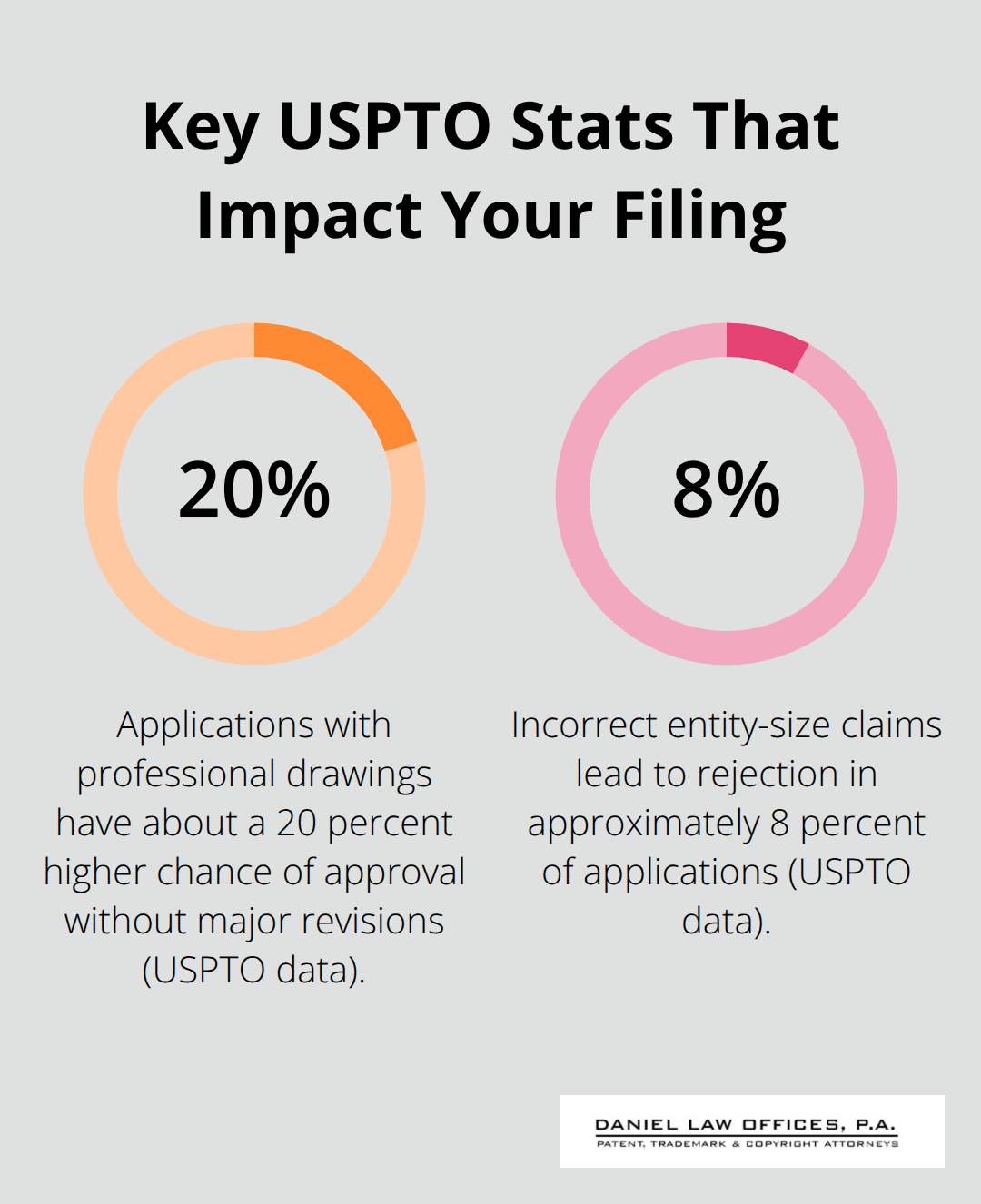
Taking five minutes to confirm your status upfront saves weeks of frustration later.
Final Thoughts
A provisional patent overview reveals that these applications solve a genuine problem for inventors who must establish priority without the expense of a full utility patent. The 12-month window provides time to test your invention, conduct patent searches, and refine your design before committing to the nonprovisional stage. You avoid premature investment in formal claims and detailed specifications when your concept is still evolving, and the cost difference alone justifies filing a provisional first-$75 to $300 in government fees compared to $300 to $600 just for basic utility filing, before search and examination costs multiply your expenses.
File a provisional application when your invention is functional enough to describe how someone would make and use it, but before you have finalized every design detail. This applies whether you work in Orlando’s optics sector, life sciences, advanced manufacturing, or any other field. The provisional grants you legal protection and patent-pending status while you validate your market and refine your technical approach, and it also triggers the Paris Convention priority year (which matters if you plan international protection later).
The mistakes we outlined-incomplete technical descriptions, missed deadlines, and incorrect inventor information-are entirely preventable with proper planning. Start your nonprovisional preparation at month six, not month eleven, and verify your entity classification upfront. Contact us to discuss your invention and determine whether a provisional application fits your protection strategy.