



Patent Prosecution Strategy: From Office Action to Issued Patent
Getting a patent application rejected by the USPTO doesn’t mean your innovation is unpatentable. Most applications receive at least one Office Action, and how you respond determines whether you’ll reach patent issuance or face continued delays.
We at Daniel Law Offices, P.A. help inventors navigate patent prosecution strategy with precision, turning rejections into opportunities to strengthen your claims and move closer to protection.
Patent Office Actions: What They Are and How to Respond in Orlando, Florida
Understanding the Office Action and Its Impact
An Office Action is the USPTO examiner’s formal written response to your patent application, arriving within months of filing. This letter details exactly why the examiner believes your invention fails to meet patentability standards, citing prior art references, legal rejections, or technical objections about claim language. The USPTO data shows that most patents receive at least one Office Action before issuance, making this stage the true battleground of patent prosecution. Non-Final Office Actions are the first formal response, outlining rejections and giving you three months to respond, extendable to six months for a fee. A Final Office Action follows if issues persist and restricts further material changes, meaning your options narrow considerably.
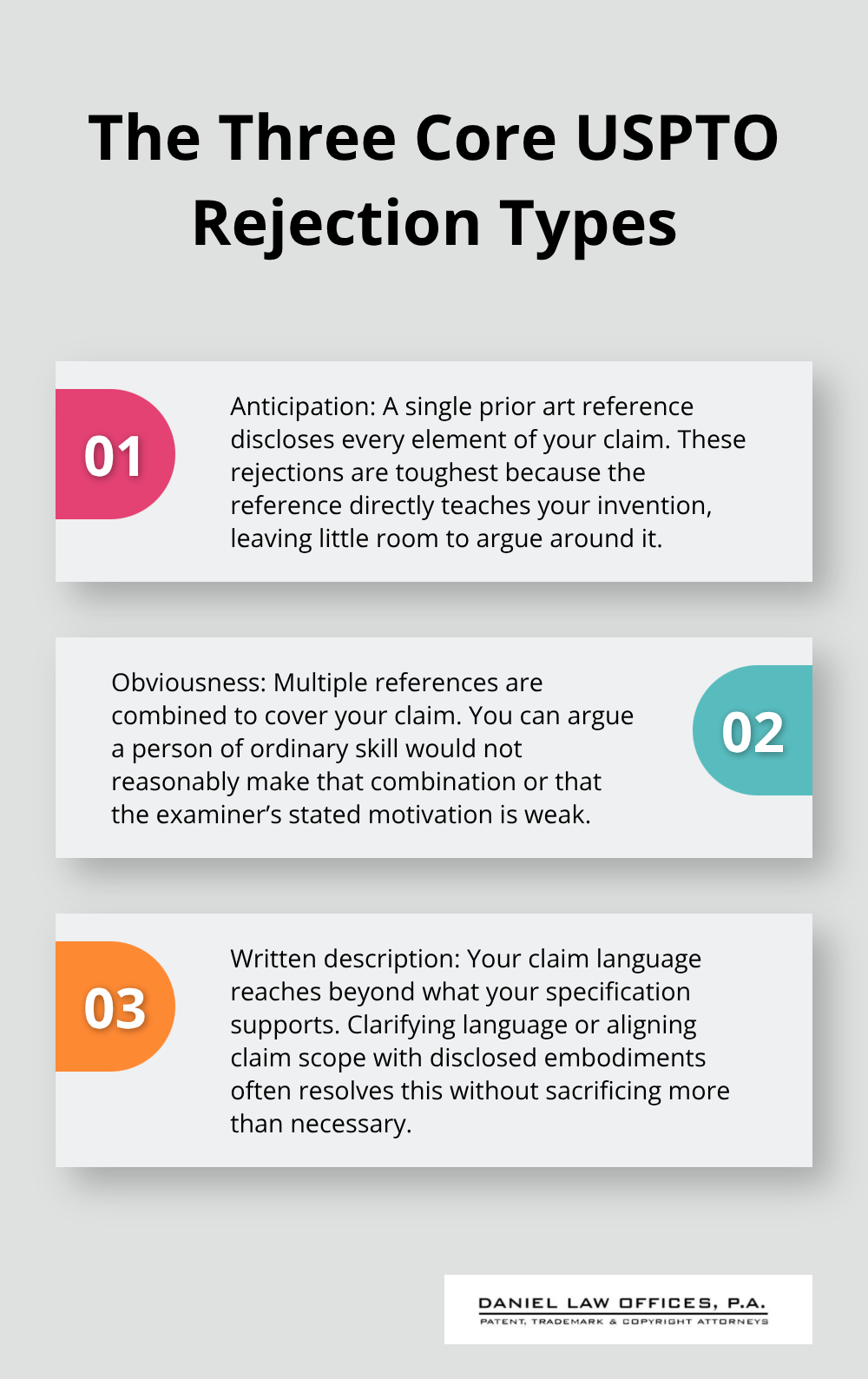
Understanding the specific basis of each rejection matters far more than assuming the examiner simply misunderstood your invention. Many applicants make the mistake of broadly arguing patentability rather than surgically addressing the examiner’s actual reasoning. The rejection typically falls into one of three categories: anticipation by a single prior art reference, obviousness when combining multiple references, or written description problems where your claims lack sufficient support in the specification.
Recognizing the Three Types of Rejections
Anticipation rejections are the hardest to overcome because the prior art directly discloses your invention. Obviousness rejections offer more room to argue that a skilled person would not have combined references as the examiner suggests. Written description rejections stem from vague or unsupported claim language and often resolve through clarification rather than narrowing your claims.
Meeting the Three-Month Deadline
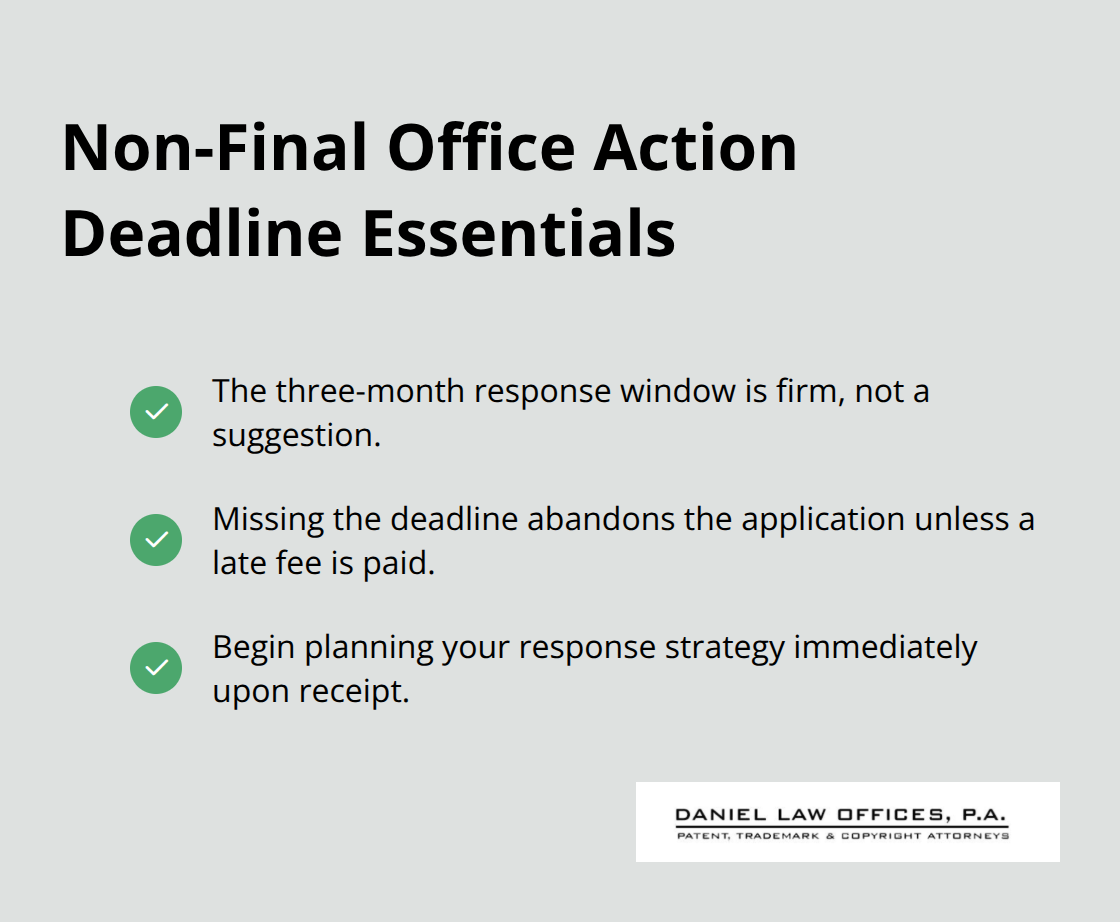
The three-month deadline from a Non-Final Office Action is not a soft guideline. Missing it abandons your application entirely unless you pay a late fee, adding unnecessary cost and complexity. Plan your response strategy immediately upon receiving the Office Action, not weeks later when time pressure clouds your judgment.
Your response has three primary tools: amending claims to narrow scope or add technical details, presenting arguments that differentiate your invention from cited references, or submitting declarations from inventors providing evidence of non-obviousness. Examiner interviews are underutilized but often move prosecution forward faster than written responses alone, allowing you to discuss the examiner’s interpretation, propose alternative claim sets, and clarify technical misunderstandings without creating a written record that could trigger prosecution history estoppel. The interview costs nothing and takes thirty minutes, yet many applicants skip this step and instead file written responses that repeat arguments the examiner has already rejected.
Choosing Between Amendments and Arguments
When deciding between amending claims or arguing patentability, avoid the trap of over-narrowing to achieve quick allowance. Surgical amendments that address the specific rejection while preserving broad claim coverage serve your patent far better in future enforcement than rushed claim narrowing that abandons valuable protection. The path forward depends on whether the examiner’s reasoning contains weaknesses you can exploit or whether your original claims truly need refinement to match your specification.
How to Analyze Rejections and Decide Your Response Strategy in Orlando, Florida
Read the Office Action Twice for Clarity
Start by reading the Office Action twice before forming any response plan. The first read identifies which rejections apply to your claims; the second read reveals the examiner’s actual reasoning, which often differs from what applicants assume. Examiners cite prior art references and explain their logic, but applicants frequently misinterpret that logic or argue against a rejection that doesn’t actually apply to their broadest claims. Map each rejection to the specific claim language the examiner targeted. If the examiner rejected claim 1 for obviousness but you think the rejection applies only to claim 3, that misalignment will sink your response.
Extract and Study the Actual Prior Art Documents
Pull the actual prior art documents the examiner cited, not summaries. Read them in full. Many rejections collapse when you discover the examiner misread a reference or cited a document that doesn’t actually teach what the examiner claims it teaches. The WIPO guidance on prior art analysis emphasizes systematic comparison between cited references and your invention to identify distinguishing features. This detective work takes time but saves months of prosecution delay later. You uncover weaknesses in the examiner’s reasoning that your written response can exploit directly.
Assess Your Specification Against Your Claims
Deciding between amending claims and arguing patentability requires honest assessment of your specification. If your specification genuinely supports broader language than your current claims, argue patentability and preserve scope. If your specification is thin or vague on a particular element, amending claims to match what you actually disclosed moves prosecution forward faster. Obviousness rejections almost always benefit from argument rather than immediate narrowing. The examiner must show a motivation to combine multiple references, and weak or unsupported motivations can undermine the rejection entirely. Counter-arguments citing secondary considerations like commercial success or long-felt industry need carry weight if you have evidence. Anticipation rejections leave little room for argument; if a single prior art reference discloses every element of your claim, amendment is your only realistic option.
Consider an Examiner Interview Before Final Response
Many applicants working with patent counsel should request an examiner interview before submitting a written response to a Final Office Action. Interviews allow you to propose alternative claim amendments without creating a written record that limits your future enforcement options. The cost is zero; the examiner simply discusses the issues by phone. This informal dialogue often reveals that the examiner will accept a narrower claim set you hadn’t considered, or that a clarifying amendment to dependent claims will allow the independent claim. The interview strategy works particularly well when you’ve identified multiple plausible paths forward and want to test which one the examiner prefers before committing to a formal written response.
Build Your Claim-to-Reference Map
A detailed claim-to-reference map forms the foundation of any strong response. This map shows exactly which claim elements the examiner matched to which prior art disclosures, exposing gaps in the examiner’s logic. Test multiple amendment strategies before filing any response, ensuring your final patent protects your actual innovation without surrendering enforceability. The strength of your response depends on this preparation work, not on eloquent legal arguments that repeat points the examiner has already rejected. Once you’ve completed this analysis and decided your response direction, you’re ready to move into the actual drafting phase-where precise claim language and targeted arguments transform your strategy into a response that moves prosecution forward.
Turning Rejections Into Patent Strength in Orlando, Florida
Strategic Claim Amendments That Preserve Enforceability
Strategic claim amendments separate patents that survive litigation from those that collapse under scrutiny. The goal isn’t to narrow your claims as quickly as possible to appease the examiner; it’s to amend with surgical precision so your patent remains enforceable while addressing the examiner’s stated objections. When the USPTO cited prior art in your Office Action, that citation reveals exactly which elements the examiner questioned. Your amendment should target only those elements, leaving everything else untouched.
Over-narrowing happens when applicants panic and restrict claims far beyond what the rejection demands, sacrificing protection they could have kept. A common mistake is amending independent claims when dependent claims could have resolved the issue instead. If the examiner rejected claim 1 for obviousness but claim 2 narrows the scope sufficiently, fold claim 2’s limitations into claim 1 through amendment rather than creating a new dependent claim. This approach preserves your broader independent claim language while offering the examiner a narrower path to allowance.
Understanding File History and the Doctrine of Equivalents
The file history created during prosecution becomes intrinsic evidence in any future litigation, so each amendment you make creates a record. Amendments that unnecessarily narrow scope under the doctrine of equivalents (Festo Corp. v. Shoketsu Kinzoku Kogyo Kabushiki Co.) limit how broadly your patent can be enforced later. Avoid amendments that concede scope you don’t actually need to concede.
Test multiple amendment strategies before filing your response, running each through your specification to confirm it’s supported. This preparation prevents the costly cycle of rejected amendments that force another Office Action and delay issuance by months.
Navigating Multiple Office Actions and Your Options Forward
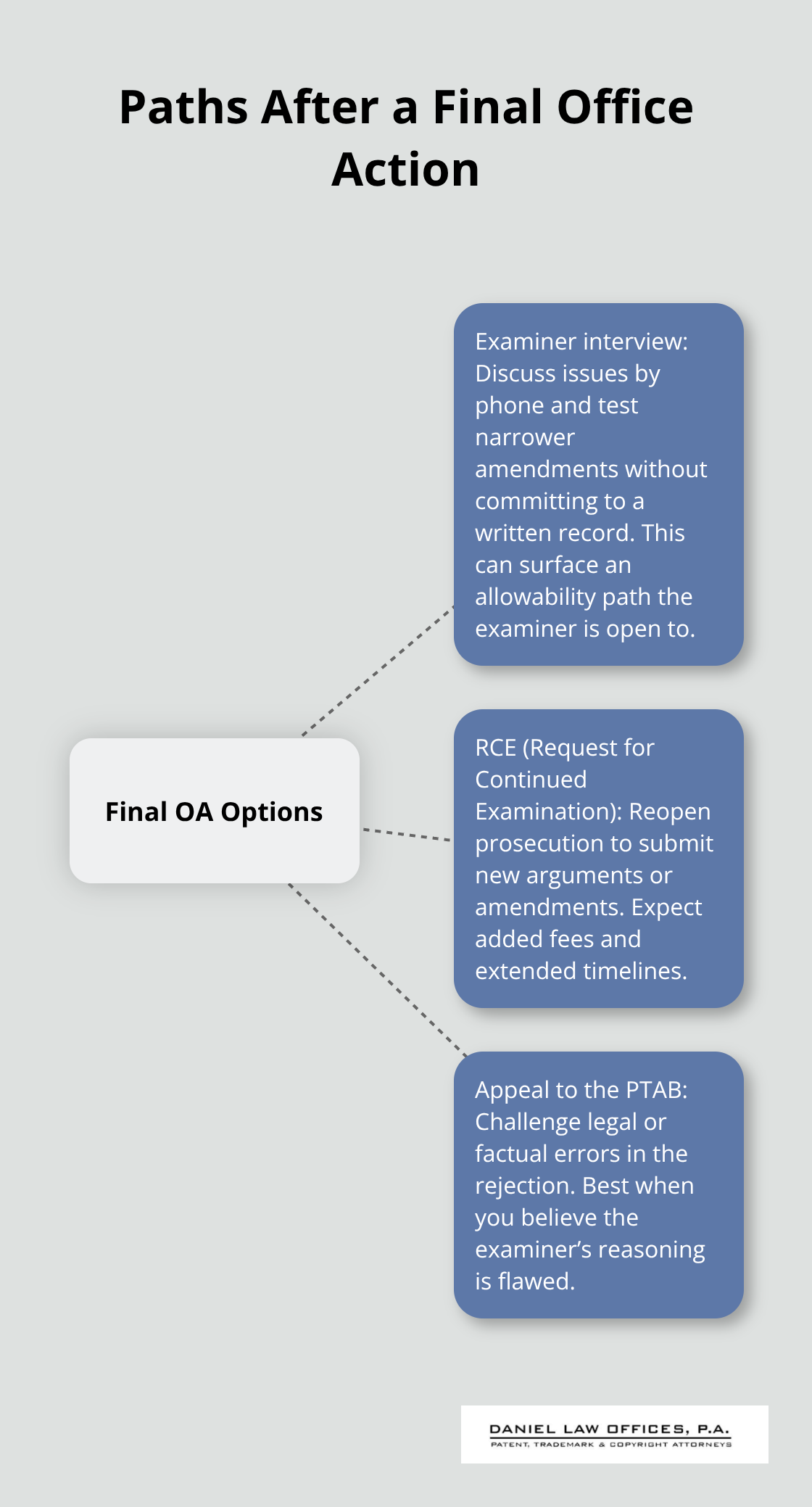
Multiple Office Actions signal that your initial prosecution strategy missed the mark. If you receive a Final Office Action after your first response, you face three realistic paths forward. First, you can request an examiner interview and propose alternative amendments the examiner might accept without issuing another rejection. Second, you can file a Continued Examination request and submit a revised response with new arguments or different amendments, though this extends prosecution and costs additional fees. Third, you can appeal to the Patent Trials and Appeals Board if you believe the examiner’s reasoning contains legal or factual errors.
Appeal statistics matter here; the USPTO data shows that around 111,000 PTAB decisions exist on specific arguments, offering a scouting report on whether similar rejections have been reversed. If your art unit’s allowance rate sits significantly below the overall USPTO average, or if the specific examiner assigned to your application has a low allowance rate compared to peers, appeal becomes more attractive.
Continuation Applications as a Strategic Tool
Continuation applications let you file a new application that shares your original filing date, allowing you to pursue broader claims in one continuation while narrowing claims in another to secure faster issuance. This strategy works when you want patent protection quickly but also want to explore broader claim scope through a related application.
The cost trade-off matters: each continuation application incurs new filing fees and prosecution costs, so you’re essentially running two patent races simultaneously. Only pursue this path if your business timeline and budget support it. Patent counsel can help you evaluate whether appeal, continued examination, or a continuation application serves your innovation strategy best, weighing prosecution costs against the risk that further examination will yield nothing.
Final Thoughts
Patent prosecution strategy succeeds when you treat Office Actions as opportunities rather than obstacles. The rejections you receive from the USPTO examiner reveal exactly where your claims need refinement or where your arguments require strengthening. Surgical amendments that address the examiner’s specific objections while preserving broad protection serve your innovation far better than rushed claim narrowing that abandons valuable enforceability.
The path from Office Action to issued patent demands precision at every stage. Over-narrowing claims to achieve quick allowance weakens your patent in future litigation, and missing the three-month deadline abandons your application entirely. Understanding the distinction between Non-Final and Final Office Actions, recognizing your options when facing multiple rejections, and considering examiner interviews before submitting formal responses all prevent costly delays and lost protection.
We at Daniel Law Offices, P.A. guide clients through patent prosecution with thorough prior art analysis and strategic claim drafting. Our registered patent attorney helps you understand what each Office Action actually says, not what you assume it means, and we develop responses tailored to your specific circumstances and business timeline. If you’re facing an Office Action or planning to file a patent application, contact us to discuss your patent prosecution strategy and move your innovation toward protection.