



Intellectual Property Strategy Orlando: Aligning IP With Business Goals
Your intellectual property strategy in Orlando directly impacts whether your business captures the value of its innovations or watches competitors profit from them instead.
At Daniel Law Offices, P.A., we’ve seen companies with strong patents and trademarks grow faster and command higher valuations than those without clear IP protection. This guide walks you through aligning your IP assets with your actual business goals-not the other way around.
Understanding Your Business Goals and IP Assets
Define What Success Looks Like for Your Company
Most businesses treat IP strategy as a checkbox exercise rather than a business lever. They file patents because competitors do or register a trademark without understanding how it connects to revenue. This approach wastes money and leaves protection gaps where they matter most.
Write down your actual business objectives for the next three to five years. Are you targeting market share growth, preparing for acquisition, licensing your technology, or defending against competitors in specific regions? Your IP strategy must follow these goals, not precede them. A SaaS company pursuing international expansion needs trademark protection in target markets immediately, while a hardware manufacturer might prioritize patents in countries where manufacturing occurs.
Audit What You Already Own
Once you know where you’re heading, audit what you already own. Most businesses underestimate their IP assets. Patents filed years ago, abandoned trademark applications, software code, manufacturing processes, customer databases, and proprietary methodologies all constitute IP. Document everything with filing dates, registration numbers, and renewal deadlines.
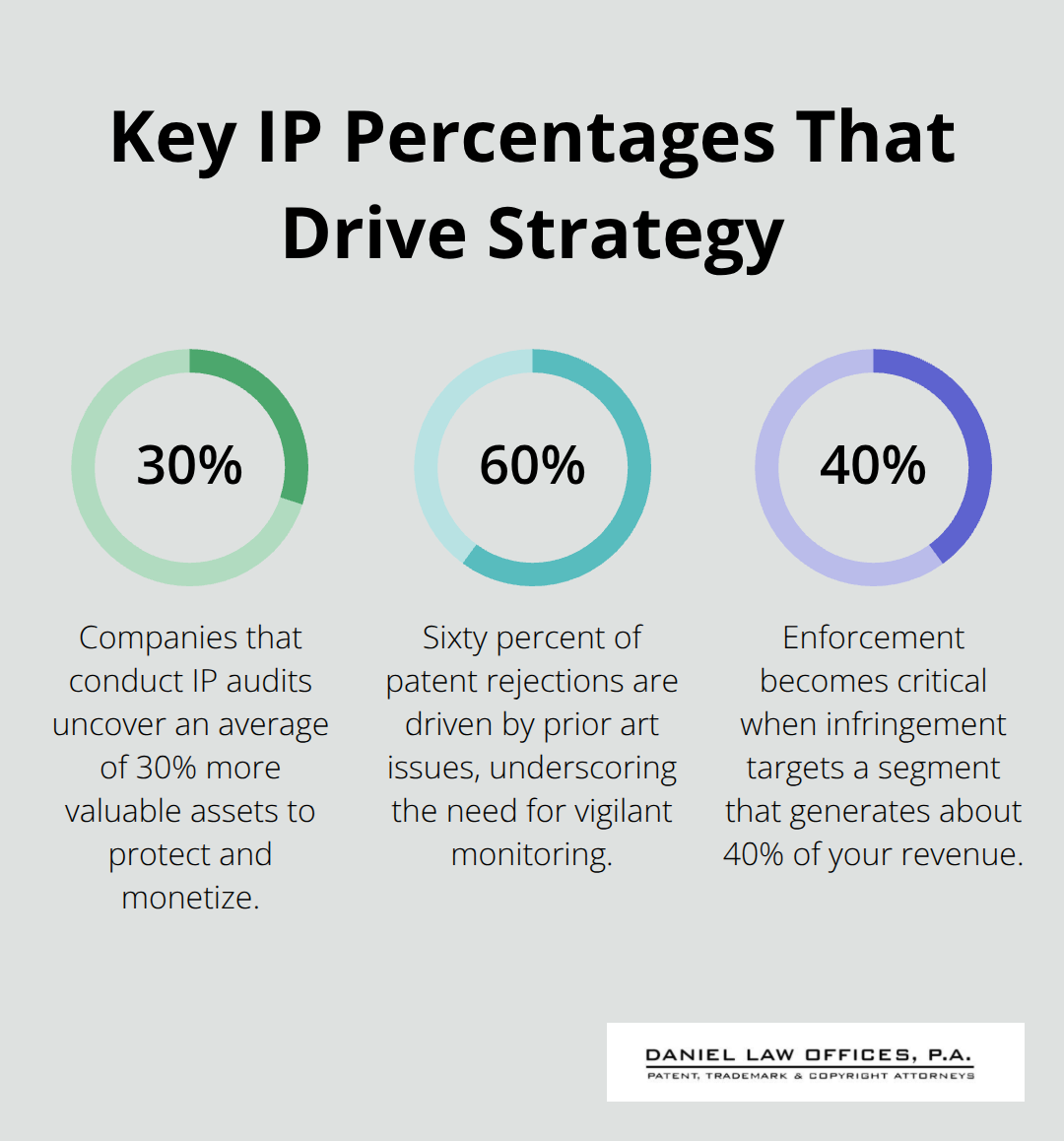
The American Intellectual Property Law Association reports that companies spending time on IP audits catch an average of 30% more valuable assets they didn’t realize they had. This discovery often reveals hidden value and prevents costly oversights.
Connect Your IP Assets to Revenue
Map your assets directly to revenue streams. Which patents protect your highest-margin products? Which trademarks appear on your bestselling lines? Which trade secrets give you competitive advantage in your most profitable market segment? This mapping shows you where protection is solid and where gaps exist.
If your core revenue generator relies on a patent expiring in two years with no backup protection, that’s a strategic problem. If your brand generates significant licensing income but your trademark registration covers only the United States, that’s another gap that demands attention. This clarity prevents you from protecting low-value assets while leaving critical ones exposed-and it sets the stage for building a filing strategy that actually protects what matters.
Building a Comprehensive IP Strategy
Separate Innovations by Competitive Value
Not every innovation deserves a patent filing, and not every brand element needs trademark registration. The decision hinges on which assets generate revenue and which competitors could realistically copy. Start by separating innovations into three categories: those that provide genuine competitive advantage, those that are nice-to-have improvements, and those that competitors will work around within months anyway. A manufacturing process that cuts production costs by 30% belongs in the first category. A minor user interface tweak belongs in the third. Only the first category justifies the $9,520 to $18,200 investment for domestic utility patent prosecution in Orlando, according to American Intellectual Property Law Association data. For trademarks, the threshold is simpler: if your brand name, logo, or tagline directly connects to customer recognition and purchasing decisions, register it. A SaaS company’s product name that customers search for online absolutely warrants trademark protection. An internal codename for a project does not.
Time Your Patent Filings Around Market Launch
Patent filing strategy often fails because companies file too late or too early. File too late and you lose protection for months or years of development. File too early without adequate market validation and you waste money prosecuting a patent for technology nobody wants. The sweet spot is filing a provisional patent application within 12 months of your first public disclosure or market launch. Provisional filings cost $2,000 to $5,000 total and give you 12 months to evaluate market demand, refine the invention, and decide whether a full utility patent is worth the $7,000 to $15,000 additional investment. This staged approach prevents you from filing patents for failed products and forces you to prove market fit before committing serious money. For geographic coverage, most Orlando businesses should file domestically first, then expand to Europe, Japan, and China only if the product gains traction.
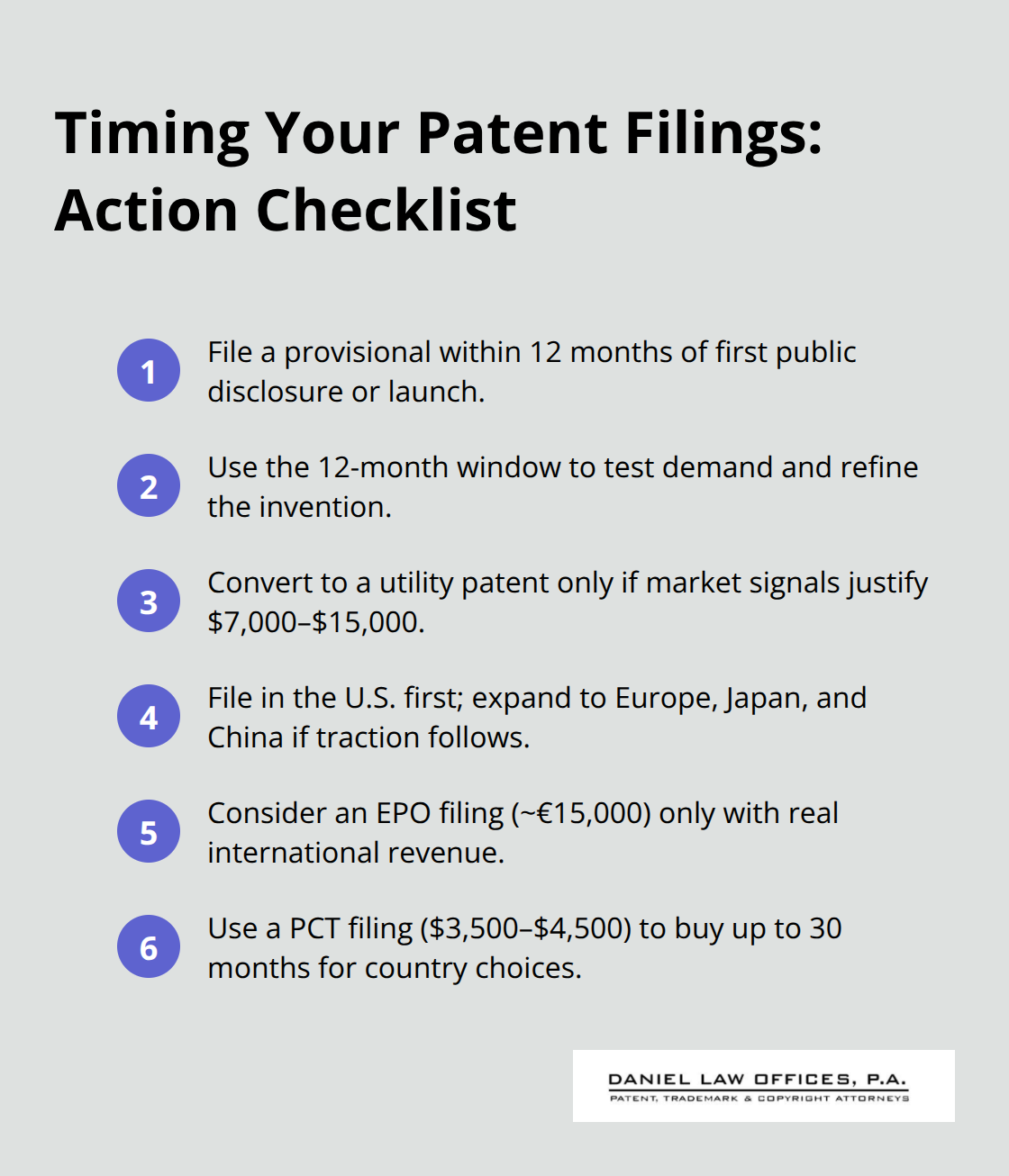
European Patent Office filings cost roughly 15,000 euros upfront and validate across 38 member states, making them valuable only when you have genuine international revenue. A strategic Patent Cooperation Treaty application typically costs $3,500 to $4,500 and buys you 30 months to decide which countries warrant national filings, letting market performance guide your spending rather than speculation.
Register Trademarks Where You Actually Operate
Trademark registration should follow your actual customer geography, not your aspirational geography. If you sell exclusively in the United States, register with the USPTO and stop. If you target Canada and Mexico, add those filings. If you’re pursuing European expansion, the European Union trademark system covers all member states with a single filing costing roughly 850 euros. The mistake we see repeatedly is companies registering trademarks in 15 countries they don’t operate in, spending thousands on maintenance fees for protection they’ll never enforce. Worse, trademark registrations require renewal every 10 years, and maintaining dead registrations drains budget from protecting markets where you actually compete. Register your brand name, primary logo, and any distinctive tagline that customers associate with your products. Secondary logos and internal brand variations rarely justify the filing costs. If your business model includes licensing your brand to partners or franchisees, trademark protection becomes non-negotiable in every jurisdiction where those partners operate, since trademark infringement claims could expose your partners and damage your licensing revenue.
Move Forward With Strategic Enforcement Planning
Your filing decisions today determine which competitive advantages you can actually defend tomorrow. Once you’ve identified what to patent and where to register trademarks, the next step involves monitoring how competitors use similar innovations and brands in your markets-and preparing to act when infringement occurs.
Turning IP Assets Into Enforceable Rights
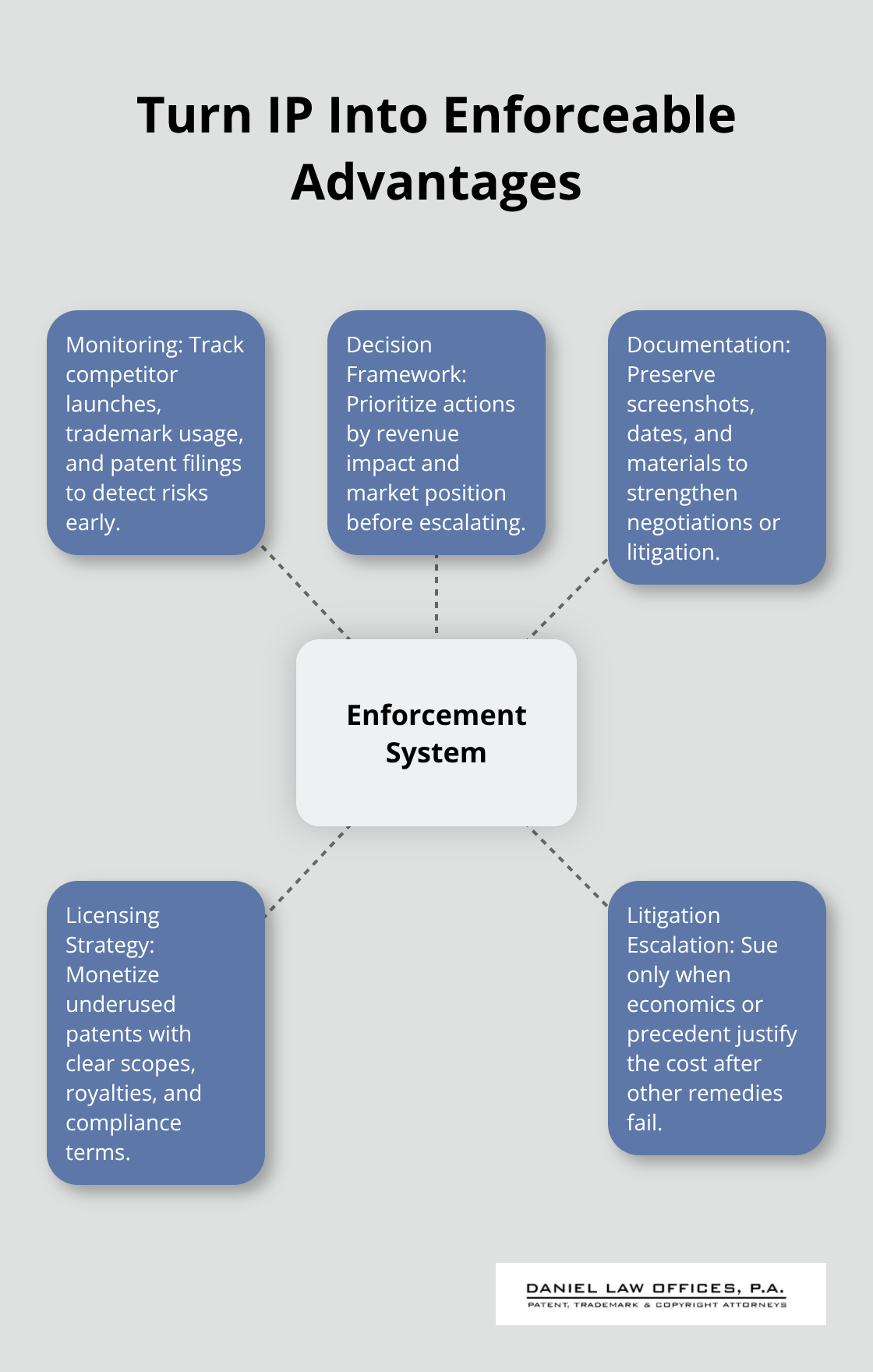
The moment you file a patent or register a trademark, you own intellectual property on paper. But ownership means nothing without enforcement. We at Daniel Law Offices, P.A. guide clients through the practical reality of protecting what they own: monitoring the market for infringement, acting decisively when competitors cross the line, and extracting revenue from your portfolio through licensing and partnerships. Most Orlando businesses fail here because they treat IP protection as a one-time filing event rather than an ongoing competitive operation. You need a monitoring system that catches infringement early, a decision framework for when to pursue legal action, and a revenue strategy that transforms your IP assets into licensing income. Without these three elements, your patents and trademarks become expensive decorations rather than business weapons.
Detect Infringement Before Competitors Embed Your Technology
Waiting for infringement to find you is a losing strategy. Competitors count on your inattention. Set up a monitoring system that tracks competitor product launches, trademark usage, and patent filings in your market segment. The European Patent Office research shows that 60 percent of patent rejections stem from prior art issues, meaning competitors are constantly filing and launching products you need to know about. Subscribe to USPTO trademark watch services for free to receive alerts when competitors file marks similar to yours. Monitor competitor websites, product announcements, and trade show materials quarterly. Use Google Patents alerts for competitors filing patents in your technology space. This costs almost nothing but catches infringement months or years earlier than reactive approaches. When you spot a competitor using a trademark confusingly similar to yours or selling a product that operates identically to your patented process, document everything immediately: screenshots, dates, product descriptions, and any communications. This documentation becomes critical evidence if litigation becomes necessary. Companies that catch infringement within the first six months of competitor activity have significantly higher settlement rates and lower litigation costs than those who wait years before acting.
Make Enforcement Decisions Based on Revenue Impact, Not Emotion
Not every infringement warrants legal action. A competitor infringing on a patent that generated minimal revenue last year probably does not justify the $50,000 to $150,000 cost of patent litigation. A competitor using a confusingly similar trademark in your core market absolutely does. Prioritize enforcement based on the revenue at stake and the infringer’s market position. If a competitor is selling products using technology covered by your patent in a market segment generating 40 percent of your revenue, enforcement is mandatory. If they infringe a secondary patent in a market where you generate 2 percent of revenue, enforcement is optional. Start with a cease-and-desist letter detailing the infringement, your rights, and the requirement to stop. Many competitors respond by changing their product or negotiating a licensing agreement rather than fighting. If the infringer ignores your cease-and-desist or refuses reasonable settlement terms, then escalate to litigation. The cost calculus matters: pursue litigation only when the infringer’s revenue from the infringing product exceeds your litigation budget, or when allowing continued infringement would establish dangerous precedent in your market.
Build Licensing Revenue From Underutilized Patents
Your patent portfolio likely contains patents you are not commercializing. Rather than maintaining them as defensive insurance, license them to competitors or adjacent businesses. A manufacturer holding patents on a production process might license those patents to suppliers or contract manufacturers. A software company with patents on data encryption might license those patents to security firms or cloud providers. Licensing generates immediate revenue without product development costs. Structure licensing agreements carefully: define exactly which patents are licensed, which markets the licensee can serve, whether exclusive or non-exclusive rights apply, and what royalty rates or upfront fees the licensee pays. Royalty rates typically range from 2 to 8 percent of licensee revenue depending on the technology’s competitive value and the licensee’s market position. An exclusive license to a valuable patent in a specific market commands higher royalties than a non-exclusive license to a commodity patent. Track licensee compliance rigorously: require quarterly or annual royalty reports, audit rights, and minimum royalty payments to prevent licensees from sitting on the license without commercializing. Many businesses overlook licensing because they lack internal sales infrastructure, but working with a licensing agent or IP attorney to identify potential licensees accelerates deal flow and reduces administrative burden significantly.
Final Thoughts
Your intellectual property strategy in Orlando succeeds only when it stays aligned with how your business actually makes money. The filing decisions you make today, the markets you choose to protect, and the enforcement actions you take tomorrow all determine whether your innovations become competitive weapons or expensive paperwork. Treat your IP strategy as a living document that evolves with your business-market conditions shift, competitors launch new products, and your revenue streams change, so you must review your patent portfolio and trademark registrations annually to confirm they still protect what matters most.
Update your strategy when business conditions change materially. Entering a new geographic market demands trademark registration in that jurisdiction before competitors claim similar marks, while launching a product line with genuine competitive advantage requires patent protection before public disclosure. Preparing for acquisition means conducting a thorough IP audit to show buyers exactly what you own and what gaps exist, since each of these scenarios demands strategy adjustments that most businesses miss because they treat IP as static rather than dynamic.
Partner with professionals who understand both intellectual property law and business strategy to ensure your innovations and brands receive proper legal protection. Daniel Law Offices, P.A. guides clients through comprehensive patent searches, application drafting, USPTO prosecution, and trademark registration that protect your intellectual property strategy in Orlando effectively. Your intellectual property represents some of your most valuable business assets, and protecting them properly determines whether your applications survive examination and whether your registrations withstand challenges.