



How to Navigate the Patent Process Successfully
Getting a patent approved isn’t simple, but it’s manageable when you understand each step. The patent process involves multiple stages, from initial research through final approval, and mistakes at any point can derail your application.
At Daniel Law Offices, P.A., we’ve guided countless inventors through this journey. This guide breaks down what you need to know to move forward successfully.
What Patents Actually Protect and Why They Matter
Patents protect inventions from being copied, manufactured, sold, or imported by competitors without permission. They grant you exclusive rights for a defined period, which means you control who can profit from your creation. In the United States, utility patents last 20 years from your earliest filing date, design patents last 15 years from filing, and plant patents also last 20 years. These timeframes give you a real window to build market advantage, license your invention, or sell the rights entirely. Without patent protection, your competitive edge disappears the moment someone reverse-engineers your work. The USPTO issued 254,957 utility patents in 2023 alone, showing how many inventors recognize that protection matters for commercialization and investment appeal.
Which Type of Patent Fits Your Invention
Utility patents cover how something works or what it does, and they dominate the landscape-more than 90 percent of all USPTO grants fall into this category. Design patents protect only the ornamental appearance of an article, not its function, and they require no maintenance fees after grant. Plant patents cover new plant varieties that are asexually reproduced, a narrower category but essential for botanical innovations. Most inventors need a utility patent because it protects the functional aspects that drive market value. If your invention has both a unique appearance and unique function, you might file both a utility and design patent to maximize protection across different competitive threats.
The Five Patentability Standards You Must Meet
Your invention must clear five patentability criteria before the USPTO will grant protection. First, it must fall within patentable subject matter-meaning it cannot be a purely abstract idea, law of nature, or mental process. Second, it must have utility, which means a real, believable, practical use tied to real-world applications. Third, it must be novel, meaning no single prior patent or publication disclosed every element of your invention before your filing date. Fourth, it must be non-obvious to someone skilled in your field-a standard the courts clarified in KSR International Co. v. Teleflex Inc., making it harder to patent obvious combinations of existing technologies. Fifth, your written description must enable someone skilled in the art to make and use the invention without undue experimentation.
Why Prior Art Searches Matter Before You File
About 8 percent of applications fail the novelty test alone according to USPTO data, which is why a thorough prior art search before filing becomes your first actionable step. A comprehensive search identifies existing patents and publications that might block your application, saving you time and money down the road. You can start at a Patent and Trademark Resource Center (such as the Orange County Library System, which assisted over 500 local inventors in 2022) or conduct your own search using the USPTO’s Patent Public Search tool. The more thoroughly you search before filing, the better you understand what makes your invention truly different. This groundwork positions you to move forward with confidence into the application process.
Building Your Patent Application From Start to Finish
The gap between having an invention and filing a strong patent application determines whether you walk away with meaningful protection or waste months fighting rejections. You need three things working in your favor: a thorough search confirming novelty, crystal-clear documentation of what you invented, and guidance from someone who understands how the USPTO actually evaluates applications.
Start Your Search Immediately
Start your search immediately, even before you think about filing. The USPTO’s Patent Public Search tool lets you filter by technology classification and review existing patents side-by-side with your concept. Spend time reading the claims sections of similar patents because claims define the legal scope of protection-understanding what competitors already patented shows you exactly where to position your invention as different. Applications prepared with professional assistance are about 10 percent more likely to gain approval without major revisions according to USPTO data, and much of that advantage comes from thorough upfront searching that prevents filing an application destined for rejection.
Write Your Specification With Precision
Documentation quality separates applications that sail through examination from those trapped in endless office actions. Your written specification must describe your invention in such detail that someone skilled in your field could build it without calling you for questions. Include every feature, every dimension that matters, every material choice, and explain why each element works the way it does. Well-written specifications boost approval odds by roughly 30 percent without major revisions, according to USPTO data. Include alternative embodiments and variations-this broadens your protection and fills gaps competitors might exploit.
Create Technical Drawings That Show Everything
Your drawings carry equal weight; they must be black-and-white technical illustrations (color only if absolutely necessary) that show every component and how parts connect. High-quality drawings improve approval rates by about 20 percent and reduce the need for follow-up office actions. Each drawing should correspond directly to your written description so examiners see exactly what you mean.
Draft Claims That Balance Scope and Validity
The hardest part comes next: crafting claims that are broad enough to cover real-world variations but narrow enough to avoid existing patents. Start with independent claims that capture your core invention in broad terms, then add dependent claims that narrow the scope for specific versions. Strong claims reduce initial rejections by about 25 percent. This is where professional guidance becomes practical, not optional-a registered patent attorney conducts comprehensive prior art searches you cannot replicate alone, drafts applications that anticipate examiner objections, and responds to office actions with amendments and arguments that actually move your case forward rather than triggering more rejections. Once your application takes shape, the USPTO examination process begins, and how you respond to examiner communications determines your path to grant.
Navigating Patent Prosecution and Office Actions in Orlando, Florida
What Happens After You File Your Patent Application
After you file your application, the USPTO begins examination around 18 months later, though this timeline varies based on workload and technology area. During examination, a USPTO examiner assigned to your technology field reviews your application against patentability standards and prior art.
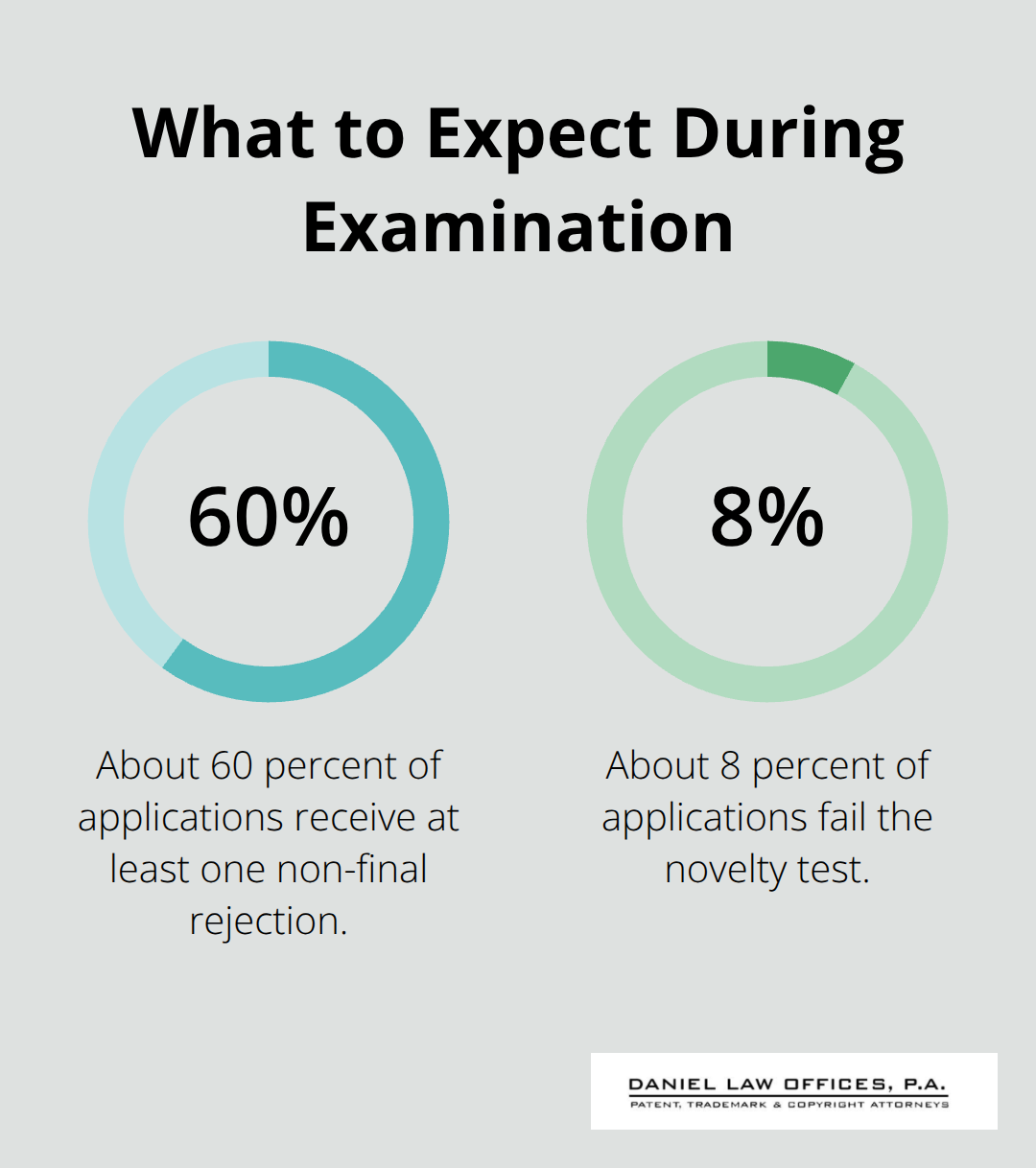
About 60 percent of applications receive at least one non-final rejection according to USPTO data, which means most inventors face office actions that require responses. An office action is the examiner’s written communication identifying issues with your application-whether novelty rejections, clarity problems, claim scope concerns, or procedural defects. The examiner gives you roughly six months to respond, though you can request extensions for additional fees.
Understanding Examiner Rejections and What They Mean
When an examiner rejects a claim as obvious or anticipated by prior art, they cite specific references and explain their reasoning. Your job is not to argue that you disagree, but to show factually why the examiner’s position misses something about your invention. This might mean narrowing your claims to exclude the prior art reference, amending your specification to clarify distinctions the examiner missed, or presenting arguments showing why combining references would not be obvious to someone skilled in your field. Applications with strong initial claims experience about 25 percent fewer rejections, which is why investing in precise claim drafting upfront matters more than trying to fix weak claims later. Understanding what the examiner actually wants separates inventors who move smoothly toward grant from those caught in endless back-and-forth cycles.
Responding to Office Actions and Moving Forward
If the examiner issues a final rejection after your first response, you have three realistic paths forward: appeal to the Patent Trial and Appeal Board, file a request for continued examination to reopen prosecution with new arguments or amendments, or abandon the application and refile as a continuation with refined claims. Most inventors choose continued examination because it costs less than appeals and lets you incorporate new evidence or arguments without starting completely fresh. The entire patent prosecution process typically takes 24 months or longer depending on complexity, office action volume, and how quickly you respond to examiner communications.
Managing Costs Throughout Patent Prosecution
Basic filing fees for utility patents range from 80 dollars for micro-entities to 320 dollars for large entities according to 2023 rates, but prosecution costs accumulate through office action responses, potential appeal fees, and issue fees once your patent is allowed. Many inventors underestimate these ongoing costs and get surprised when maintenance fees arrive at 3.5, 7.5, and 11.5 years after grant. These fees range from 450 dollars to over 1,600 dollars depending on entity size, and the USPTO sends no reminders, meaning missed payments result in automatic expiration. A registered patent attorney during prosecution prevents costly mistakes that force abandonment or lead to weak patents that competitors easily design around.
Meeting USPTO Deadlines and Tracking Correspondence
Failing to respond within the six-month window abandons your application automatically, so treating USPTO deadlines as non-negotiable is essential. Track all correspondence carefully, set internal deadline reminders at least two weeks before the USPTO deadline, and prepare your response early rather than rushing at the last moment.
Final Thoughts
The patent process rewards those who invest time upfront in thorough documentation, precise claim drafting, and understanding what examiners actually evaluate. About 60 percent of applications face at least one rejection, so expect office actions and respond thoughtfully rather than defensively. Skipping the prior art search, rushing your specification, or ignoring USPTO deadlines costs far more in the long run than getting it right the first time.
Common pitfalls derail applications unnecessarily: incomplete disclosures leave gaps examiners exploit, weak claims invite rejections that stronger initial drafting could prevent, and missing maintenance fee deadlines after grant causes automatic expiration. Public disclosure before filing destroys your rights in many countries, while underestimating costs leads to abandoned applications midway through prosecution. These mistakes are preventable when you understand the stakes and plan accordingly (especially regarding timelines and fees).
We at Daniel Law Offices, P.A. help inventors navigate this entire journey by conducting comprehensive patent searches, drafting applications that anticipate examiner concerns, and responding to office actions with arguments that move cases forward. A registered patent attorney guides you through each decision point so you avoid costly mistakes and build protection that actually defends your market position. Contact us to discuss your patent strategy and move forward with confidence.