



How to Meet Patent Law Requirements Successfully
Getting a patent approved requires navigating complex patent law requirements and strict procedural rules. Many inventors miss critical deadlines or file incomplete applications that lead to rejections.
At Daniel Law Offices, P.A., we guide clients through each stage of the patent process. This guide walks you through the essential steps to protect your innovation successfully.
What Makes Your Invention Patentable in Orlando, Florida
Your invention must satisfy three core requirements to earn patent protection: it must be new, useful, and non-obvious. The USPTO rejects approximately 8% of applications solely for lack of novelty, which means prior art searches are not optional-they are foundational. Prior art includes any public disclosure before your filing date, whether that comes from existing patents, trade shows, films, articles, YouTube videos, social media posts, or marketplace presence. International scope matters here; a US patent can be blocked by prior art disclosed worldwide, so you must search foreign databases and non-English sources as essential due diligence. The Orange County Library System’s Patent and Trademark Resource Center assisted over 500 local inventors in 2022, yet many still filed without adequate searches. A professional patent search boosts approval chances by about 10% compared with initial searches at a resource center alone.
Building Your Prior Art Search Strategy
Start with a six-step strategy to identify what already exists in your field. Brainstorm descriptive terms reflecting your invention’s function and key features, then identify relevant CPC classifications that match your technology. Retrieve and review pertinent documents from the USPTO database, expand your search to non-US sources such as WIPO databases, and compile your findings into a detailed report. Use multiple search engines and databases to avoid missing relevant references; relying on a single source leaves you vulnerable to rejections. This comprehensive approach (combining USPTO resources with international databases) significantly strengthens your application before you file.
Creating Documentation That Satisfies USPTO Standards
Your documentation process shapes your entire application strength. The USPTO requires a detailed specification that enables someone skilled in your field to make and use the invention-vague descriptions lead to rejections. High-quality drawings improve approval rates by about 20% and must clearly depict every feature mentioned in your claims; ensure consistency between your written description and visual elements while following USPTO drawing standards. Professional drawings communicate technical details effectively and prevent objections during examination.
Understanding Disclosure Timing and Grace Periods
You have a one-year grace period from public disclosure to file in the United States, but early disclosure can severely harm foreign patent rights, so you should keep your invention confidential until filing or consult counsel about proper disclosure timing. The duty to disclose all information material to patentability means you must reveal known prior art to the USPTO to avoid later rejections or unenforceability. File a nonprovisional application within 12 months of your provisional filing to preserve your filing date and rights. The first-to-file system rewards early submission; you can file before a finished prototype exists as long as you clearly describe how the invention works (even without a working model, a thorough written description suffices).
With your invention documented and your prior art research complete, you now face the critical task of translating your technical knowledge into patent claims and application materials that meet USPTO standards.
Turning Your Invention Into Patent Claims in Orlando, Florida
Define Your Claims With Precision and Strategy
Your claims are the legal boundaries of your patent protection, and weak claims will cost you money and market advantage. Claims define what the USPTO grants you exclusive rights to manufacture, use, and sell for up to 20 years for utility patents, so this section demands precision and strategy, not guesswork. Start with broad independent claims that capture the core invention, then add dependent claims that narrow the scope and protect against rejections. Strong claim strategy reduces initial rejections by about 25% according to patent filing data, yet many inventors file with vague or overly broad language that invites examiner pushback.
Your first independent claim should describe the essential elements of your invention in clear, functional terms. Follow this with secondary independent claims offering alternative technical approaches, then use dependent claims to add specific details and fallback positions. This layered approach gives examiners multiple paths to approve your invention while protecting your core innovation from being designed around.
Avoid Language That Triggers Rejections
Avoid common pitfalls like claiming features not supported by your specification, using indefinite language such as “comprising” or “including” without clear antecedents, or adding claims that contradict each other. Each claim must be a single sentence, and every term must either appear in your specification or be interpreted according to standard industry definitions. If your application includes more than 20 total claims or more than three independent claims, the USPTO charges excess-claim fees, so plan your claim strategy around the fee structure. The specification must enable a person skilled in your field to make and use the invention without undue experimentation, meaning your written description must support every claim element you include.
Anchor Your Application With Technical Specifications and Drawings
Your technical specifications and drawings anchor the entire application to USPTO standards and prevent rejections during examination. The specification requires a detailed description section that walks through how your invention works, what problem it solves, and how it differs from existing technology. High-quality drawings improve approval rates by about 20% and must clearly depict every feature in your claims using proper USPTO format standards (including consistent numbering, shading, and perspective).
Manage Fees and Filing Deadlines
Pay attention to fee deadlines at multiple stages: the basic filing fee for non-provisional utility patents runs $320 for large entities, $160 for small entities, and $80 for micro-entities as of 2023, with additional charges for pages beyond 100 and claims beyond 20. Filing electronically via Patent Center avoids the $400 non-electronic filing fee that applies to mailed submissions. Small entities and micro-entities qualify for reduced fees through certification forms PTO/SB/15A and PTO/SB/15B, so verify your eligibility before filing.
Meet All Filing Requirements and Preserve Your Priority Date
Ensure all required parts are included with your filing: the transmittal form, fees, the data sheet, the complete specification, drawings, and your oath or declaration. The USPTO typically begins examination about 18 months after filing, and you should expect office actions with response windows of three to six months; failure to respond within that timeframe leads to abandonment. Missing required items or deadlines triggers USPTO notices or rejection, making timely filing and payment completion essential to meeting patent law requirements. The first-to-file system rewards early submission, so file your nonprovisional application within 12 months of any provisional filing to lock in your priority date and preserve your rights against competing filings.
Once your application reaches the USPTO, the examination process begins-and how you respond to examiner feedback will determine whether your patent issues or faces rejection.
Navigating USPTO Examination in Orlando, Florida
Understanding Office Actions and Response Deadlines
The USPTO typically starts examination about 18 months after filing, and your response strategy during this phase directly determines whether your patent issues or faces rejection. Office actions arrive with response windows of three to six months, and missing these deadlines leads to automatic abandonment-there is no grace period for late responses. When you receive an office action, read it carefully because examiners cite specific prior art references and explain their rejection rationale in detail. Many inventors misinterpret office actions or respond with generic arguments that fail to address the examiner’s actual concerns.
Crafting Targeted Responses to Rejections
Analyze each rejection point separately and respond with targeted amendments or arguments that directly counter the examiner’s position. If the examiner rejects your claims for obviousness, show how your invention combines existing elements in an unexpected way that produces superior results. If the rejection centers on lack of novelty, demonstrate that your prior art search already identified those references and your claims distinguish your invention through specific technical features. Each response must address the examiner’s exact objections rather than restating your original application language.
Conducting Examiner Interviews
An interview with the examiner can shorten prosecution significantly-many examiners clarify their objections and suggest claim amendments that lead to allowance without requiring additional written response cycles. The Patent Trial and Appeal Board data shows that applicants who conduct examiner interviews resolve rejections faster than those relying solely on written arguments. This direct communication often reveals what the examiner needs to see in order to approve your application.
Pursuing Appeals and Continued Examination
You can file a continued examination request (RCE) to keep your application alive after a Final Action, or you can appeal to the Patent Trial and Appeal Board if you believe the examiner’s rejection lacks merit. Many applications that initially face rejection ultimately issue because applicants persist through the examination process with well-reasoned arguments. At Daniel Law Offices, P.A., we recommend responding strategically rather than accepting rejections without challenge.
Managing Patent Maintenance Fees
Your patent term runs 20 years from your filing date for utility patents, but this protection only continues if you pay maintenance fees at specific intervals: 3.5 years, 7.5 years, and 11.5 years after issuance. The USPTO charges $900 for large entities, $450 for small entities, and $225 for micro-entities per maintenance fee payment as of recent fee schedules. Failure to pay even one maintenance fee results in patent expiration, and you cannot revive an expired patent simply by paying the overdue fee later.
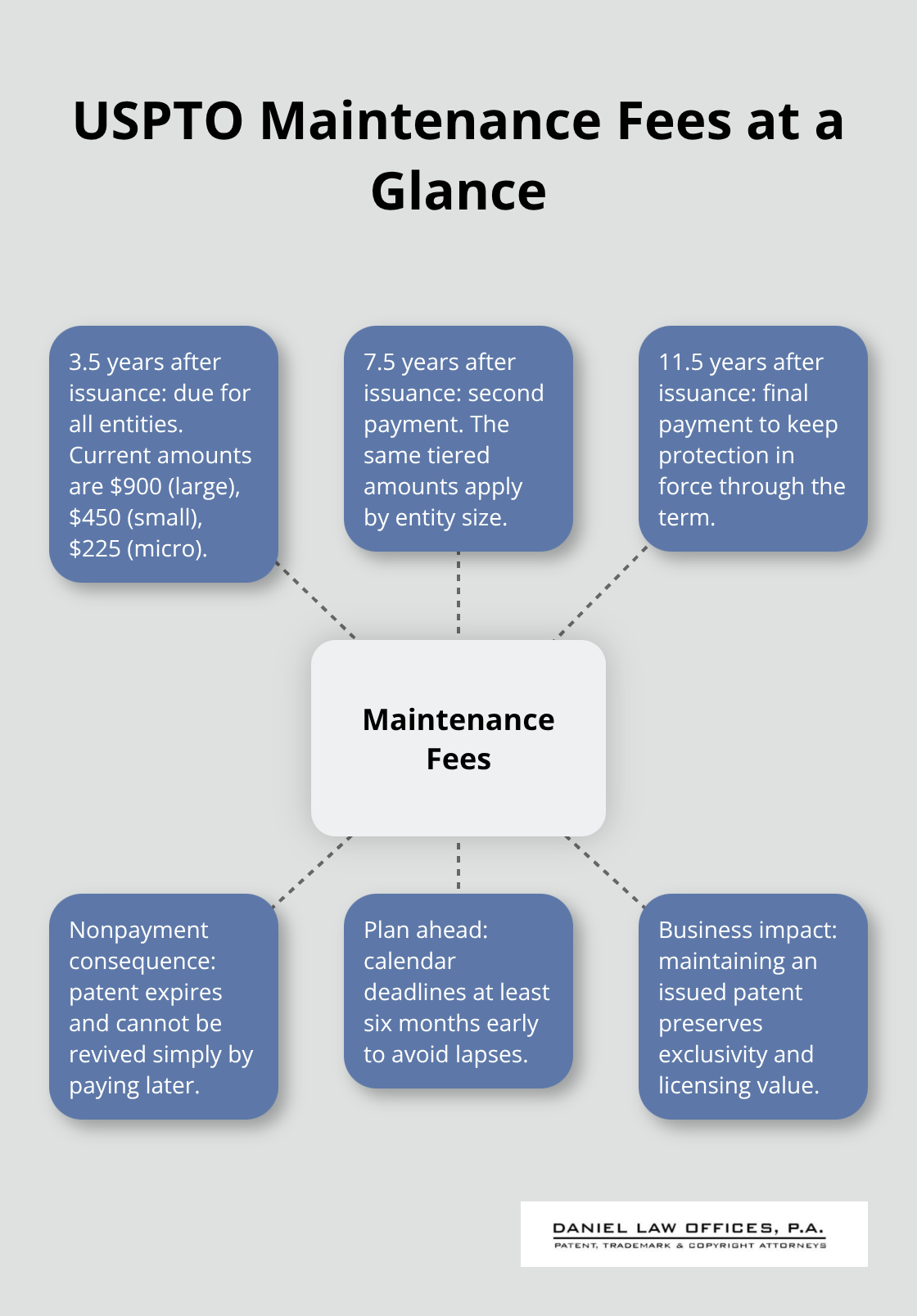
Plan ahead for these payments by marking your calendar at least six months before each deadline-many inventors lose patent rights unintentionally because they overlooked maintenance fee obligations. Once your patent issues, you hold exclusive rights to manufacture, use, and sell your invention, giving you substantial market advantage and licensing opportunities that generate significant revenue streams for your business.
Final Thoughts
Patent protection succeeds when you understand the core patent law requirements and execute each step methodically. Your invention must be new, useful, and non-obvious-backed by thorough prior art searches that examine both US and international databases. Your application must include precise claims, detailed specifications, and high-quality drawings that meet USPTO standards. Your responses to office actions must address examiner objections directly rather than restating your original arguments.
Common mistakes derail inventors before they reach approval. Filing without adequate prior art searches invites novelty rejections that could have been prevented, while drafting vague or overly broad claims triggers examiner pushback and reduces your actual protection scope. Missing response deadlines or failing to interpret office actions correctly leads to automatic abandonment, and overlooking maintenance fee obligations causes patent expiration even after you’ve invested years and money in prosecution. Disclosing your invention publicly before filing damages foreign patent rights and creates prior art against yourself.
After your patent issues, your work shifts from prosecution to enforcement and commercialization. You hold exclusive rights to manufacture, use, and sell your invention for up to 20 years, creating licensing opportunities and market advantages that generate substantial revenue. We at Daniel Law Offices, P.A. guide inventors and businesses through comprehensive patent searches, application drafting, and the entire USPTO prosecution process-contact us to discuss your invention and develop a patent protection plan tailored to your goals and budget.