



How to Pay USPTO Trademark Registration Fees
Registering a trademark with the USPTO involves more than just filing an application-you also need to understand the USPTO trademark registration fees and how to pay them correctly.
At Daniel Law Offices, P.A., we’ve helped countless clients navigate the payment process and avoid costly mistakes. This guide walks you through fee structures, payment methods, and common pitfalls so you can complete your registration without delays.
How to Pay USPTO Trademark Registration Fees in Orlando, Florida
What You’ll Actually Pay for a Trademark Application
The base filing fee for a trademark application is $350 per class when you file electronically through the USPTO, according to the current fee schedule effective January 19, 2025. This single figure represents the most straightforward part of your cost structure, but it’s where many applicants stop calculating and then face surprises later. If you file on paper instead of electronically, that same base fee jumps to $850 per class, which explains why electronic filing has become the only practical option for most applications. The real complexity emerges when you multiply this base fee by the number of classes your trademark covers. If your brand spans three product or service classes, you’re looking at $1,050 in base fees alone, not $350. Most applicants underestimate their total costs by forgetting this multiplication factor during the planning stage.
Hidden Fees That Add Up Quickly
Beyond the base fee, the USPTO charges additional fees for incomplete or vague identifications of goods and services. If your identification lacks sufficient information, you’ll pay an extra $100 per class. If you use free-form text instead of selecting from the Trademark ID Manual, that costs $200 per class. Exceed 1,000 characters in your identification, and each additional 1,000 characters adds $200 per class.
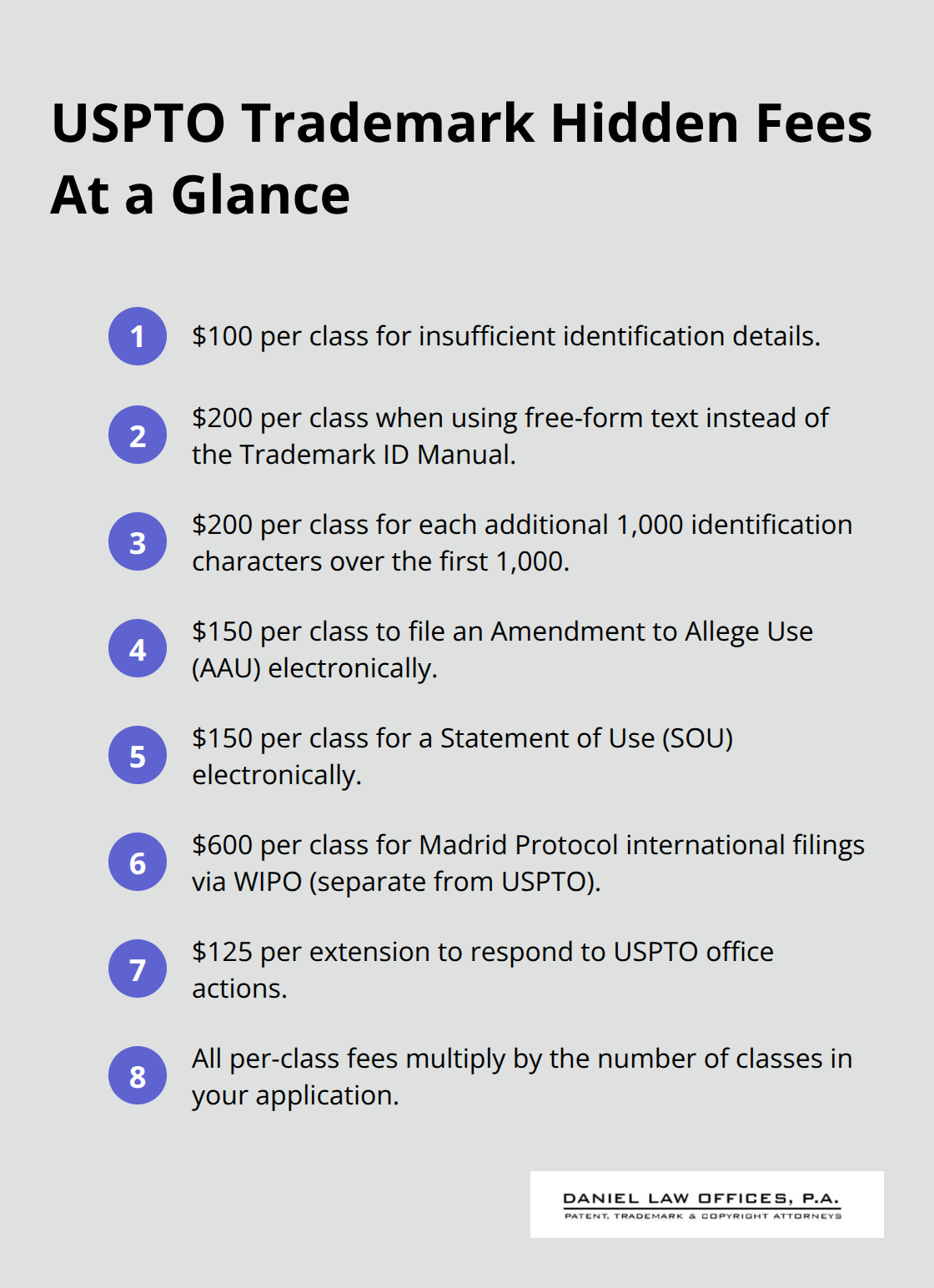
These aren’t theoretical penalties; they’re real costs triggered by submission quality. Intent-to-use applications require additional payments down the line. When you file an Amendment to Allege Use, that’s $150 per class electronically. A Statement of Use costs another $150 per class. Madrid Protocol international filings carry a $600 per class fee through WIPO, separate from your domestic filing. Extensions of time to respond to USPTO office actions cost $125 each, and multiple extensions compound those fees.
Post-Registration Maintenance Fees
Your costs don’t stop after the USPTO registers your trademark. Between five and six years after registration, you must file a Section 8 declaration of use, which costs $325 per class electronically. If you combine it with a Section 15 declaration of incontestability, the combined filing costs $575 per class. Every ten years after registration, you’ll pay renewal fees of $325 per class electronically for Section 8 and 9 combined filings. These maintenance deadlines are calculated directly from your registration date, and missing them results in cancellation with no second chances except filing a completely new application. The USPTO fee schedule, last revised March 1, 2026, reflects these ongoing obligations, making trademark protection a long-term financial commitment rather than a one-time expense. Understanding these post-registration costs helps you budget for the full lifecycle of your trademark protection.
How to Actually Pay Your USPTO Trademark Fees in Orlando, Florida
Select Your Payment Method
We at Daniel Law Offices, P.A. recommend starting with the payment method that causes the least friction: electronic filing through the USPTO’s Trademark Center or TEAS system. You have four legitimate options when paying electronically. Credit cards accepted include American Express, Discover, MasterCard, and Visa, though MasterCard and Visa debit cards work too. The per-transaction credit card limit sits at $24,999.99, which covers most single applications, but if your total fees exceed that amount, you’ll need an alternative method. Electronic funds transfer from a U.S. bank account works without daily limits and avoids card transaction caps entirely, though new EFT accounts require an eight-day verification period before activation. Pre-paid deposit accounts eliminate the need to enter payment information repeatedly and protect your filing date if a fee miscalculation occurs. Electronic funds transfer and deposit accounts must be set up in the USPTO’s Financial Manager before you can use them for payment.
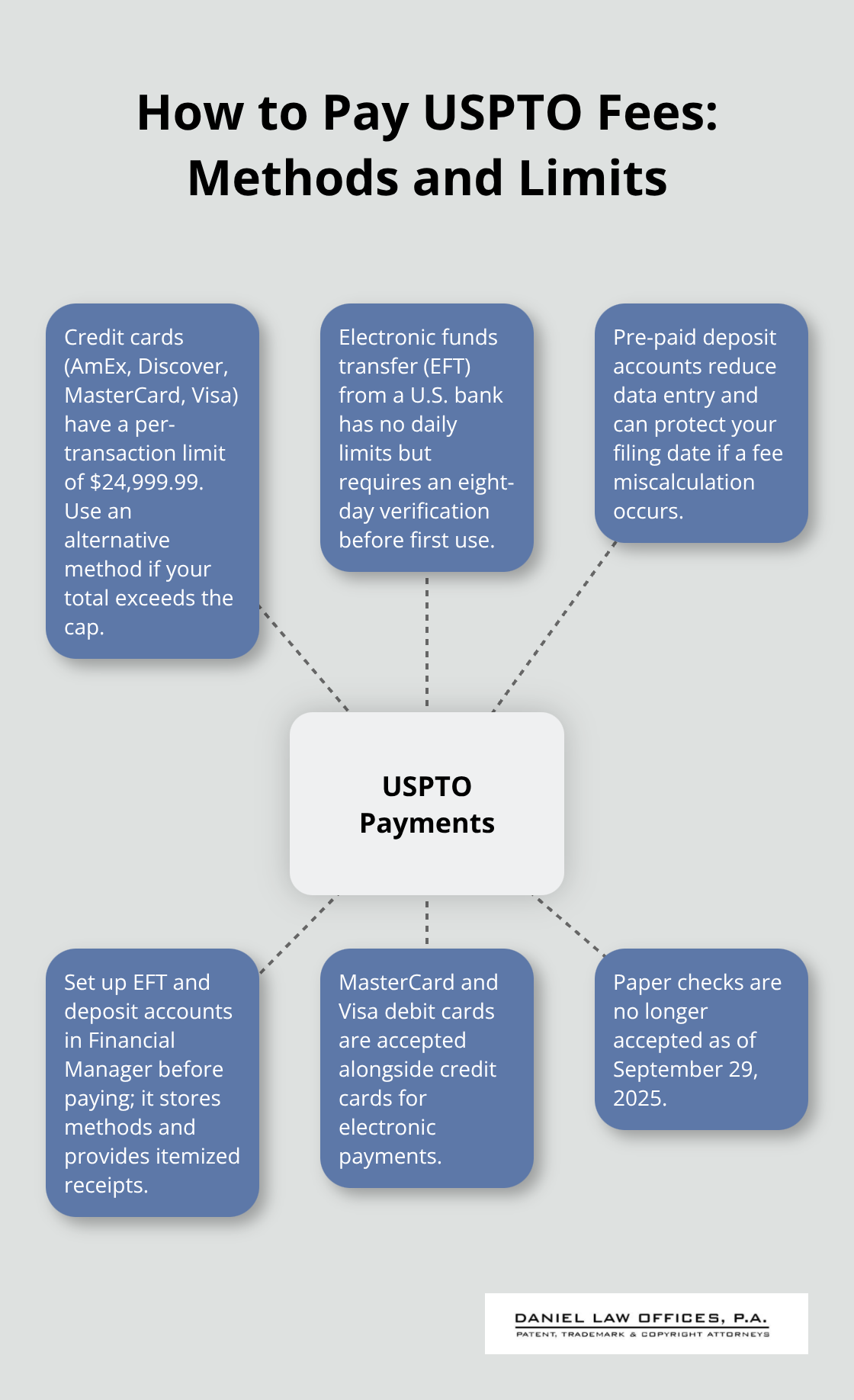
Paper checks became obsolete on September 29, 2025, when the USPTO eliminated all paper check disbursements, so that option no longer exists.
Choose the Right System for Your Filing
The Trademark Center handles filing new applications and maintenance documents, while TEAS processes form submissions and related payments. Both systems connect to the same payment infrastructure, so your choice between them depends on which function you’re performing, not on payment capability. The Financial Manager stores your payment methods, manages deposit accounts, and generates itemized receipts showing exactly which fees were charged for each class and action.
Submit Your Payment and Receive Confirmation
Submitting payment takes minutes once you select your method and enter the required information. The USPTO processes electronic payments immediately, and you receive a confirmation number instantly upon successful submission. That confirmation number becomes your proof of payment and should be saved alongside your application receipt for your records. If you’re paying multiple trademark fees at once on a single credit card, the transaction appears as one entry on your card statement, but you can download an itemized receipt from Financial Manager showing the breakdown by class and fee type.
Verify Payment Processing and Protect Against Scams
After submission, the USPTO applies your payment to the appropriate application or maintenance filing within one business day. The registration process continues regardless of payment timing as long as funds clear, but delays in payment can trigger office actions requesting corrected fees or cause missed maintenance deadlines to result in cancellation. Scam alerts remain active regarding non-USPTO solicitations and spoofed calls impersonating the USPTO asking for payments, so always verify payment requests through official USPTO.gov channels only. If you encounter payment issues or need clarification on fee calculations before submitting, contact the USPTO’s Contact Center at 571-272-9250 or toll-free 1-800-786-9199 rather than proceeding with uncertain amounts. Once your payment clears and the USPTO processes your application, you’ll move into the examination phase, where an examiner reviews your trademark for registrability and compliance with federal law.
Common Mistakes to Avoid When Paying Fees in Orlando, Florida
Submitting Incorrect Payment Amounts
Paying USPTO trademark fees seems straightforward until you realize the fee structure contains multiple traps that catch applicants regularly. The most common error occurs when applicants submit an incorrect payment amount. Many applicants calculate the base fee of $350 per class correctly but fail to account for additional charges triggered by their specific submission. If your identification of goods or services uses free-form text instead of selections from the Trademark ID Manual, that triggers a $200 per class surcharge according to the USPTO fee schedule effective January 19, 2025. If your identification exceeds 1,000 characters, each additional 1,000 characters adds another $200 per class. When you file across multiple classes, you multiply every single charge by that number. An applicant filing across three classes with an oversized identification could owe $1,800 in additional fees beyond the $1,050 base cost and never realize it until the USPTO rejects the payment as insufficient. The Financial Manager tool shows your exact fee calculation before submission, so review that breakdown carefully rather than guessing. When you underpay, the USPTO does not process your application until you submit the correct amount, which delays your filing date and extends the examination timeline.
Missing Payment Deadlines
Missing payment deadlines creates worse consequences than submitting incorrect amounts. The Section 8 declaration of use must be filed before the end of the sixth year after registration, according to USPTO maintenance requirements. If you miss that deadline, you have a six-month grace period, but filing during that window costs an additional fee on top of the standard $325 per class charge. Miss the grace period entirely, and the USPTO cancels your registration with no reinstatement available except filing a completely new application and paying all fees again.
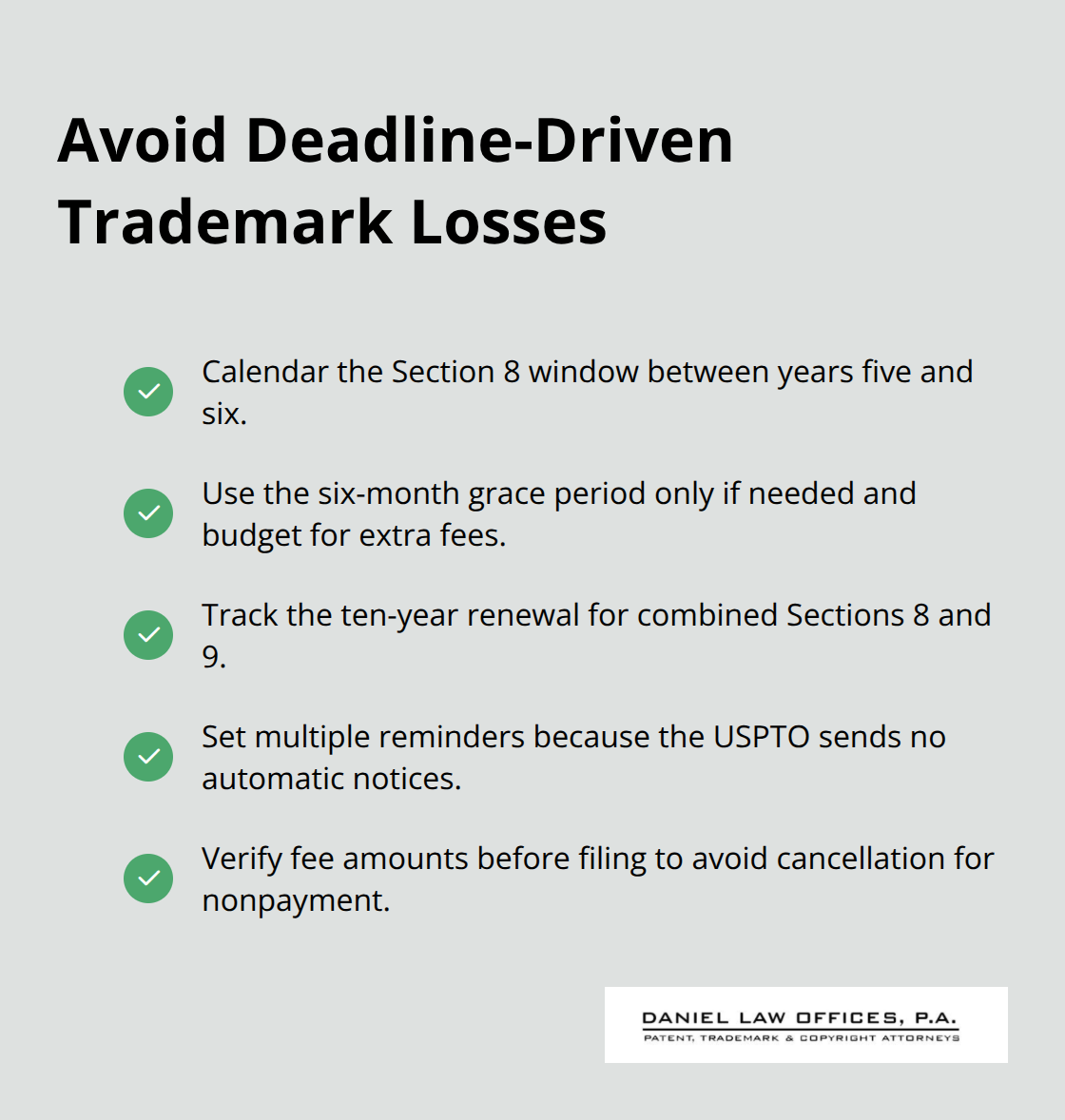
The ten-year renewal deadline carries the same stakes. Applicants often lose registrations not because they cannot afford the fees but because they forgot the deadline existed or did not receive a reminder. The USPTO sends no automatic notices, so you must calendar these dates yourself the moment your registration certificate arrives. The Section 8 and 9 combined renewal filing costs $325 per class, a manageable expense that prevents the catastrophic loss of your trademark rights.
Failing to Keep Payment Receipts and Confirmation Numbers
Failing to keep payment receipts and confirmation numbers creates a different category of problems. When you submit payment through the Trademark Center or TEAS, you receive a confirmation number immediately. That confirmation number is your only proof that payment cleared, especially if a dispute arises about whether funds were received. The USPTO processes electronic payments within one business day, but if you delete your confirmation email or lose track of the number, you cannot verify payment status without contacting the USPTO directly. Keep your confirmation number with your application receipt and any correspondence from the USPTO. Download your itemized receipt from Financial Manager, which shows exactly which fees were charged for each class and action. That itemized breakdown protects you if the USPTO later claims you underpaid or if you need to reconcile your records with your accountant or business partner.
Final Thoughts
Paying your USPTO trademark registration fee correctly protects your brand from the start and prevents costly delays or cancellations down the road. The base filing cost of $350 per class sets the foundation, but your total expense depends on application complexity, the number of classes you protect, and whether you file additional documents like amendments or international designations. Post-registration maintenance fees of $325 per class every ten years represent an ongoing commitment that many applicants overlook during initial planning.
Electronic payment through the Trademark Center or TEAS remains your fastest and most reliable option, whether you use a credit card, deposit account, or electronic funds transfer. Your confirmation number and itemized receipt protect you against payment disputes and help you track your trademark protection timeline. After your payment clears, the USPTO examiner begins reviewing your application for registrability and compliance with federal trademark law, typically taking several months while potentially issuing office actions that require responses with additional fees.
We at Daniel Law Offices, P.A. help clients navigate the entire trademark registration process, from initial searches through post-registration maintenance. If you need guidance on calculating your exact costs, selecting the right payment method, or managing your trademark portfolio over time, contact Daniel Law Offices, P.A. to discuss your specific situation and protect your brand properly.