



How Much Does Patent Submission Cost?
Patent submission costs vary wildly depending on your invention type and protection goals. The patent submission cost can range from a few hundred dollars for a simple utility patent to tens of thousands for complex inventions with international coverage.
We at Daniel Law Offices, P.A. break down exactly what you’ll pay at each stage, from initial filing fees to long-term maintenance costs. Understanding these expenses upfront helps you budget properly and avoid surprises.
What You’ll Actually Pay the USPTO
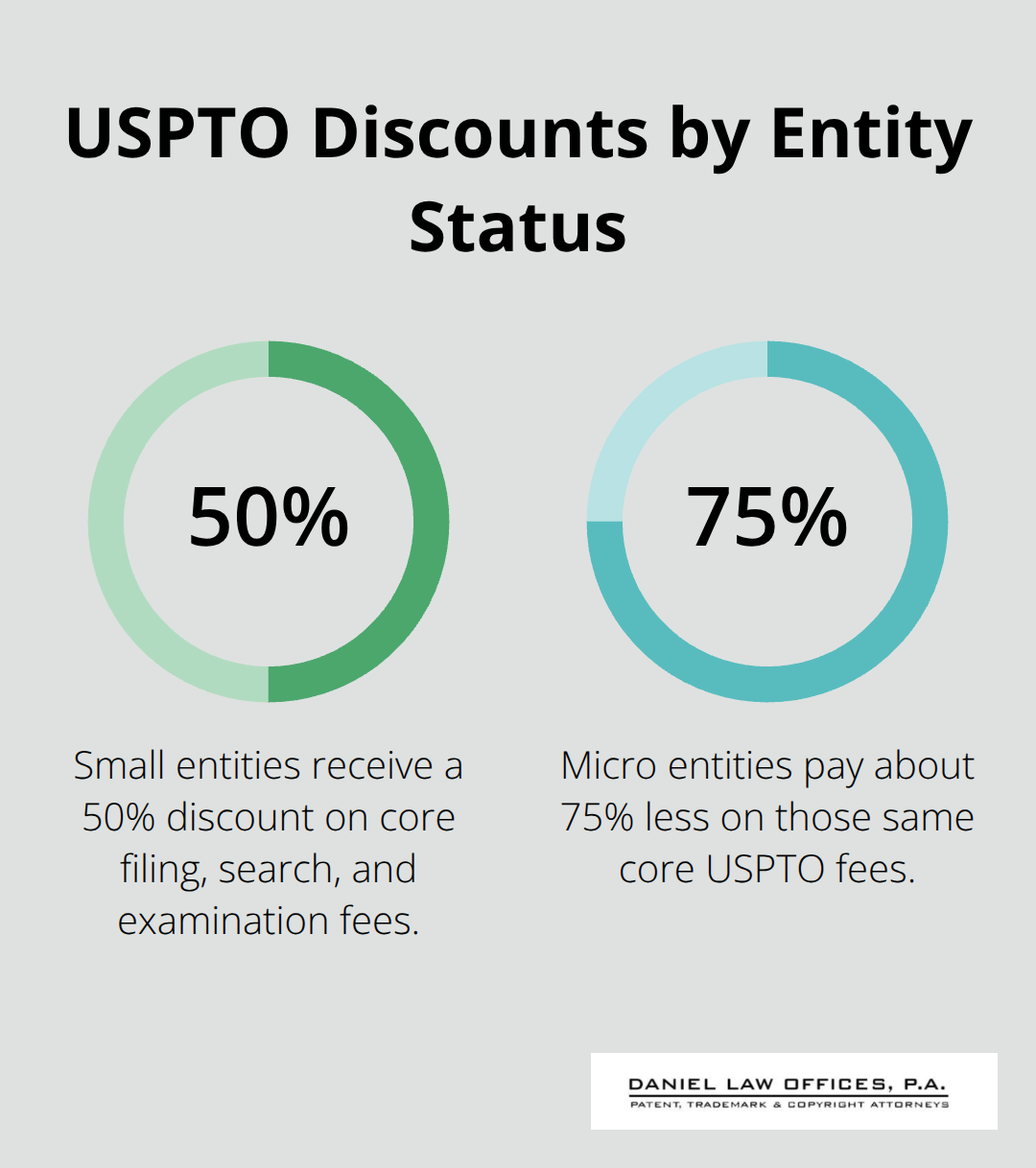
The USPTO charges a straightforward fee structure, but the total depends heavily on your entity status and application type. A utility patent filing for a large entity costs $320 in basic filing fees, $700 for search, and $800 for examination-totaling $1,820 before you add a single claim or page. Small entities receive a 50% discount, bringing those same fees to roughly $910. Micro entities, typically individual inventors or startups under specific income thresholds, pay about 75% less, or around $455 for the core filing, search, and examination fees combined. The USPTO updated these rates in January 2025, so current pricing matters when you budget.
Filing and Examination Fees
If your application exceeds three independent claims, you’ll pay an additional $460 per extra claim for large entities or $230 for small entities. Applications over 100 pages trigger size surcharges of $450 for each additional 50 pages. These costs add up quickly for complex inventions with detailed specifications. When you receive an Office Action-a rejection or request for clarification-responding typically requires attorney help. If you miss the USPTO deadline and need to respond late, you’ll pay between $65 and $2,700 depending on how late you file.
Costs After Initial Examination
If your application requires a Request for Continued Examination to keep prosecution alive after a final rejection, small entities pay $600 while large entities pay $1,500. The issue fee at grant is substantial: $1,290 for large entities, $516 for small entities, and $258 for micro entities. These fees arrive when allowance is near, so plan ahead. Maintenance fees then kick in at 3.5, 7.5, and 11.5 years after your patent grants. Large entities pay $2,150, $4,040, and $8,280 respectively; small entities pay half those amounts; micro entities pay roughly 75% less. Missing a maintenance fee deadline costs an additional $540 to $2,700 in late-payment surcharges depending on entity size and how late you pay.
Claiming Small Entity or Micro Entity Status
Small entity status cuts your government fees nearly in half, and micro entity status cuts them by roughly 75%. Qualifying is straightforward: small entities are businesses with fewer than 500 employees or individuals who haven’t licensed their invention to others. Micro entities must meet additional income thresholds-typically under $150,000 in prior-year gross income-and haven’t filed more than four patents. If you qualify, file the appropriate declaration with your application to lock in the discount. Many startups miss this opportunity and pay full price unnecessarily. Claiming small entity status on day one costs nothing but saves thousands over prosecution. Electronic filing through the USPTO’s Patent Center avoids a $400 paper-filing surcharge for large entities or $200 for small entities, making it the only practical choice for cost-conscious filers.
The government fees represent only part of your total patent cost. Attorney fees, prior-art searches, and professional drawings often exceed the USPTO charges themselves, which is why understanding what happens beyond the filing stage matters for your overall budget.
What Happens After You File
Attorney fees dwarf government costs for most inventors. The American Intellectual Property Law Association reports that drafting a patent application requires 25 to 40 hours of attorney time, and Orlando attorneys commonly charge $200 to $400 per hour, averaging around $300. A simple mechanical patent costs $7,500 at 25 hours, while complex software or biotech inventions frequently exceed $12,000. A prior-art search before filing costs roughly $1,500 to $4,000 and takes 10 to 15 hours of professional work. This search prevents expensive Office Actions later. Professional searches raise the likelihood of approval by about 20 percent compared to DIY approaches using free USPTO tools.
Patent Drawings and Visual Preparation
Patent drawings add another $300 to $500 per sheet, and most applications need 3 to 5 sheets, totaling $900 to $2,500. Professional drawings reduce Office Actions significantly because examiners understand your invention more clearly from the start. Poor-quality drawings force you to revise and resubmit, wasting time and money. Investing in quality illustrations upfront pays dividends throughout prosecution.
Office Actions and Prosecution Responses
Office Actions arrive in roughly 85 percent of applications, according to the American Intellectual Property Law Association. Responding to each Office Action costs $2,000 to $4,000 in attorney fees, and most applications see at least one action. Complex cases require two or three responses, pushing total prosecution costs to $4,000 to $8,000 beyond your initial filing fees. If you receive a final rejection and want to continue, a Request for Continued Examination costs $600 for small entities or $1,500 for large entities, plus another $2,000 to $4,000 in attorney time to prepare the response. Appeals for final rejections run $8,000 to $12,000 in attorney fees alone.
Maintenance Fees and Portfolio Management
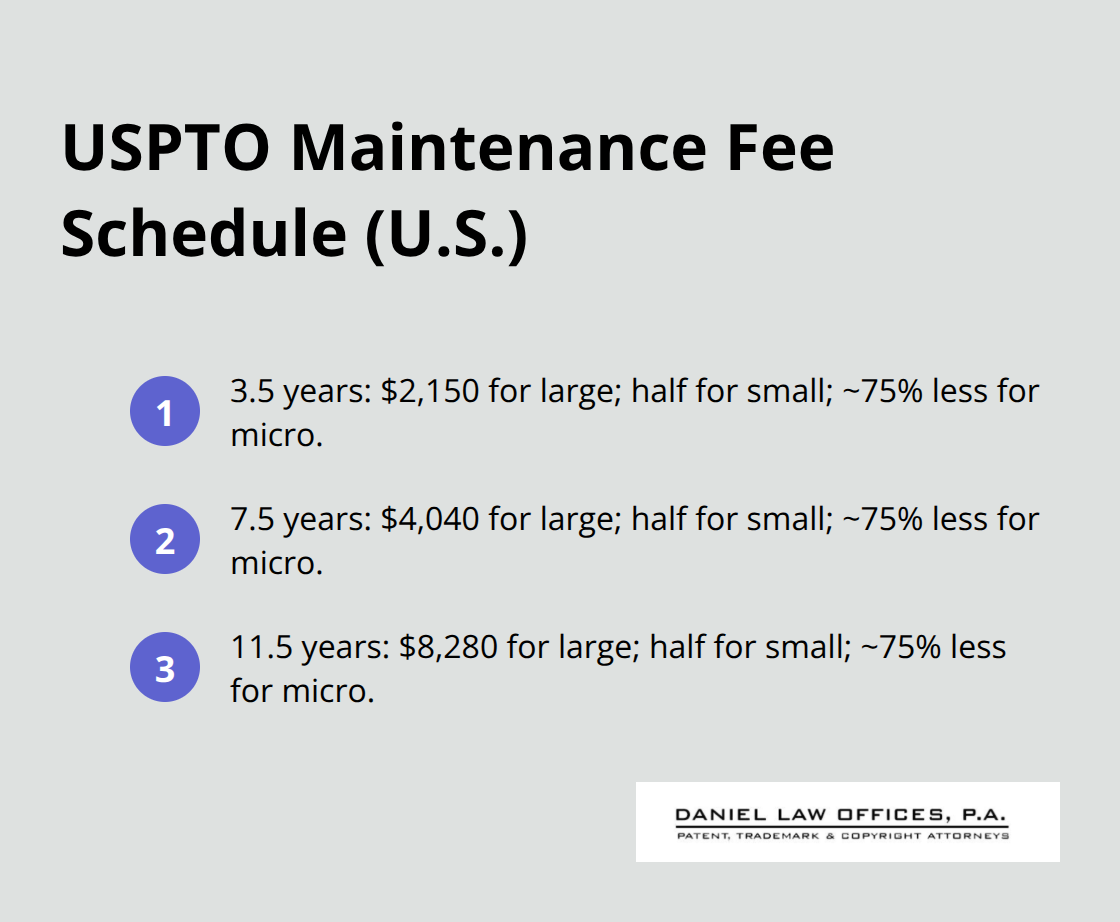
After your patent grants, maintenance fees keep the patent alive at 3.5, 7.5, and 11.5 years. Large entities pay $2,150, $4,040, and $8,280 respectively. Small entities pay half those amounts. Missing a maintenance fee deadline triggers late-payment surcharges of $540 to $2,700 depending on entity size.
Patent portfolio management services monitor these deadlines across multiple patents and cost $200 to $500 annually. For a portfolio of five patents, that amounts to $1,000 to $2,500 yearly just to avoid expensive missed deadlines.
Total Lifecycle Costs
Most inventors should budget $9,000 to $25,000 in total costs over the patent lifecycle when combining government fees, attorney time, drawings, searches, and prosecution responses. These figures shift dramatically based on your invention’s complexity and whether you pursue international protection, which introduces additional layers of cost and strategy that shape your overall patent investment.
What Drives Your Total Patent Cost in Orlando, Florida
How Invention Complexity Shapes Your Budget
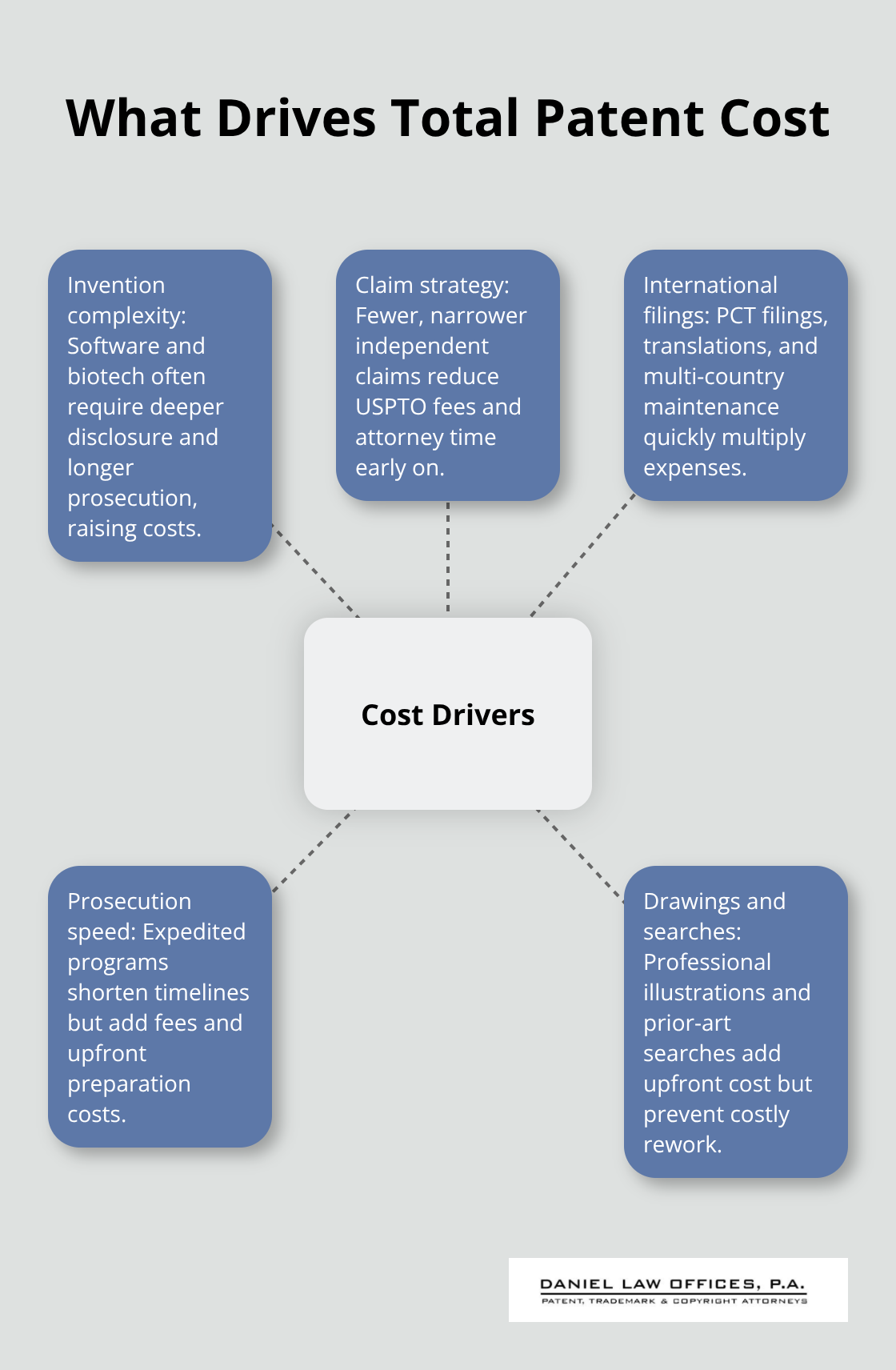
Simple mechanical inventions with straightforward claims cost far less than software, biotech, or electrical systems where every detail matters. A mechanical patent might require 25 hours of attorney time and cost around $7,500 total when you combine government fees, drafting, and searches. Software patents routinely exceed $12,000 because examiners scrutinize code-related claims heavily, rejections arrive more frequently, and responses demand deeper technical explanation. Biotech patents push even higher due to biological specification requirements and lengthy prosecution timelines.
Complexity also affects drawing costs, search depth, and office action responses. A simple invention with three independent claims and 20 pages of specification costs substantially less than a complex system requiring 40 independent claims spread across 100 pages. The American Intellectual Property Law Association reports that moderately complex electrical or mechanical inventions typically run $9,000 to $14,000, while highly complex software or biotech applications frequently exceed $14,000 to $20,000.
Strategic Claim Drafting Reduces Costs
You control some of this through drafting strategy: narrower claims with fewer independent claims reduce both USPTO fees and attorney time. Start with a focused scope rather than attempting to patent every variation upfront, then file continuation applications later if your budget allows. This approach keeps initial costs manageable while preserving your ability to expand protection as your invention evolves and revenue grows.
International Protection and Market Expansion
International protection multiplies costs dramatically but protects your market position across multiple countries. Filing a single U.S. patent costs $9,000 to $25,000 total, but adding European, Canadian, and Australian patents through the Patent Cooperation Treaty route typically costs $3,000 to $5,000 in government and attorney fees per additional country when you file within the PCT system. Translations alone run $2,000 to $3,000 per language, and maintaining patents across five countries means paying maintenance fees in each jurisdiction, which can total $10,000 to $50,000 annually depending on entity size and country.
The PCT system gives you 30 to 31 months before committing to national phase entry in specific countries, allowing you to test market demand and secure funding before spending heavily on international protection. Most startups file only in the U.S. initially, then expand to the European Union, Canada, and Australia once revenue justifies the investment.
Prosecution Speed and Timeline Tradeoffs
Speed of prosecution also affects your bottom line: expedited examination costs extra but delivers a granted patent within months rather than years, which matters if competitors are entering your market. Standard prosecution typically takes 18 to 24 months with at least one office action costing $2,000 to $4,000 to respond. Accelerated examination can halve that timeline but requires additional fees and a more polished initial application, raising upfront attorney costs by $1,500 to $3,000.
Final Thoughts
Patent submission costs range from $9,000 to $25,000 for most inventors when you combine government fees, attorney time, drawings, and prosecution responses. Your actual costs depend on invention complexity, entity status, and whether you pursue international protection-a simple mechanical patent with small entity status might total $7,500, while a complex software invention with multiple office actions could exceed $20,000. Strategic planning cuts costs significantly: qualifying for small or micro entity status saves 50 to 75 percent on government fees, electronic filing avoids a $400 surcharge, and lean claim drafting reduces both USPTO charges and attorney time.
We at Daniel Law Offices, P.A. help inventors and businesses manage these expenses by guiding you through each stage of the patent process. Our registered patent attorney performs comprehensive prior-art searches to prevent expensive office actions later, drafts applications strategically to minimize claim fees, and handles prosecution responses so rejections don’t derail your timeline. We also help you determine whether you qualify for small or micro entity status and advise on international protection timing so you don’t overspend on countries that don’t match your business goals.
Contact Daniel Law Offices, P.A. to discuss your invention and receive a cost estimate tailored to your situation. We’ll walk you through the entire process and help you make informed decisions about where to invest your patent budget for maximum protection and return.