




How to Submit a Provisional Patent Application
A provisional patent application is one of the fastest ways to protect your invention while you refine it. At Daniel Law Offices, P.A., we help inventors navigate the provisional patent submission process so they can secure their intellectual property without delay.
This guide walks you through each step, from understanding what makes a provisional application different to actually filing with the USPTO.
What Makes a Provisional Patent Application Different
A provisional patent application establishes your filing date with the USPTO without the formality and expense of a full utility patent. The core advantage is speed and cost. Filing fees run $75 for micro entities, $150 for small entities, and $300 for large entities according to USPTO data, compared to $320 and up for a non-provisional filing. You skip the examination process entirely, meaning no patent examiner reviews your work for patentability during those first 12 months. Instead, you gain immediate patent-pending status, which you can use in marketing and on your products.

What You Must Include in Your Provisional Filing
The written description must enable someone skilled in your field to make and use the invention, but you do not need formal drawings, declarations, or prior art citations. Drawings are optional but recommended if they clarify your invention. You can submit photos, sketches, or CAD files without strict formatting requirements. All inventors must be named with their residential addresses, and if you have multiple inventors, every person who contributed must be listed. The application itself cannot exceed 100 pages without incurring extra fees, so keep your description focused and complete.
The 12-Month Window Is Absolute
The provisional remains active for exactly 12 months from your filing date and cannot be extended. This deadline is not negotiable. Within that window, you must file a corresponding non-provisional application to preserve your original filing date as your priority date. If you miss the 12-month deadline, you lose the benefit permanently. The USPTO offers a 14-month grace period with a petition for unintentional delay, but missing the 12-month window without filing that petition eliminates your early filing date. Set calendar reminders at six and nine months to begin preparing your non-provisional so you do not scramble in month 11.
How Provisional Filings Fit Your Patent Strategy
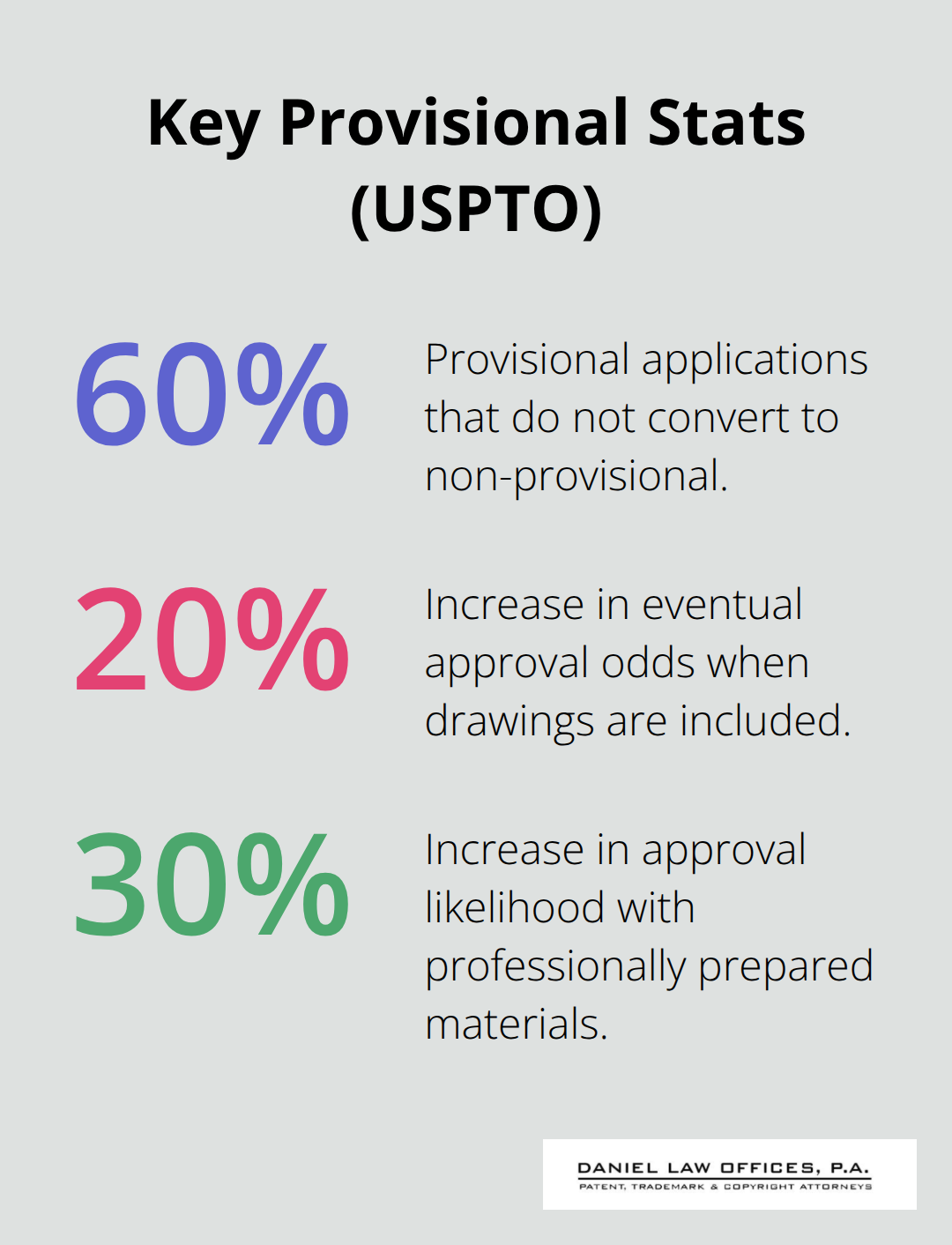
About 60 percent of provisional applications do not convert to non-provisional patents, according to USPTO statistics. This happens because inventors discover during the 12-month period that the market is not viable or the invention needs major redesign. A provisional lets you avoid spending $5,000 to $10,000 on a full non-provisional if your invention does not pan out. If market potential remains strong, a non-provisional typically costs $1,600 to $3,200 in combined government fees and attorney time. The provisional also establishes your invention as prior art, which supports your later patent strategy against others’ filings. Filing electronically via the USPTO Patent Center is the fastest method, accepting PDF, JPEG, and TIFF formats with real-time payment processing and immediate provisional number assignment. Once you understand these differences, the next step is preparing the actual materials you will submit to the USPTO.
What to Include in Your Provisional Patent Application
Write a Complete Technical Description
A strong provisional filing starts with a written description that allows someone skilled in your field to make and use your invention without experimentation. This is the legal standard under Section 112(a) of the patent law, and it matters because a vague or incomplete description weakens your filing date protection if you later face challenges. Write your description in clear, technical language specific to your industry. Include dimensions, materials, assembly steps, and operational details. For a software invention, describe the algorithm and data flow. For a mechanical device, explain how each component interacts.
Include Visual Materials and Drawings
The USPTO does not require formal patent drawings in a provisional, but including them increases your odds of eventual approval by about 20 percent according to USPTO data. Sketches, photographs, and CAD files work fine without strict formatting rules. Make sure your drawings or images show every functional aspect of your invention from multiple angles if needed. Professional preparation of materials raises the likelihood of eventual non-provisional approval by about 30 percent according to USPTO data.
Name All Inventors and Organize Your Materials
List all inventors who contributed to the invention, including their full names and residential addresses. If you have co-inventors, every person must be named because omitting an inventor can create problems later when you file your non-provisional application. Keep your entire filing under 100 pages to avoid extra page fees that the USPTO charges for submissions exceeding that limit. Do not add new material or drawings after you file because the USPTO will not accept amendments that introduce information not in your original submission.
Prepare Materials Before Submission
Spending time upfront organizing your materials pays dividends. Create a single document or folder containing your written description, all drawings or photos, technical specifications, and a list of all inventors with their addresses before you submit anything. If budget allows, a patent attorney can review your description and drawings before filing and catch gaps that strengthen your filing. If you prepare materials yourself, read your description aloud to catch unclear passages, and have someone outside your field review it to identify confusing sections. Set your submission deadline for at least one week before you actually plan to file so you have time to fix any issues without rushing.
With your materials organized and complete, you are ready to move forward with the actual filing process through the USPTO portal.
Filing Your Provisional Patent Application in Orlando, Florida
Choose Electronic Filing for Speed and Accuracy
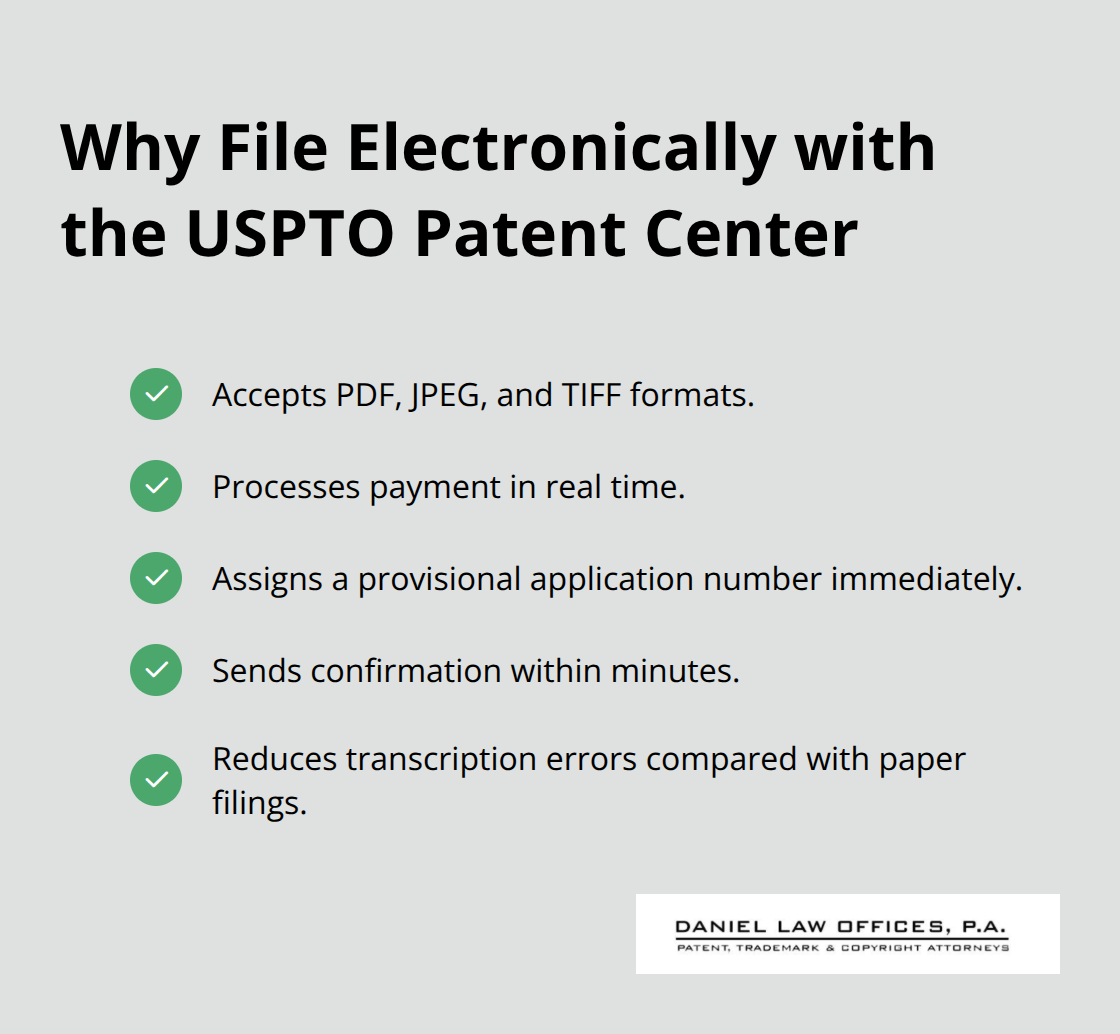
The actual filing process moves quickly once your materials are ready. You have two submission options: electronic filing through the USPTO Patent Center or mailing documents to the Commissioner for Patents at P.O. Box 1450, Alexandria, VA 22313-1450. Electronic filing is vastly superior. The Patent Center accepts PDF, JPEG, and TIFF formats, processes your payment in real time, and assigns your provisional number immediately upon successful submission. You receive confirmation within minutes, not weeks. When you file electronically, the system automatically loads your data into the USPTO database, which eliminates transcription errors that slow paper filings.
Complete the Cover Sheet and Gather Your Fee
The cover sheet, form PTO/SB/16, must accompany your submission and include your invention title, all inventors’ names and residential addresses, your correspondence address, your attorney or agent registration number if applicable, and identification of any U.S. Government agency with a property interest in your invention. The filing fee depends on your entity classification: micro entities pay $75, small entities pay $150, and large entities pay $300 according to current USPTO fee schedules. If you submit your cover sheet late or file after a deadline, expect surcharges that increase your costs.
Submit Your Application Through the USPTO Portal
Access the Patent Center through the USPTO website, upload your written description and any drawings or supporting materials in a single PDF or as separate image files, complete the cover sheet fields, and review everything for accuracy before submission. The system confirms your provisional number and filing date immediately, which becomes your official priority date. Your application enters the USPTO database upon successful submission, and you gain full patent-pending status for 12 months.
Monitor Your Filing and Plan Your Next Steps
You can monitor your filing status anytime through Patent Center by logging into your account and viewing your application record. The USPTO does not examine provisional applications for patentability, so you will not receive office actions or examination communications during those 12 months. Your sole responsibility is tracking the calendar. Set phone reminders at month six and month nine to begin preparing your non-provisional filing, because the 12-month deadline arrives faster than most inventors anticipate. If you filed without an attorney, contact the Inventors Assistance Center at IndependentInventor@uspto.gov or call 800-786-9199 if you have questions about your filing status or next steps. A registered patent attorney can guide you through the transition from provisional to non-provisional, because that step requires careful attention to priority claims and claim drafting to maximize your patent protection.
Final Thoughts
Filing your provisional patent submission marks the start of your patent protection journey, not the finish line. The 12-month window ahead gives you time to test market viability, refine your invention, and decide whether a full non-provisional filing makes financial sense. Set reminders at six and nine months to prepare your non-provisional strategy, because missing the deadline costs you your priority date permanently.
When month nine arrives, you face a critical decision about your invention’s future. If your invention shows strong market potential and competitive threats exist, filing a non-provisional application preserves your early filing date and moves your invention into formal USPTO examination. The non-provisional requires clearly defined claims, detailed prior art searches, and formal USPTO formatting standards that differ significantly from your provisional submission, with combined government fees and attorney time running $1,600 to $3,200.
About 60 percent of provisional applications never convert to non-provisional patents, and that outcome is often the right business decision. The provisional still served its purpose by establishing your filing date and giving you 12 months to validate your idea without committing to a larger investment. Contact us at Daniel Law Offices, P.A. for guidance on your patent strategy and to discuss whether a non-provisional filing makes sense for your invention.